

What is Sales Outsourcing
Sales outsourcing works when your business already has a reliable pipeline and you’re looking to add capacity, speed, or specialized skills. It can reduce sales costs by 30 to 50 percent and help you enter new markets faster, but it’s not a shortcut. Done wrong, it drains cash. Done right, it drives growth without losing control of your sales engine.
I want to be clear about something up front. Sales is one of the hardest functions to outsource. Every business has to be good at sales. You need to understand your offer, your customer’s pain, and how to solve it. That’s not something you can fully hand off to someone else.
But done right, sales outsourcing can be a powerful growth tool. Over the years running Kore BPO, I’ve seen companies succeed with it and I’ve seen many fail. The difference usually comes down to preparation. In this article, I’ll share how to approach outsourcing sales without losing control of your growth engine.
Types of Sales Outsourcing
Not all outsourcing is the same. Depending on your stage and goals, you might choose:
- Lead generation outsourcing – a team handles cold calls, emails, and setting appointments.
- Sales development outsourcing (SDRs) – outsourced reps qualify inbound leads and pass them along.
- Inside sales – remote reps selling over phone or video.
- Outside sales – field reps closing deals face to face.
- Full-cycle outsourcing – handing over the entire process, from prospecting to closing.
Example of outsourcing to a group doing cold calling, email, and appointment setting. The right model depends on whether you need more leads, better qualified conversations, or more closers.
Before You Outsource: Build the Marketing Foundation
Here’s the mistake I see most often: companies hire a $150K to $200K salesperson and expect magic. Within months, that rep is failing. Not because they lack talent, but because there’s no pipeline.
Salespeople need leads. Without marketing qualified leads (MQLs) flowing in, they’re left relying only on their personal network or grinding out cold outreach. That’s expensive and usually unsustainable.
Your sales organization doesn’t start with the salesperson. It starts with an effective marketing team that generates leads and turns them into opportunities. If you haven’t built a system that consistently converts MQLs into sales qualified leads (SQLs), outsourcing sales will burn cash fast.
When Outsourcing Sales Makes Sense
Outsourcing works best when:
- Your internal team is stretched thin.
- You’re entering a new market and need speed.
- You need specialized skills your team doesn’t have.
- You already have a reliable flow of leads from marketing.
In founder led businesses, the founder is often the best salesperson early on. I know this from personal experience. Founders bring confidence, product knowledge, and credibility. That’s hard to replace. Outsourcing makes sense only after you’ve built a system that doesn’t depend solely on the founder.
Benefits of Sales Outsourcing
If done strategically, outsourcing sales can be highly beneficial. Many companies cut their sales expenses by 30 to 50 percent while scaling employees up or down with demand.
A good outsourcing partner eliminates the time lag to get into new markets. With their relationships and industry expertise, you arrive quicker without the usual setup lag.
Risks and Challenges
Outsourcing isn’t risk free. Common issues include:
- Quality control. Will outsiders represent your brand properly?
- Alignment gaps. If you can’t turn MQLs into SQLs internally, no outsourced team can fix that for you.
- Hidden costs. Vendor management, software, and training add up.
- Cultural mismatch. A team in another region may not understand your buyers.
- Data security. You’re giving outsiders access to sensitive customer information.
Outsourcing doesn’t remove responsibility. You still have to manage the system.
Watch: How Sales Outsourcing Really Works
In this video, I break down the real-world challenges and opportunities of outsourcing sales. I also share practical steps on how to keep control of your growth engine while adding outside capacity.
Play to learn how to avoid the most common mistakes and make outsourcing a growth lever.
Choosing the Right Outsourcing Partner
If you decide to outsource, look for:
- A proven track record in your industry.
- Clear cost models such as fixed, commission-based, or performance-based.
- Technology and reporting capabilities you can trust.
- A cultural fit with your team.
- Service-level agreements (SLAs) that spell out KPIs and accountability.
Don’t just buy capacity. Buy capability.
Managing Outsourced Sales
Signing a contract doesn’t mean stepping back. To get results, you need to:
- Treat outsourced reps as part of your team.
- Give them tools, dashboards, and visibility.
- Train them on your brand voice.
- Review performance regularly.
- Track key metrics like cost per lead, conversion rate, and deal cycle time.
The companies that win with outsourcing are the ones that stay hands-on.
A Story I’ll Never Forget
I once worked with a founder who hired a $200K salesperson. On paper, this person was a star. But within months, they were failing. Not because they lacked skill, but because the company had no marketing pipeline.
They were expected to close deals out of thin air. That’s not sales, it’s a setup for failure. The company wasted time, money, and morale.
The lesson is simple. Don’t throw money at sales until your marketing and pipeline are dialed in.
The Future of Sales Outsourcing
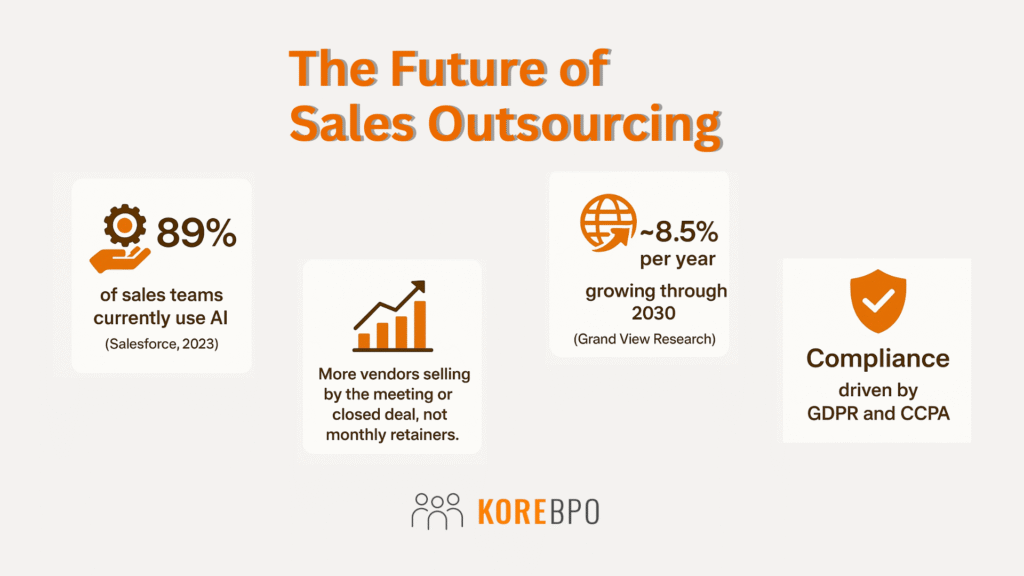
The outsourcing market is evolving fast:
- AI prospecting. AI prospecting. 89 percent of sales teams currently use AI (Salesforce, 2023).
- Performance-based models. More vendors selling by the meeting or closed deal, not monthly retainers.
- Remote-first sales teams. The global BPO sector is developing at growing at about 8.5 percent per year through 2030.(Grand View Research)
- Compliance. Outsourcing agreements are being driven by data protection laws like GDPR and CCPA. execsintheknow.com
The trend is clear: outsourcing is getting smarter, more flexible, and more accountable.
Checklist Before You Outsource
Ask yourself:
- Do we have a working marketing pipeline?
- Are MQLs consistently turning into SQLs?
- Is the founder still the main closer?
- Do we know how we’ll measure success?
- Have we budgeted for management, not just outsourcing fees?
If you can’t answer yes to these, you’re not ready to outsource.
Our Outsourcing Checklist
We’ve put together “The Ultimate Outsourcing Checklist” to help businesses like yours avoid common pitfalls and make smarter decisions when partnering with an outsourcing provider.
If you’re here, you’re already thinking about optimizing your processes this outsourcing checklist will guide you through everything from vendor selection to performance tracking.
FAQ’s
How do I choose the right sales outsourcing company?
Look for a provider with proven industry experience, clear reporting practices, strong client reviews, and flexible pricing models.
Can sales outsourcing work for small businesses?
Yes, sales outsourcing is often ideal for small businesses. It provides access to experienced sales professionals without the high expenses.
How does sales outsourcing reduce costs?
Sales outsourcing reduces costs by eliminating the need for full-time salaries, training, and infrastructure. Businesses only pay for the outsourced services they need.
What industries benefit most from sales outsourcing?
Industries such as SaaS, technology, healthcare, real estate, and professional services benefit most from sales outsourcing.
Takeaways
Sales outsourcing can absolutely work but not as a shortcut. You need the foundation first. Marketing, pipeline, process.
Don’t outsource to cover weaknesses. Outsource to extend strengths. Build your system first, then scale it with the right partner.
That’s how you make outsourcing work without losing control.
Book a strategy call to see if outsourced sales fits your growth plan.
Stop wasting time on tasks that don’t grow your business. Start outsourcing smarter today.
