

Why This Question Keeps Coming Up
If you’re an SMB owner, IT manager, or executive, you’ve probably asked this already.
Why does it feel so hard, slow, and expensive to build a reliable data engineering team in house?
I’ve had this conversation hundreds of times with growing companies. Everyone agrees data matters. Better reporting. Cleaner pipelines. Faster decisions. But hiring experienced data engineers locally often turns into a long and frustrating process with unpredictable outcomes.
That’s why more leaders are considering offshore data engineers. Not as a shortcut. As a strategic operating decision.
This article walks through the real benefits of hiring offshore data engineers versus fully in house teams, the risks you should understand upfront, and how to decide what actually fits your business.
What We Mean by Offshore vs In House Data Engineers
In House Data Engineering Teams
In house data engineers are full time employees embedded inside your organization. They typically work on:
- Building and maintaining data pipelines
- Managing data warehouses
- Supporting analytics and BI teams
- Preparing data for automation and decision making
The upside is direct control. The downside is cost, slow hiring, and turnover risk.
Offshore Data Engineering Teams
Offshore data engineers are dedicated team members based outside the US and hired through a delivery partner. When structured correctly, they:
- Work as an extension of your internal team
- Follow your processes and priorities
- Execute engineering work while internal leaders own strategy and architecture
Offshore does not mean disconnected. It means distributed.
The Top Benefits of Hiring Offshore Data Engineers
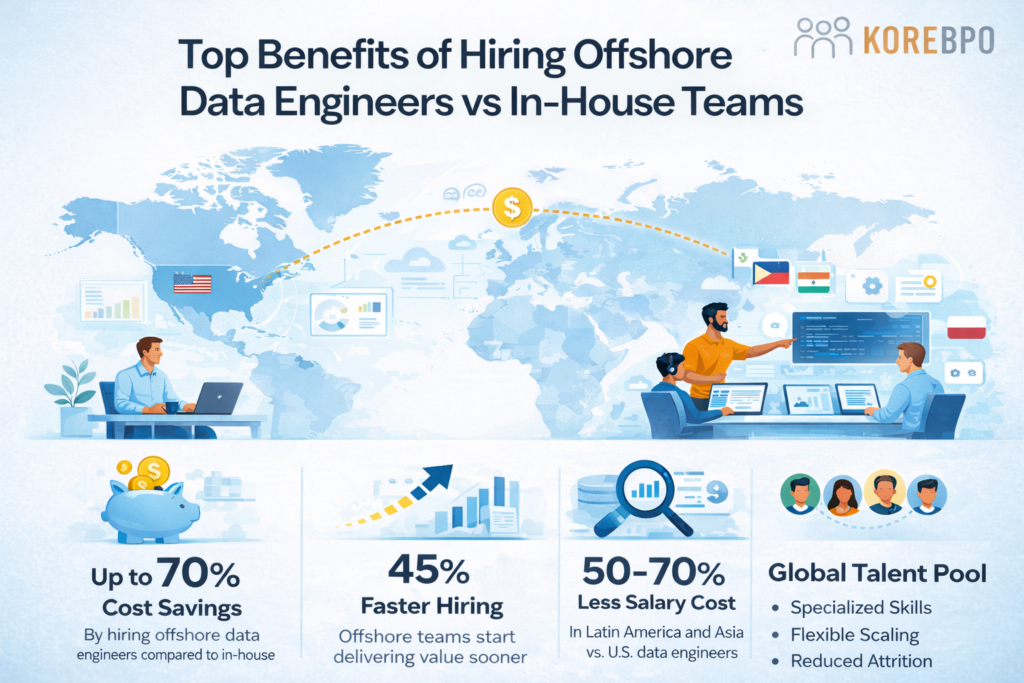
1. Real Cost Savings Beyond Salary
Cost is usually the first thing people think about, but salary is only part of the picture.
With in house hiring, you’re paying for:
- High base salaries
- Benefits and payroll taxes
- Recruiting fees
- Long ramp up periods
- Attrition when someone leaves after 18 to 24 months
In our experience at Kore BPO, companies often save 40 to 70 percent by hiring offshore data engineers compared to building the same capability internally. More importantly, those costs are predictable.
Teams often budget for salaries and still get blindsided by turnover. Offshore models reduce that surprise factor.
2. Faster Time to Hire and Faster Time to Value
Hiring senior data engineers in the US can take 3 to 6 months. That’s before they’re fully productive.
Offshore teams move faster because:
- Talent pools are deeper
- Hiring pipelines are already active
- Engineers often bring hands on experience with production data systems
The real return isn’t the hourly rate. It’s how fast work moves safely into production. Offshore data engineers with the right background often deliver value in weeks, not quarters.
3. Access to Specialized Data Engineering Skills
A common mistake is hiring general developers and asking them to handle data work. Data engineering is its own discipline.
Strong offshore data engineers often bring experience with:
- Modern data platforms like Snowflake, BigQuery, and Redshift
- Cloud environments such as AWS, GCP, and Azure
- ETL workflows, orchestration, and pipeline management
- Data modeling and performance optimization
You’re not training from scratch. You’re plugging into experience.
4. Easier Scaling Without Organizational Friction
In house scaling is slow. Headcount approvals, budget cycles, and hiring freezes can stall progress fast.
Offshore teams give you flexibility to:
- Scale up for migrations or rebuilds
- Scale down once systems stabilize
- Match capacity to changing data priorities
That flexibility matters because data needs always change.
5. Reduced Key Person Risk
Many in house data teams depend heavily on one senior engineer. When that person leaves, progress stalls.
Well structured offshore teams reduce that risk through:
- Shared ownership
- Required documentation
- Knowledge transfer
Cheap labor isn’t the goal. Consistent delivery is.
6. Improved Continuity and Lower Burnout
Data engineering is demanding work.
Offshore teams help by:
- Distributing coverage
- Reducing constant fire drills
- Creating sustainable workloads
Healthier teams last longer and perform better
7. Better Focus for Internal Leaders
When offshore data engineers handle execution, internal leaders can focus on:
- Data strategy and architecture
- Stakeholder alignment
- Roadmap planning
That separation often improves outcomes on both sides.
8. Exposure to Proven Engineering Practices
Offshore data engineers often work across multiple environments.
That experience shows up as:
- Stronger documentation
- Cleaner pipelines
- Fewer reinventions
You benefit from patterns that already work.
9. Predictable Delivery Over Heroics
In house teams often rely on late nights and individual effort.
Offshore teams emphasize:
- Clear scope
- Defined handoffs
- Repeatable delivery
Executives value predictability more than hustle.
10. Easier Budgeting and Forecasting
Offshore models usually operate on a clear monthly cost basis.
That makes it easier to:
- Forecast spend
- Tie cost to output
- Avoid surprise hiring expenses
Predictability is often underestimated.
The Real Risks of Offshore Data Engineering and How to Handle Them
Data Security and Compliance
Security is a fair concern.
In practice, most data issues come from weak governance, not geography. Offshore data engineers work best when you have:
- Role based access controls
- Clear data handling policies
- Audit logging
- Defined ownership
Skipping guardrails creates risk. Remote work does not.
Communication and Time Zones
Offshore teams struggle when expectations are vague.
They succeed when you have:
- Defined overlap hours
- Clear handoffs
- Documented workflows
- Outcome based management
Async work succeeds when it’s designed intentionally.
When In House Data Engineering Teams Make Sense
Offshore is not always the right answer.
In house teams may be the better choice when:
- You’re still defining what questions your data should answer
- You operate in heavily regulated environments
- You’re not ready to invest in documentation and process
Offshore teams amplify clarity. They don’t create it.
Offshore vs In House Data Engineers Comparison
- Cost is typically lower and more predictable offshore
- Speed to hire is faster offshore
- Scalability is easier offshore
- Control is tighter in house
- Both models require strong governance
There’s no universal winner. Only the right fit for where you are today.
What Success Looks Like in the First 90 Days
Strong offshore data engineering teams tend to hit similar milestones.
By Day 30
- Clear pipeline ownership
- Access and permissions finalized
By Day 60
- Documented data flows
- Stable delivery cadence
By Day 90
- Shared definition of done
- Predictable output tied to business goals
When these pieces are missing, performance slips.
How to Decide If Offshore Data Engineers Are Right for You
Ask yourself:
- Do we know our top data priorities?
- Do we have internal ownership?
- Are we managing outcomes instead of hours?
If you can answer yes, offshore data engineers are worth serious consideration.
FAQs
Is hiring offshore data engineers really cheaper than building in house teams?
Yes, most SMBs save 40 to 70 percent once you factor in salary, hiring time, and turnover.
Will offshore data engineers actually feel like part of our team?
When set up right, they work inside your workflows and feel like an extension of your internal team.
How fast can offshore data engineers start delivering real results?
Many teams see meaningful progress within weeks instead of waiting months for local hires.
Is data security a bigger risk with offshore teams?
Not if you have clear access controls, documentation, and ownership, since process matters more than location.
When does it make more sense to keep data engineering fully in house?
In house teams work better when priorities are still unclear or heavy regulation limits flexibility.
Ready to Explore What This Could Look Like
Hiring offshore data engineers isn’t about cutting corners. It’s about building data capability that’s sustainable for growing companies.
If you want to explore what this could look like for your organization:
- Book a strategy call
- Ask questions specific to your data environment
- Get an honest recommendation, even if offshore isn’t the right move
Subscribe for more practical insights, or reach out to Kore BPO to talk through vetted offshore data engineering teams built for real world execution.
