

If you’re trying to hire experienced .NET developers right now, you’ve probably felt the same frustration many of our clients mention during their first call.
- Roles stay open for months.
- Salary expectations keep climbing.
- Internal teams are stretched thin.
According to multiple outsourcing market reports, companies can reduce development costs by 40 – 70% by hiring offshore developers while maintaining strong engineering output. That’s one reason the global offshore development market continues to expand each year. (smartdev.com)
But offshore hiring isn’t just about lower costs. The companies that succeed treat it as a strategic way to build reliable engineering teams.
In this guide, you’ll learn:
- Offshore .NET Developer Rates In 2026
- Where Companies Hire Developers Globally
- What Factors Influence Developer Pricing
- How to Hire Offshore Engineers Correctly
If you’re an SMB owner, IT manager, CTO, or executive, this guide will give you a practical overview of how offshore .NET hiring works.
What is Offshore .NET Development?
Before comparing them, it helps to define what each model means in practice.
Offshore .NET development is a model of hiring software developers remotely from another country.
Instead of hiring locally, companies build distributed teams that collaborate online using tools most engineering teams already use.
Common collaboration tools include
- GitHub
- Jira
- Slack
- Microsoft Teams
- Azure DevOps
The rationale for offshore development is straightforward: access to a larger talent pool, while controlling costs.
Offshore vs Nearshore vs Onshore Development
Distributed teams can be set up in Several ways.
- Model | Location | Typical Cost | Best For
- Onshore | Same country | Highest | Sensitive or regulated projects
- Nearshore | Nearby countries | Moderate | Time zone alignment
- Offshore | Distant regions | Lowest | Cost efficiency and scalability
Many companies now combine these approaches into hybrid engineering teams. For example, product leadership can be maintained by individuals in the USA, while development teams work out of Eastern Europe or Asia.
Offshore .NET Developer Rates in 2026
One of the first questions that management wants to answer is simple.
How much does an offshore .NET developer cost?
Well, it all depends on a variety of different things.
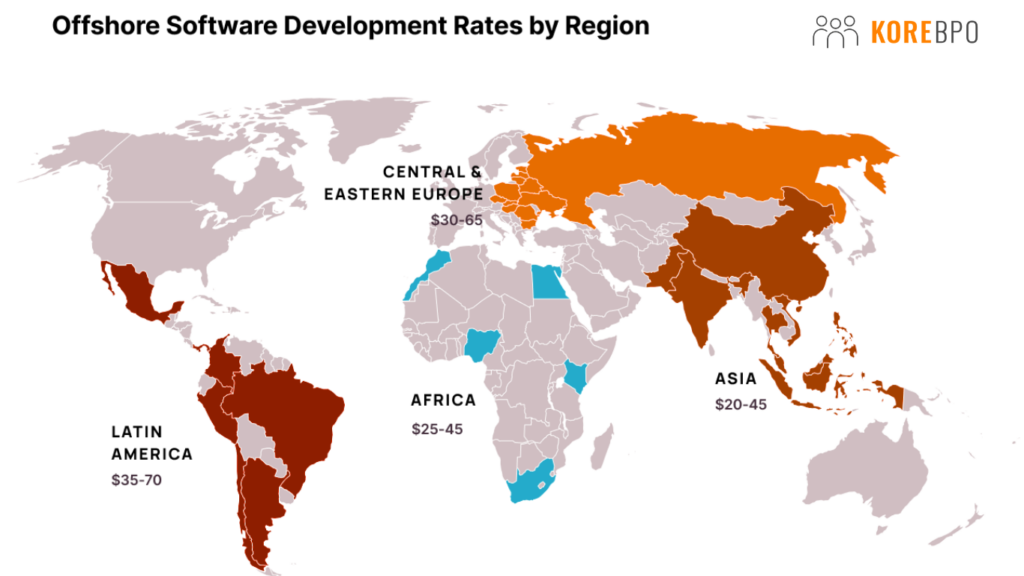
Average Offshore Developer Hourly Rates
- Region | Typical Hourly Rate
- United States or Canada | $100 – $200
- Western Europe | $70 – $120
- Eastern Europe | $35 – $70
- Latin America | $35 – $75
- South Asia | $20 – $45
- Southeast Asia | $25 – $50
For many companies, the sweet spot falls between $35 and $60 per hour. This range usually provides experienced mid-level developers who can contribute quickly.
.NET Developer Rates by Experience Level
Experience plays a major role in pricing.
- Developer Level | Hourly Rate
- Junior .NET Developer | $20 – $40
- Mid-Level .NET Developer | $35 – $70
- Senior .NET Developer | $60 – $120
- Solution Architect | $100 – $180
Responsibilities of senior developers include:
- Designing system architecture
- Building scalable APIs
- Optimizing performance
- Mentoring junior developers
For many SMB projects, a team with 1 senior developer and 2-3 mid-level engineers works well.
Why Companies Hire Offshore .NET Developers
Cost savings matter, but they’re rarely the only reason companies expand offshore.

Access to a Larger Talent Pool
Hiring experienced .NET developers locally can take months. Many companies simply cannot find enough qualified engineers in their region.
Offshore hiring dramatically expands the search.
Faster Hiring Timelines
Sourcing talent globally can speed up hiring.
Typical hiring timelines look like this.
- Week 1- 2 candidate sourcing
- Week 2 – 3 interviews
- Week 3 – 4 onboarding
This speed can make a major difference when product deadlines are tight.
Cost Efficiency
Offshore hiring can significantly reduce development costs.
Companies often see savings of 40 – 70% compared with local hiring. (zoolatech.com)
These savings come from:
- Lower regional salary benchmarks
- Reduced infrastructure costs
- Flexible team scaling
Important Elements Affecting Offshore Developer Prices
Hourly rates vary based on several key factors.
Developer Experience
Experience usually creates the biggest price difference.
Junior developers cost less but require more oversight. Senior developers typically solve problems faster and help prevent long term technical issues.
Technology Stack
Specialized skills can increase developer rates.
Examples include:
- ASP.NET Core
- Azure cloud architecture
- Microservices development
- Enterprise system integration
Developers with cloud and architecture expertise usually command higher rates.
Project Complexity
Rates also vary depending on project difficulty.
Simple projects
- Internal dashboards
- Basic web applications
Complex projects
- Enterprise platforms
- Fintech systems
- SaaS infrastructure
More complex systems require more experienced developers.
Best Regions to Hire Offshore .NET Developers
Several global regions dominate offshore hiring.
Eastern Europe
Countries like Poland, Romania, and Ukraine have a high standard of engineering talent and a good education system.
Typical rates
$40 – $80 per hour
Latin America
Latin America is popular for companies in the United States because of time zone overlap and cultural alignment.
Typical rates
$35 – $75 per hour
South Asia
South Asia remains one of the largest developer talent markets.
Countries include
- India
- Pakistan
- Bangladesh
Typical rates
$20 – $45 per hour
Southeast Asia
Southeast Asia continues to expand as a destination for outsourcing.
Countries include
- Philippines
- Vietnam
- Indonesia
Typical rates
$25 to $50 per hour
How to Hire Offshore .NET Developers
The project scope is an important factor that needs to be considered when deciding how to hire offshore developers
Step 1: Define the Project Scope
Before hiring, outline
- Project goals
- Technical requirements
- System architecture
- Expected timeline
Clear planning prevents confusion later.
Step 2: Choose a Hiring Model
Companies can use one of three models for hiring developers.
Freelancers
- Flexible
- Lower cost
- Less long term stability
Staff augmentation
- Developers join your existing team
- Flexible scaling
Dedicated offshore teams
- Fully managed engineering teams
- Best for long term development
Step 3: Screen Technical Skills
When interviewing .NET developers, evaluate
- C# proficiency
- ASP.NET Core experience
- Database design
- API development
- Cloud infrastructure
Technical assessments help verify real experience.
Step 4: Integrate Developers Into Your Team
One of the biggest mistakes companies make is treating offshore developers like external contractors.
Offshore Development Cost Examples
Companies usually plan budgets around team costs rather than hourly rates.
- Team Setup | Monthly Cost
- 1 mid level developer | $6k – $10k
- 3 person startup team | $18k – $30k
- 6 person product team | $35k – $60k
- Enterprise team | $50k – $90k
The actual costs will vary depending on the experience and location of the developers.
FAQs
The cost to employ an offshore .NET developer in 2026 remains unknown.
Developers charge hourly rates that range from $35 to $70 which depends on their experience level and their work location and the project requirements.
Can you trust offshore .NET development to deliver dependable results for extended work periods?
Offshore teams enable companies to operate their multi-year products through development teams which require developers to work as permanent members of the engineering staff instead of temporary staff.
What technical skills should a strong .NET developer have?
Most experienced developers will be comfortable with C# ASP.NET Core API development database design and cloud tools like Azure.
Which countries serve as primary locations for businesses to hire offshore .NET development services?
Eastern Europe and Latin America and South Asia and Southeast Asia serve as popular hiring destinations for companies which seek to recruit developers because those regions possess extensive engineering talent and affordable salary options.
Final Thoughts
Offshore .NET development has emerged as a viable approach for organizations that have to expand their engineering workforce rapidly.
When done correctly, offshore hiring can provide
- Faster development cycles
- Scalable engineering capacity
- Predictable development costs
The key is to focus on quality, communication, and team integration, not rates.
Work With an Experienced Offshore Development Partner
If you are researching offshore .NET development, you should be aware that the way to hire offshore developers is quite impactful.
Our specialty at Kore BPO is helping businesses succeed with their offshore engineering teams, including skilled .NET programmers.
We would be pleased to assist you with your needs if you are seeking information on offshore development.
