
A practical guide to hiring offshore data architects, covering roles, costs, and what actually works in real teams.
- 01What Does a Data Architect Actually Do?
- 02Data Architect vs Other Data Roles
- 03Operator Insight
- 04When Do You Actually Need a Data Architect?
- 05What Happens If You Don’t Hire One
- 06Real-World Scenario
- 07Why Companies Are Hiring Data Architects Offshore
- 08Cost Efficiency
- 09Flexibility
- 10Operator Insight
- 11Offshore vs Local Hiring: Full Cost Breakdown
- 12What Impacts Cost
- 13Hidden Costs to Watch
- 14How to Hire an Offshore Data Architect (Step-by-Step)
- 15Operator Insight
- 16What to Look for in a Strong Offshore Data Architect
- 17Best Practices for Managing Offshore Data Architects
- 18FAQs
- 19How Kore BPO Supports Offshore Data Hiring
- 20Bottom Line
Most teams don’t realize they need a data architect until something breaks.
Reporting slows down. Dashboards don’t match. Teams start arguing over whose numbers are right. And suddenly, data becomes a bottleneck instead of an advantage.
Hiring locally isn’t getting easier. Around 75% of companies say they’re struggling to fill technical roles. And data-related roles are some of the hardest to close. (okoone.com)
That’s why more companies are looking offshore. Not just for cost savings, but for access.
In this guide, I’ll walk you through things like
- What a data architect actually does
- When you really need one
- What offshore hiring looks like in practice
- Real cost ranges
- How to hire and manage effectively
No theory. Just what we see working across teams.
What Does a Data Architect Actually Do?
Core Responsibilities
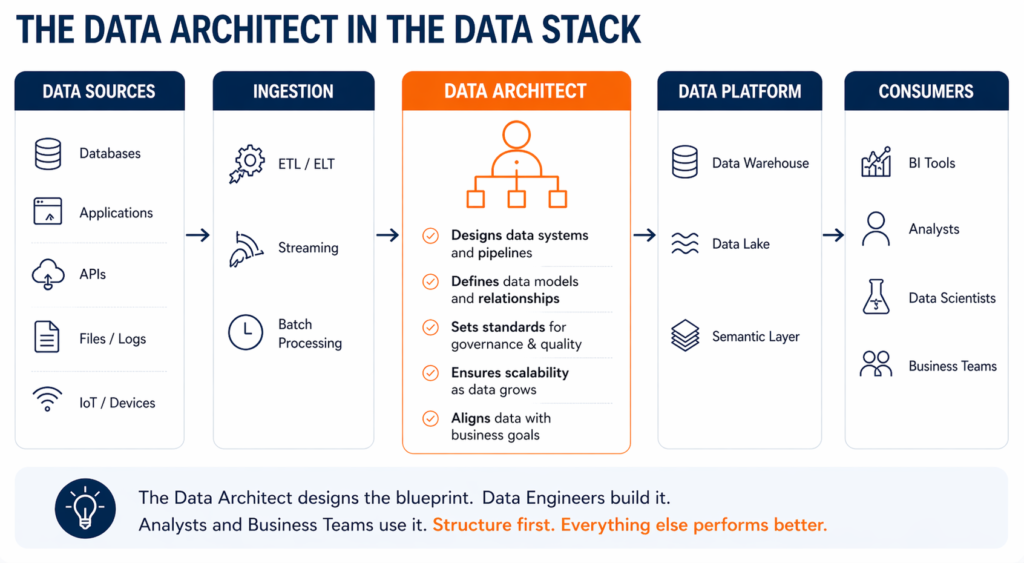
A data architect is responsible for how your data is structured, stored, and used across the business.
That includes things like
- Designing data systems and pipelines
- Defining data models and relationships
- Setting standards for consistency and governance
- Ensuring scalability as data grows
- Aligning data infrastructure with business goals
They’re not just building pipelines. They’re deciding how everything fits together.
Data Architect vs Other Data Roles
This is where many teams get confused.
Here’s the simple breakdown
Data Engineer
- Builds and maintains pipelines
- Focuses on execution
Data Architect
- Designs the system that those pipelines run on
- Focuses on structure and scalability
BI Analyst
- Uses the data for reporting
- Focuses on insights
If no one owns architecture, engineers end up making structural decisions on the fly. That’s where problems start.
Operator Insight
Most teams don’t hire a data architect too early.
They hire too late.
By the time issues show up, you’re already dealing with
- Inconsistent data definitions
- Duplicate pipelines
- Slower reporting cycles
Fixing it later costs more than doing it right up front.
When Do You Actually Need a Data Architect?
Common Triggers
You don’t need one on day one. But certain signals are hard to ignore.
Look for things like
- Rapid growth in data sources (5 → 15+ systems)
- Teams reporting different numbers for the same metric
- Data engineers are spending more time fixing than building
- Scaling from startup to mid-market
What Happens If You Don’t Hire One
This is what we typically see
- Reporting delays increase
- Data quality drops
- Engineering costs creep up
- Decision-making slows down
And eventually, leadership loses trust in the data.
Real-World Scenario
One team we worked with scaled quickly.
- 6 → 18 data sources in under 6 months
- No architectural oversight
- Reporting delays increased by ~40%
Once, a data architect came in
- Data models were standardized
- Pipelines were simplified
- Reporting stabilized within 30-60 days
That’s the difference structure makes.
Why Companies Are Hiring Data Architects Offshore
Access to Talent
Local hiring is tight. Especially for senior roles.
Offshore opens up things like
- Larger talent pools
- Faster hiring timelines
- More experienced candidates across industries
Cost Efficiency
Let’s be direct. Cost matters.
Typical savings
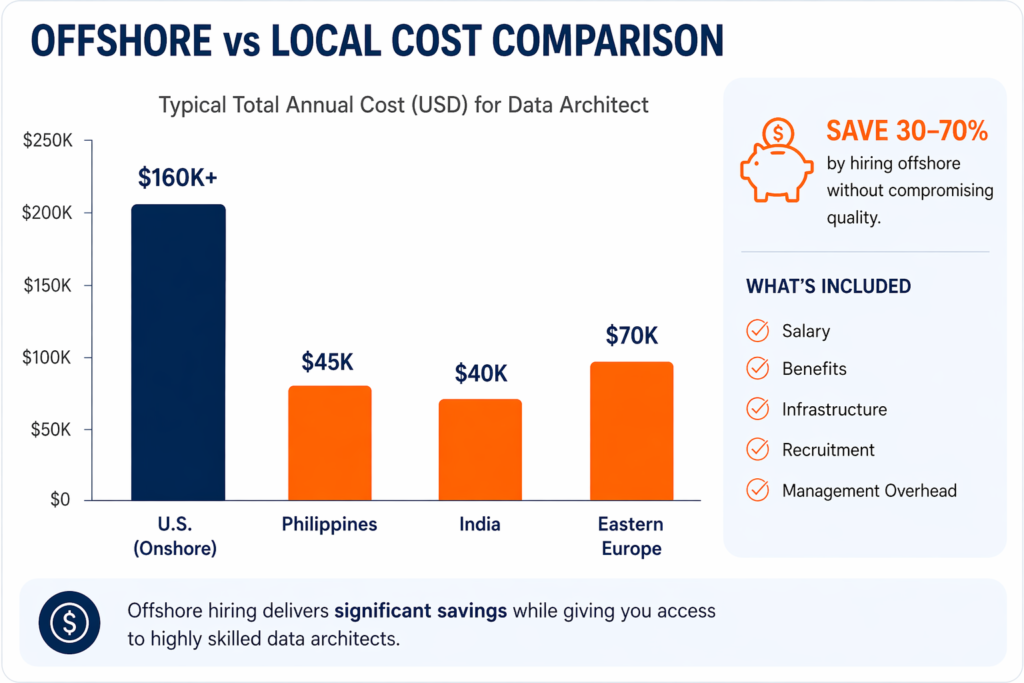
- 30-70% compared to local hires (arnia.com)
But the real value isn’t just lower cost. It’s getting the right skill set within budget.
Flexibility
Offshore hiring gives you
- Faster scaling
- Easier team adjustments
- Less long-term overhead
Operator Insight
The best offshore hires we’ve seen aren’t just cheaper.
They’re often more structured.
Why? Because they’ve worked across different systems, teams, and environments. That experience shows up in how they design solutions.
Offshore vs Local Hiring: Full Cost Breakdown
Onshore Salary Benchmarks
- US data architect $130k-$180k+
- Senior roles $200k+ total comp
Offshore Salary Benchmarks
- Philippines $30k-$60k
- India $25k-$55k
- Eastern Europe $50k-$90k
What Impacts Cost
It’s not just salary.
You’re also factoring in things like
- Benefits
- Recruitment costs
- Infrastructure
- Management overhead
Even with that included, offshore hiring still comes in significantly lower.
Hidden Costs to Watch
This is where teams get caught off guard
- Poor hiring decisions
- Lack of onboarding structure
- Misaligned expectations
Cheap hires that don’t perform aren’t savings. There are delays.
How to Hire an Offshore Data Architect (Step-by-Step)
Step 1 – Define the Role Clearly
Start with business needs. Not just tools.
- What problems are you solving
- What systems need structure
- What outcomes do you expect
Step 2 – Identify Required Skills
Look for things like
- Data modeling expertise
- Cloud platforms (AWS, Azure, GCP)
- Data warehousing (Snowflake, BigQuery)
- Governance and compliance knowledge
Step 3 – Source Candidates
Options include things like
- Offshore staffing partners
- Direct hiring
- Referrals
Each has tradeoffs. Partners tend to reduce risk and speed things up.
Step 4 – Screen Effectively
Don’t rely on resumes alone.
Use things like
- Real-world scenario questions
- Architecture problem-solving
- Past project discussions
Step 5 – Conduct Structured Interviews
Consistency matters.
Focus on things like
- Decision-making ability
- System thinking
- Communication
Step 6 – Onboard for Success
This is where most teams fail.
Set things like
- Clear ownership
- Defined KPIs
- Documentation standards
Operator Insight
Most hiring failures aren’t about skill.
They come from unclear expectations.
What to Look for in a Strong Offshore Data Architect
Technical Capabilities
- Strong data modeling
- System design thinking
- Experience with scalable architectures
Business Alignment
They should be able to
- Translate business needs into data structures
- Work across teams
Communication Skills
This is critical offshore.
Clarity beats brilliance if teams can’t collaborate.
Red Flags
Watch out for things like
- Tool-heavy, system-light thinking
- Poor communication
- No experience scaling systems
Best Practices for Managing Offshore Data Architects
Set Clear Ownership
Someone needs clear ownership over
- Data models
- Standards
- Definitions
Align on Standards Early
Align on standards early. Define things like
- Naming conventions
- Data definitions
- Governance rules
Maintain Communication
Maintain communication. Keep it simple
- Weekly syncs
- Clear documentation
- Defined workflows
Build for Long-Term Scale
This isn’t a short-term role. Treat it like part of your core team.
Common Mistakes Companies Make
- Hiring too late
- Hiring without a clear scope
- Prioritizing cost over capability
- Treating offshore teams as transactional
FAQs
How Kore BPO Supports Offshore Data Hiring
At Kore BPO, we focus on getting this right from day one.
What Makes Our Approach Different
- Pre-vetted talent
- Structured hiring process
- Focus on long-term fit, not quick placement
Typical Outcomes
- Faster hiring timelines
- 30-70% cost savings
- More stable data systems
Making the Right Hire
Hiring a data architect isn’t just about filling a role. It’s about fixing the structure.
When done right, it delivers
- Improved decision-making
- Lower long-term costs
- Stronger support for growth
Offshore hiring, when done properly, gives you that capability faster and more efficiently.
Bottom Line
If you’re thinking about hiring a data architect, don’t guess your way through it.
Let’s talk through things like
- Your current data setup
- What’s working and what’s not
- What the right hire should look like
Reach out to Kore BPO for a quick consultation. No pressure. Just a practical conversation about what makes sense for your team.
Or subscribe for more operator-level insights on building and scaling offshore teams the right way.
What does a data architect do?
How much does an offshore data architect cost?
Is offshore hiring reliable?
How long does it take to hire?

Related Articles



Ready to Build Your Offshore Team?
Get pre-screened resumes in 2 to 5 days. No upfront fees. One partner from hire to payroll.
Contact Us