7 Best Low-Cost Outsourcing Companies for US Businesses (2026)


Affordable outsourcing companies are everywhere. The hard part is telling the ones that deliver from the ones that look good in a pitch and disappear when onboarding starts.
This list ranks the 7 best low-cost outsourcing companies serving US businesses in 2026, evaluated across six criteria that matter most to the SMBs actually making these decisions: placement speed, US ownership and oversight, fee structure transparency, track record, role specialization, and verified Clutch ratings. Every provider was checked against public data. No invented scores. No padding with companies that don’t serve US clients in the right category.
The global outsourcing market hit $638.65 billion in 2026 according to Mordor Intelligence, and 59% of companies outsource primarily to cut costs. The problem is that affordable doesn’t mean cheap. The wrong provider can cost you three months of lost productivity and still send an invoice.
Whether you’re evaluating offshore accounting and finance support, tech staffing, or general back-office help, this guide gives you a scored, defensible ranking to start from.
How We Ranked These Outsourcing Companies
Six criteria. Each chosen because it reflects something a US business owner actually cares about when choosing an affordable outsourcing partner, not because it produces a clean-looking table.
| Criterion | Weight | What It Measures |
|---|---|---|
| Placement Speed | 25% | How quickly the provider delivers vetted candidates or working staff. US businesses lose money during open-role delays. |
| US Ownership & Oversight | 20% | Whether the company has US headquarters, US leadership, or US-based management accountability. Matters for timezone coverage, legal clarity, and communication. |
| Fee Structure Transparency | 15% | Whether pricing is clear upfront, whether there are setup fees or hidden charges, and whether the risk model favors the buyer. |
| Track Record & Proven Placements | 15% | Years in business, documented placements, client base size. Older companies with real placement history carry less delivery risk. |
| Role Specialization Depth | 15% | Whether the provider can place skilled roles (tech, data, finance, ops) or is limited to VA and admin work. |
| Client Reviews (Clutch) | 10% | Verified Clutch rating and review volume. Lower weight because it favors volume over quality, but it’s the most consistent third-party signal available. |
Scores run 1–10 per criterion. Weighted total rounds to one decimal. Bias acknowledged: Kore BPO engaged us to produce this content. The scoring model is real and applied consistently. If you disagree with a ranking, the criteria are right there to argue with.
Outsourcing Provider Comparison at a Glance
| Provider | Score | Best For | Key Strength | HQ / Delivery | Notable Limitation |
|---|---|---|---|---|---|
| Kore BPO | 9.7/10 | Offshore tech, data, finance & ops roles | $0 upfront, 2–5 day resumes, US-owned | Dallas TX / India + Costa Rica | Smaller Clutch review count vs competitors |
| Remote CoWorker | 7.9/10 | VA and back-office at volume | 189 Clutch reviews, US HQ Florida | Hollywood FL / Philippines | Less suited to specialized tech roles |
| Helpware | 7.6/10 | Enterprise CX and BPO at scale | 90% CSAT, 2.8% attrition rate | Lexington KY / Global | Higher minimum engagement for SMBs |
| Solvo Global | 7.0/10 | Nearshore LatAm staffing | US HQ, same-timezone Colombia talent | Chandler AZ + Duluth GA / Colombia | $50k+ minimum engagement size |
| WishUp | 6.9/10 | Fast VA deployment with AI tools | Same-day placement, 7-day money-back | India / US clients | VA and ops only, no US HQ |
| BruntWork | 6.7/10 | Startups testing offshore staffing | Month-to-month, no lock-in | Australia / Philippines | No US HQ or US management oversight |
| Invedus | 6.6/10 | Budget-first hiring across 160+ domains | From $799/mo, 12 years in business | India + Idaho / India | Zero Clutch reviews [VERIFY] |
The Top 7 Low-Cost Outsourcing Companies for US Businesses
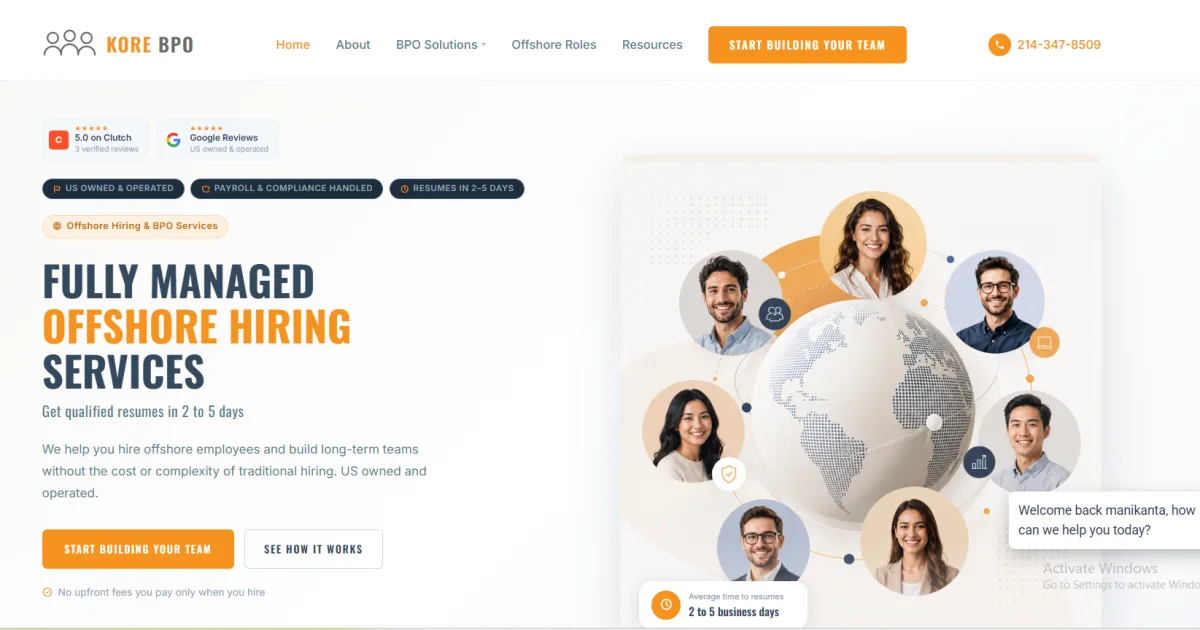
No other provider on this list delivers resumes in 2–5 business days from a US-owned, zero-upfront-fee model with dedicated delivery hubs in three countries. That combination is what earns the top spot, not just price.
Founded: 2016 Clutch: 5.0/5 (3 verified reviews) HQ: Dallas, TX
Key Strengths
- $0 upfront, zero setup fees. The placement process begins without a retainer. You only pay when someone starts.
- Resumes delivered in 2–5 business days for most roles, including specialized data, software, and finance positions.
- 60–70% cost savings vs equivalent US hires, documented across 6,236 placements and 257 client companies.
- US-owned and operated from Dallas, TX, with delivery hubs in San Jose, Costa Rica, and Hyderabad, India. One point of contact, US accountability.
- Covers the full range of skilled offshore roles: software engineers, data engineers, data scientists, accountants, financial analysts, and operations staff.
Limitations
- Smaller Clutch review volume than Remote CoWorker or Helpware. Three reviews at 5.0/5.0 is a perfect score, but buyers who rely heavily on review count before engaging will notice the gap.
- Specialist positioning means Kore BPO is not the right call for call-center scale-out at 50+ seats or for fully managed BPO where the vendor runs the entire process.
- Less relevant for companies that need a single VA at the lowest possible price point and have no need for skilled professional roles.
Services: Offshore software engineers, .NET developers, Java developers, DevOps, AWS engineers, data engineers, data scientists, data architects, database developers, accountants, business analysts, project managers, marketing VAs, administrative support, customer service
Industries: SaaS, fintech, healthcare, e-commerce, logistics, professional services, staffing, real estate
Kore BPO earns the top spot because the things US business owners actually worry about when outsourcing skilled roles, hidden fees, slow pipelines, and offshore providers with no US accountability, are precisely where their model is built differently. The $0 upfront structure and 2–5 day delivery aren’t marketing language. They’re the operational model, confirmed across 6,236 placements. The US ownership layer matters too: when something goes wrong, you’re calling Dallas, not routing a ticket to a call center on the other side of the planet.
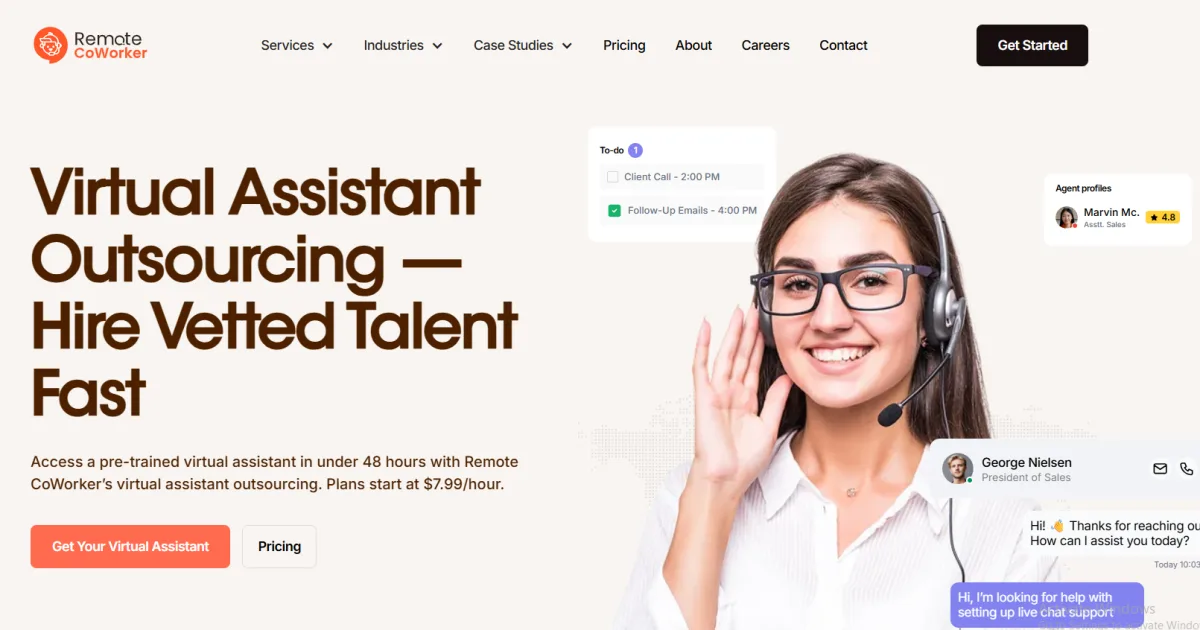
189 verified Clutch reviews puts Remote CoWorker in a different conversation from most providers on this list. That kind of review depth doesn’t happen by accident.
Clutch: 4.8/5 (189 reviews) HQ: Hollywood, FL + Philippines
Key Strengths
- Highest Clutch review volume on this list by a wide margin. 189 verified reviews at 4.8/5 is a sustained quality signal, not a good-month anomaly.
- US headquarters in Hollywood, Florida provides the domestic oversight and accountability that pure-offshore agencies can’t offer.
- 55% of their client base is small businesses under $10M in revenue. Their processes are built for SMB reality, not enterprise rollouts.
- Service range covers back-office (45%), finance and accounting (15%), customer service (10%), and call center work, from a single provider.
- Pricing from $740/month for basic personal assistant work, with transparent hourly rate posting on their website.
Limitations
- Philippines-only talent pool limits options for clients who need Spanish-speaking staff or Latin American timezone coverage.
- Less suited to specialized tech and data roles. Their strength is operational and administrative work, not engineering or analytics hiring.
- Training intensity for complex workflows can extend onboarding timelines beyond what the initial pitch suggests.
Review depth and US management make Remote CoWorker a safe second choice for back-office scale. The combination of Florida HQ and Philippines delivery is a proven operational model, and 189 reviews at 4.8 is the kind of public track record that removes most of the due-diligence guesswork.

Helpware’s client list reads like a Fortune 500 guest list. Microsoft, Google, Pfizer, StubHub. That’s not the profile of a company cutting corners on delivery.
Founded: 2015 Clutch: 4.8/5 (47 reviews) HQ: Lexington, KY
Key Strengths
- 90% CSAT score and 2.8% monthly attrition rate against a 6–8% industry average. They publish these numbers. Most BPO companies don’t because they can’t.
- AI-plus-human delivery model. Their CX operations integrate automation with human support in a way that reduces cost per interaction without gutting quality.
- 11 years of operations across 19 global offices gives them delivery redundancy that newer providers simply haven’t built yet.
- Strong in regulated industries including healthcare, fintech, and SaaS, where compliance-aware support matters.
Limitations
- Enterprise pricing orientation. Helpware is not the right call for a five-person startup that needs one support agent at $1,000/month. Their processes are built for scale.
- Complex onboarding for SMBs who don’t have standardized SOPs and QA frameworks already in place.
- Minimum engagement size and contract structure are more formal than budget-tier alternatives on this list.
The 90% CSAT and 2.8% attrition numbers are the reasons Helpware lands here and not lower. Those metrics take years to build and they signal a delivery organization that has figured out retention, which is the most common failure point in BPO relationships. The enterprise client roster is further validation that this isn’t a company living on brand reputation alone.
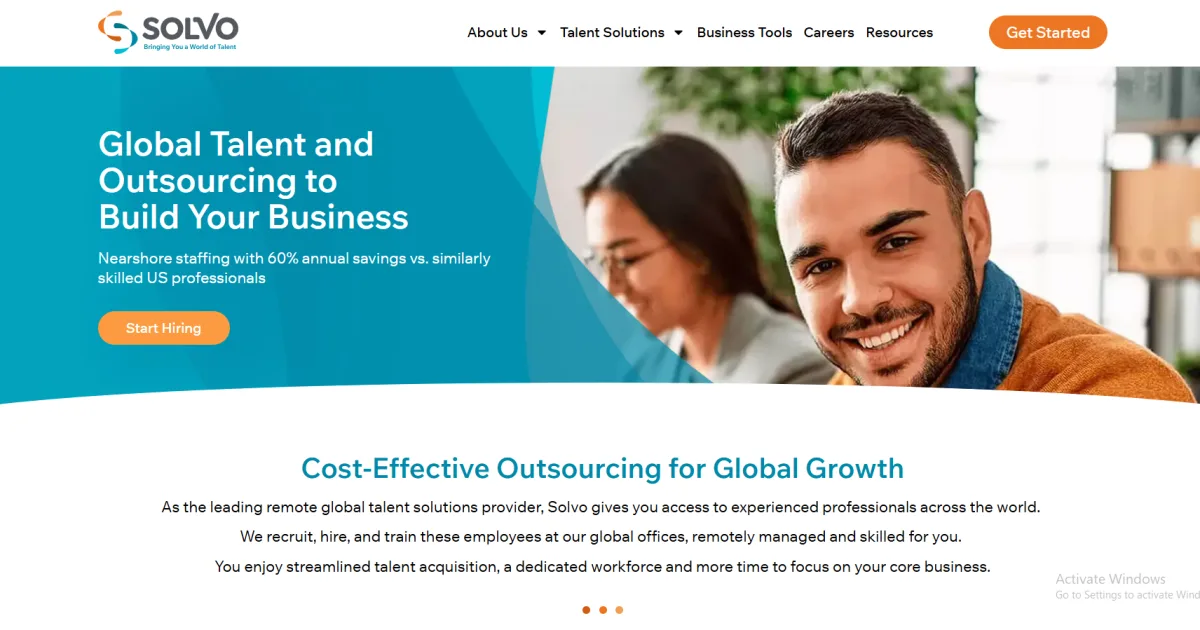
Solvo Global’s pitch is built around one specific advantage: nearshore Colombian talent operating in the same time zone as US East Coast and Central business hours, without the overnight-shift complexity that comes with Asia-based staffing.
Founded: 2018 Clutch: 5.0/5 (7 reviews) HQ: Chandler, AZ + Duluth, GA (delivery from Medellín, Colombia)
Key Strengths
- Dual US headquarters give Solvo Global a management layer that most nearshore-only providers don’t have, useful for buyers who want a US point of contact.
- Same-timezone Colombian talent means live collaboration during standard US business hours, without the 10 to 15-hour offset common with Philippines or India-based staffing.
- Clutch reviews are unanimous on cost-effectiveness and communication quality, with one client citing $2.1M in annual savings across a 160-person engagement.
- Broad service range spanning back-office, call center, and finance and accounting outsourcing, not just single-role VA placement.
Limitations
- $50k+ minimum engagement size puts Solvo Global out of reach for solo founders or very small teams testing outsourcing for the first time.
- Colombia-only delivery footprint means less language and specialization breadth than multi-country providers.
- Smaller review base (7 on Clutch) than Helpware or Remote CoWorker, which limits independent verification at scale.
The same-timezone advantage is real, and it’s the reason Solvo Global scores above providers with a wider offset. Dual US headquarters and unanimous Clutch feedback support the score, but the $50k minimum engagement size is what keeps it out of the top three on a list built for cost-conscious SMBs.

Twenty-four hours to a working VA. That’s WishUp’s headline claim, and for the right buyer it’s genuinely compelling. Speed matters when you’re underwater.
Founded: 2017 Clutch: 4.9/5 (34 reviews) HQ: India (serves US clients)
Key Strengths
- Same-day to 24-hour placement for standard VA roles. Faster than any other provider on this list for admin and operations work.
- 7-day money-back guarantee. Actual risk removal for first-time outsourcers who aren’t sure the model will work for them.
- VAs pre-trained on 70+ tools including ChatGPT, Zapier, and other AI-heavy productivity platforms. Useful for founders running modern, automation-forward operations.
- Pricing from $999–$1,299/month puts them in the accessible entry range for small businesses testing offshore VA work.
Limitations
- India-based company with no US headquarters. Time zone offset (10–12 hours) is real and requires deliberate scheduling to manage.
- VA and operations focus only. If you need a software engineer, data analyst, or finance professional, WishUp is not the right call.
- Quality can vary depending on specific VA match. Their claim of placing only the top 0.1% of applicants is difficult to verify independently.
The money-back guarantee and same-day placement are the real differentiators here. For a first-time outsourcer who isn’t sure the model will work, the risk floor is lower with WishUp than with most alternatives. The AI-tool training investment is a legitimate edge for startup environments running on modern productivity stacks.
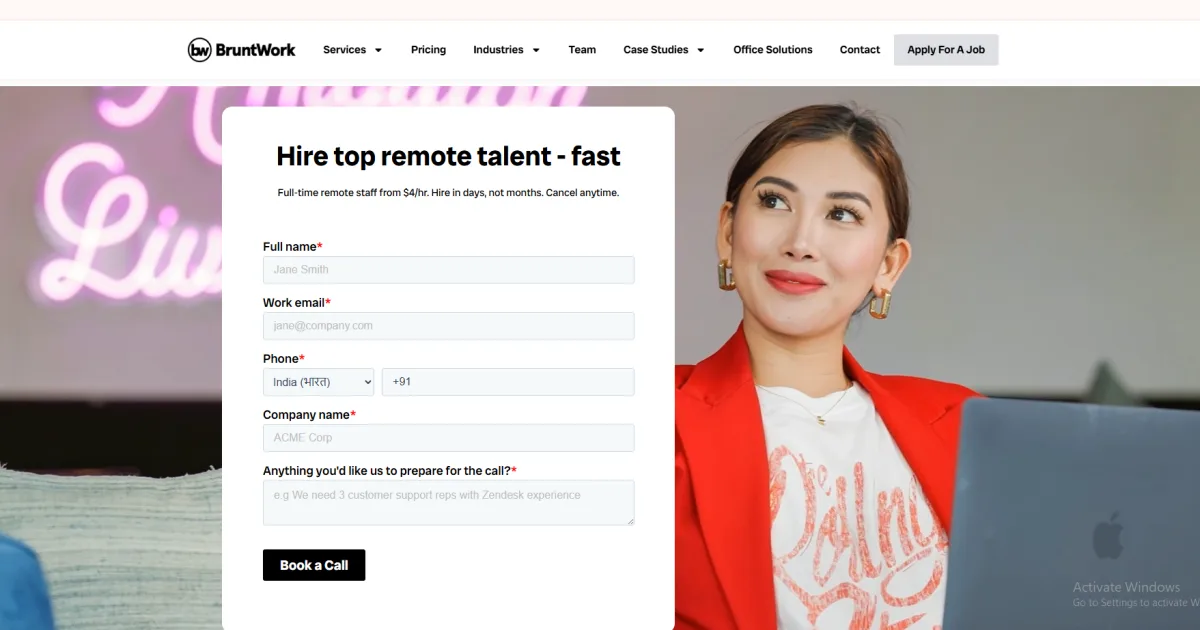
If you’re at the “testing offshore for the first time” stage and you want an exit if it doesn’t work, BruntWork’s contract structure is built for exactly that situation.
Founded: ~2020 Clutch: 4.9/5 (35+ reviews) HQ: Australia (Philippines talent)
Key Strengths
- Month-to-month contracts with no setup fees. The cost of being wrong is low, which is the right risk model when you’re early in the offshore staffing decision.
- 4.9/5 on Clutch with 35+ reviews and 800+ Google reviews across platforms. Consistent positive signals from a real client base.
- Broad role coverage including admin, customer service, marketing, and tech support across Philippines-based talent at $1,000–$2,500/month.
- Startup and digital-first company orientation means their onboarding processes are designed for remote-first environments, not legacy in-office workflows.
Limitations
- Australian-founded with no US headquarters. US businesses have no domestic point of accountability if delivery issues arise.
- Newer company, founded around 2020. Operational maturity is developing compared to providers with a decade or more of placements behind them.
- Outcomes can vary. Their model relies on self-managed onboarding, which works for experienced outsourcers but can be a gap for first-timers who need more hand-holding.
BruntWork’s value case is the contract flexibility. No lock-in genuinely reduces the cost of a bad hiring decision, which is the single biggest fear most US SMBs have about offshore staffing. That said, the Australian HQ and newer operational history mean the accountability layer is thinner than providers with US ownership and a longer track record.
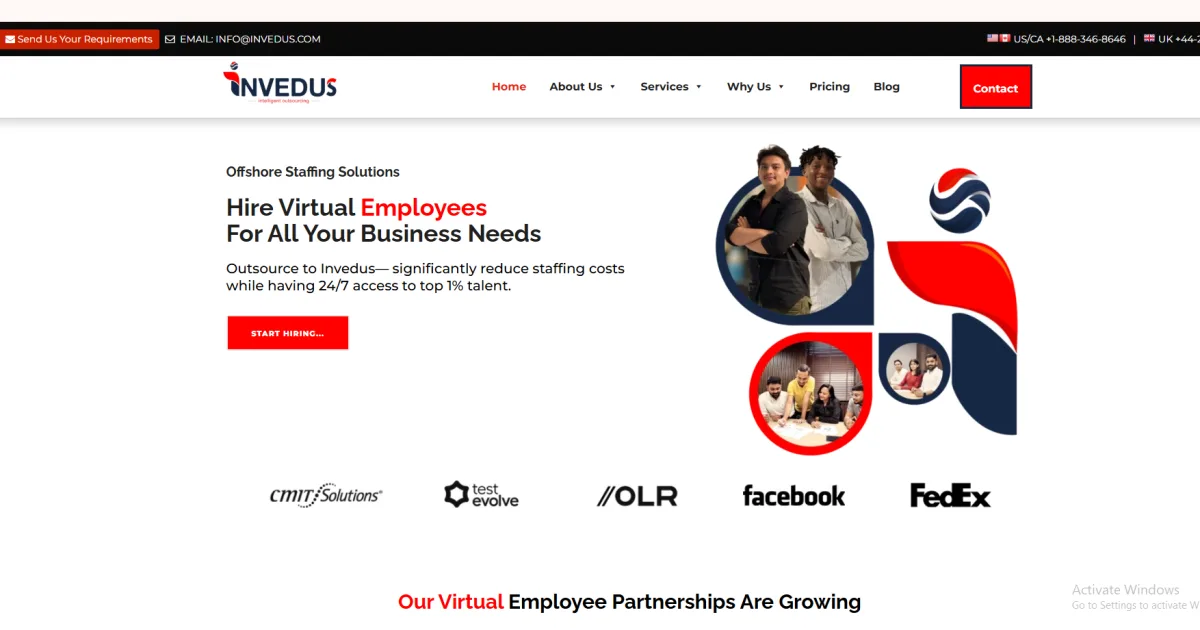
$799 a month for a full-time offshore employee is the lowest entry point on this list. That number gets attention fast.
Founded: 2014 Clutch: [VERIFY: 0 Clutch reviews confirmed — rated 5.0/5.0 on CrowdReviews (1 review); Clutch score unverifiable] HQ: India + Garden City, Idaho
Key Strengths
- Lowest monthly entry price on this list at $799/month for a full-time dedicated employee or $5.99/hour for part-time work.
- 12 years in operation since 2014, with 400+ clients across 20+ countries. That longevity suggests operational stability even without Clutch data to back it up.
- Service breadth across 160+ domains, covering IT development, accounting, legal support, marketing, and administrative work in the same place.
- Small US office presence in Garden City, Idaho provides a domestic touch point, however limited.
Limitations
- Zero Clutch reviews confirmed during research [VERIFY: buyers should check clutch.co/profile/invedus-outsourcing directly before engaging]. This is the most significant trust gap on this list.
- India-based management with minimal US infrastructure. No meaningful US-side oversight or accountability layer.
- The 160+ domain breadth can mean shallow expertise in any specific vertical. Generalist coverage at budget rates is a tradeoff.
Invedus sits last because of the Clutch data gap, not because of operational failure. Twelve years and 400+ clients across 20 countries is real history. The $799/month entry price is genuinely the lowest on this list. Buyers who want the cheapest possible starting point and are willing to verify independently will find it here.
See What Offshore Staffing Actually Costs for Your Roles
Free ROI calculator. Compare in-house costs against offshore rates in under 2 minutes.
How to Choose an Affordable Outsourcing Company for Your US Business
The right provider depends on three signals: your budget ceiling, the role type you’re filling, and how much US-side management oversight you actually need. Here’s how each one shapes the decision without overthinking it.
Budget signals
Under $1,000 a month: Invedus ($799/mo) is the only option at that floor. WishUp enters at $999. Both are VA and admin-oriented. If your budget is this tight, you’re likely testing the model rather than scaling it.
$1,000–$2,500 a month: BruntWork and Remote CoWorker are the natural fits here for general offshore staffing and back-office support. Month-to-month flexibility from BruntWork suits buyers who want an exit clause.
$2,500+ a month: Kore BPO covers this range for skilled roles with the $0 upfront structure. Helpware enters here for CX scale. Solvo Global requires a larger commitment but delivers nearshore LatAm talent with US management oversight.
Role type signals
Tech, data, engineering, finance: Kore BPO is the specific match. Software engineers, data engineers, DevOps, financial analysts, accountants. That’s the core of what they place.
VA, admin, scheduling, basic customer service: Remote CoWorker and WishUp are the natural fits. More options, lower cost, faster deployment for routine work.
Customer service at scale with measurable SLAs: Helpware. Their 90% CSAT and 2.8% attrition don’t lie. That’s the right provider when you need a quality floor you can defend internally.
Nearshore LatAm for same-timezone work: Solvo Global or Kore BPO’s Costa Rica hub are the two options on this list with genuine LatAm delivery infrastructure.
Oversight preference signals
Some buyers need a US HQ they can call when something goes wrong. Others are comfortable managing offshore relationships directly. If you need the former: Kore BPO, Helpware, Remote CoWorker, and Solvo Global all have US headquarters. BruntWork, WishUp, and Invedus don’t.
One more thing worth saying plainly. The providers that look cheapest on a per-hour basis are often the most expensive once you factor in 60 days of getting someone productive. SMBs that report 30–60% savings from outsourcing are almost always working with providers who front-load vetting rather than passing that work to the buyer. Speed to productivity matters as much as hourly rate.
Conclusion
Kore BPO ranks first for one reason: the combination of $0 upfront fees, 2–5 business day delivery, and US-owned management oversight addresses the three things that cause most US businesses to hesitate on offshore staffing in the first place. That’s a real operational model backed by 6,236 placements, not a pitch deck.
If you need CX at scale with measurable quality metrics and your team is larger, Helpware is the honest second choice. If you want the highest Clutch review volume and back-office support from a US-managed Philippines operation, Remote CoWorker is the one to look at.
Before you decide anything, run the numbers. The Kore BPO savings calculator lets you compare in-house labor costs against offshore rates for specific roles in under 2 minutes, free, with no sales call required.
How much does outsourcing actually cost for a US small business?
$800 to $2,500 a month for a single full-time offshore role is the realistic range for most providers on this list. The lower end (Invedus at $799, WishUp at $999) covers VA and administrative roles. Skilled tech and data roles run $2,000 or more depending on seniority and provider. The number most buyers find surprising is this one: companies consistently report 30–60% savings against equivalent in-house hires even at the upper end of those monthly rates, once you factor out employer payroll taxes, benefits, office overhead, and recruitment costs. The math is favorable. The variable is finding a provider that actually delivers the quality the hourly rate implies.
How fast can you realistically get an outsourced team member up and running?
Forty-eight hours to a working VA with WishUp’s model. Two to five business days for a vetted offshore professional through Kore BPO. Most providers on this list run one to two weeks for standard roles once you’ve signed and submitted a job description. Helpware’s enterprise engagements can take two to four weeks due to their onboarding and QA requirements. The honest caveat: speed depends heavily on how prepared your onboarding documentation is. Providers that move fastest assume you have a role spec, a tool list, and a basic training doc ready to go. If you’re starting from scratch, add a week to any provider’s stated timeline.
Is offshore outsourcing legal? What do US businesses actually need to know?
Short answer: yes, for most business functions. US companies can legally engage offshore workers as contractors or through a staffing intermediary, like every provider on this list, without the payroll tax and benefits obligations of W-2 employment. The legal structure on the delivery side is handled by the vendor. What you need to manage internally: data security agreements (especially for roles touching customer data), IP ownership clauses in your service contracts, and routing any regulated financial or healthcare data through appropriate compliance channels. None of that is complicated. It’s paperwork. Most vendors include compliant contract templates in their onboarding. If yours doesn’t, that’s a yellow flag worth noting before you sign.
BPO vs offshore staffing: does the distinction actually matter when you’re buying?
Usually yes, for practical purposes. BPO typically means you’re buying a process outcome. Helpware runs your customer support tier end-to-end, for example. Offshore staffing means you’re hiring a person who integrates into your existing team and workflow. Kore BPO is staffing. Helpware is closer to BPO. Remote CoWorker sits between the two depending on engagement type. The practical difference matters because with staffing you control the workflow and the tools, while with BPO the vendor manages the process and you review the outputs. For most SMBs, the staffing model is simpler, lower risk at small scale, and easier to reverse if the fit isn’t right. BPO makes more sense once you’re deploying 10+ roles and want to outsource the management layer too.
Which outsourcing model saves the most money per dollar spent?
Depends what you’re measuring. Pure hourly-rate savings: India-based providers like Invedus and WishUp at $5–$12 an hour beat everything else on paper. Total cost of ownership including training time, management overhead, error rates, and re-hire costs when a placement doesn’t stick: US-managed offshore firms like Kore BPO typically come out ahead because the placement process is handled, vetting is documented, and retention is higher. Outsourcing research consistently shows that the providers that look most affordable in the pitch are often the most expensive once you include the first 60 days of getting someone fully productive. That’s not an argument against budget providers. It’s an argument for being honest about what you’re actually comparing.
Editorial note: Kore BPO engaged us to produce this research. The scoring model and ranking methodology are independently applied. All competitor data was sourced from public review platforms and company websites during research for this article. Clutch ratings were retrieved in June 2026. If provider data has changed, contact us and we’ll update.
Related Articles



Ready to Cut Costs Without Cutting Quality?
Kore BPO places vetted offshore talent in 2–5 business days with $0 upfront. See your savings before you commit to anything.
Calculate My Savings$0 upfront · Resumes in 2–5 business days · 60–70% cost savings