
For most growing companies, offshore software engineers scale engineering capacity faster and cost 40 to 70 percent less than in-house developers. But the highest-performing teams use a hybrid model — in-house engineers own architecture and product strategy, while offshore engineers handle feature development, QA, and ongoing maintenance.
- 01What “Scaling Faster” Actually Means
- 02In-House Software Developers: Strengths and Constraints
- 03Offshore Software Engineers: How They Scale Teams
- 04Why Companies Struggle to Scale Engineering
- 05Side-by-Side: Offshore vs In-House
- 06When In-House Makes the Most Sense
- 07When Offshore Is the Better Choice
- 08The Hybrid Model (What Actually Works Best)
- 09Common Mistakes Companies Make
- 10How to Choose the Right Model
- 11FAQs
- 12Final Thoughts: What Actually Scales Faster?
The Decision Every Growing Engineering Team Faces
Posting a job advertisement and waiting for applications isn’t the only way to scale a software team and for most growing companies, it’s no longer the fastest one.
SMB owners and IT leaders are running into the same wall. Product demand grows, the roadmap expands, and hiring software engineers locally takes months. The Bureau of Labor Statistics projects software development will grow 17 percent by 2033, outpacing most other industries (bls.gov). That growth pressure is forcing a decision every engineering leader eventually faces:
Should you build a larger in-house development team, or scale with offshore software engineers?
This guide breaks down what actually works what each model costs, how fast each scales, where each fits, and why most high-performing teams now run a hybrid.
What “Scaling Faster” Actually Means
Scaling an engineering team isn’t about hourly rates. It’s about how quickly you can convert headcount into shipped features.
The real scaling equation looks like this:
Scaling speed = Time-to-hire + Time-to-ramp + Throughput per engineer Rework
That’s why a $70/hr offshore engineer who ships in week three can outperform a $130/hr local hire who starts in week twelve. Most teams underestimate this and optimize for the wrong variable.
In-House Software Developers: Strengths and Constraints
In-house developers are engineers hired directly as employees. They sit inside your org, attend planning, and work closely with product, leadership, and other functions.
A typical in-house engineering team includes:
- Software engineers
- Product managers
- QA engineers
- DevOps specialists
- Technical leads
Where in-house teams win
- Strong collaboration with product and leadership
- Deep ownership of architecture and long-term systems
- Full control over engineering process and security
- Cultural alignment with company strategy
Where in-house teams struggle
The constraint isn’t quality it’s hiring physics. In competitive markets, finding a strong full-stack engineer takes 8–16 weeks. Total loaded cost (salary + benefits + recruiting + tools + office) for a mid-level US developer typically runs $140K–$220K per year.
Offshore Software Engineers: How They Scale Teams
Offshore software engineers are developers based in another country who work remotely for your team. Companies engage them through several models:
- Staff augmentation adding individual engineers directly to your team
- Dedicated development teams groups working exclusively on your product
- Offshore development centers (ODCs) long-term remote engineering offices
Offshore engineering hubs are typically in:
- Eastern Europe
- Southeast Asia (India, Philippines, Vietnam)
- Latin America
- Africa
The reason teams move offshore isn’t just cost. It’s access to a vastly larger pool of engineers and a hiring cycle measured in weeks, not quarters.
Why Companies Struggle to Scale Engineering
Scaling rarely fails because of bad ideas. It fails because of hiring friction. Three forces drive most of it:
1. Global developer talent shortage
Tech companies, startups, and enterprises are all fishing in the same pond. The result is longer hiring timelines, higher salaries, and aggressive recruiter competition. For SMBs trying to win candidates from FAANG-tier offers, the math rarely works.
2. Local hiring bottlenecks
The typical in-house pipeline:
- Job posting and sourcing 2 to 4 weeks
- Technical screening and interviews 3 to 6 weeks
- Offer negotiation 1 to 2 weeks
- Notice period 2 to 4 weeks
That’s 8–16 weeks to hire one engineer per role. For teams scaling 3 to 5 roles at once, the delay compounds and the roadmap slips.
3. Rising engineering costs
Beyond salary, in-house engineers carry recruiting fees, benefits, payroll taxes, office space, equipment, and 4–6 weeks of onboarding overhead. The fully loaded number is what shocks most CFOs.
Side-by-Side: Offshore vs In-House
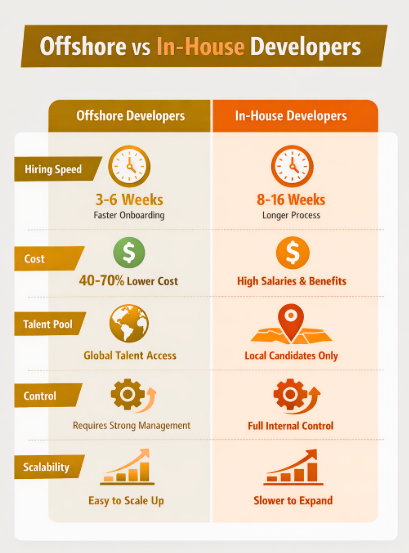
Offshore engineers win on cost ($20–$70/hr vs $70–$150/hr) and hiring speed (3–6 weeks vs 10–18 weeks). In-house engineers win on architecture ownership, time-zone overlap, and security-sensitive work. The table below maps the trade-offs across the seven factors that drive most scaling decisions.
| Factor | In-House Developer | Offshore Engineer |
|---|---|---|
| Hourly rate (mid-level) | $70–$150 (NA), $60–$120 (W. Europe) | $20–$70 depending on region |
| Time to first PR | 10–18 weeks | 3–6 weeks |
| Annual loaded cost | $140K–$220K | $50K–$110K |
| Talent pool | Local market only | Global |
| Best for | Architecture, sensitive systems, long-term ownership | Feature delivery, QA, maintenance, scale |
| Management overhead | Low | Medium (needs documentation + clear ownership) |
| Cultural / time-zone friction | None | Manageable with overlap hours |
When In-House Makes the Most Sense
In-house developers are still the right call for specific workloads. Keep work in-house when you’re:
- Building core product architecture and platform foundations
- Developing highly sensitive systems (financial, healthcare, defense)
- Working with strict security or data residency requirements
- Managing complex internal platforms tightly coupled to business logic
The unique advantages are deeper product ownership, faster internal communication, and strategic alignment that’s hard to replicate at a distance.
Rule of thumb: if a system would be a competitive moat or a regulatory failure point, build it with in-house engineers.
When Offshore Is the Better Choice
Offshore engineering is the right play when speed and capacity matter more than co-location. The most common use cases:
- Accelerating product development against a fixed roadmap
- Building MVPs without permanent headcount
- Expanding engineering capacity during a growth surge
- Standing up dedicated QA and maintenance teams
- Accessing specialized skills (cloud, DevOps, AI/ML, data engineering) you can’t hire locally
Need offshore engineers fast?
Get pre-screened resumes in 2–5 days. $0 upfront. One partner from hire to payroll.
The Hybrid Model (What Actually Works Best)
In practice, the most effective engineering organizations don’t pick a side they layer both models.
A typical hybrid structure
In-house engineers handle:
- Product strategy and architecture decisions
- Technical leadership and code review
- Critical-path and security-sensitive work
Offshore engineers handle:
- Feature development and shipping velocity
- Quality assurance and automated testing
- Ongoing maintenance and bug-fix cycles
Why this works
- Cuts total engineering cost 20–40% vs full in-house
- Preserves strategic control where it matters most
- Multiplies execution capacity without slowing leadership
- Minimizes rework by keeping architecture decisions in-house
Common Mistakes Companies Make
Offshore engineering works when it’s set up correctly. When it fails, it’s almost always one of these reasons:
- No clear product owner on the company side
- Poor or missing documentation
- Unrealistic expectations on velocity from day one
- Treating offshore engineers as a black box instead of an extension of the team
If you can’t name the internal lead who owns the offshore team’s output, the engagement will underperform regardless of how good the engineers are.
Successful teams invest upfront in clear sprint planning, structured onboarding, and consistent communication rhythm. The rest takes care of itself.
How to Choose the Right Model
There’s no universal answer but the decision usually comes down to four questions:
- How fast do you need to scale engineering capacity?
- How much product control do you require?
- How complex is your technology stack?
- Do you have leadership capable of managing distributed teams?
Most companies that get this right start with a small offshore team paired to a senior internal lead, then expand as the playbook proves itself.
FAQs
The six questions founders and engineering leaders ask most often when evaluating offshore vs in-house developers answered directly below.
Final Thoughts: What Actually Scales Faster?
Offshore engineers win on pure hourly rate, while in-house wins on strategic ownership. However, on total cost to scale, the hybrid model wins almost every time.
- Simple, well-scoped work → offshore is more cost-effective
- Architecture and core platform work → in-house is the right anchor
- Ongoing roadmap execution → hybrid is the operating model that scales
For most growing companies, the question is no longer whether to use offshore developers it’s how to structure the team so offshore capacity multiplies your in-house leadership instead of pulling against it.
If you’re looking to scale engineering capacity without doubling your loaded cost, connect with the Kore BPO team and we’ll map a hybrid model to your roadmap pre-screened resumes in 2 to 5 days, no upfront fees.
Common Questions on Cost and Timeline
Are offshore software engineers cheaper than in-house developers?
How long does it take to hire an offshore developer vs an in-house developer?
What work do offshore software engineers handle best?
What is a hybrid software development model?
Security and When to Avoid Offshore
Are offshore developers a security or compliance risk?
One Last Consideration
When should a company NOT use offshore developers?

Related Articles



Ready to Scale Your Engineering Team?
Get pre-screened offshore engineers in 2 to 5 days. No upfront fees. One partner from hire to payroll.
Contact Us