What Is Recruitment Process Outsourcing (RPO) and When Should You Use It?

- 01What Is Recruitment Process Outsourcing (RPO)?
- 02What RPO Is Not
- 03How Recruitment Process Outsourcing Actually Works
- 04Common RPO Models and When They Make Sense
- 05Why Companies Use RPO
- 06Where the Cost Savings Come From
- 07When Should You Use Recruitment Process Outsourcin
- 08When RPO Is Not the Right Solution
- 09RPO Compared to Other Hiring Models
- 10RPO for Small and Mid Sized Businesses
- 11What to Look for in an RPO Partner
- 12Real World Insight From the Field
- 13FAQs on Recruitment Process Outsourcing
- 14Key Point
- 15Ready to See If RPO Makes Sense for You?
Recruitment process outsourcing (RPO) hands a company's hiring function to a specialist provider. It makes business sense when you have 10+ hires per year, inconsistent time-to-fill, or no dedicated in-house recruiter.
Hiring should not feel like a constant fire drill. But if you are an SMB owner, IT leader, or executive, there is a good chance it does.
Roles sit open for months. Recruiters are overloaded. Agency fees keep climbing. Hiring still feels reactive instead of planned.
That is usually when people start asking about Recruitment Process Outsourcing, also known as RPO.
Let’s slow this down.
This article explains what RPO is, when it makes sense, and when it does not. It is based on what we see every day, working with growing businesses.
What Is Recruitment Process Outsourcing (RPO)?
Recruitment Process Outsourcing means partnering with an external team owning part or all of your hiring process.
This is not just resume sourcing or filling seats.
An RPO team manages the work behind hiring, including
- Job intake and role alignment
- Candidate sourcing and screening
- Interview scheduling
- Hiring manager communication
- Offer support and onboarding handoff
- Hiring data and reporting
You still make the final hiring decisions. Culture, pay strategy, and who gets hired stay with you. The RPO partner owns execution and consistency.
What RPO Is Not
RPO is often misunderstood, so this matters.
RPO is not
- A staffing agency that sends resumes and disappears
- Cheap offshore recruiters working without context
- A replacement for leadership or hiring managers
- Only for Fortune 500 companies
When RPO works well, it feels like adding a seasoned hiring function almost overnight.
How Recruitment Process Outsourcing Actually Works
Every provider packages RPO differently, but the flow is usually similar.
A Typical RPO Workflow
Role intake
Align on what success looks like for the role.
Hiring plan
Set volume, timelines, interview steps, and ownership.
Sourcing and screening
Proactive outreach, not just inbound applicants.
Interview coordination
Keep the process moving without bottlenecks.
Offer and close support
Speed matters more here than most teams expect.
Reporting and optimization
Track time to hire, cost, and quality trends.
That last step is one most internal teams rarely have time for.
Common RPO Models and When They Make Sense
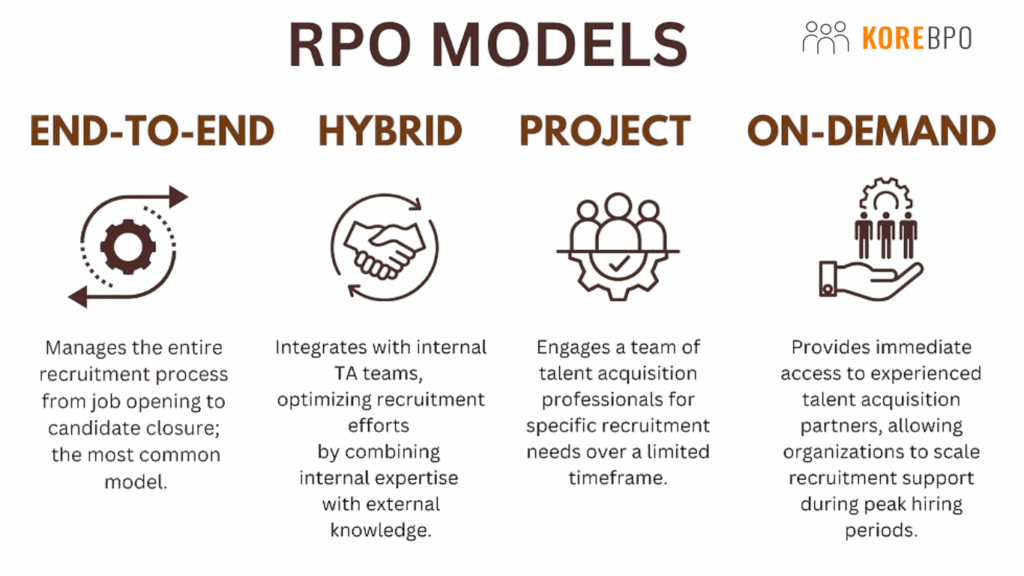
RPO does not have to be all or nothing.
Full Lifecycle RPO
- End to end ownership of hiring
- Common in fast growth or complex environments
- Best when hiring volume is high or unpredictable
Project or Surge RPO
- Short term hiring support
- Useful for expansions, launches, or backfills
Modular or Function Specific RPO
Support for specific roles or departments
Popular with SMBs that want flexibility
This last model is where many smaller companies see the most value.
Why Companies Use RPO
Companies don’t adopt RPO because it’s trendy. They do it because something is breaking.
Across the industry, RPO is linked to
- Faster time to hire
- Lower cost per hire
- Reduced agency spend
- More consistent candidate experience
- Better visibility into hiring performance
In our experience, the biggest wins come from removing friction, not cutting corners.
Where the Cost Savings Come From
This surprises many teams.
Savings usually do not come from paying recruiters less. They come from
- Fewer agency fees
- Fewer bad hires
- Roles are staying open for fewer weeks
Every open role has a cost. RPO shortens that window.
Companies using RPO see 40–50% lower cost-per-hire and 30–40% faster time-to-fill compared to in-house recruiting, according to Everest Group’s RPO State of the Market research.
When Should You Use Recruitment Process Outsourcing?
RPO works best under specific conditions. These are the most common ones we see.
7 Signs You Are Ready for RPO
- Hiring volume rises and falls throughout the year
- Time to hire keeps getting longer
- Internal recruiters are stretched thin
- Agency fees have become the default
- Hiring managers complain about delays
- Candidates drop out due to slow feedback
- Leadership lacks clear hiring metrics
If you are nodding at more than a few of these, RPO is worth a serious look.
When RPO Is Not the Right Solution
This is an important point that is often left unsaid.
- RPO is not a one-size-fits-all solution.
- It is usually not the right move when
- Hiring volume is very low and stable
- Leadership will not commit to faster decisions
- Role requirements change daily
- There is no interest in improving the process
RPO surfaces problems quickly. That is a feature, not a flaw.
RPO Compared to Other Hiring Models
Here is a simple way to think about it.
Staffing agencies are transactional, resume driven, and expensive at scale.
In house recruiting works best when volume is predictable and teams are staffed.
RPO works best when scale, speed, or consistency is the problem.
RPO sits in the middle. It combines ownership with flexibility.
RPO for Small and Mid Sized Businesses
Most RPO content is written for large enterprises. That misses the mark.
SMBs do not need massive 12 month programs. They need
- Targeted support
- Predictable costs
- Fast impact
Modular RPO gives smaller teams help where it matters most without overcommitting.
What to Look for in an RPO Partner
If you are evaluating RPO, ask these questions early.
How do you measure success?
How quickly can the model adjust?
Who owns candidate experience?
How do you work with hiring managers?
What happens when hiring slows down?
Clear answers here prevent problems later.
Real World Insight From the Field
We see this constantly.
RPO works best when companies outsource execution, not accountability.
You still make hiring decisions. We own making the process work.
A very simple concept: when that balance is clear, the results follow.
FAQs on Recruitment Process Outsourcing
How does RPO differ from a staffing agency?
RPO manages the hiring process from start to finish, while staffing agencies allow for the focus to be on filling individual roles.
Does RPO take control of hiring decisions?
No, your team still makes all final hiring decisions.
Is RPO only for large companies?
No, many SMBs use modular RPO for targeted and flexible hiring support.
How fast can RPO make an impact?
Companies’ improvements are mostly noticed in between 30-60 days.
Is RPO cheaper than hiring in house recruiters?
Often, yes, particularly if it reduces the agency fee and expediently shortens the time to hire.
Key Point
Recruitment Process Outsourcing is not about giving up control. It’s about building a hiring engine that can keep up with your business.
If hiring feels reactive, expensive, or exhausting, RPO may be the missing piece.
Ready to See If RPO Makes Sense for You?
If you want an honest conversation about whether RPO fits your business, let’s talk.Book a strategy call with Kore BPO, and we will walk through your hiring challenges with no pressure attached.
AI is already reshaping how RPO providers operate. See how AI is reshaping recruitment process outsourcing for practical steps HR leaders can take now.
Related Articles



Ready to Build Your Offshore Team?
Get pre-screened resumes in 2 to 5 days. No upfront fees. One partner from hire to payroll.
Talk to an RPO Specialist