
Offshore Golang Developer Rates in 2026: What US Companies Pay by Country


Last updated: July 2, 2026
Go is one of the hardest backend languages to staff in the US right now. A senior Golang engineer in a major tech market costs $180,000 to $230,000 base before recruiting fees, equity, and benefits stack on top. And unlike Python or JavaScript, Go doesn’t have a massive bench of available talent sitting idle.
So US companies go looking offshore. But most of the rate comparisons they find lump Go developers in with general software engineers, which understates the actual market. Offshore developer roles vary significantly by language specialization, and Go carries a premium even in markets like India and Eastern Europe where developer costs are generally lower.
This breakdown covers offshore Golang developer costs country by country for 2026: rate cards, all-in totals, hiring model comparisons, and a plain guide for which country fits which type of Go project.
Why Golang Developers Cost More Than Most Offshore Hires
Finding a senior Go engineer offshore is harder than most hiring managers expect. Go has a smaller global talent pool than Python or JavaScript, and the talent gap follows you into offshore markets. Rates run 20 to 35% above comparable language equivalents in every major hiring market.
The Stack Overflow Developer Survey consistently ranks Go developers among the highest-paid globally. That premium doesn’t vanish when you move offshore. It compresses significantly, but the underlying scarcity shows up in the numbers anyway.
Most offshore rate guides compare full-stack JavaScript or Java developers. Golang is different. The language was released in 2009 and didn’t hit mainstream production adoption until Docker, Kubernetes, and Terraform made it unavoidable for infrastructure work. That’s a shorter runway than Python or Java, which means the median Go developer globally has fewer years of real production experience.
Offshore markets reflect this. In India, Python developers outnumber Go developers roughly 8 to 1 in the active hiring pool. Eastern Europe runs closer to 5 to 1. Junior Go talent is findable. Senior engineers who actually understand goroutines, channel patterns, and memory efficiency at scale are less common, even in Bangalore.
That scarcity is what drives the premium. Worth knowing before you anchor on a rate you saw in a generic offshore dev cost guide.
Offshore Golang Developer Rates by Country in 2026
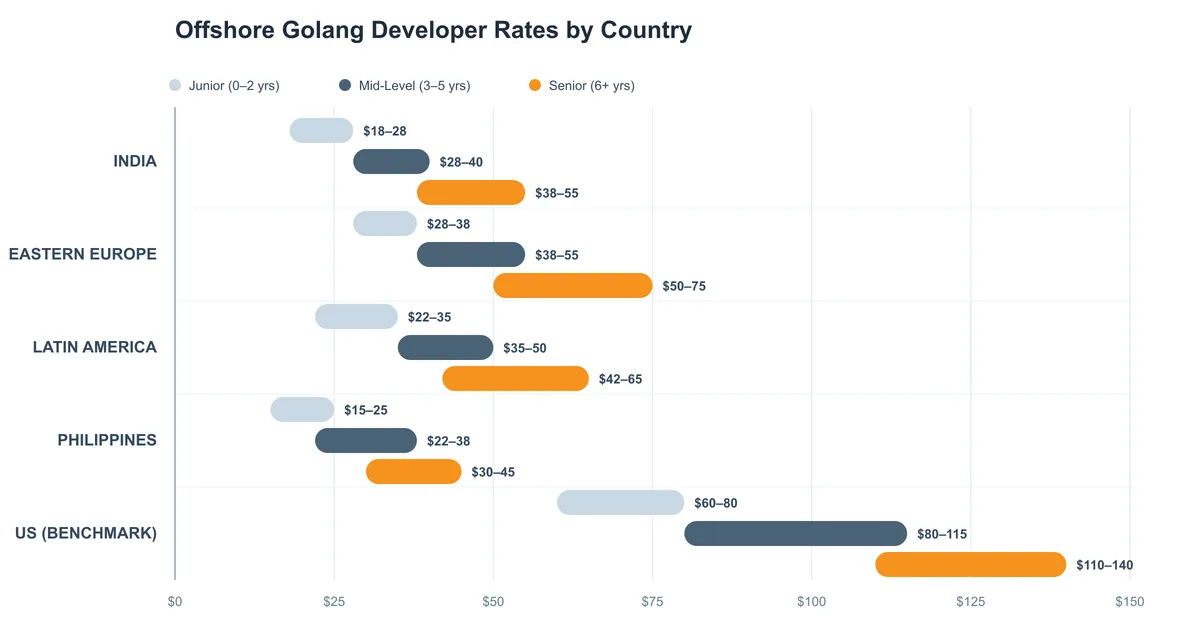
These are working market rates, not best-case quotes. The ranges below reflect what you’d actually negotiate at different seniority levels in each market, based on Golang.cafe’s 2026 global salary data, Lemon.io’s rate tracker, and Kore BPO’s own placement data across active Go engineering searches.
| Country / Region | Junior (0–2 yrs) | Mid-Level (3–5 yrs) | Senior (6+ yrs) | All-In via BPO Partner |
|---|---|---|---|---|
| India | $18–28/hr | $28–40/hr | $38–55/hr | $38,000–$68,000/yr |
| Eastern Europe | $28–38/hr | $38–55/hr | $50–75/hr | $55,000–$90,000/yr |
| Latin America | $22–35/hr | $35–50/hr | $42–65/hr | $42,000–$75,000/yr |
| Philippines | $15–25/hr | $22–38/hr | $30–45/hr | $30,000–$50,000/yr |
| US (benchmark) | $60–80/hr | $80–115/hr | $110–140/hr | $160,000–$290,000/yr |
India
India has the deepest Golang hiring pool of any offshore market. Bangalore, Hyderabad, and Pune carry the largest concentrations of Go engineers, particularly those with Docker, Kubernetes, and gRPC backgrounds. Tier-2 cities (Coimbatore, Indore, Ahmedabad) run 20 to 30% lower than the metro rates and produce comparable senior-level quality once properly vetted.
Glassdoor’s Bangalore data puts local Golang developer compensation at roughly $12,600 USD annually at market rates. What you actually pay through an offshore BPO partner is higher, covering overhead, benefits, management fees, and local compliance. For a senior hire, expect $38,000 to $68,000 per year all-in. One US senior engineer’s salary covers three to four dedicated Indian Go engineers at comparable experience levels.
Best for API development, microservices architecture, SaaS backends, and data pipeline work where async collaboration is workable. Not ideal for teams that need real-time pair programming cadences.
Eastern Europe
Poland, Ukraine, and Romania are the most active Eastern European markets for Go development. Poland carries the highest premium ($50–95/hr for senior profiles) driven by EU compliance positioning and aggressive developer market rates. Ukraine runs closer to $35–55/hr and has historically strong mathematical and systems-engineering backgrounds. K&C’s international Go salary research shows Romania and Hungary filling the mid-tier at $40–60/hr for senior profiles.
The time zone math works for US East Coast teams. Eastern European engineers at 9am-6pm Warsaw or Kyiv time overlap 3 to 5 hours with US Eastern, depending on daylight saving. That’s enough for daily standups and async code review cycles without anyone working late consistently.
Best for fintech systems, compliance-adjacent development, EU-regulated platforms, or teams where GDPR familiarity on the engineering side matters.
Latin America
Latin American Golang rates dropped 7.1% year-over-year in 2025, per Globental’s Go developer salary research. That’s the sharpest regional decline of any market. Supply caught up to demand, and dollar-denominated contracts became more attractive to local developers in Argentina and Colombia, which flooded the placement market with available senior talent.
The nearshore advantage is genuine. Colombia sits at US Eastern-2. Mexico is US Central plus or minus nothing. Teams that need real-time collaboration can run daily standups without the late-night meetings that India-based arrangements often require. If sprint cadence and cross-timezone friction are already breaking your team’s rhythm, Latin America earns the slightly higher cost versus India.
Philippines
Most rate guides ignore the Philippines for Golang, which is a gap worth understanding. English proficiency is the highest of any offshore Go market, and the mid-level supply (3 to 5 years of Go experience) is better than it looks from a distance, particularly among engineers who transitioned from Node.js or Python stacks. Second Talent’s developer rate data puts Philippines international remote rates at $22 to $38 per hour for mid-level Go work.
Senior-level Go supply is thinner than India or Eastern Europe. Sourcing takes longer. For teams that already run support, operations, or QA through the Philippines and want to expand into mid-level backend development, it’s worth the search time.
The Rate Card Isn’t the Real Number
The hourly rate covers the developer’s compensation. It doesn’t cover management overhead, platform fees, equipment, local payroll taxes, or the coordination cost of async collaboration across 9 to 12 time zones. Add those in and the actual all-in cost runs 20 to 40% higher in most models.
Three models dominate offshore Golang hiring, and they have very different true costs.
| Hiring Model | What You Pay | Hidden Costs | Best For |
|---|---|---|---|
| Freelance Platform (Upwork, Toptal) | Quoted rate + 10–20% platform fee to you | No backup if engineer leaves. Full replacement search on you. | Short contracts, 1-off projects |
| Staff Augmentation Agency | Rate + 20–40% agency margin | Your management time. Engineer isn’t culturally embedded. | 3–6 month contracts |
| Dedicated BPO Partner | Fixed all-in monthly fee | Least hidden cost. Management, HR, equipment included. | Ongoing teams of 2+ engineers |
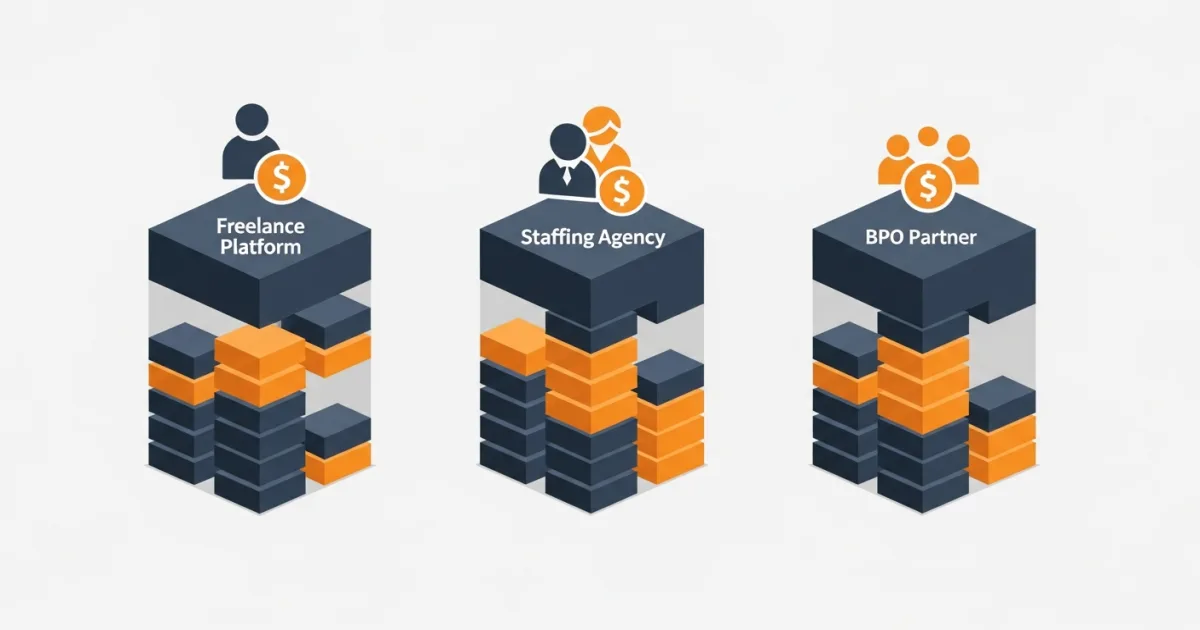
For a 4-person Golang team offshore, the BPO partner model typically runs $15,000 to $20,000 per month all-in versus $28,000 to $40,000 for the same headcount through a staff augmentation agency at comparable rates. Index.dev’s Go developer cost breakdown by region shows this model comparison clearly for backend development teams.
Below 2 engineers, the platform or freelance model is often cheaper because you’re not paying for account management infrastructure you don’t need. At 3 to 5 engineers, the managed model typically wins on per-unit cost. At 6 or more, it’s not a close comparison.
See What Your Golang Team Actually Costs
Run your headcount and target country through the ROI calculator for a real all-in comparison.
Which Country Fits Your Golang Project?
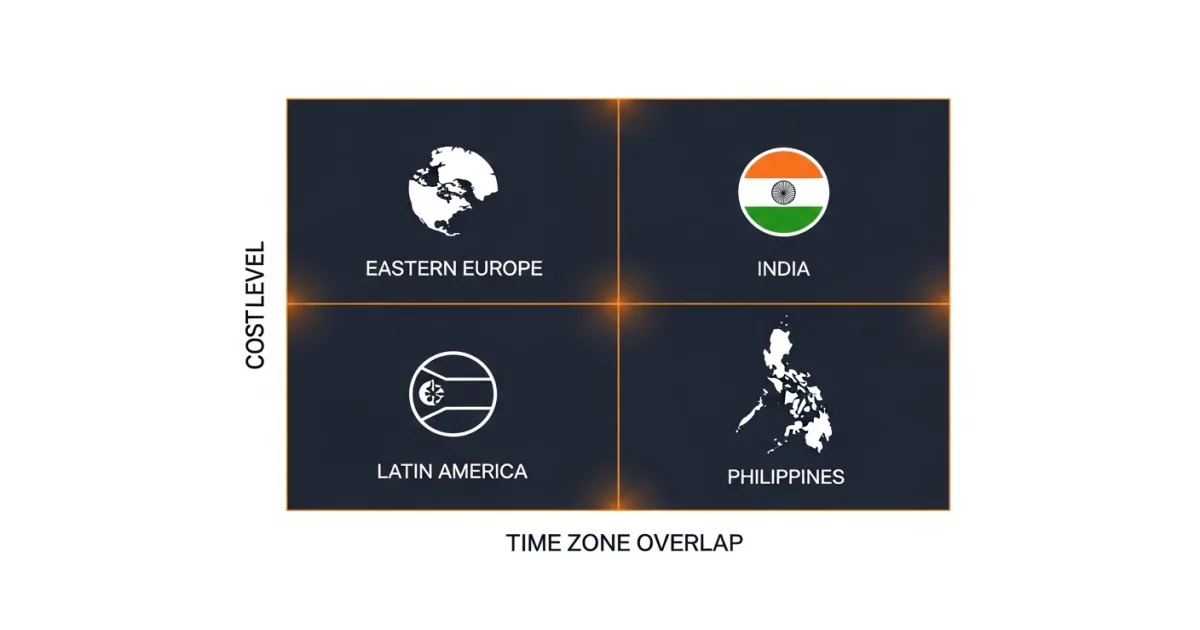
Not every Go use case needs the same offshore profile. Country selection should follow the work requirements, not just the rate card.
| Project Type | Best Country | Why It Fits | Watch Out For |
|---|---|---|---|
| High-volume API, microservices, SaaS backend | India | Deepest Go supply, strong Kubernetes/Docker backgrounds, lowest all-in cost | Async-only collaboration; standups require early AM US time |
| Fintech, EU-regulated, compliance-adjacent | Eastern Europe | GDPR familiarity, 3-5 hr US East overlap, ISO background stronger | Higher rate; Poland premium especially |
| Real-time collaboration, product-embedded dev | Latin America | Same time zone as US, stand-up ready, strong English | Rates rose faster than India pre-2025. Senior Go supply still thinner. |
| English-first team, mid-level Go, Node or Python to Go transition | Philippines | Highest English proficiency offshore, growing mid-level Go supply | Senior-level Go is harder to source; expect longer search timeline |
A few things the table doesn’t capture. Philippines is worth considering if your team already runs operations offshore there and you’re adding development capacity; the cultural integration is smoother than starting cold in a new market. Eastern Europe carries a real advantage for system-design discussions in real-time, not just compliance familiarity. And Latin American rates, while higher than India, look different when you factor in the manager time you save by not running 9pm standups.
What Hiring Model Actually Costs Less?
Short answer: depends on headcount. Below 2 engineers, a staffing platform or freelance arrangement is usually cheaper because you’re not paying for account management structure you don’t need yet. At 3 to 5 engineers, a BPO partner typically becomes more economical on a per-engineer basis. At 6 or more, the managed model wins on total cost by a margin that’s hard to argue with.
The cleaner way to think about it is risk-adjusted cost, not just the rate. Freelance arrangements save money per hour until the engineer leaves or goes unavailable at a critical sprint. That happens more than it should. A BPO partner with a replacement guarantee absorbs that risk. Whether the premium for that guarantee is worth it depends on how much of your product roadmap sits on that single engineer’s availability.
Worth being direct about where we sit in this. Kore BPO is a US-owned offshore hiring partner based in Dallas, TX. We place dedicated Golang engineers and full backend dev teams for US companies, not project outsourcing arrangements. Our model includes pre-screened candidates, 90-day replacement guarantees, and all-in monthly fees covering equipment, local payroll taxes, HR compliance, and account management. It’s a specific model that works well for certain team structures. If you want to see whether the math works for yours, the outsourcing ROI calculator shows the comparison directly.
What to Ask Before You Hire
Six questions worth running through any vendor or platform before you commit to anything.
- What percentage of your Golang placements have 4 or more years of Go-specific experience, not just Go listed on a resume?
- Can I see Go code samples and GitHub activity before the interview stage?
- Ask for average time from placement to first meaningful code contribution, specifically for Go engineers.
- How do you handle replacement if the engineer leaves in the first 90 days?
- Is your all-in quote inclusive of equipment, statutory benefits, local payroll taxes, and account management?
- The engineer-to-account-manager ratio tells you more than most vendors advertise. Get the number.
That last one is underrated. A 1:25 ratio means your account manager is too spread to catch issues early. 1:10 to 1:15 is where most clients report consistently better outcomes. Ask for it directly.
One more thing on vetting Go skill specifically. Resumes and LeetCode scores don’t catch it. What actually shows Go competence is public GitHub activity on Go projects, a take-home that tests goroutines and channel patterns (not generic CRUD), and a system design discussion that includes concurrency constraints. Any vendor or platform that screens only on algorithmic puzzles is not actually vetting Go engineering ability.
The numbers here are clear enough to run your own comparison. A senior Golang engineer in the US costs $180,000 to $230,000 base before fees and overhead. The same profile offshore through a BPO partner runs $38,000 to $75,000 per year all-in, depending on country and seniority. That’s not a rounding difference. That’s a second or third hire at the same budget.
Country matching matters more than most companies account for. India for volume and lowest cost, Eastern Europe for compliance-adjacent and time zone overlap, Latin America for real-time collaboration, Philippines for English-first mid-level teams. Pick the model before you pick the country, because the model changes the true cost more than the rate card does.
If you’re ready to see what a dedicated Golang engineer costs at your specific headcount and target country, tell us what you’re building and we’ll send pre-screened profiles in 2 to 5 business days.
What Golang Hiring Managers Want to Know
So what makes Golang developers harder to find offshore than Python or Node.js engineers?
The talent pool is simply smaller. Go was released in 2009 and didn’t achieve mainstream production adoption until Docker, Kubernetes, and Terraform made it unavoidable for infrastructure work. That gives Go a shorter runway than Python or Java, which means the median Go developer globally has fewer years of real production experience. In India, Python developers outnumber Go developers roughly 8 to 1 in the active hiring pool. Eastern Europe runs closer to 5 to 1. The supply isn’t absent. It’s compressed at the senior end, which is where most US companies need it.
Realistically, how fast can I get an offshore Golang engineer placed and productive?
3 to 5 days for vetted candidates. 2 to 3 weeks to final offer and contract. 30 days to first meaningful code contribution for most senior hires. The ramp is faster than most hiring managers expect, because offshore Go engineers in active placement pipelines are working on Go right now, not transitioning from another language. Where ramp slows down is documentation: if your codebase has no onboarding docs, expect to add 2 to 4 weeks regardless of how good the engineer is.
India vs. Eastern Europe for senior Go work: does the rate gap justify the difference?
The gap narrows at senior level but doesn’t disappear. Senior Indian Go engineers with 6 or more years of distributed systems and gRPC experience are genuinely comparable to Eastern European counterparts. The rate difference (roughly $40–55/hr India versus $55–75/hr Eastern Europe for senior) reflects time zone premium and compliance familiarity more than raw capability. If you’re building a fintech system with EU regulatory requirements, Eastern Europe earns its premium. For a SaaS backend serving US customers on async workflows, the gap is harder to justify.
Is a $30 per hour rate for a Golang developer ever real, or is that always a junior placeholder?
Real, but barely. At $30 per hour, you’re looking at a mid-level engineer in India or a junior-to-mid profile in Latin America or Eastern Europe. Not entry-level syntax-knowledge territory, but not the person architecting your distributed message queue either. If someone quotes you $30 per hour for a senior Go engineer with 6 or more years of distributed systems work, ask for a portfolio and GitHub activity. The math doesn’t hold unless they’re cutting corners on vetting, benefits, or management.
If I use a BPO partner instead of hiring direct, what am I actually paying for?
More than the engineer’s time. The monthly fee typically includes the engineer’s salary, local payroll taxes, statutory benefits, equipment (laptop, monitor, peripherals), office space or work-from-home allowance, HR compliance in the local jurisdiction, account management from a dedicated contact, and a replacement guarantee if the engineer leaves. When you price those items individually against the BPO fee, the managed model usually runs 15 to 25% lower than building the same stack yourself through direct hiring and a local employer-of-record service.
How do I verify a Go developer’s actual skill level before I commit?
Three things matter. First, public GitHub activity on Go projects specifically, not just general coding repos. Look at commit frequency, code structure, and whether the patterns match what you’d expect from someone at their stated level. Second, a take-home assessment that tests Go-specific patterns: goroutines, channels, context handling, proper error propagation. Not generic CRUD endpoints. Third, a system design discussion with a concurrency constraint built in. Any vendor or platform that screens only on LeetCode or algorithmic puzzles is not actually vetting Go engineering ability. Ask what their Go-specific vetting process looks like before you engage.
Related Articles



See What a Dedicated Golang Engineer Costs Your Team
Kore BPO places pre-screened offshore Go engineers for US companies. Tell us your stack and we’ll send vetted profiles in 2 to 5 business days.
Contact Us