Why US Tech Companies Are Now Outsourcing Go (Golang) Development in 2026


Last updated: July 2, 2026
Golang runs the internet’s backend. Docker, Kubernetes, Terraform, Prometheus — all written in Go. Cloudflare’s CDN, Uber’s dispatch system, Google’s internal tooling. The language was built for exactly what modern cloud infrastructure demands: fast, concurrent, lightweight processes at scale.
And yet, if you’ve tried hiring a Go backend engineer in the US recently, you know the market moves slowly. The offshore roles we staff at Kore BPO tell the same story consistently: companies arrive after spending three to five months searching locally, watching an open role collect dust while product timelines slip.
That gap between demand and local supply is driving a shift. More US tech companies are building offshore Go teams in India, Eastern Europe, and Latin America. Not purely to cut costs, though the savings are real. The shortage is the real driver.
This post explains why the local Go talent pool works the way it does, what offshore Go development costs by region, and how to decide whether the model fits your team.
What Makes Go the Language Everyone Wants but Can’t Find?
Go is genuinely a small community. The JetBrains 2025 Developer Ecosystem Report puts the number of professional developers using Go as their primary language at 2.2 million worldwide. That sounds large until you compare it to Python’s 51 million or JavaScript’s 70 million.
The language attracts a specific type of engineer — typically someone coming from systems programming who values performance and simplicity over ecosystem breadth. Go developers are opinionated. They chose the language because they care about concurrency patterns, clean type systems, and compile-time errors over runtime surprises. That self-selection produces strong engineers but a small talent pool.
Meanwhile, demand keeps climbing. Go job postings grew +41% in 2025 — faster than Python, faster than Java. Docker repositories using Go-based tooling grew 120% year-over-year. According to Cloudflare Radar’s 2024 Year in Review, Go now accounts for 12% of all API calls on the internet, up from 8.4% the previous year.
Small pool. Fast-growing demand. The arithmetic on local hiring gets uncomfortable quickly.
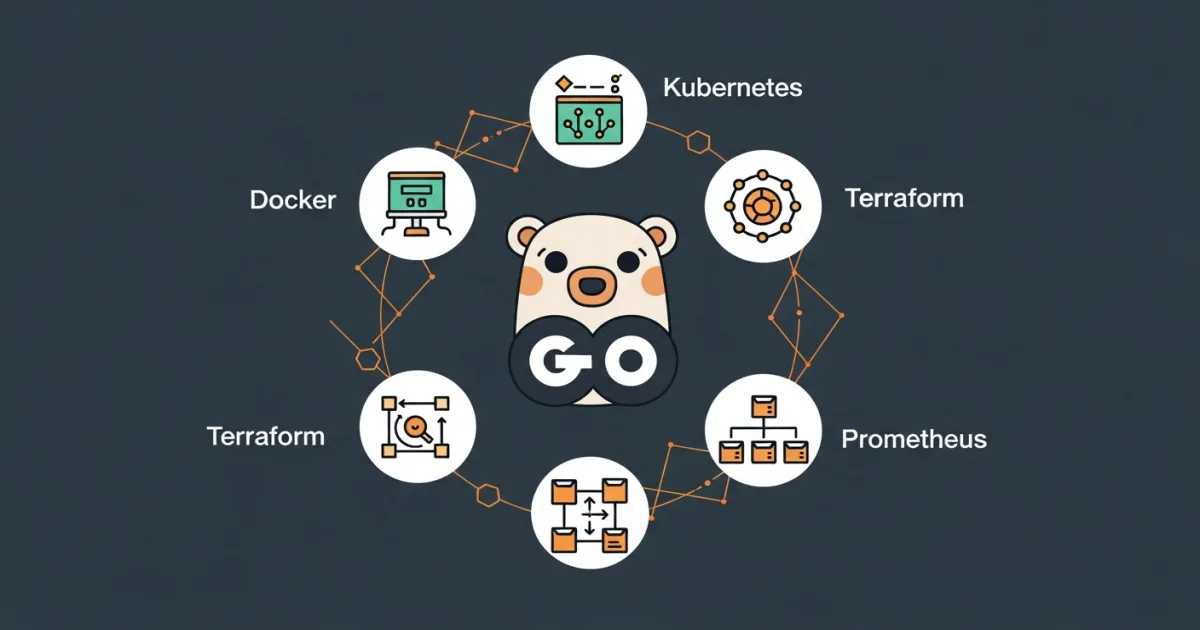
Go’s dominance in cloud-native infrastructure isn’t a trend that’s peaking. Kubernetes, Docker, Terraform, Prometheus, and Grafana — the whole DevOps toolchain most engineering teams now run daily — were built in Go. If your team ships on cloud infrastructure in 2026, you’re already running Go code whether you know it or not. The engineers who can build and maintain that layer are in short supply domestically.
Why Is Hiring Go Developers in the US So Expensive?
Supply and demand, made worse by who absorbs most of the supply.
The average US Golang developer salary hit $172,000 per year in 2026, with senior engineers in San Francisco or New York frequently clearing $200,000 to $230,000 in total compensation. Those numbers reflect where most Go talent ends up.
Google invented Go. Google, Cloudflare, Uber, Amazon, and the other hyperscalers actively recruit Go engineers with compensation packages that most SaaS companies and growth-stage startups can’t match. By the time the available Go talent filters down to mid-market companies, it’s thin. The Gophers Slack workspace and GopherCon alumni networks are the richest sources of passive Go candidates — engineers who genuinely care about the language — but they’re not actively searching. They’re already employed, usually well.
Average time to hire a Go backend engineer runs 90 to 120 days for US companies. That’s not recruiter failure. It’s a numbers problem.
Beyond salary, consider the full carrying cost of a US Go hire: employer taxes, benefits, PTO, equity, and recruiter fees typically push the real cost to 1.5 to 1.85 times the base. A $172,000 base engineer costs somewhere between $258,000 and $318,000 per year all-in.
That’s the problem offshore Go development solves for most teams. Not “we want to cut corners.” More often: “we can’t close this role locally and we’ve been trying for four months.”
What Does Offshore Go Development Actually Cost?
Rates vary by region. What follows is based on current market data for mid-to-senior engineers who have shipped production Go systems — not junior developers or generalists who added Go to a resume after a weekend tutorial.
| Region | Mid-Level ($/hr) | Senior ($/hr) | Annual Equivalent | US Time-Zone Overlap |
|---|---|---|---|---|
| India | $25–$40 | $40–$60 | $52K–$125K | 10–12 hrs behind EST |
| Eastern Europe | $40–$55 | $55–$75 | $83K–$156K | 6–8 hrs ahead EST |
| Latin America | $30–$45 | $50–$70 | $62K–$146K | 0–3 hrs from EST |
| Philippines | $25–$40 | $40–$60 | $52K–$125K | 12–13 hrs ahead EST |
| US (benchmark) | $75–$100 | $90–$130 | $156K–$270K | Same |
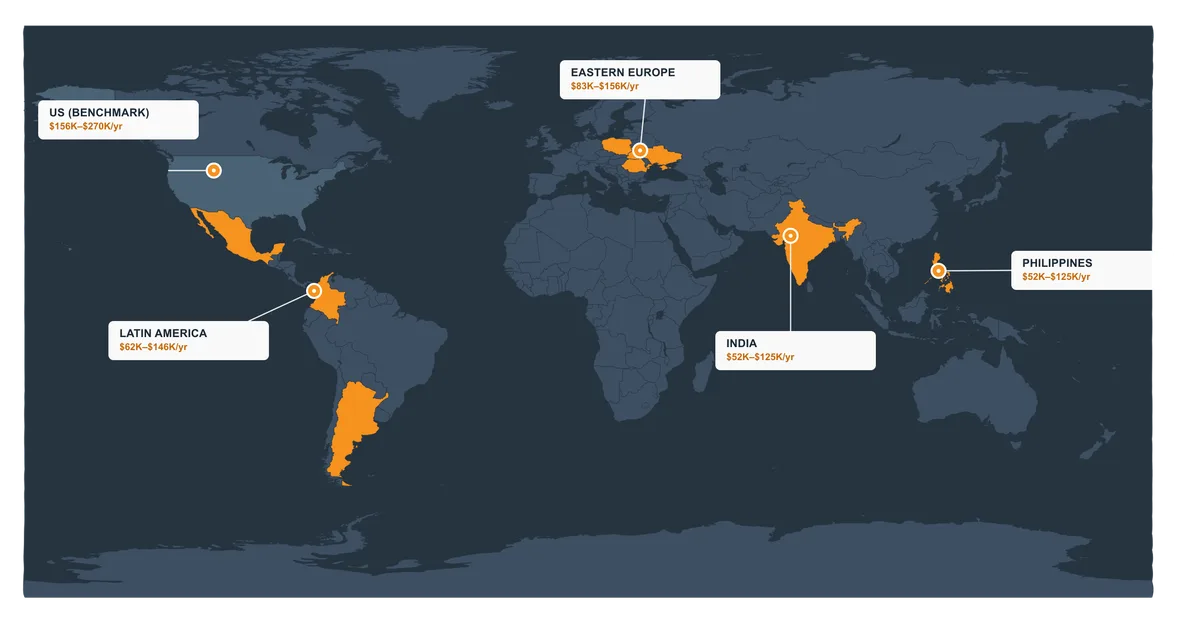
A few things worth noting. Eastern Europe (Poland, Romania, Ukraine) offers the best time-zone overlap for US East Coast teams — you can run morning standups with real-time participation. India offers the largest Go talent pool by volume, which matters when you’re staffing three or four engineers rather than one. Latin America (Brazil, Argentina, Colombia) sits in the sweet spot for West Coast companies needing afternoon overlap.
The savings are real. A 3-person Go team in Eastern Europe at $55 per hour each runs roughly the same annual cost as a single senior US Go engineer at $175,000. That changes what you can build.
For a full breakdown on in-house versus offshore engineering economics, the offshore cost comparison guide covers the full model with worked dollar examples.
Need Go Engineers Fast?
Kore BPO staffs vetted offshore Go developers for US tech teams. Resumes in 2 to 5 days, $0 until you hire.
What Are US Companies Actually Using Go For?
Not everything. That’s important context before building a Go team.
Go is purpose-built for a specific set of problems: high-throughput APIs, concurrent microservices, infrastructure tooling, real-time data pipelines, and anything that needs to perform predictably under load. It’s not the right choice for rapid prototyping, frontend work, data science, or general-purpose scripting. Python and JavaScript own those territories for good reasons.
The use cases where offshore Go engineers consistently deliver strong results include:
- Backend microservices handling tens of thousands of concurrent requests without Node.js overhead or Java threading complexity
- Internal developer tooling and CLI applications where Go’s single-binary compilation makes distribution straightforward
- DevOps and infrastructure automation — if your team manages Kubernetes clusters or writes Terraform providers, Go is the natural fit
- Real-time data processing pipelines where latency matters more than lines-of-code productivity
- API gateway and proxy layers where raw throughput is the constraint
Companies like Uber, Twitch, Dropbox, and SendGrid rebuilt performance-critical services in Go specifically because nothing else handled their concurrency requirements at scale. That pattern repeats across the industry.
If your stack includes Kubernetes-based infrastructure, cloud-native microservices, or high-volume API surfaces, Go specialists fit naturally. If you’re building a React-driven SaaS with a standard thin API layer, Go is probably overkill — and any honest Go engineer will tell you exactly that.
Should You Outsource Your Go Development?
Bias disclosed first: Kore BPO benefits when you hire offshore Go developers. That said, here is when the model actually makes sense — and when it doesn’t.
When offshore Go development works: You have a well-scoped backend problem, at least one senior engineer internally who can vet Go code quality, and you’re stuck on one of two conditions: the role has been open locally for 60 days or more, or the US compensation range is outside budget.
When it doesn’t work: If you’re making foundational architecture decisions in Go for the first time, an offshore team is the wrong starting point. Architecture decisions around concurrency models, error handling patterns, and service boundaries benefit from tight feedback loops. Build the foundation locally. Once the patterns are established and documented, offshore teams can build within them reliably.
Security-critical Go code also warrants extra scrutiny regardless of where the engineer sits. That’s not an offshore critique — it’s a process requirement for any engineer writing authentication, encryption, or access control logic.
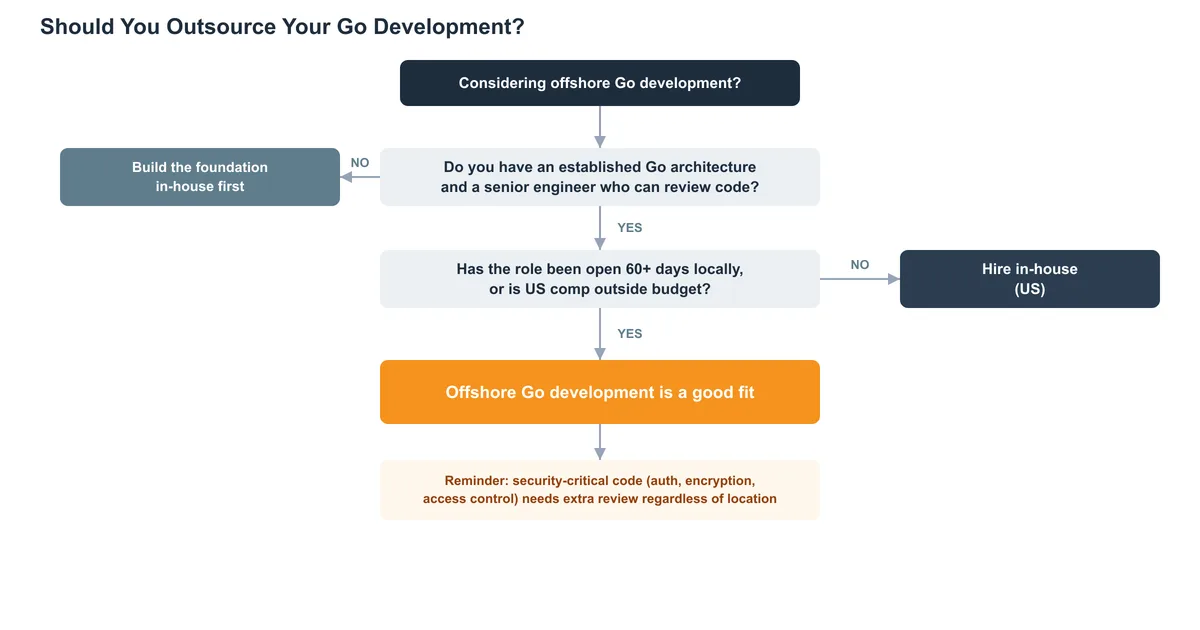
Practical decision framework:
| Condition | Offshore Go Makes Sense? |
|---|---|
| Role open 60+ days locally with no close | Yes |
| US compensation range out of budget | Yes |
| Well-defined, documented scope exists | Yes |
| Architecture not yet established | No — establish first |
| First Go project, no internal Go expertise | No — hire locally first |
| Security-critical code only, no internal reviewer | No — add internal oversight |
Most companies land somewhere in the middle. The practical answer is usually a hybrid: offshore engineers handling the implementation layer, with at least one internal Go developer or technical lead reviewing architecture and code quality. That structure captures most of the cost benefit while keeping quality control where it matters.
What to Look for When Vetting an Offshore Go Team
Go has a culture problem — in the best possible sense. The community is opinionated about idiomatic code. An engineer who learned Go as a second language while primarily working in JavaScript or Python often writes Go that looks like JavaScript or Python with different syntax. That’s a real problem in production.
Real Go practitioners can explain why they’d use goroutines and channels for a specific concurrency problem versus a worker pool. They have opinions about context propagation. They know the standard library well enough to reach for it before adding a third-party dependency. Ask for GitHub profiles — Go production experience shows clearly in commit history. Look for actual PRs to Go projects, not just repositories with Go files.
Concrete interview signals worth testing:
- Can they walk through a production Go system they built and describe a real concurrency challenge they had to debug?
- Do they know
sync.WaitGroup,context.WithCancel, andselectwell enough to use them without looking them up? - Have they contributed to or read the source of a major Go project? (Kubernetes, Docker, Prometheus, and similar)
- What’s their take on error handling patterns in Go — and do they have an actual opinion, not a textbook answer?
A 45-minute technical screen is enough to separate genuine Go practitioners from engineers who picked up the language recently. The gap in production code quality is significant, and it shows up fast.
Golang’s hiring market in the US isn’t getting easier. The talent pool grows slower than demand, hyperscalers absorb most of the senior engineers, and the cost of a single US Go hire now approaches the annual cost of a three-person offshore team.
That math isn’t reversing. More US companies are moving toward a hybrid structure: one or two senior Go engineers internally who own architecture and code quality, with offshore teams building the implementation layer at a fraction of domestic cost.
If you’re currently stuck on an open Go role — or know one is coming — explore the offshore Go roles Kore BPO staffs for US tech companies. Pre-screened engineers, resumes in 2 to 5 days, and $0 until you hire.
Common Questions About Outsourcing Go Development
How long does it actually take to hire an offshore Go developer?
2 to 4 weeks for the full process from search to start date, if you’re working with a staffing partner who maintains a pre-vetted Go pool. That’s not a promise — it’s the realistic range when the pipeline exists. For context, most US companies spend 90 to 120 days filling a Go role domestically, assuming they fill it at all. The timeline compresses offshore because the available candidate base is larger and engineers are actively reachable, not passively buried in GopherCon alumni lists.
Offshore Go developer vs. freelancer vs. agency — does the distinction actually matter?
Different tools for different problems. A freelancer takes on project work for a fixed scope and timeline. An offshore agency takes over a function — they own it, their team runs it. A dedicated offshore developer through a staffing model sits between: a full-time engineer who integrates with your team, reports to your technical lead, and accumulates context about your system over time. For Go backends that evolve continuously, the dedicated model outperforms agency or freelancer relationships because the engineer isn’t starting from zero on every engagement.
What’s a realistic rate for a senior offshore Go developer?
$40 to $75 per hour, depending on region and genuine seniority. India runs lower ($40 to $55 for true seniors with production Go experience), Eastern Europe higher ($55 to $75). Anything under $35 per hour for a claimed “senior” Go developer deserves extra scrutiny in the technical screen. The market for engineers who have actually shipped production Go systems is not that cheap, even offshore. Full rate breakdowns by region at Index.dev’s Go developer rate guide.
Can an offshore Go team handle architecture decisions, or just implementation work?
Wrong question, slightly. Architecture and implementation aren’t cleanly separable — implementation decisions surface architecture problems constantly. A senior offshore Go engineer with real production experience absolutely should participate in architecture discussions. The issue isn’t geography. It’s seniority and communication structure. If your offshore Go lead has no channel to flag design concerns, you’ll get a codebase that follows specifications precisely and quietly accumulates technical debt. Build the feedback loops into the engagement structure, and location matters considerably less than you’d expect.
Go vs. Node.js for our backend — should we even be building in Go?
Depends entirely on the problem. Node.js wins on developer speed, ecosystem depth, and hiring volume. Go wins on raw throughput, predictable memory behavior, and concurrent performance under load. Processing 10,000+ requests per second where p99 latency matters to customers? Go is probably the right call. Building a standard SaaS API with moderate traffic and a two-person backend team? Node.js or Python gets you to market faster with a much larger local hiring pool to draw from. The Go choice should come from your scale requirements — not engineering preferences. Any honest Go engineer will tell you the same.
Related Articles



Can’t Close Your Go Role Locally?
Kore BPO places vetted offshore Go developers for US tech companies. Pre-screened resumes in 2 to 5 days.
Explore Offshore Roles