How to Choose an India Staffing Agency


Generally, choose an India staffing agency by verifying its compliance track record under India’s new Labour Codes, getting fee structures in writing before signing, confirming real industry experience in your role type, and checking references directly, not just reviews.
A bad India staffing agency choice isn’t just a weak hire. It’s compliance exposure landing on you, which is why an offshore staffing agency is worth vetting properly before signing anything. For example, we’ve watched US founders sign with the first agency that answered their email, then spend six months untangling a contract that never spelled out who owed what to the Indian government. That’s the expensive version of this mistake. By contrast, the cheap version is asking the right five or six questions before you wire a deposit.
What This Guide Covers
This guide covers what actually separates a legitimate India staffing partner from one that will leave you exposed, what a fair fee structure looks like in 2026, and what changed when India’s new Labour Codes took effect on November 21, 2025. Whether it’s your first developer in Hyderabad or your fifth analyst in Bangalore, the checklist stays the same.
What Makes an India Staffing Agency Legitimate?
A legitimate India staffing agency has verifiable business registration, a real GST number, statutory compliance documentation for EPF and ESI, and current clients willing to talk to you. Otherwise, anything less is a risk you’re taking on blind.
Legitimacy in Indian staffing isn’t a vibe. Instead, it’s a document trail: registration under the Shops and Establishments Act (or the Companies Act, depending on structure), an active GST registration you can verify on the government portal, and proof they’ve actually filed EPF and ESI contributions for existing employees. Generally, agencies that dodge these requests, or get vague when you push, are telling you something.
Here’s the part most buyers skip. A polished website and a fast reply time say nothing about whether an agency actually pays statutory dues on time. Indeed, we’ve seen agencies with gorgeous case study pages that were three months behind on EPF filings for their own staff. That gap doesn’t show up until an audit, and by then it’s your company’s name attached to the contract, not just theirs. So, ask for a sample compliance report from an existing account (names redacted is fine). If they can’t produce one in a day or two, that’s your answer. Overall, three red flags show up more than any others in India staffing: upfront candidate fees, no physical registered address you can verify, and refusal to connect you with a current client for even a 15-minute call.
Documents and Proof to Ask For
- Certificate of registration under the applicable state Shops and Establishments Act
- Current GST registration certificate, verifiable on the government GST portal
- A sample compliance report showing recent EPF contribution filings and ESI coverage for their existing workforce
- A written placement agreement that spells out fee timing, refill terms, and who holds statutory liability
- References from at least two current clients, not testimonials pulled from a website
Why the November 2025 Labour Codes Change What You Should Ask
India’s four Labour Codes took effect nationwide on November 21, 2025, replacing 29 older labor laws with a single compliance framework. Consequently, every India staffing agency should be able to explain, without hesitation, how they’ve adjusted their contracts and onboarding process to match it.
Specifically, the four codes (Wages, Industrial Relations, Occupational Safety Health and Working Conditions, and Social Security) consolidated decades of overlapping and sometimes contradictory state and central rules. According to EY’s November 2025 alert, the changes touch wage definitions, appointment letter requirements, and how gig and platform workers get covered under social security for the first time.

Why This Affects Your Contract, Not Just Background Reading
Here’s why this matters for you specifically, not just as background reading. Previously, a staffing agency could technically operate without issuing formal appointment letters to every hire. Now, that’s no longer allowed. In fact, KPMG’s flash alert on the rollout flags mandatory written appointment letters as one of the most immediately enforceable changes, along with updated occupational safety and health provisions under the new OSH Code. In short, an agency still running pre-November playbooks is behind, and that’s worth knowing before you sign.
| Area | Before November 2025 | After November 2025 |
|---|---|---|
| Governing framework | 29 separate central and state labor laws | 4 consolidated Labour Codes |
| Appointment letters | Not universally mandatory | Mandatory for all employees, including contract staff |
| Gig and platform workers | Largely excluded from social security | Brought under social security coverage for the first time |
| Workplace safety rules | Fragmented across sector-specific acts | Unified under the OSH Code with expanded coverage |
| Wage definition | Varied by state and industry | Standardized definition across all four codes |
BDO’s summary of the notification puts it plainly. Presently, the transition period is over, and enforcement is the current phase, not the pilot phase. So, when you’re vetting an agency, ask a specific question. Specifically, how did your appointment letter template change after November 21? A confident, specific answer is a good sign, while a shrug is not.
What Should an India Staffing Agency Actually Cost?
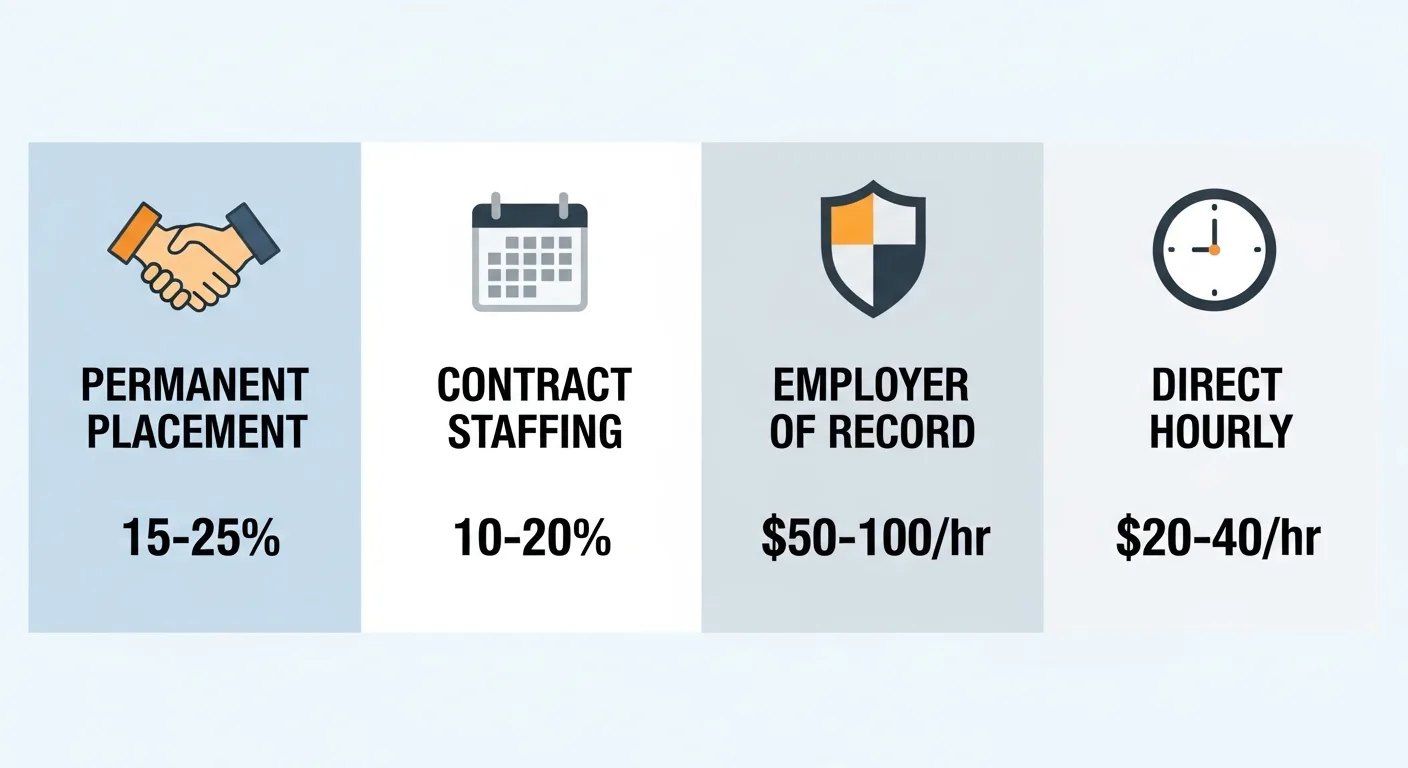
Generally, India staffing costs vary by model. Permanent placement runs 8.33% to 20% of annual CTC, while contract staffing carries a 15% to 35% markup over base pay. Meanwhile, Employer of Record services start around $99 per employee per month plus statutory costs. Still, none of these numbers mean much without a written breakdown showing exactly when each fee is earned.
In reality, the spread exists because these are genuinely different services, not just different pricing tiers of the same thing. Permanent placement is a one-time success fee tied to a hire accepting and starting. By comparison, contract staffing is an ongoing markup baked into every invoice for as long as the person works through the agency. Meanwhile, EOR is a flat monthly service fee that covers the legal employment layer, on top of statutory contributions that run roughly 13% to 18% of gross salary regardless of which model you pick.
Developer Rate Ranges by Seniority
Additionally, developer rates add another layer. Juniors typically run $15 to $30 an hour, while mid-level engineers land in the $30 to $60 range. Meanwhile, senior and specialized talent, think staff engineers or niche AI roles, can run $60 to $110 an hour. Generally, Bangalore and Hyderabad rates trend higher than tier-two cities like Pune or Coimbatore for equivalent experience.
| Model | Typical Fee Structure | Best For |
|---|---|---|
| Permanent placement | 8.33% to 20% of annual CTC, paid once on start | Long-term roles you’ll manage directly |
| Contract staffing | 15% to 35% markup over base pay, billed monthly | Project-based or flexible headcount |
| Employer of Record | $99+ per employee per month, plus 13% to 18% statutory | Fast market entry with no local entity |
| Direct hourly (developers) | $15 to $110 per hour by seniority level | Specific technical skill gaps |
Where Fee Disputes Actually Start
In effect, fee timing is where most disputes start, not the fee amount itself. Two questions catch nearly every problem before it happens. First, when exactly is the placement fee earned, on offer acceptance or on the candidate’s actual start date? Second, what’s the refill policy if the hire leaves in the first 90 days, do you get a free replacement search or does the meter start again? Ultimately, vague answers to either question are how companies end up paying twice for one role. For more detail, what a fair pricing structure looks like breaks the industry benchmarks down further.
How to Vet Compliance Before You Sign
In essence, compliance vetting for an India staffing agency comes down to three statutory programs, EPF, ESI, and gratuity. So, confirm the agency contributes correctly to all three for its existing workforce before you assume they’ll do it right for yours.
The Three Statutory Programs to Confirm
To begin with, EPF requires a 12% employer contribution on covered wages, split between 8.33% to the Employee Pension Scheme and 3.67% to the core EPF corpus, per EPFO’s published contribution rate schedule. Meanwhile, ESI applies to workers earning gross wages under ₹21,000 per month at establishments with 10 or more employees, and it’s a program a lot of US buyers have never heard of until it’s their liability. Especially relevant, full eligibility rules are on the ESIC coverage page. Finally, gratuity kicks in after five years of continuous service under the Payment of Gratuity Act, 1972, and it applies to any organization with 10 or more employees, staffing agency included.
Altogether, none of that is optional, and none of it is negotiable in a contract. However, what’s negotiable is who’s on the hook if it’s missed. In particular, some agencies bury liability language deep in the master service agreement, quietly shifting exposure back to the client company. So, ask directly. If your agency misses an EPF filing, whose name is on the penalty? Get the answer in writing, not over a call. For instance, a client of ours once inherited exactly this problem after a previous agency let ESI lapse for four months, and the invoice that followed wasn’t small.
See Kore BPO’s India Staffing Model
Vetted India talent with sourcing, screening, and compliance handled end to end.
Staffing Agency vs EOR vs Direct Offshore Hiring, Which Fits You?
Basically, these three models solve different problems, and picking the wrong one is more common than picking a bad agency within the right one. For one thing, a staffing agency sources and often employs the worker on your behalf, handling the day-to-day compliance layer while you manage the work itself. Alternatively, an Employer of Record legally employs the worker in India so you don’t need a local entity at all, useful for testing the market before committing to a full office or subsidiary. Finally, direct offshore hiring means you set up your own Indian entity and employ people outright, which only makes sense once headcount is large enough to absorb the overhead.
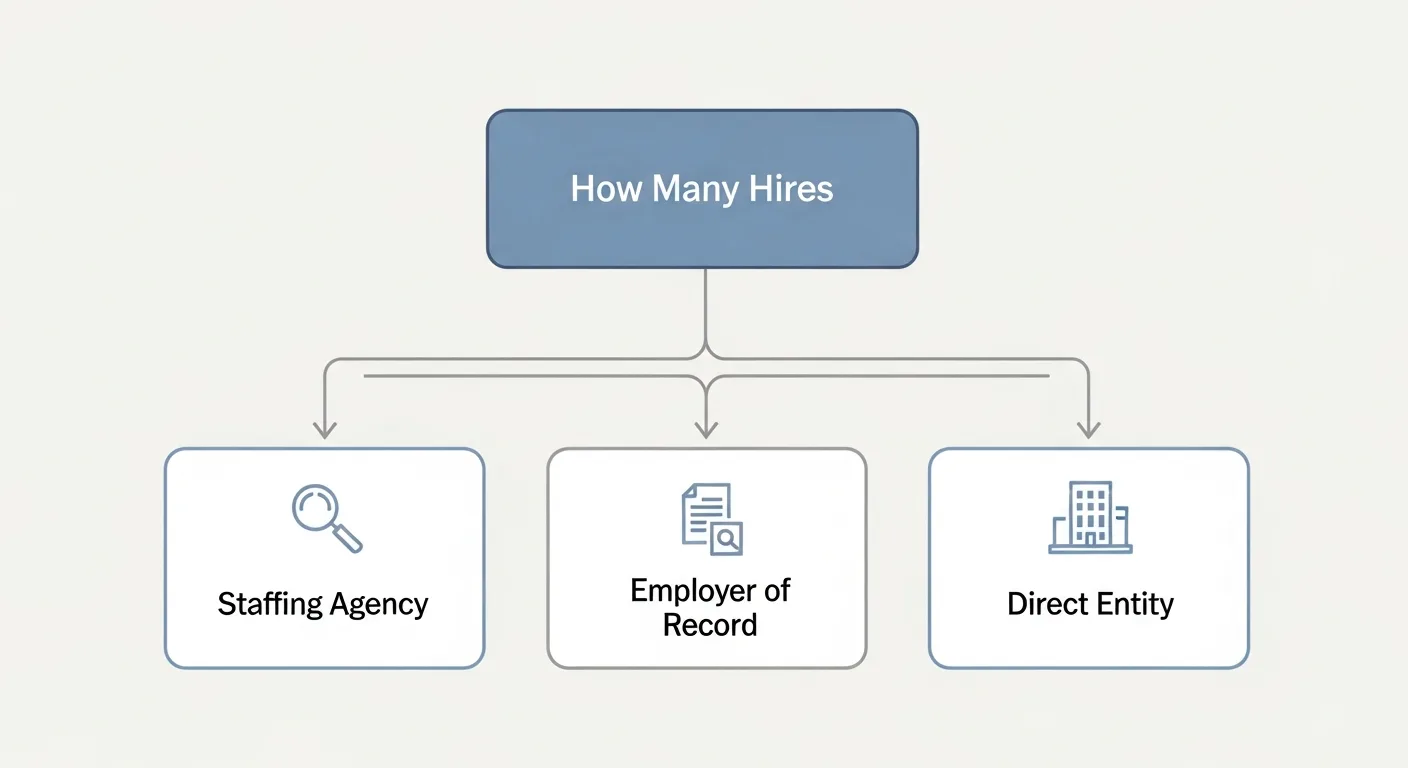
In general, cost curves cross at different headcounts for each option. Generally, under five hires, a staffing agency or EOR model almost always beats setting up an entity. Somewhere past 20 to 30 employees, however, the math starts favoring a direct entity, assuming you have the internal HR bandwidth to run Indian payroll and compliance yourself. Even so, most companies never get there and shouldn’t try to. For a deeper look at how offshore staffing compares to traditional staffing agencies, the tradeoffs go beyond just cost.
Where India Isn’t the Right Fit
To that end, one honest note here, because we’d rather say it than have you find out the hard way. However, India isn’t the right offshore fit for every company. Specifically, if your team needs heavy real-time overlap during US business hours, India’s time difference (9.5 to 13.5 hours depending on your coast) makes daily standups genuinely hard, in a way nearshore options in Latin America simply don’t have to deal with. Similarly, communication ramp-up takes longer too, not because of skill, but because of the sheer distance between time zones. So, if your workflow depends on same-hour back and forth all day, be honest with yourself about that before you commit to an India-based team.
6 Red Flags That Mean Walk Away
Some red flags are obvious, while others hide in language that sounds professional on a first read. Here, then, are the six that show up most often when an India staffing engagement goes wrong.
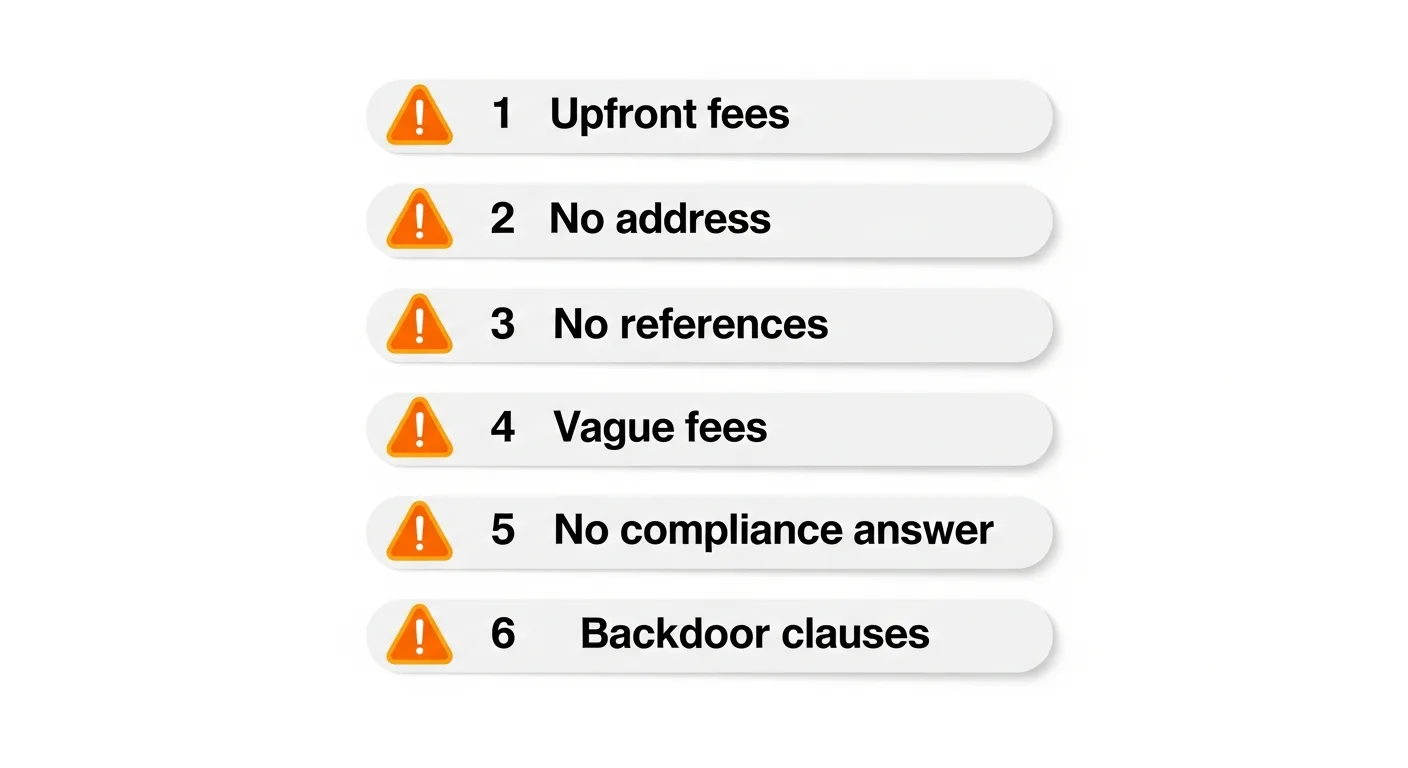
Indeed, any one of these alone might have an innocent explanation, but two or more together, walk away. Ultimately, that’s not caution for caution’s sake, it’s just pattern recognition from watching how these engagements actually fail.
How to Run Your Own Vetting Process, Step by Step
You don’t need a procurement department to vet an India staffing agency properly. Instead, you need about a week and a short checklist you actually follow instead of skimming. Overall, the process breaks down into five concrete steps.
- Request the full document set, registration certificate, GST certificate, and a sample compliance report, before any commercial discussion starts.
- Ask the compliance questions directly, EPF and ESI filing cadence, gratuity liability, and how their contracts changed after the November 2025 Labour Codes.
- Additionally, get the entire fee structure in writing, including refill terms and the exact moment a placement fee is considered earned.
- Call two references yourself, not email. A 15-minute phone call surfaces things a written testimonial never will.
- Start with a small trial placement, one role, before committing to a larger volume agreement, since it’s the cheapest insurance you’ll buy this quarter.
Five steps, and none of them take a specialist to run. Additionally, the same vetting logic applies to any offshore hire, not just one based in India, so it’s worth building this checklist once and reusing it every time headcount comes up.
Getting This Right the First Time
Above all, legitimacy proof beats a polished pitch deck every time, and that’s the single takeaway worth remembering here. The 2025 Labour Codes changed what “compliant” actually means in India, so an agency running on old assumptions is a liability whether they realize it or not. Meanwhile, fee-timing ambiguity is where most buyers get burned financially, and it’s also the easiest thing to fix, just get it in writing before you sign anything.
In fact, none of this requires becoming an India employment law expert. Rather, it requires asking five or six specific questions and walking away when the answers are vague. If you’d rather skip the trial and error, talk to our Hyderabad-based team about what a properly vetted engagement looks like.
Common Questions About Choosing an India Staffing Agency
Process and Cost
How long does it take an India staffing agency to send candidates?
Generally, 2 to 4 weeks for most standard roles, faster for common tech stacks and slower for niche or senior specializations. An agency promising a shortlist in 48 hours for a specialized role is usually pulling from a thin bench, not a deep one.
Is it legal to hire through a staffing agency in India without a local entity?
Absolutely, and that’s actually the main reason staffing agencies and EOR providers exist in the first place. Specifically, they let you employ people in India without setting up your own registered entity there, since the agency or EOR provider carries the local employer-of-record responsibilities on your behalf.
What’s the difference between a staffing agency and an Employer of Record in India?
A staffing agency typically sources and places talent, sometimes employing them directly, sometimes not, depending on the arrangement. By contrast, an EOR is specifically the legal employer of record for tax, payroll, and statutory compliance purposes. Some providers do both under one roof, so ask which one you’re actually signing up for, because the contracts read differently.
How much does an India staffing agency typically charge?
Typically, 8.33% to 20% of annual CTC for permanent placement, or 15% to 35% markup for contract staffing. Both ranges swing based on role seniority, urgency, and how niche the skill set is.
Compliance and Liability
What changed with India’s Labour Codes in late 2025?
India replaced 29 separate labor laws with four consolidated Labour Codes on November 21, 2025, covering wages, industrial relations, workplace safety, and social security. Practically, the changes that matter most to buyers are mandatory written appointment letters and expanded social security coverage for gig and contract workers.
Can a US company be held liable if its India staffing agency misses a compliance requirement?
Generally, it depends heavily on how the contract is written. Some agreements shift statutory liability entirely onto the staffing agency, while others leave gaps that quietly expose the client company, and those gaps rarely get noticed until something goes wrong. Therefore, get a lawyer familiar with Indian employment law to review the liability clause, not just the fee schedule.
Related Articles



Ready to Hire in India the Right Way?
Kore BPO handles sourcing, vetting, and compliance for India hires, so you’re not gambling on any of the checks in this guide.
See Our Offshore Staffing Model