React Native Developer Cost by Country: 2026 Rate Comparison for US Companies


Most US companies go into their first offshore React Native search with a rough number in mind. Something from a quick Google search, or something a colleague mentioned. $40 an hour. Maybe $50. Then the proposals start arriving and the numbers don’t match the mental model.
The confusion is understandable. React Native talent pools differ significantly by country, not just in price but in depth, English quality, timezone overlap, and what experience level those price points actually represent. The headline rate from India looks very different once you understand what seniority it buys. And the Colombia number looks different once you run the timezone math for a team in Texas or New York.
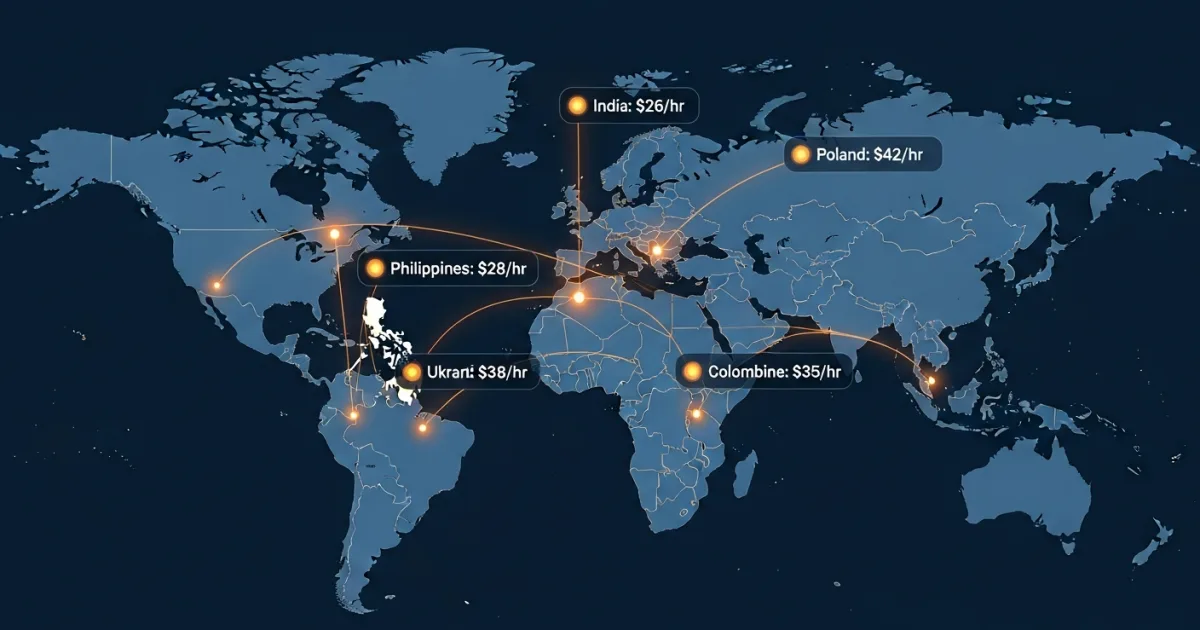
This post breaks down real React Native developer rates for five countries in 2026: India, the Philippines, Colombia, Ukraine, and Poland. We’ll look at what those rates actually include, where the pools are strongest, and how to pick a country that fits your specific situation. If you want to see all the offshore development roles Kore BPO places across tech stacks, the full directory is there.
Before we get into the country breakdown: if you want a general view of offshore developer rates across all languages and stacks, the offshore developer cost guide covers that ground. What follows here is specific to React Native.
What Does a React Native Developer Actually Cost in 2026?
Offshore React Native developers run $18-65/hr depending on country, experience level, and how you engage them. That’s a wide range, and the country makes up most of the difference. Seniority fills in the rest.
The breakdown below shows where each country’s rates cluster by experience tier. These aren’t agency quotes or rates from freelance platforms with high markups. They’re what you pay a dedicated offshore developer through a staffing arrangement, which is the model most US SMBs use when building a consistent team.
| Country | Junior (0-2 yrs) | Mid-Level (3-5 yrs) | Senior (5+ yrs) | Annual Mid-Level Est. |
|---|---|---|---|---|
| India | $18-24/hr | $25-35/hr | $36-50/hr | $30,000-$44,000 |
| Philippines | $20-28/hr | $28-38/hr | $38-50/hr | $33,000-$48,000 |
| Colombia | $25-35/hr | $35-50/hr | $48-60/hr | $42,000-$60,000 |
| Ukraine | $25-35/hr | $35-52/hr | $48-65/hr | $42,000-$62,000 |
| Poland | $35-45/hr | $45-60/hr | $55-70/hr | $50,000-$72,000 |
| US (baseline) | $60-75/hr | $85-110/hr | $115-150/hr | $100,000-$145,000 |
A few caveats worth saying out loud. These are ranges, not guarantees. A React Native developer quoting $28/hr from Manila might have three years of quality production experience. One quoting $45/hr might have the same. Rates signal the market, not the candidate. Vetting is the part that closes that gap.
React Native Developer Rates by Country (2026 Breakdown)
India
India has the deepest React Native talent pool of any offshore country. Full stop. The developer community is enormous, the React Native adoption curve started early, and there’s no shortage of candidates at every seniority level. Junior React Native developers run $18-24/hr. Mid-level, meaning 3-5 years of actual mobile production experience, lands at $25-35/hr. Seniors with Expo, custom native modules, and CI/CD mobile pipeline experience push to $36-50/hr.
The tradeoff is timezone. India Standard Time runs 9.5 hours ahead of US Eastern, which means real-time collaboration requires intentional scheduling. Most teams solve this with a structured overlap window (early morning US, late afternoon India) and async handoffs for everything else. It works. But it requires discipline that some teams underestimate before they start.
English proficiency varies more in India than in the Philippines. At the senior level and at name-brand engineering schools, it’s consistently strong. At the mid-level, you’ll find a wide spread. Screening for communication quality is as important as technical vetting when hiring from India.
Philippines
If India wins on pool depth, the Philippines wins on English quality. It’s a consistent advantage at every seniority level, not just at the top. For US companies where async written communication does a lot of the work, that consistency matters more than the rate difference between the two countries. Rates run $20-28/hr junior, $28-38/hr mid-level, and $38-50/hr for seniors.
Timezone is UTC+8, which puts the Philippines 12-13 hours ahead of US Eastern. That’s actually easier to manage than it sounds for US companies running afternoon standups, since an 8pm Philippine time overlap hits the US morning window cleanly. Some US-based product teams find the Philippines easier to sync with than India specifically because of this.
React Native adoption in the Philippines skews toward e-commerce and consumer app development. If your app falls into those categories, you’ll find candidates with directly relevant experience. Enterprise mobile apps are harder to find.
Colombia
The timezone is the headline. UTC-5 means Colombia runs on Eastern Time for most of the year — full business-day overlap with New York, Dallas, or Chicago. No 8pm standups. No async-only sprints. Your team in Bogotá is essentially working the same hours you are. Mid-to-senior React Native talent runs $30-55/hr. That rate-plus-timezone combination is why Colombia is the default nearshore pick for US companies that tried India first and missed the real-time collaboration.
The React Native community in Colombia has grown significantly over the past three years, partly driven by US tech investment in the region and partly by the nearshore demand spike that followed the remote work normalization in 2021-2022. Revelo’s 2026 nearshore hiring report notes that Latin America now delivers 30-50% cost savings versus equivalent US hires with full timezone overlap. That’s the Colombia pitch in two sentences.
Rates are higher than India or the Philippines. If your priority is pure cost minimization, Colombia isn’t your first stop. If your priority is real-time collaboration at a fraction of US rates, it’s a very competitive option.
Ukraine
Ukraine’s engineering culture has historically produced some of the most technically rigorous developers in the world. React Native specifically has deep roots there, with a strong community around Expo, React Navigation, and native module development. Mid-level developers run $35-52/hr, seniors $48-65/hr.
The operational picture in 2026 is more stable than 2022-2023, with most developers relocated or working remotely from western Ukraine, Poland, or other EU countries. At Kore BPO, we screen for location stability and reliable infrastructure as part of our standard intake for Ukrainian candidates. The talent quality is real. The logistics require more due diligence than they did five years ago.
Timezone is UTC+2 (or UTC+3 in summer), which gives 7-8 hours of overlap with US Eastern in the morning window. Not ideal for late-afternoon US standups, but workable for morning syncs.
Poland
Poland delivers the highest technical caliber at offshore-to-nearshore rates. Senior React Native developers run $55-70/hr, which is more than India’s ceiling but 40-50% below what a US-based senior commands. Polish engineers bring a reputation for clean architecture, strong TypeScript practices, and minimal technical debt accumulation.
Warsaw and Kraków both have established React Native communities. Qubit Labs’ 2026 country developer report notes that Polish senior developers earn around $46,000-$65,000 annually on full-time arrangements, which maps to the hourly ranges above at standard working hours. EU membership gives Poland stable legal and contractual frameworks that some US companies find reassuring for IP protection.
Poland is the right answer if budget is flexible and code quality is non-negotiable. It’s the wrong answer if you’re trying to maximize savings and willing to invest in tighter management.
Need Resumes Fast?
Kore BPO places vetted offshore React Native developers for US companies. Shortlisted candidates in 2-5 business days.
Understanding the React Native Rate Premium
React Native developers cost 15-25% more than standard React developers at the same experience level. That’s not a negotiating fiction. It reflects a genuinely different skill set.
A React web developer knows JavaScript, React component architecture, state management, and browser quirks. A React Native developer knows all of that, plus two additional operating systems. iOS and Android don’t behave identically, and they never will. Platform-specific rendering differences, gesture handling, permissions dialogs, push notification implementations, deep linking patterns, and the App Store versus Play Store submission processes each have their own edge cases.
Native module bridging is the most concrete example. When React Native can’t do something out of the box, a capable developer writes a bridge to call native Objective-C, Swift, Java, or Kotlin code directly. Developers who can’t do this are limited to what the standard library and community packages provide. That’s fine for simple apps. For anything with hardware access, custom payments, background processes, or performance-sensitive UI, native bridging ability is the line between a developer who can ship and one who hits a wall.
Expo has simplified the learning curve significantly, but it hasn’t closed the gap. Senior React Native developers in any country earn more than senior React web developers. Budget accordingly.

US Baseline: What You’re Actually Comparing Against
The comparison number most teams get wrong is the US salary figure. They look at a job listing showing $130,000, compare it to an offshore quote of $35/hr, and do the math incorrectly.
According to ZipRecruiter’s June 2026 data, the average US React Native developer salary is $129,348 per year. Glassdoor puts the median slightly lower at $113,906. Both numbers are before benefits.
Add benefits and you’re at 1.25-1.35x salary. Add employer payroll tax, workers’ comp, equipment provisioning, software licensing, office allocation if applicable, and recruiting cost amortized over the average 1.8-year tenure in mobile development. The fully loaded annual cost of a mid-level US React Native hire runs $155,000-$185,000. Senior developers push $185,000-$220,000.
That’s what offshore saves against. Not $129,000. The real comparison for a senior India or Philippines developer at $40-50/hr, working a standard 2,000-hour year, is $80,000-$100,000 in direct cost against $185,000-$220,000 fully loaded. The savings are real and compounding. They don’t require creative accounting.
Run the numbers on a senior-level hire: a senior US React Native developer costs $185,000-$220,000 fully loaded per year. The same seniority from India or the Philippines runs $60,000-$95,000 in total annual cost through a dedicated staffing model. That’s a $90,000-$140,000 difference per developer per year — without changing the quality bar.
One thing worth saying plainly: offshore doesn’t mean cheap, and it doesn’t mean slow. The companies that treat it as a cost-cutting tactic with low expectations get cost-cutting results. The ones that hire for real seniority, build proper onboarding, and invest in communication infrastructure get a developer who does the same work as a US-based hire at 40-60% of the cost. The difference is almost always in how the company shows up, not the country the developer is in.
Which Country Should You Pick?
No single answer here. The right country depends on a few specific variables, and most companies should weight them in this order: timezone, seniority requirements, budget floor, and team communication patterns.
| Priority | Best Country | Why It Fits |
|---|---|---|
| Tightest budget, largest talent pool | India | Deepest React Native community, lowest floor rates, wide seniority range |
| Budget + consistently strong English | Philippines | Strong written English at all levels, good rates, e-commerce RN experience |
| Real-time US timezone overlap | Colombia | UTC-5, same hours as US East/Central, growing RN community |
| High technical depth, Eastern Europe culture | Ukraine | Strong CS fundamentals, RN community, stable in 2026 with due diligence |
| Premium quality, EU legal framework | Poland | Highest caliber at offshore rates, TypeScript and clean-arch strength |
A few combinations worth noting. If you’re building a small 2-3 person mobile team and need real-time collaboration, Colombia plus one India developer on async tasks is a model several Kore BPO clients have used effectively. You get timezone overlap for your core loop and cost efficiency for volume work.
If your React Native app is deeply iOS-focused and you need someone who’s shipped complex App Store releases with custom native extensions, Poland or Ukraine will get you there faster than India. The pool for that specific profile is smaller globally, and Eastern Europe over-indexes on it.
If you’re hiring your first offshore React Native developer and aren’t sure what you need yet, India gives you the most flexibility. The pool is large enough that you can narrow by specialty, find multiple candidates quickly, and course-correct if the first hire isn’t the right fit.

How Kore BPO Places React Native Developers
Kore BPO is a US-owned offshore staffing firm based in Dallas, TX. We’ve placed more than 6,200 developers, analysts, and operations professionals for 257 US companies. React Native sits squarely within our full-stack developer and mobile engineering practice.
Our process for React Native placement works like this. You send us a brief, and we mean a real brief: experience level, stack requirements, any specific frameworks (Expo vs bare CLI, Redux vs Zustand, any custom native module history), timezone preference, and start timeline. We screen against that brief, not against a generic React Native checklist.
Shortlisted resumes land in your inbox within 2-5 business days. We don’t send 15 candidates and let you figure it out. We send 3-5 that actually fit. Technical screenings happen before you see a resume, not after. The interview stage is yours to run, and we’ll be there for it if you want a second perspective.
$0 upfront. You don’t pay until you hire. The engagement model protects you from the scenario where the search takes three weeks and the candidate withdraws. That risk is ours, not yours.
For companies that want a broader look at what’s available across roles, the offshore roles directory covers every tech and operations category we place. If you’re ready to talk specifics on React Native, the direct path is the contact page.
Questions US Companies Ask Before Hiring Offshore React Native
How much does an offshore React Native developer cost per hour?
$18-65/hr in 2026, depending on country and experience. India runs $18-40/hr (junior to senior). Philippines $20-40/hr. Colombia $30-55/hr. Ukraine $35-60/hr. Poland $40-65/hr. Senior developers with Expo, custom native module experience, and CI/CD mobile pipeline history sit at the top of each country range. Rates on freelance platforms run higher because of platform margins. Direct staffing arrangements through a firm like Kore BPO reflect what developers actually earn, not what an intermediary charges after adding its cut.
Why do React Native developers cost more than standard React developers?
15-25% more, typically. The cross-platform skill set covers iOS and Android simultaneously, which means understanding two operating systems, two submission processes, and two sets of platform-specific quirks. Native module bridging is the starkest dividing line: a React Native developer who can write custom native code in Swift or Kotlin is genuinely rarer than one who writes JavaScript components. That scarcity has a price. Most of what looks like a React Native premium is just the market accurately pricing a harder skill to find.
Which country has the best React Native talent for US companies?
Depends what “best” means for your company. India has the largest pool. Colombia has the timezone advantage. Poland has the highest caliber at non-US rates. In our placement work at Kore BPO, the companies that care most about maximizing savings choose India or the Philippines. The ones that care most about real-time communication choose Colombia or Ukraine. The ones that had a bad experience with code quality elsewhere and want to solve that problem specifically usually end up at Poland or Ukraine.
How does offshore React Native compare to hiring a US developer in-house?
The math is significant. A US-based React Native developer costs $129,000-$165,000 in base salary (ZipRecruiter, June 2026). Fully loaded with benefits, payroll tax, equipment, and recruiting amortization, that number reaches $170,000-$220,000 annually. A senior offshore developer from India or the Philippines runs $30,000-$60,000 all-in. The code quality difference, when you hire correctly and vet carefully, isn’t 3x. The quality gap is smaller than most teams expect. The cost gap is larger.
How long does it take to hire an offshore React Native developer?
Through Kore BPO, shortlisted resumes arrive in 2-5 business days. Add 1-2 weeks for interviews and a technical assessment if you run one, and most engagements close within 2-3 weeks of the initial brief. Compare that to US-based hiring, where the average time-to-hire for a mobile developer sits north of 45 days, and that’s before counting the 30-60-day ramp to full productivity. Offshore isn’t faster because the search is easier. It’s faster because the pool is larger and the pipeline is already built.
Is React Native still worth hiring for in 2026, or has Flutter taken over?
Still worth it. Flutter has grown significantly, holding around 46% of the cross-platform mobile market versus React Native’s 35% (tech-insider.org, 2026). But React Native still leads in active US and Canadian job listings: 6,800 open roles versus Flutter’s 3,200 (Stack Overflow Developer Survey, 2025). If your web stack is already React, React Native is almost always the right choice. Your developers share patterns, components can sometimes cross-target, and the ramp for a React web developer moving to React Native is weeks, not months.
Rate ranges in this post reflect mid-2026 staffing market data for dedicated offshore placements. Freelance platform rates, agency project rates, and staff augmentation through large outsourcing firms may differ. All figures are pre-overhead and do not include client-side management time or tooling costs. Kore BPO internal data refers to placement outcomes from 2024-2025 and reflects client-reported comparisons to prior US-based hiring costs in equivalent roles.
Related Articles



Ready to Hire a React Native Developer Offshore?
Kore BPO places vetted React Native developers for US companies. Shortlisted candidates in 2-5 business days, $0 until you hire.
Get Candidate Profiles