Mobile App Outsourcing 101: What Every Non-Technical Founder Needs to Know


Most founders I talk to have already spent money before asking the right questions.
They found a development shop with a polished portfolio. Signed after one call. Wired a deposit. Then spent four months chasing updates, re-explaining features, and watching the budget drift past what they’d planned. The app that launched looked almost like the app they’d described. Almost.
Mobile apps generated over $935 billion in global revenue in 2025. Plenty of vendors are chasing that money. Not all of them should be building your product. And if you don’t have a technical co-founder to evaluate partners, read source code, or flag a bad contract, the burden of getting this right falls entirely on you.
This guide covers what non-technical founders need to understand before outsourcing: the engagement models, real cost ranges, red flags you can spot without coding knowledge, and the contract basics that determine whether you actually own what gets built. For a wider view of how outsourcing decisions fit into business operations overall, our outsourcing guide for US businesses covers the full landscape.
What Is Mobile App Outsourcing, Really?
Outsourcing means contracting an outside team to design, build, and deliver your app. You retain ownership. They do the work. Simple concept. The part that trips founders up is understanding what “outside team” actually means, because the four models available look similar on the surface and perform very differently in practice.
It’s also different from hiring. When you hire a developer, you’re adding headcount. Benefits, equipment, onboarding, performance reviews, the whole overhead stack. Outsourcing contracts the work instead. You pay for delivery. For a first app without a live product yet, that distinction matters a lot.
According to DataInsights Market research, the global mobile app outsourcing market reached $721 million in 2025 and is projected to hit $1.5 billion by 2033. The demand exists because the math works: the same build that costs $120,000 with a US agency can cost $45,000 to $70,000 with a well-vetted offshore team, according to Cleveroad’s 2026 cost analysis. That gap doesn’t come from lower quality. It comes from labor market differences in countries where strong engineering talent exists at a fraction of US rates.
The word “outsourcing” covers a lot. Let’s get specific about what you’re actually choosing between.
The Four Engagement Models: Which One Fits Your Stage?
Four models cover almost every scenario. Freelancer, agency, offshore dedicated team, staff augmentation. Which one works depends on your budget, how defined your spec is, and how much project management capacity you personally have.
Most non-technical founders default to agencies because they feel safer. The agency handles project management, which removes a real burden. But that convenience costs money. Offshore dedicated teams offer similar structure at a fraction of the price. No hidden margin, no markup stacked on top of every developer hour.
| Model | Best For | Typical Rate | PM Burden on You | Risk Level |
|---|---|---|---|---|
| Freelancer | Simple app, locked spec, tight budget | $20–60/hr | High | High (no backup if they go quiet) |
| US/Western Agency | Hands-off build, full PM coverage | $100–250/hr | Low | Medium (expensive mistakes) |
| Offshore Agency | Mid-complexity builds, cost-conscious | $25–80/hr | Medium | Medium (varies heavily by partner) |
| Offshore Dedicated Team | MVP to full product, ongoing dev | $28–65/hr | Medium | Low (structured, dedicated, accountable) |
| Staff Augmentation | You have a tech lead, need resources | $30–75/hr | Very High | Low (requires technical oversight) |
When a Freelancer Makes Sense (and When It Doesn’t)
Freelancers work for simple builds with a locked spec. One developer, clear scope, defined timeline. If you need a straightforward iOS utility to demo at a pitch, a vetted freelancer with a credible portfolio can deliver it. Budget-friendly. Fast to start.
Where they fall apart is anything with backend complexity, third-party integrations, or a spec that will evolve. No project manager. No QA. No coverage when they go quiet for a week. If they disappear mid-build, you’re starting over with someone new who doesn’t know the codebase. For a first product that isn’t perfectly specified up front, that risk is real.
Agency vs. Offshore Dedicated Team — the Real Difference
An agency coordinates the team for you. That sounds ideal when you don’t have a technical co-founder. The problem is the business model. Agencies make margin on every developer hour they bill. That markup compounds. A $40/hr developer becomes a $90/hr line item after agency overhead.
An offshore dedicated team working through a structured partner like Kore BPO operates differently. The team works exclusively on your project. You communicate directly with the team lead. The offshore software engineers we place go through a vetting process before they’re ever presented to a client. You’re paying for the developer, not a layer of project management markup.
For most US founders building a first product, a dedicated offshore team is the strongest combination of cost efficiency and accountability once the spec is solid.
What Does It Actually Cost to Build a Mobile App Offshore?
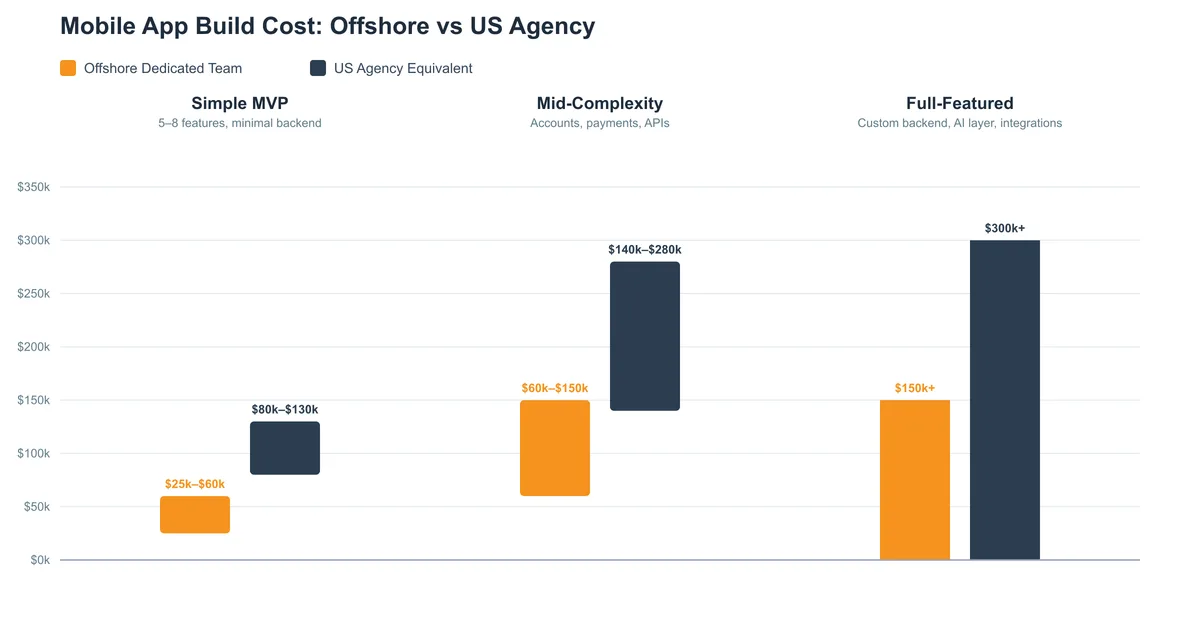
A simple MVP runs $25,000 to $60,000 with an offshore team. Mid-complexity apps with user accounts, payment processing, and third-party APIs land between $60,000 and $150,000. Full-featured builds with custom backends start above $150,000. Those ranges assume you’re working with a competent offshore team, not a domestic agency.
Regional hourly rates drive those numbers. According to Code-Brew’s 2026 cost breakdown, senior mobile developers in the US cost $150 to $250/hr, Eastern Europe runs $45 to $80/hr, and India and Southeast Asia range from $20 to $40/hr. The Philippines occupies an interesting middle position: rates comparable to India, English proficiency that ranks first globally among major offshore markets, and a tech talent pool that’s grown considerably over the last five years.
| App Complexity | Offshore Cost Estimate | US Agency Equivalent |
|---|---|---|
| Simple MVP (5–8 features, minimal backend) | $25,000–$60,000 | $80,000–$130,000 |
| Mid-complexity (accounts, payments, APIs) | $60,000–$150,000 | $140,000–$280,000 |
| Full-featured (custom backend, AI layer, integrations) | $150,000+ | $300,000+ |
| Annual maintenance (% of initial build) | 15–25% | 15–25% |
What founders consistently undercount is maintenance. Once your app is live, plan on 15 to 25% of the original build cost annually for updates, security patches, OS compatibility fixes, and App Store compliance. A $60,000 MVP carries $9,000 to $15,000 in annual upkeep. That number isn’t in the original contract. It catches people off guard every single time.
For a detailed breakdown of what senior mobile developers cost by country, our iOS developer cost guide for 2026 covers rate ranges across 12 markets with specific role-level data.
What Framework Choice Costs You
React Native and Flutter builds typically run 30 to 40% cheaper than native iOS plus Android development. One codebase, two platforms. For a first app without extreme performance demands, cross-platform is almost always the right call. Pure native earns its premium for hardware-intensive features: AR, real-time camera processing, deep OS integration. If you’re not building any of those, you’re paying a performance premium you don’t need yet.
Offshore mobile development has accelerated significantly in recent years. Our analysis of why offshore mobile development is growing covers the talent trends and cost dynamics reshaping how US companies build products.
How to Vet a Partner When You Can’t Read the Code
Non-technical founders can’t evaluate code quality in a portfolio review. A clean-looking app says nothing about the architecture underneath it. What you can evaluate is process transparency, communication behavior, and whether the vendor’s business model aligns with yours. Those signals are visible without technical knowledge.
The most dangerous failure mode for non-technical buyers is the proxy interview. The vendor presents a polished developer on the discovery call. Someone else shows up to the project. It’s more common than the industry will admit. Our vetting framework for offshore developers covers the technical interview in depth, but here are the red flags non-technical founders can catch on their own.

- 50 resumes in 48 hours. A vendor who sends you a stack of candidates that fast isn’t vetting. Volume delivery is one of the clearest signals that screening is minimal or nonexistent. Real vetting takes days, not hours.
- No discovery phase before quoting. Any vendor giving you a hard price and fixed timeline before understanding your business logic is guessing. Scope creep will follow. A serious partner needs to understand what the app actually does before telling you what it costs.
- Developers who agree to everything. A qualified engineer will push back on specs they know are ambiguous or technically risky. If every answer is “yes, no problem,” they’re not reading the spec carefully, or they’ll say yes now and figure it out later at your expense.
- No camera during technical portions. Require camera-on for all live demos and technical interviews. Ask follow-up questions mid-demo that only the actual developer could answer in real time. The proxy interview problem disappears when you force it to.
- “We test everything” with no specifics. A professional shop has regression tests, UAT protocols, and documented QA steps. Vague reassurance isn’t a process. Ask what a bug report looks like in their workflow and who fixes it.
One more thing worth saying directly: a vendor who is impossible to reach during the sales process will be worse to reach during the build. Test it intentionally. Send an email at 3pm on a Thursday and see what comes back. Communication patterns set before contract don’t improve after you’ve signed.
Contract Basics Before You Sign
Fixed price vs. time and material is the first decision. Fixed price works when your spec is complete and stable — clean MVPs with defined feature lists. Time and material (T&M) works when scope will evolve, which is almost every first-time build. Saigon Technology’s 2026 contract guide recommends a hybrid approach for most projects: fixed-price discovery and architecture phases, then T&M for development itself.
The IP assignment clause matters more than the NDA. Most founders focus on the NDA. The NDA protects confidential information during the process. The IP assignment clause determines who owns the code when it’s done. These are different protections and you need both.
According to Aalpha’s NDA guide for app development, without an IP assignment clause, the developer may retain copyright on the work as the original creator. You could have a finished app that you don’t legally own. Your contract must explicitly state that all code, design assets, and development work transfer to you on delivery or payment. Not a license to use. Ownership.
Minimum checklist before signing anything:
- IP assignment clause (full ownership transfers on delivery or payment milestone)
- NDA with specific confidential information defined — not just “all information”
- Source code repository in your name from day one, not handed over at project end
- Milestone-based payment schedule — never pay more than 30% upfront
- Defined communication cadence, tools, and escalation path
- Clear acceptance criteria for each milestone before payment releases
None of this requires a lawyer to understand. But it does require you to read the contract before signing, not after.
Should You Even Outsource? A 3-Question Reality Check
Outsourcing works when you have a defined spec, a realistic budget, and enough time to manage a remote relationship. If any of those three are missing, outsourcing doesn’t fail on its own. You set it up to fail.
Three questions to run before signing:
Can you describe every screen and user action in writing? If not, you’re not ready for a developer. You’re ready for a product strategist or UX designer first. Handing an undefined idea to an offshore team is how $50,000 buys you a half-built app that doesn’t match what you imagined. Document the spec first. Outsource the build second.
Do you have six months of runway beyond the build cost? Apps take longer than quoted. Budget 20 to 30% over the initial estimate as a baseline, not a best-case scenario. If that math breaks your runway, reconsider the build scope before starting.
Is your core logic your competitive advantage? Non-core features — user authentication, payment processing, push notifications, analytics dashboards — are safe to hand off. The logic that makes your product different deserves more scrutiny in vendor selection, tighter IP protection, and potentially a closer working relationship. Be honest about which category yours falls into.
Kore BPO is a US-owned offshore hiring partner based in Dallas, TX. We place vetted iOS, Android, React Native, and Flutter developers for US companies that need dedicated offshore talent without the overhead of a domestic agency. Every developer is screened, technically interviewed, and aligned to the client’s stack before placement. We’ve supported over 257 US clients across tech, marketing, operations, and data functions. The offshore developer roles we place cover the full mobile development stack.
Three things determine whether mobile app outsourcing works for a non-technical founder. The engagement model you pick determines cost and control. The contract you sign determines who owns the result. The vetting process you run determines whether the person building your product is the person you met on the call.
Most expensive mistakes happen before a line of code is written. Get those three things right and the build becomes the easy part.
Ready to Find Your Mobile Developer?
Vetted iOS, Android, React Native, and Flutter engineers placed for US companies. Resumes in 2–5 days.
Questions Founders Ask Before They Sign Anything
What’s the minimum budget to outsource a mobile app?
$25,000 is a realistic floor for a simple MVP with an offshore team covering five to eight core features and a minimal backend. Below that, you’re either getting a prototype or you’re being underbid, and you’ll pay the difference through scope change requests. US-based development for the same scope starts around $80,000. Both numbers assume you arrive with a written spec, not just an idea. Without a spec, no quote is worth the paper it’s on.
Freelancer vs. offshore agency — does that gap actually matter for a first app?
Usually, yes. The difference isn’t always quality — it’s accountability and continuity. A freelancer has no backup. If they go quiet for two weeks, you’re stuck. An agency or structured offshore team has process continuity, escalation paths, and backup coverage. For a first build where you’re not technical enough to diagnose delays yourself, that structure is worth the extra cost. The exception is a very simple app with a completely locked spec and a freelancer who has shipped similar projects you can verify.
My developer says I don’t need an IP clause because we have an NDA — is that actually true?
No. Different documents, different protections. The NDA keeps your information confidential during the project. The IP assignment clause determines who owns the code once it’s built. Without the assignment clause, the developer retains copyright as the original creator — even if you paid for everything. You need both. If a vendor pushes back on including an IP assignment clause, that’s a hard stop. Move on.
Realistically, how long does it take to go from idea to app store?
4 to 8 months for a well-specified MVP with a full-time offshore team. That assumes a complete spec before development starts, one round of major revisions, and standard App Store review times (1 to 3 days for iOS, typically faster for Android). Add 30 to 60 days if you’re starting discovery from scratch. Add another 30-day buffer if this is your first time managing an outsourced build — there’s a ramp period where you’ll spend more time aligning than you’d expect.
How do I stay in control of a project if I don’t have a technical co-founder?
Weekly standups, milestone-based payment releases, and read access to the shared code repository. You don’t need to read the code — you need to see it exists and is being committed regularly. The payment structure is your primary control lever. Never release the next milestone payment until the previous one meets the acceptance criteria you defined upfront. That single habit prevents more project failures than any technical oversight. Also: get a written status update every Friday. If you stop getting it, that’s your early warning.
Disclosure: Kore BPO is an offshore hiring partner. Some links in this post point to our own service pages. We’ve included them because they’re relevant to the topic, not to manufacture clicks.
Related Articles



Ready to Find Your Mobile Developer?
Kore BPO places vetted offshore iOS, Android, React Native, and Flutter engineers for US companies. Pre-screened resumes in 2 to 5 days.
Explore Offshore Roles