Angular vs React for Offshore Frontend Builds: Which ROI Wins in 2026


Last updated: June 22, 2026
The framework debate usually lives in engineering. The ROI debate lives in your P&L.
Most guides on Angular vs React tell you which one has cleaner separation of concerns, better TypeScript integration, or the stronger Google support model. What they skip is which one costs less to staff offshore, fills faster when you post the role, and ships more working features per dollar when your team is in Cebu or Medellin instead of Austin or Denver.
That distinction matters more than people acknowledge. For US companies building offshore frontend talent right now, the framework sitting at the top of your job description directly affects your hiring timeline, your onboarding cost, your governance overhead, and your total cost per shipped feature over the product’s life.
React and Angular are both production-grade. Both power enterprise apps at scale. But viewed through an offshore hiring lens, they perform very differently. And the choice between them isn’t as close as most technical comparisons suggest.
Does Framework Choice Actually Matter When You’re Hiring Offshore?
Yes, significantly. Framework choice directly affects your offshore talent pool size, hiring timeline, onboarding duration, and ongoing governance overhead. React gives you a larger candidate supply and faster ramp. Angular gives you structural guardrails at the cost of a smaller hiring pool and a longer time-to-productivity.
The gap isn’t marginal. According to the Stack Overflow 2025 Developer Survey, React is used by 44.7% of developers worldwide compared to Angular’s 18.2%. That’s a 2.5x ratio, and it follows through to every major offshore market. In Latin America, the mid-and-senior React pool runs 3–4x larger than Angular’s. The Philippines shows a similar pattern.
In practice, this shows up in your hiring funnel before it shows up in your code. Post an offshore React role and you see a deep applicant pool within days. Post an offshore Angular role and you’re working from a narrower set of candidates, many of whom understand Angular’s surface area but not the framework internals that enterprise production code actually demands. Average time to an accepted offer for Angular offshore runs 5–8 weeks through a staffing partner. React fills faster.
The Talent Pool Gap Is Bigger Than Most CTOs Realize
Angular’s offshore developer base isn’t small in absolute terms. Experienced Angular engineers exist throughout Southeast Asia, Latin America, and South Asia. The challenge isn’t finding one. It’s finding one with the right depth.
Enterprise Angular roles require developers who understand dependency injection beyond the basics, RxJS observable patterns at a production level, and the Signals-based change detection model Angular 20 has fully formalized. That intersection of framework knowledge plus real production experience narrows the pool considerably. Estimates from offshore hiring partners put qualified senior Angular candidates at roughly 30% of the already-smaller Angular base in most markets.
React doesn’t hit this wall to the same degree. The framework is smaller and more composable. A competent JavaScript developer with solid component thinking can reach useful production output on React in 2–4 weeks. That’s not true of Angular at the same project complexity.
What Does an Offshore React Developer Actually Cost vs Angular?
Offshore hourly rates for React and Angular developers are nearly identical on paper. The real cost difference surfaces in two places: the premium Angular specialists command at senior levels, and the extended time-to-productivity that pushes your effective cost per shipped feature upward.
At Kore BPO, offshore React developers run $1,600–$5,200 per month depending on experience, a 60–70% saving versus US equivalents at $94,000–$133,000 annually. Angular rates track closely at junior and mid-levels, but senior Angular specialists often run $500–$1,000/month higher in the Philippines and LATAM markets, reflecting the tighter supply.
Where the cost premium compounds most sharply is at the senior level. React is a library with a relatively small core API. Angular is a complete opinionated framework. A mid-level React developer can ship production features within a few weeks on a new codebase. A mid-level Angular developer without strong framework fundamentals will create technical debt that needs a senior to resolve. You sometimes end up hiring at a higher level just to get the output you need, which shifts your cost structure upward regardless of hourly rate.
Region-by-Region Rate Breakdown
These are representative 2026 market rates for React and Angular developers across the two most common offshore markets for US companies. Exact rates vary by specific location, company size, and individual candidate background.
| Level | React (Philippines) | Angular (Philippines) | React (LATAM) | Angular (LATAM) |
|---|---|---|---|---|
| Junior (1–3 yrs) | $1,600–$2,200/mo | $1,700–$2,300/mo | $2,200–$3,000/mo | $2,300–$3,100/mo |
| Mid-Level (3–6 yrs) | $2,500–$3,800/mo | $2,700–$4,100/mo | $3,200–$4,800/mo | $3,500–$5,000/mo |
| Senior (6–10 yrs) | $3,800–$5,200/mo | $4,200–$5,800/mo | $4,800–$6,800/mo | $5,200–$7,200/mo |
The senior-level gap is where it shows up most clearly: $400–$600/month more for Angular in the Philippines, $400–$1,000/month in LATAM. Across 24 months, that delta adds up. And it doesn’t account for the longer hiring timeline, which often costs more in delayed output than the rate difference itself.
Need a vetted shortlist in 2–5 days?
Kore BPO places offshore React and Angular developers for US companies. $0 until you hire.
How Long Does It Take to Hire and Onboard an Offshore Frontend Developer?
React offshore hiring runs faster than Angular at every stage. Shortlists arrive sooner (larger candidate pool), screening takes less time, and onboarding runs 2–4 weeks before a developer reaches consistent production contribution. Angular’s hiring cycle and ramp both run longer, and the gap compounds on a 90-day launch timeline.
Staffing partner data puts Angular offshore hiring at 5–8 weeks from kickoff to signed offer. React’s larger talent density in the same markets shortens that window. At Kore BPO, React shortlists typically arrive within 2–5 business days. A six-week delay in filling an Angular senior role can easily cost more in delayed output than two years of the rate premium.
The onboarding gap is where the real cost hides. Angular requires developers to internalize several framework-specific concepts before they’re useful on a real project. Dependency injection architecture. Reactive programming with RxJS. The Signals model. The module system. Angular’s specific TypeScript conventions. Even developers switching between Angular versions hit friction. A developer experienced in Angular 15 will need real ramp time to work effectively in Angular 20’s Signals-first patterns.
React’s core API is genuinely smaller. Most developers with solid JavaScript and component thinking reach first-commit quality in 2–4 weeks. Ecosystem complexity around state management and routing choices can extend that slightly, but the framework itself doesn’t create onboarding drag the way Angular does.
One client we placed a senior React developer with went from kickoff call to first code review in 11 business days. The same search for a senior Angular developer at a comparable company took 8 weeks before we had a shortlist the client was happy with. Both hires were excellent. The timelines were not comparable.
Angular’s Real Advantage Offshore (and When It Actually Matters)
React wins on availability, speed, and short-term ramp. That’s real. But I’m not calling Angular the loser and leaving it there.
Angular’s structural advantage is specifically relevant when you have 10 or more developers working the same codebase across different time zones over a multi-year horizon. React’s flexibility is a feature right up until it isn’t, and distributed teams are where it starts working against you.
Offshore teams face a coordination challenge that co-located teams handle more easily through conversation. Code review catches some architectural drift. The rest you find 18 months later. Different developers make different decisions about state management, folder structure, component composition, and data fetching patterns. Some use Zustand, some use Redux, some roll their own. Over two years and twelve developers, a React codebase without strong engineering leadership can become genuinely hard to navigate.
Angular doesn’t let that happen at the same rate. The framework is opinionated by design. Dependency injection, the module system, reactive forms, strict TypeScript mode. These aren’t just conventions, they’re enforced. When a new developer joins an Angular team in Manila eight months into a project, the codebase structure looks familiar. They don’t need to decode someone else’s architectural decisions before writing their first PR.
Angular 20’s technical improvements also matter for long-lived products. Zoneless change detection backed by Signals delivers 30–40% faster initial renders compared to Angular 19. Google maintains it with a predictable release cadence. For regulated industries or products with a 5–10 year life expectancy, that long-term support profile matters in ways that are hard to quantify until something breaks.
Angular’s offshore advantage is a team-size and time-horizon argument. Under 10 developers, short-to-medium project life, fast iteration priority, React wins clearly. Ten-plus developers, long-lived enterprise product, consistency over speed. Angular’s guardrails earn back their premium.
The Offshore Frontend ROI Stack
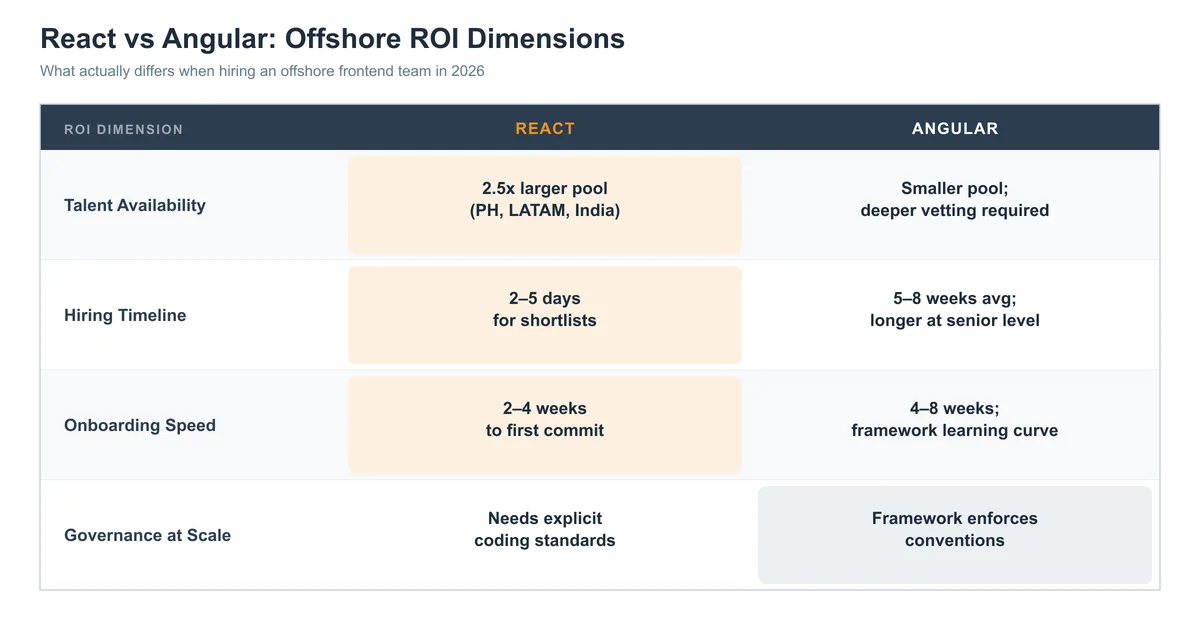
Four dimensions separate the two frameworks when you view them through an offshore ROI lens. Everything else (performance benchmarks, ecosystem breadth, component model philosophy) matters less for the specific question of what to build with an offshore team in 2026.
| ROI Dimension | React Offshore | Angular Offshore |
|---|---|---|
| Talent availability | 2.5x larger pool across PH, LATAM, India | Smaller pool; deeper vetting required |
| Hiring timeline | 2–5 days for shortlists; faster offer cycle | 5–8 weeks avg; longer at senior level |
| Onboarding speed | 2–4 weeks to first commit | 4–8 weeks; framework learning curve |
| Governance at scale (10+ devs) | Needs explicit coding standards | Framework enforces conventions |
| Senior rate premium | Baseline | $500–$1,000/mo above React at same level |
| Best for | Teams under 10, fast iteration, MVP products | Teams 10+, long-lived enterprise products |
Most US companies evaluating offshore BPO partners for frontend talent in 2026 land in the React column unless they have an existing Angular codebase or a specific enterprise architecture requirement. That’s not a technical preference. It’s an operational one. You get a faster hire, a shorter ramp, and access to a larger pool of people who can actually do the work.
The exception is real and worth taking seriously. If you’re building a financial platform that will run for seven years with 15 developers across three continents, Angular’s architecture enforcement is worth more than the shorter hiring cycle. Get that wrong in React’s favor and you’ll pay for it in technical debt that outpaces the initial savings.
Who Should NOT Hire an Offshore Angular Developer?
Three situations where Angular offshore creates more friction than it’s worth.
Fast-moving startups. If you ship weekly and measure success in feature cycle time, Angular’s onboarding overhead eats sprints. The framework conventions slow early-stage experimentation by design, which is useful later but genuinely costly before product-market fit.
Teams starting from a greenfield React codebase. Bringing Angular developers onto a React project doesn’t work without rewriting the codebase, and migrating mid-stream is rarely justified unless the architectural problems in the existing code are already severe. If you’re starting fresh with no existing Angular investment, there’s no reason to absorb the smaller talent pool and longer hire cycle.
Companies under a hard hiring deadline. If you need someone contributing code in under 60 days and your target offshore market is showing limited Angular supply at the seniority you need, the practical choice is React. Don’t let a framework preference hold up a launch date.
Bias disclosed: Kore BPO places both React and Angular developers. We benefit from the hire either way. The analysis above reflects what we actually see in hiring cycles, not a preference for one framework. If Angular is right for your codebase, we’ll say so and find you the right person.
If you’re evaluating an offshore software engineer more broadly (not tied to a single framework), that’s a different conversation and often worth exploring alongside the React vs Angular question.
Both frameworks run serious offshore teams. Neither is wrong for every context. But viewed through an offshore hiring and ROI lens (talent availability, hiring timeline, onboarding speed, and governance overhead at scale), the choice isn’t close for most US companies in 2026.
React gives you a faster hire, a shorter ramp, and a candidate pool roughly 2.5x deeper in the markets where offshore hiring actually happens. Manila, Medellin, Mexico City, Hyderabad. For teams under 10 developers or products still finding their shape, it’s the lower-friction path.
Angular pays back its premium on longer timelines, larger teams, and enterprise environments where code consistency across a distributed team matters more than time to first commit. If you’re building something that’ll run for five years with 12 developers in three time zones, Angular’s guardrails are worth the trade-offs.
If you’re evaluating offshore React or Angular developers and want to see what a vetted shortlist looks like, book a call with Kore BPO. Shortlists in 2–5 business days. $0 until you hire.
Is it harder to find senior Angular developers offshore than senior React developers?
Consistently yes. Senior Angular developers who genuinely understand the full framework at production depth (DI architecture, RxJS patterns, Angular 20 Signals, NgRx state management) represent roughly 30% of an already-smaller pool in every major offshore market. Senior React developers are more plentiful in LATAM, the Philippines, and India because the framework base is 2.5x larger to begin with. You’ll find Angular seniors. It just takes longer and the vetting bar is harder to clear because framework depth is easier to fake on a resume than it is in a code review.
React or Angular offshore: does framework choice affect code quality?
Not directly. Both frameworks produce excellent code in the hands of a strong developer. The difference shows up when the developer is average. Angular’s conventions constrain how far off-track a weaker developer can drift. React’s flexibility means a mediocre developer can make architectural decisions that take senior engineers months to untangle. For offshore teams with less real-time oversight, that governance difference matters more than it would for a co-located team. The framework becomes a partial substitute for the architectural oversight that’s harder to provide across time zones.
Can I switch my offshore team from Angular to React mid-project?
Possible, rarely advisable. The codebase migration is only part of the cost. You also lose the Angular institutional knowledge your developers have built, rebuild component architecture from scratch, and absorb the React learning curve simultaneously. Pre-launch, the switch can make sense if the architectural reasons are compelling. In production with real users, you need a specific justification that outweighs the rewrite risk and timeline hit. Most teams that make this switch mid-stream underestimate the second cost by a significant margin.
How do offshore Angular developers handle enterprise architecture without local oversight?
Better than most people expect, because Angular’s opinionated structure handles a lot of what a local senior architect would otherwise enforce through code review. That said, you still need at least one strong lead (local or embedded in the offshore team) who can configure the Nx workspace, set module boundaries, and review PRs for architectural correctness. Fully unsupervised Angular teams drift too, just more slowly than React ones. The framework buys you margin. It doesn’t replace judgment.
What’s the realistic monthly cost difference between offshore React and Angular developers?
At mid-level, the gap is usually $0–$400/month, nearly identical in most markets. At senior level, Angular specialists run $500–$1,000/month more in the Philippines and LATAM. But the rate is the smaller number. The real cost difference is the longer hiring cycle and extended ramp time. A six-week delay filling an Angular senior role can easily cost more in missed output than two years of the rate premium. Model the total cost, not just the monthly rate.
Sources: Stack Overflow Developer Survey 2025 · HireWithNear Offshore Angular Report 2026 · Aalpha Offshore Rate Guide 2026 · Techvedhas React vs Angular CTO Guide 2026 · Radixweb Angular vs React 2026 · Nivelics React vs Angular Decision Guide
Related Articles



See What a Vetted Shortlist Looks Like
Kore BPO delivers pre-screened offshore React and Angular developers to US companies. Shortlists in 2–5 business days. No fee until you hire.
Book a Free Call