Android Offshore Development: Google Play Compliance Mistakes US Companies Make


- 01What Google’s 2025 Enforcement Numbers Mean for Outsourced Android Apps
- 02Mistake 1: Handing Over the Developer Account
- 03Mistake 2: The Data Safety Form Gets Filled In Blind
- 04Mistake 3: Over-Permissioning Goes Undetected Until Review
- 05Mistake 4: Missing Google’s 2026 Policy Deadlines
- 06Mistake 5: No Rejection Protocol Before Launch
- 07What a Compliance-Ready Offshore Android Team Looks Like
- 08What US Companies Ask Before Outsourcing Android Development
Last updated: June 29, 2026
Google blocked 1.75 million apps from the Play Store in 2025 and banned more than 80,000 developer accounts. Not all from bad actors. A lot of those were engineering failures: wrong permissions, missing privacy policy links, Data Safety forms that didn’t match the app’s actual behavior.
That gap gets wider when the team is offshore. Not because offshore developers are less capable. The problem is coordination. An offshore Android developer across time zones gets less real-time feedback on policy nuance, less context on what Google’s reviewers are currently flagging, and less visibility into what changed in the last quarterly policy update. The US company finds out when the app gets rejected. Or worse, when the account gets flagged.
Kore BPO places Android developers for US companies through India and the Philippines. What follows are the five compliance mistakes we see most often, and what a contract and team structure that prevents them actually looks like.
Sound familiar? Keep reading.
What Google’s 2025 Enforcement Numbers Mean for Outsourced Android Apps
Google doesn’t publish a breakdown by developer geography. But the enforcement numbers from 2025 tell a clear story about where compliance failures come from.
According to Google’s 2025 Play Store safety report, 1.75 million app submissions were blocked for policy violations, and 255,000 apps were denied access to sensitive data permissions. The leading categories were crashes and instability, thin or low-quality content, over-permissioning for SMS or contacts, and inaccurate Data Safety section declarations.
None of those violation categories require a bad actor. They require a team that didn’t know the rules, didn’t test against them before submission, or didn’t have anyone accountable for tracking policy changes. That’s a coordination problem. Offshore builds have more coordination surface area than in-house builds.
One more thing worth understanding. Google’s enforcement isn’t always a one-app rejection. Account-level bans affect every app tied to that account. If your offshore team is building on a shared developer account, one violation by one app can take down everything. That’s the real risk most US companies don’t price in when they sign the initial engagement.
Mistake 1: Handing Over the Developer Account
Your offshore development vendor asks for access to your Google Play developer account. Seems reasonable. They need it to submit builds, manage releases, run internal testing tracks. Most US companies say yes without thinking through what that access actually means.
Full account access is a policy liability. If the offshore team makes a submission that violates Google’s Developer Program Policies, the violation sits on your account. Not theirs. The ban that follows isn’t on their Google account. It’s on yours. And Google’s enforcement extends to linked accounts, meaning new accounts created after a ban can be flagged and removed if Google connects them to the banned entity.
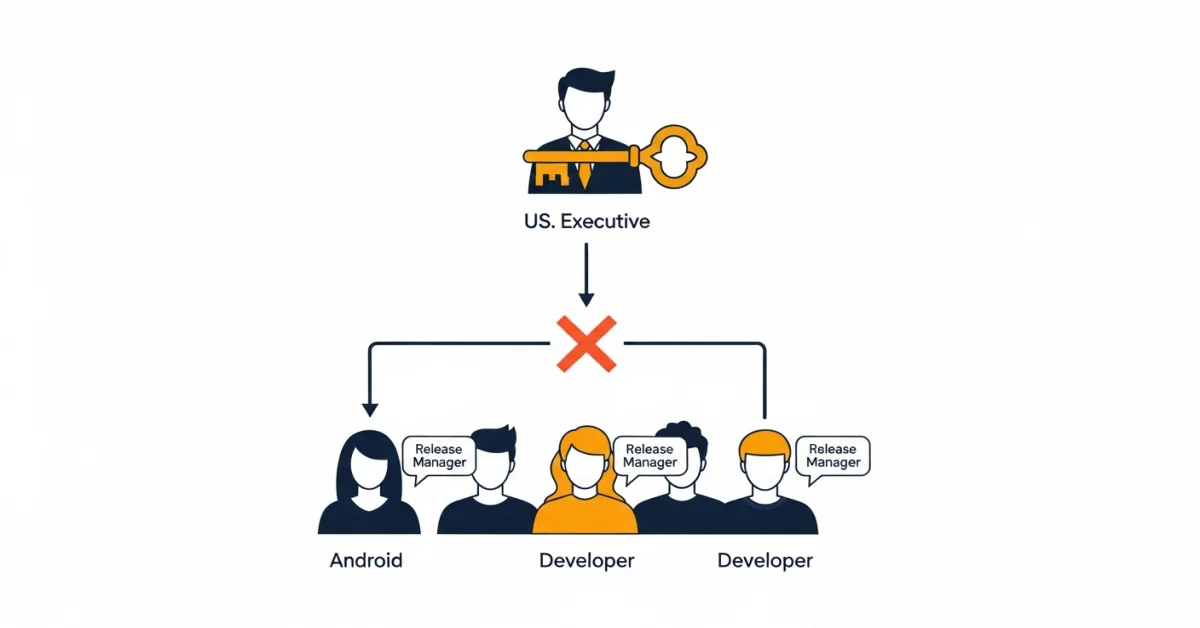
The right setup is simple. You hold the developer account. The offshore team gets added as a user with release manager or release editor permissions. They can manage builds, submit to tracks, respond to reviews. They can’t change billing, can’t alter account-level settings, and can’t do anything that doesn’t go through a submission you approve. That permission layer isn’t bureaucratic overhead. It’s the firewall between a policy violation and an account ban.
Account setup rule: Never give an offshore vendor owner-level or admin access to your Google Play developer account. Add them as a release manager or release editor. Review all submissions before they go live on the production track.
What This Looks Like in Practice
We’ve seen this play out twice in the last 18 months with clients who came to us after getting burned. One company handed over full admin access to a development shop in Eastern Europe. The shop submitted an app update with SDK-level advertising tracking that violated Google’s data policy. The account got flagged. The company’s main app, which had nothing to do with the violation, got caught in the same flag because it lived on the same account. Two weeks of back-and-forth with Google support to restore access. The fix took two days. The damage took two weeks to undo.
The second company had the same setup but caught it earlier. Their app got rejected at review, not banned post-publication. Still cost three weeks of delay. Both cases had the same root cause: the offshore team had full account access and no US-side review gate before submission.
Mistake 2: The Data Safety Form Gets Filled In Blind
Google’s Data Safety section isn’t optional and it isn’t cosmetic. It’s a disclosure that tells users exactly what data your app collects, how it’s used, whether it’s shared with third parties, and whether users can request deletion. Inaccurate Data Safety declarations are a direct policy violation. Google can remove the app for a mismatch between what the form says and what the app actually does.
Offshore teams fill this form out at submission time, often under deadline pressure. They fill it from their understanding of the app’s data flows. The problem is that understanding is incomplete. It doesn’t include third-party SDKs the client added after spec was finalized, analytics tools the marketing team requested mid-build, or advertising SDKs the offshore team bundled as dependencies without flagging it.
One SDK can push a “no data collected” declaration into a violation. Firebase Analytics, Meta Audience Network, Adjust, AppsFlyer all collect user data and require specific Data Safety disclosures. An offshore team working fast on a fixed-price contract doesn’t always run a full SDK audit before ticking boxes on the form.
The fix isn’t complicated. Before any submission, someone on the US side runs a data flow audit with the offshore software engineer lead. Every SDK in the build gets listed. Every data collection point gets mapped. The Data Safety form gets filled out against that map, not from memory. This takes a few hours. A rejected app due to a Data Safety mismatch costs weeks.

Third-Party SDKs Are the Hidden Variable
SDK-level data collection is the most common blind spot in offshore builds. The app developer writes clean code. The client requests analytics and advertising integrations. Those integrations pull in SDKs that collect device IDs, location signals, behavior data. None of that gets flagged in the original spec. All of it needs to appear in the Data Safety disclosure.
Google’s April 2026 policy update tightened enforcement on SDK-level data collection specifically. Apps that fail to disclose third-party SDK data behavior are now subject to removal, not just warning. That’s a material change from 2024. Offshore teams working from older process documentation won’t know this happened unless someone tells them.
Staffing Android Developers Who Know Play Policy
Kore BPO places offshore Android developers with active Google Play experience. Pre-vetted, compliance-aware, US-timezone overlap available.
Mistake 3: Over-Permissioning Goes Undetected Until Review
Android apps declare permissions in the manifest file. Those declarations tell Google and the user what device capabilities the app wants access to. Requesting permissions that aren’t justified by the app’s core functionality is a direct policy violation and one of the leading causes of rejection in 2025.
Offshore developers over-permission for a few reasons. Template projects include broad permission sets that get used “just in case.” Legacy SDK dependencies request permissions that modern alternatives don’t need. Developers working under time pressure include permissions for features that didn’t make the final build because removing them takes a pass they don’t have time for. None of this is malicious. All of it triggers Google’s automated review systems.
Google’s December 2025 policy update specifically added the Android Contact Picker requirement. Apps that need contact access must now use Android’s native Contact Picker instead of requesting broad READ_CONTACTS permission. An offshore team working from a codebase that predates this update, or one that wasn’t tracking the December policy cycle, will ship an app that requests a permission Google now flags at review.
| Permission | Old Approach (Gets Flagged) | Current Requirement |
|---|---|---|
| Contacts | READ_CONTACTS broad permission | Android Contact Picker API only |
| Location | Background location bundled with foreground | Foreground only unless core feature requires background; must justify |
| SMS | READ_SMS for verification flows | SMS Retriever API; direct READ_SMS requires explicit justification |
| Phone state | READ_PHONE_STATE for device ID | Advertising ID API; direct phone state access restricted |
| Storage | READ_EXTERNAL_STORAGE blanket access | Scoped storage with specific media type permissions |
The audit here is simple. Before submission, export the manifest and run every declared permission against Google’s current policy documentation. Any permission that doesn’t map to an active, user-facing feature gets removed. This takes an hour. An offshore team without this step in their release checklist skips it.
Mistake 4: Missing Google’s 2026 Policy Deadlines
Google publishes policy updates quarterly. Not every update has a hard deadline. But three of them from the 2025-2026 cycle do, and all three affect how US companies structure Android development with offshore teams.
| Policy Change | Deadline | Who It Affects |
|---|---|---|
| Alternative Billing and External Payments | January 28, 2026 | Apps with in-app purchases targeting US users. Must allow external payment options per court order. |
| Age Verification (TX, UT, LA) | January 1, 2026 | Apps targeting users in Texas, Utah, and Louisiana. Must verify age using Play Age Signals API or equivalent. |
| Developer Identity Verification | Rolling, Sept 2026 | All developer accounts. Government-issued ID and residency proof required. Offshore teams managing accounts need a US-side account holder. |
The January deadlines are already past. If your offshore team built an app with in-app purchases that went live before you implemented alternative billing support, you’re already out of compliance. The developer verification deadline rolling out through September 2026 is the one to watch right now.
Verification requires linking a government-issued ID to the developer account. For accounts managed by offshore vendors, this creates a structural problem: the account holder on paper needs to be a real, verifiable person who can produce documentation. If your vendor manages the account under their company entity, that verification falls to them. If the account is yours, you handle it. Either way, it’s not something you can patch in after the deadline.
When did your offshore team last check Google’s policy changelog? If you don’t have an answer ready, that’s the gap this section is about.
If you’re working with an offshore team and haven’t confirmed which of these three applies to your app, that’s worth a call this week. Vetting offshore Android engineers for policy awareness is now a legitimate part of the qualification process, not just a technical screen.
Policy tracking tip: Google publishes all policy changes at Play Developer Policy Center. Add it to your offshore team’s sprint review checklist quarterly. Offshore teams that don’t track Google’s policy cadence will always be one update behind.
Mistake 5: No Rejection Protocol Before Launch
Most offshore Android engagements have a launch plan. Few have a rejection plan.
Google can reject an app update after it’s live. The update goes into review, fails, and the live version rolls back. Or worse, Google takes action on the current published version, not just the update. When that happens mid-project with an offshore team, a few things tend to collapse at once: the offshore team’s contract doesn’t cover post-rejection remediation. The US company doesn’t have access to the developer console to respond quickly. Nobody owns the fix.
A rejection protocol is three things in writing before the engagement starts. First, who holds account access and who can respond to Google’s review team. Second, what the response timeline looks like, whether the offshore team’s contract covers remediation work or whether that’s billed separately. Third, what defines a successful fix, so there’s no disagreement about whether the offshore team’s job is done.
That last one matters more than it sounds. An offshore team under a fixed-price contract has every incentive to call the fix done at the first resubmission. If Google rejects it again, the US company absorbs the cost of the next round. Getting this in the contract before work starts is the only way to avoid a negotiation happening in the middle of a rejection cycle.

What a Compliance-Ready Offshore Android Team Looks Like
Compliance isn’t a personality trait. It’s a process. The right offshore Android team has the process baked in, not bolted on at the end of a sprint.
Here’s what that looks like in practice, across four areas:
Kore BPO sources and places offshore Android developers who meet these criteria before we put them in front of clients. The vetting process includes a direct screen on Google Play policy knowledge, not just Android development proficiency. Those are different things. A strong developer who doesn’t know the policy landscape is a compliance risk. Both matter.
Getting This Right Before the First Build
The compliance mistakes outlined here are all preventable. None of them require a different caliber of developer. They require a different structure around the engagement.
Account ownership stays with you. Data Safety forms get audited before submission, not filled from memory. Permission manifests get reviewed against current policy, not against what the previous app did. Policy deadlines get tracked as part of the sprint cycle, not discovered at rejection. And the contract covers what happens when Google says no.
An offshore Android developer with this kind of process discipline costs the same as one without it. Browse offshore Android developer roles at Kore BPO to see what compliance-aware candidates look like in practice before you decide whether to build in-house or offshore.
Disclosure: Kore BPO benefits when companies choose offshore staffing over in-house hiring. The compliance analysis above is based on Google’s published policy documentation and our direct experience managing offshore placements for US clients, not neutral third-party research.
Who should actually own the Google Play developer account?
You. Always. The US company should be the account owner with the offshore team added as a release manager or release editor. This isn’t a trust issue, it’s a liability one. Google’s enforcement attaches to the account, not the code. If the offshore team’s submission triggers a ban, it hits your account. Keeping ownership on your side gives you control over access and response when something goes wrong.
Can an offshore-built app get my entire developer account banned?
Short answer: yes. Google’s enforcement covers all apps on an account, not just the one that violated policy. A ban on one app can trigger account-level review. New accounts created after a ban can be flagged if Google connects them to the banned entity. This is exactly why the account structure matters before the first build is submitted, not after something goes wrong.
How do I know if my offshore team is tracking Google’s 2026 policy changes?
Ask them. Specifically: when did they last review Google’s Developer Policy Center changelog, and what did they flag as affecting current builds? A team that tracks policy changes will have a real answer. A team that doesn’t will give you a vague one about “staying current with best practices.” That’s the tell. The three changes that mattered most in the 2025-2026 cycle were the Contacts Permissions update (December 2025), the age verification mandate for Texas, Utah, and Louisiana (January 2026), and the alternative billing requirement (January 2026). If they can’t name at least one, they aren’t tracking the policy cycle.
Which countries produce the most compliance-aware Android developers?
India and the Philippines, in our experience, produce the highest volume of Android developers with active Google Play publishing experience. Poland and Bulgaria are worth considering for regulated-industry apps given their GDPR familiarity. Eastern European developers often have stronger exposure to EU privacy frameworks, which carry over to data safety thinking. That said, country of origin is a weaker signal than verifiable Play Store publishing history. Ask to see apps the developer has shipped and review their Play Console track record before geography factors in.
What should my contract say about Google Play rejection?
Three things, minimum. First, who holds account access and who communicates with Google’s review team during a rejection. Second, whether remediation work after a rejection is included in the project price or billed at an hourly rate, and how many remediation rounds are covered. Third, what the turnaround commitment is, because Google’s rejection review windows are time-sensitive and a slow offshore response makes them worse. If the contract doesn’t address rejection, add a clause before signing. The negotiation is much easier before work starts than after an app gets pulled.
Related Articles



Ready to Build a Compliance-Ready Android Team?
Kore BPO places offshore Android developers who know Google Play policy, not just Android code. US-managed. Pre-vetted. Deployed in weeks.
Talk to Our TeamNo commitment. Just a conversation about what you’re building.