How to Build a High-Performing Offshore Cloud Engineering Team (That Actually Delivers)


A practical guide to building offshore cloud teams that ship faster, reduce waste, and actually perform.
- 01Introduction
- 02What Is an Offshore Cloud Engineering Team?
- 03How It’s Different from Traditional Offshore Teams
- 04Where Companies Get It Wrong Early
- 05Why Companies Are Building Offshore Cloud Teams
- 06What High-Performing Actually Means
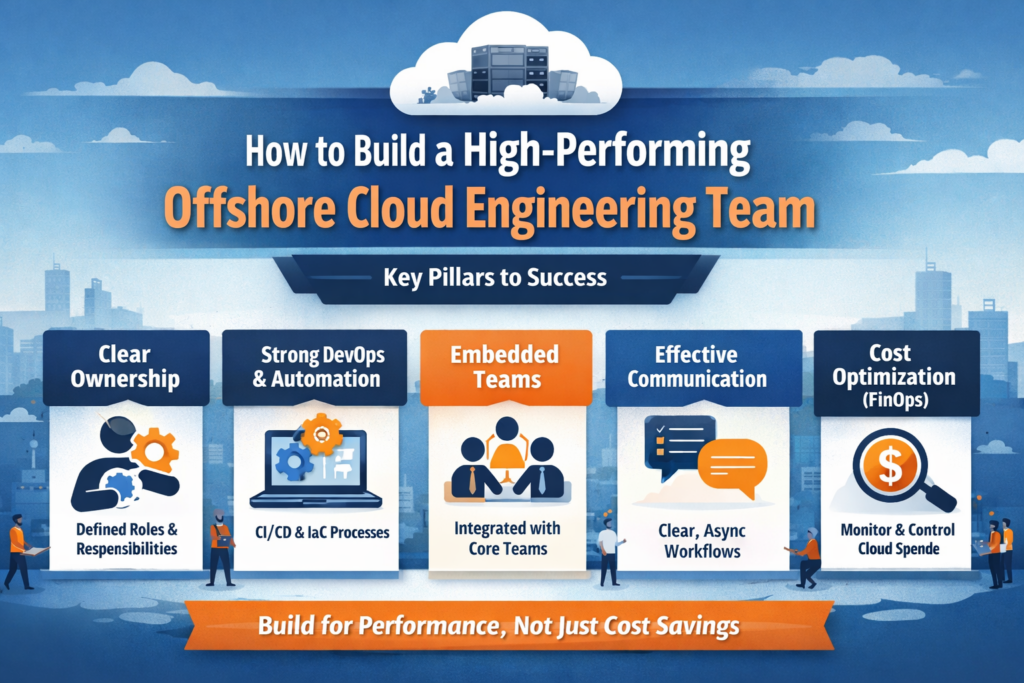
- 07The 5 Core Pillars of a High-Performing Offshore Cloud Team
- 08How to Structure Your Offshore Cloud Engineering Team
- 09Step-by-Step: How to Build Your Offshore Cloud Team
- 10Common Mistakes That Kill Offshore Cloud Teams
- 11Real Challenges and How to Solve Them
- 12How to Scale from 2 to 20 Engineers
- 13Offshore vs In-House Cloud Teams
- 14When Offshore Cloud Teams Make Sense
- 15Final Takeaways
- 16FAQs
- 17Ready to Build a Team That Actually Performs?
Introduction
Most companies don’t struggle to find offshore cloud engineers. They struggle to make them work.
On paper, the math looks great.
- 30-70% cost savings
- Faster hiring
- Access to global talent
But in reality, we have seen teams save on salaries and lose it right back through:
- Slow deployments
- Poor ownership
- Cloud waste
- Constant rework
Most articles won’t tell you this. Offshore cloud teams don’t fail because of talent. They fail because of how they’re built.
This guide walks you through how to build a high-performing offshore cloud engineering team. One that ships fast, owns outcomes, and doesn’t create more problems than it solves.
What Is an Offshore Cloud Engineering Team?
A Practical Definition
An offshore cloud engineering team isn’t just a group of remote developers.
It’s a team responsible for:
- Cloud infrastructure (AWS, Azure, GCP)
- CI/CD pipelines
- Deployment workflows
- System reliability (SRE)
- Cost optimization (FinOps)
This isn’t support work. This is core engineering.
This is also where structured outsourcing makes the difference. Not just hiring engineers, but building a managed cloud function with clear ownership, accountability, and performance tracking.
How It’s Different from Traditional Offshore Teams
Most companies treat offshore teams like execution layers. That doesn’t work in cloud environments.
Cloud engineering requires:
- Ownership of production systems
- Responsibility for uptime
- Accountability for cost
If no one owns these things clearly, everything slows down.
Where Companies Get It Wrong Early
The biggest mistake I see is this.
- Treating cloud as a shared responsibility
- Splitting ownership between onshore and offshore
- No one owns incidents or costs
That’s where things start to break.
Why Companies Are Building Offshore Cloud Teams
Talent Shortage Is Real
Hiring strong cloud engineers locally is getting harder:
- Roles take 30-90 days or longer to fill
- Demand for DevOps and SRE talent keeps growing
So companies look offshore.
Cost Pressure Is Driving Change
Let’s be honest. Cost matters.
- Offshore teams can reduce labor costs by 30-70% (triforce-inc.com)
- Savings only hold if the team performs
We have seen companies save 40% on hiring and lose 25-30% of it back in inefficiencies.
Cloud Complexity Is Increasing
This isn’t just about infrastructure anymore.
You’re dealing with:
- Multi-cloud environments
- CI/CD pipelines
- Observability
- Security
- Cost management
That requires a coordinated team, not just individual hires
What High-Performing Actually Means
Most articles skip this.
Let’s define it clearly.
The Metrics That Matter (DORA Framework)
- Deployment frequency
- Lead time for changes
- Change failure rate
- Mean time to recovery (MTTR)
What High-Performing Teams Actually Do
They:
- Ship code faster
- Recover from failures quickly
- Break things less often
- Maintain stable systems
A high-performing offshore team isn’t about cheaper engineers. It’s about how fast you can safely ship to production and recover when things break.
The 5 Core Pillars of a High-Performing Offshore Cloud Team
1. Clear Ownership
You need to define:
- Who owns infrastructure
- Who owns CI/CD pipelines
- Who handles incidents
- Who owns cloud costs
If ownership isn’t clear, performance drops fast.
2. Strong DevOps and Automation Foundations
Your team should have:
- CI/CD pipelines in place
- Infrastructure as Code (Terraform, etc.)
- Automated testing and deployments
Manual processes will slow everything down.
3. Embedded Team Structure
Don’t build a separate offshore team.
Instead:
Separate teams create friction. Embedded teams create alignment.
- Embed offshore engineers into product or platform teams
- Give them real ownership
4. Communication Systems
It’s not about tools. It’s about structure.
- Clear documentation
- Async workflows
- Defined escalation paths
Most issues aren’t time zone problems. There are clarity problems.
5. Cloud Cost and Performance Accountability
You need:
- Visibility into spend
- Ownership of cost optimization
- Accountability tied to engineering decisions
On average, companies waste 28-32% of cloud spend. (techmonitor.ai)
How to Structure Your Offshore Cloud Engineering Team
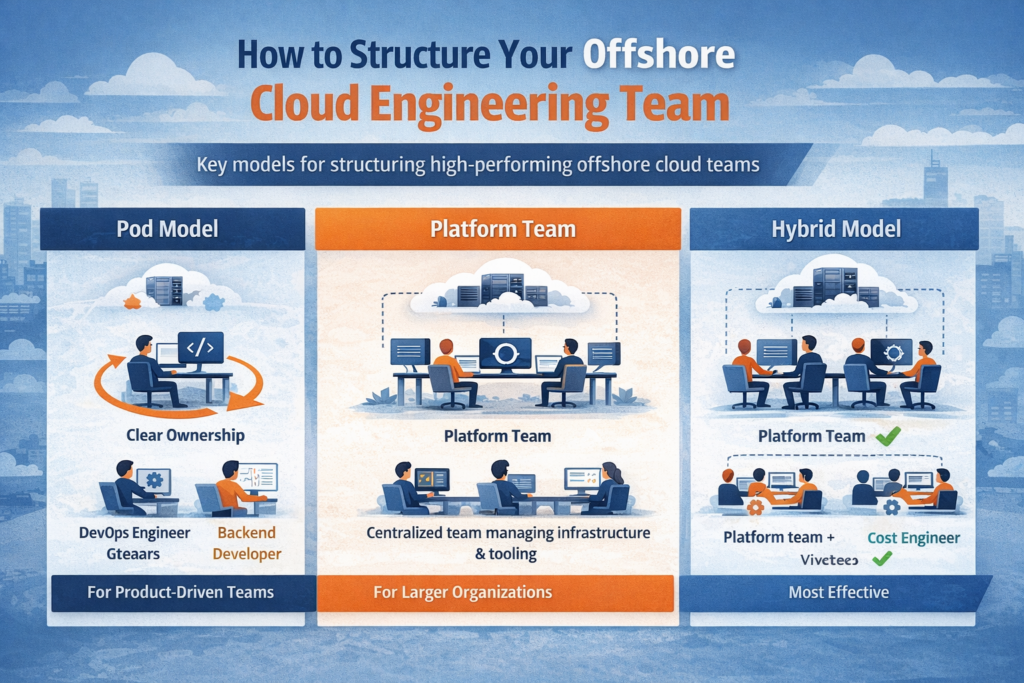
Common Team Models
Pod Model
- Cross-functional team aligned to a product
- Includes DevOps, backend, QA
Best for:
- Product-driven companies
Platform Team
- Centralized team managing infrastructure and tooling
Best for:
- Larger organizations
- Standardized environments
Hybrid Model (Most Effective)
- Platform team plus embedded engineers
This gives you:
- Control and flexibility
Key Roles to Include
- DevOps Engineers
- Cloud Engineers
- Site Reliability Engineers (SRE)
- Platform Engineers
Avoid hiring generalists without a clear function.
What Good Structure Looks Like
- Clear reporting lines
- Defined ownership boundaries
- Shared tools and workflows
Step-by-Step: How to Build Your Offshore Cloud Team
Step 1 – Define Ownership Before Hiring
Define:
- Who owns infrastructure
- Who owns deployment
- Who owns monitoring
If you skip this, you’ll fix it later under pressure.
Step 2 – Hire for Roles, Not Headcount
Hire based on function:
- DevOps
- SRE
- Platform
Step 3 – Set Up Your Cloud and DevOps Stack
- CI/CD tools (GitHub Actions, Jenkins)
- Infrastructure as Code (Terraform)
- Monitoring (Datadog, CloudWatch)
Step 4 – Build a 30-60-90 Day Onboarding Plan
0-30 days
- Access and documentation
- System understanding
- Shadowing
30-60 days
- Small deployments
- Pipeline contributions
60-90 days
- Ownership of tasks
- Production impact
Step 5 – Track Performance
Measure:
- Deployment frequency
- Lead time
- Incident response time
If you don’t measure it, you won’t improve it.
Common Mistakes That Kill Offshore Cloud Teams
- No clear ownership
- Treating offshore as separate
- Weak onboarding
- Ignoring cloud cost management
- Too many meetings, not enough systems
Most failures come from unclear ownership, not lack of talent.
Real Challenges and How to Solve Them
Time zone gaps
- Async workflows
- Defined overlap hours
Communication breakdowns
- Documentation-first culture
- Clear communication channels
Cloud cost overruns
- Assign cost ownership
- Implement FinOps practices
Slow ramp time
Clear expectations
Structured onboarding
How to Scale from 2 to 20 Engineers
1-3 engineers
- Flexible
- Informal processes
4-10 engineers
- Need structure
- Documentation becomes critical
10-20 engineers
- Ownership must be locked
- Processes must be consistent
Scaling from 2 to 10 engineers is where cracks show up. Process and ownership either hold or break.
Offshore vs In-House Cloud Teams
Cost
Offshore: 30-70% lower
In-house: Higher
Hiring speed
Offshore: Faster
In-house: Slower
Scalability
Offshore: High
In-house: Limited
Control
Offshore: Depends on structure
In-house: High
When Offshore Cloud Teams Make Sense
- You need to scale quickly
- Local talent is limited
- You’re under cost pressure
- You need 24/7 coverage
Final Takeaways
- Offshore success isn’t about cost. It’s about structure
- High-performing teams are built on:
- Ownership
- Systems
- Accountability
- Most problems aren’t talent-related. They’re design problems
FAQs
Ready to Build a Team That Actually Performs?
If you’re building or scaling an offshore cloud engineering team, start with structure. Not hiring.
At Kore BPO, we build and manage offshore engineering teams that integrate directly into your operations. That includes DevOps, cloud infrastructure, and ongoing performance management.
We don’t just provide talent. We build systems that perform.
If you want a clear path forward:
- Get a second opinion on your current setup
- Map out a team structure that actually scales
Book a consultation, and we’ll walk through your current model, where it’s breaking, and how to fix it before it costs you more time and money.
What is an offshore cloud engineering team?
Why do offshore cloud teams fail?
How much can companies save with offshore cloud teams?
What makes a cloud engineering team high-performing?
What roles should be included in an offshore cloud team?
Related Articles



Ready to Build Your Offshore Team?
Get pre-screened resumes in 2 to 5 days. No upfront fees. One partner from hire to payroll.
Contact Us