Cross-Platform Mobile App Development: Flutter vs React Native vs Xamarin


What “Cross-Platform” Actually Means (and What It Doesn’t)
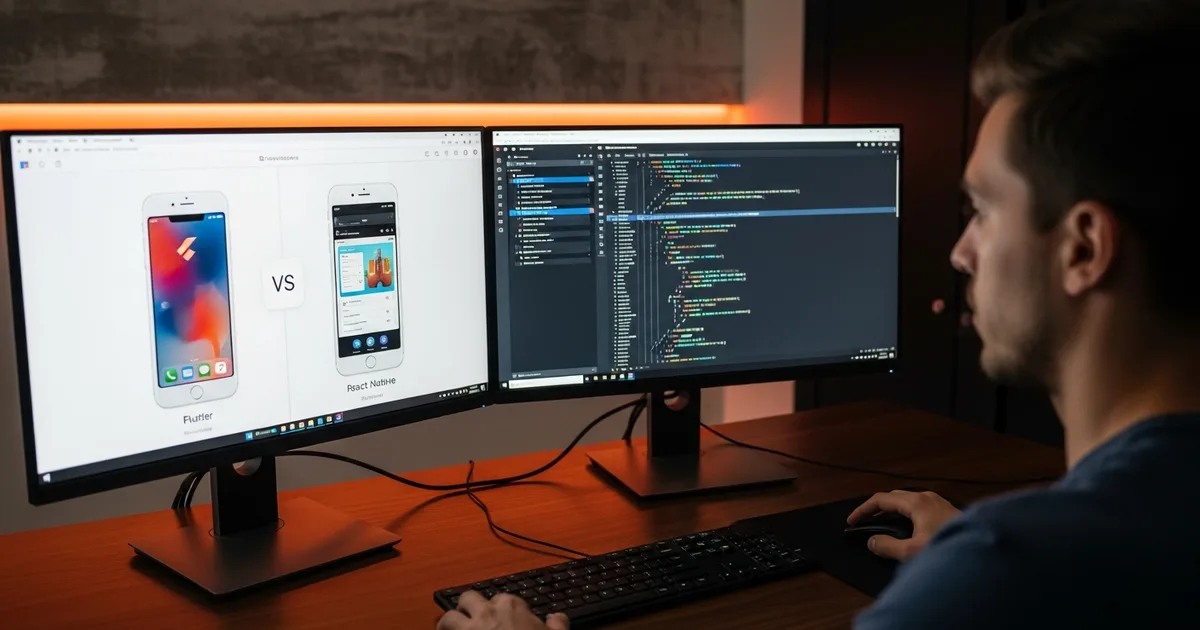
One codebase. Two platforms. That’s the core promise of cross-platform mobile development. You write your application once and it runs on both iOS and Android without maintaining two separate codebases, two release cycles, or two specialized teams. For companies weighing the build decision, that matters a lot. And it’s also why the in-house vs offshore software development conversation almost always lands on framework choice inside the first meeting.
The part most comparisons skip over: “one codebase” doesn’t mean zero platform-specific code. It means significantly less of it. In practice, cross-platform apps share 70 to 95% of their logic. The remaining slice handles device-specific features like camera access, biometrics, push notification behavior, or platform-level permission flows. For most business applications (internal tools, customer portals, logistics dashboards, SaaS companion apps), that overlap sits closer to 90%.
The cross-platform software market reached $104.6 billion in 2025 and is tracking toward $121 billion in 2026 at a 15.7% CAGR, according to The Business Research Company. More than 40% of new mobile applications now use cross-platform frameworks for at least part of their architecture. That’s not a niche approach anymore. It’s the default for most new mobile builds.
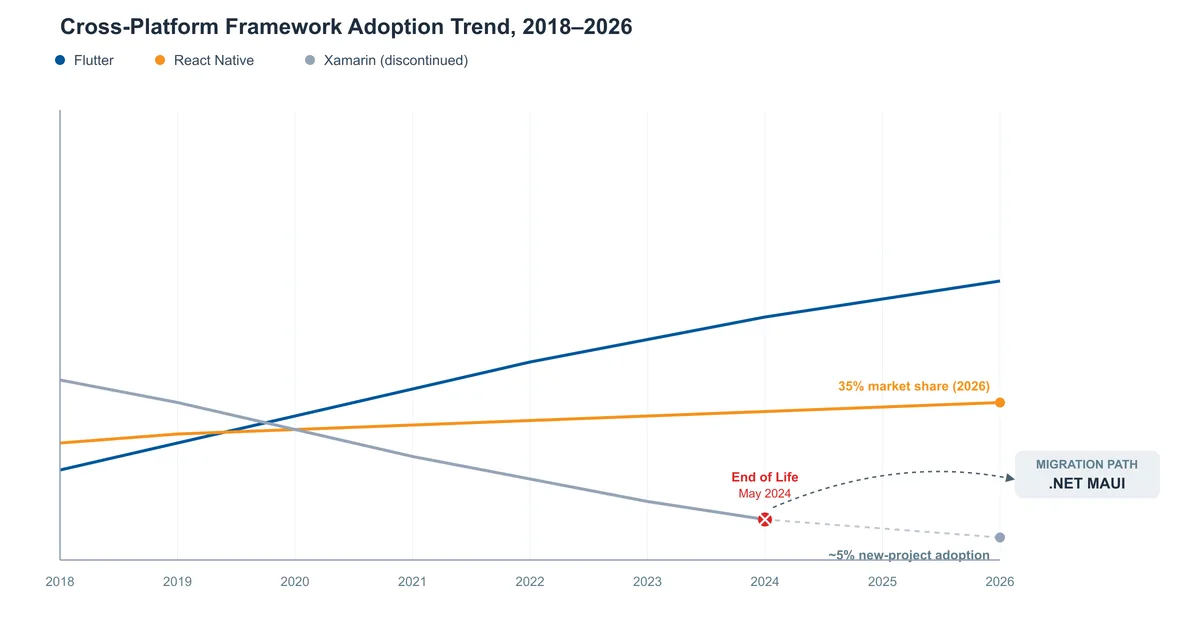
Three frameworks have dominated this space. Flutter, React Native, and Xamarin. In 2026, only two of them are viable starting points for new projects. The third needs its own section, with a clear warning.
Flutter in 2026
Flutter is Google’s cross-platform framework, built on Dart and compiled directly to native ARM code via ahead-of-time (AOT) compilation. That compilation model is what drives Flutter’s performance edge. Instead of interpreting JavaScript at runtime or relying on a bridge to native APIs, Flutter renders its own UI using a custom graphics engine.
The 2026 version of Flutter is substantially stronger than what Google shipped in 2019. The Impeller rendering engine, now fully stable on both iOS and Android, eliminates shader compilation jank entirely. Bolder Apps’ 2026 analysis puts Impeller 2.0 at 50% faster frame rasterization compared to Flutter’s previous Skia-based renderer. Cold start times average around 250ms. Memory footprint runs 25MB on iOS and 14MB on Android.
Flutter wins 7 out of 10 standard benchmark categories against React Native, per adevs.com’s 2026 benchmark report. Its GitHub repository sits at 170,000 stars with 12,400 contributors, growing roughly 3x faster in new contributors than React Native over the past two years. Market share is now at 46% of global cross-platform developers, up from 42% the year before, according to Statista 2025 data.
Flutter’s real weakness isn’t performance. It’s Dart. Most developers coming from JavaScript, Python, or Java need 2–3 weeks to become productive in Dart. The language isn’t difficult, but it’s a detour. The US job market reflects this. Flutter has around 3,200 open positions in the US and Canada, versus React Native’s 6,800. That hiring gap matters when you’re trying to fill a role quickly.
Flutter dominates the developer market in India, Brazil, Indonesia, and Nigeria. If offshore hiring is part of your plan, the talent pool is wide and deep. But domestic US hiring takes longer than React Native by a meaningful margin.
Best fit: consumer apps with heavy animation requirements, brand-driven products where pixel-perfect consistency across both platforms matters, teams comfortable with a short Dart onboarding ramp, or companies planning to build once and deploy across mobile, web, and desktop.
React Native in 2026
Thirty-five percent of the cross-platform developer market. That’s React Native’s share in 2026, and it gets there on ecosystem strength more than benchmark scores. It uses JavaScript or TypeScript and bridges to platform-native UI components, which means your iOS buttons look like iOS buttons and your Android list views feel like Android list views. Platform authenticity is part of the design.
The New Architecture React Native has been building toward for years is now the default. Fabric (the new UI layer), JSI (a JavaScript interface that replaces the old asynchronous bridge), and TurboModules together eliminate most of the performance complaints React Native carried from 2017 to 2022. Bridge latency that used to cause dropped frames in complex scroll animations is largely resolved.
Cold starts still average around 350ms compared to Flutter’s 250ms. Memory usage runs higher, at 45MB on iOS and 33MB on Android. React Native loses 7 of 10 benchmark categories. For 90% of standard business applications, none of those numbers are visible to users.
What actually matters is ecosystem depth. 67% of developers already know JavaScript, per the Stack Overflow Developer Survey 2024. React Native inherits that entire pool. React Native has 6,800 open job listings in the US and Canada versus Flutter’s 3,200, roughly double. Positions fill in 3–4 weeks on average compared to 6–8 weeks for Flutter roles. Over 220,000 Stack Overflow questions cover React Native topics. Help is everywhere.
React Native’s honest weaknesses: third-party library fragmentation. Community packages occasionally break on major version bumps, and maintenance costs run 15–25% higher annually than Flutter as a result. If you need very consistent cross-platform UI and animation quality, you’ll occasionally fight against React Native’s platform-authentic rendering behavior. It looks different on iOS and Android by design, and that’s not always what teams want.
Best fit: JavaScript teams who already know the React paradigm, companies that also maintain a web product and want code-sharing between web and mobile, products where fast hiring and onboarding matter more than peak benchmark performance, and any team that needs to fill roles in under a month.
Xamarin: What Happened, and What Comes Next
Xamarin support officially ended May 1, 2024. Microsoft confirmed this in their official support policy. No bug fixes, no security patches, no updates of any kind. If your product runs on Xamarin right now, it runs on an unsupported framework.
Most comparison articles mention this in passing. It deserves more than that. Security vulnerabilities discovered in Xamarin after May 2024 will remain permanently unpatched. Major iOS and Android releases can break Xamarin apps with no recourse. As Brainvire documented, teams that haven’t migrated are running a growing technical liability with each platform update Apple and Google ship.
The official migration path is .NET MAUI (Multi-platform App UI), Microsoft’s successor framework. For teams running Xamarin.Forms, migration has tooling support and documented paths. For teams on native Xamarin (Xamarin.iOS or Xamarin.Android directly), migration to .NET MAUI requires more substantial rework. It’s not a simple upgrade. Budget accordingly.
.NET MAUI is real and worth considering if you’re already deep in the C# and .NET ecosystem. It covers mobile, desktop (Windows and macOS), and web via Blazor hybrid. If your backend is .NET and your team writes C#, MAUI is a sensible next step. New project adoption for Xamarin in 2026 sits at roughly 5% according to recent developer surveys. Nobody’s starting new Xamarin projects.
Flutter vs React Native vs Xamarin: Head-to-Head
The benchmark gap between Flutter and React Native has narrowed considerably in 2026. Xamarin is off the table for new projects. Here’s where each stands across the dimensions that actually affect a build decision:
| Dimension | Flutter | React Native | Xamarin / .NET MAUI |
|---|---|---|---|
| Performance | Wins 7/10 benchmarks; cold start ~250ms | Near-parity for most apps; cold start ~350ms | Adequate; Xamarin EOL, MAUI still maturing |
| Language | Dart (2–3 week ramp for JS/Python devs) | JavaScript / TypeScript (days to productive) | C# (.NET ecosystem) |
| Community | 170K GitHub stars; fastest-growing | 122K GitHub stars; largest existing base | Declining (Xamarin); growing (MAUI) |
| US Job Listings | ~3,200 open roles | ~6,800 open roles | Very few for Xamarin; early for MAUI |
| Offshore Talent Depth | Deep — India, Brazil, Indonesia lead | Deep — broad global JS pool | Thin |
| 2026 Status | Active, dominant globally | Active, dominant in US market | EOL (Xamarin) / Early stage (MAUI) |
| Best For | UI-heavy, brand-driven consumer apps | JS teams, web-sharing roadmaps, fast hiring | .NET enterprises migrating from Xamarin |
Which Framework Wins in 2026?
Depends on what you’re optimizing for. There isn’t a universal winner. Any article that tells you there is one is either oversimplifying or hasn’t thought through the hiring side of the equation.
Flutter wins on raw performance. It wins on UI consistency. It wins on global market share and developer momentum. If you’re building a consumer app with serious animation requirements, a brand-driven product where design precision matters across both platforms, or you want a single codebase that extends to web and desktop down the road, Flutter is the stronger choice technically.
React Native wins on hiring speed, ecosystem depth, and team fit. If your current engineers know JavaScript, if your roadmap includes a web product that shares logic with mobile, or if you need to staff a team quickly, React Native’s practical advantages outweigh Flutter’s benchmark results. The performance gap for typical business apps is invisible to users.
Here’s how the decision breaks down by scenario.
- A SaaS company building a mobile companion to their existing web product, with a JavaScript team already in place. React Native wins here. The code-sharing opportunities are real, the ramp is fast, and the hiring pool is twice the size.
- A startup building a consumer fitness app, creative tool, or media product that needs smooth animations and brand consistency across both platforms. Flutter wins here. The Dart learning curve pays back quickly when UI work is heavy.
- An enterprise team currently running Xamarin.Forms. Migrate to .NET MAUI now. Don’t build new features on Xamarin. Budget the migration into the next two quarters before a platform update forces the issue.
- An enterprise team with a .NET backend evaluating from scratch. .NET MAUI is worth serious consideration. Flutter and React Native win for most teams, but MAUI’s native C# integration and desktop coverage make it the right call when those factors are load-bearing.
One thing I’ve seen consistently working on staffing decisions with US clients: teams spend too much time on the framework choice and not enough on vetting the developers they hire into it. The framework rarely determines project success. Team quality does.

How Your Framework Choice Affects What You Pay to Hire
This is the angle most comparison posts skip. The framework you choose directly shapes your hiring timeline, the size of your candidate pool, and your cost per hire, especially when you’re staffing with offshore developers.
In the US, senior Flutter developers earn a median salary around $138,000 per year, compared to $122,000 for senior React Native developers, according to Glassdoor Q1 2026 data. Flutter positions are harder to fill domestically and slightly more expensive when you find someone. Expect 6–8 weeks to close a Flutter hire versus 3–4 weeks for React Native.
Offshore, the picture shifts. It’s the reason framework choice comes up early when we’re building a team for a US client.
Flutter dominates the developer market in India, Brazil, Nigeria, and Indonesia. React Native’s strongholds are the US, UK, Germany, and Japan. If you’re building an offshore team and Flutter is your framework, the South and Southeast Asian talent pool is deep and competitive. Offshore Flutter and React Native developers in India run $20–$60 per hour depending on seniority, with a fully loaded senior developer costing $42,000–$68,000 annually. US equivalent rates run $250,000–$380,000 fully loaded for a senior. That difference compounds fast across a team of three or four developers.
The framework doesn’t determine whether offshore works. Vetting does. We’ve placed Flutter and React Native developers for US clients in e-commerce, SaaS, healthcare tech, and fintech. The conversations that go well are the ones where the client knows what they need and the vetting process is tight. The ones that struggle are usually light on technical screening, regardless of which framework is on the brief.
If you’re looking at offshore software engineers for a mobile build, the framework matters less than finding someone who’s shipped production apps with it. Our offshore roles directory covers Flutter and React Native developers alongside the full range of tech placements we’ve made for US companies.

Need a Flutter or React Native Developer?
Kore BPO places vetted offshore mobile developers for US companies. Resumes in 2–5 days.
Common Questions About Cross-Platform Mobile Development
Flutter or React Native for a startup: does the choice actually matter that much?
Not as much as people think. For a typical startup building a standard product app (user auth, data display, payments) both frameworks deliver results users can’t distinguish. The decision matters more once you’re staffing. If your founding engineers already know JavaScript, React Native removes a week of onboarding friction. If you’re planning to hire offshore first, Flutter’s depth in the Indian developer market gives you a wider candidate funnel to draw from. Pick based on your team’s current skills and your hiring timeline, not benchmark scores.
Can I still build on Xamarin in 2026?
You can keep running existing Xamarin apps. You shouldn’t start new ones. Microsoft ended all Xamarin support on May 1, 2024. No security patches, no bug fixes, nothing. Every iOS and Android update Apple and Google ship is a potential break with no recourse. If you have an active Xamarin.Forms codebase, migration tooling exists and Microsoft has documented paths. If you’re on native Xamarin directly, budget for a meaningful rewrite rather than a quick port. Either way, put the migration on the roadmap now before a platform update forces your hand at the worst possible moment.
I know JavaScript. How fast can I get productive in Flutter?
Two to three weeks for most developers. Dart borrows heavily from strongly typed languages and its async/await patterns will feel familiar if you’ve written TypeScript. The widget-based UI model takes a bit longer to internalize than the React component model, but most JavaScript developers who’ve made the switch report the ramp was shorter than they expected. A month in, few miss JavaScript. The bigger adjustment is usually tooling and debugging, not the language itself.
What does it actually cost to hire a Flutter or React Native developer offshore?
$20–$60 per hour in India, depending on seniority and specialization. A fully loaded senior developer runs $42,000–$68,000 annually. Salary, benefits, and overhead included. US equivalent rates start at $125,000–$180,000 base salary and climb from there. We’ve seen offshore hires at $30/hr outperform US hires at $160K because the screening was tighter on the offshore side.
Does the framework I choose affect how easy it is to staff offshore?
Yes, and more than most people realize. React Native draws from the global JavaScript pool, which is broadly distributed across Latin America, Eastern Europe, Southeast Asia, and beyond. Flutter’s offshore talent concentrates heavily in South and Southeast Asia, particularly India, where adoption is highest. Both pools are large enough to staff a team from. But if you need to move fast and want the widest possible candidate funnel across multiple geographies, React Native gives you more optionality. Flutter gives you a deeper concentrated pool in specific markets, which can actually be an advantage if you’re hiring in India specifically.
Disclosure: Kore BPO is a US-owned offshore staffing and BPO company. We place Flutter and React Native developers for US businesses. Some links in this article connect to our service pages.
Related Articles



Build Your Offshore Mobile Dev Team
Kore BPO places vetted Flutter and React Native developers for US companies. No recruiter fees. Resumes in 2–5 days.
Talk to Our Team214-347-8509 · US-owned, offshore-staffed