
8 Top Flutter Development Outsourcing Companies for US Startups in 2026


Flutter crossed a milestone last year that most startup founders didn’t notice. It became the most widely used cross-platform mobile framework on earth, with 46% developer adoption according to the Stack Overflow Developer Survey. Over 2 million developers actively build with it, a figure growing at roughly 10% month over month since early 2024.
That matters for US startups because the talent pool is global and the cost gap is real. A senior Flutter developer in San Francisco costs $130,000 to $180,000 a year in base salary alone, according to Ptolemay’s in-house cost analysis. The same output from an offshore developer, accessed through a managed offshore team, runs $40,000 to $65,000 at equivalent seniority. Same hours. Same codebase. Same delivery cadence.
The problem isn’t finding Flutter outsourcing companies. There are dozens. The problem is that most “top 10” lists are agency directories. They don’t explain whether a company does project work or builds your dedicated team, what state management they prefer, or who actually writes your code versus who sells the contract. That distinction changes everything about whether the engagement works six months in.
This guide covers eight vetted options across all three engagement models, what each costs in 2026 with real salary data, and a checklist for evaluating any Flutter partner before you commit.
What “Flutter Outsourcing” Actually Means (and Why the Model Matters More Than the Name)
Flutter outsourcing runs on three distinct models: project agencies, freelancer marketplaces, and dedicated offshore teams. Each one changes how the engagement works, who manages the developer, what you pay, and what happens after delivery.
Most founders go looking for a company name when they should be choosing a model first. The name on the contract matters less than the structure underneath it.
Model 1: Project Agency. You define a scope of work. The agency builds it, delivers it, invoices you. The developer is theirs. You get a product, not a team. This works for one-time builds and MVPs. It breaks down when your product needs iteration, because every version restart means rebooting context with a team that’s moved on to the next client.
Model 2: Freelancer Marketplace. You browse a curated pool of vetted Flutter developers and engage one or more directly. You manage them. They’re independent contractors. Good for augmentation and short-term sprint work. The risk is continuity: the right freelancer for your stack may not be available when you need them next quarter.
Model 3: Dedicated Offshore Team. You hire a Flutter developer who is permanently embedded in your team through a BPO partner who handles compliance, benefits, and HR admin. This behaves like an internal hire. The developer builds institutional knowledge, owns a domain, and doesn’t hand off to the next client when your sprint ends. For software products that live beyond an MVP, this is the model that compounds.
If you want a reference point on what separates credible outsourcing partners from ones that look good at the proposal stage but break down at delivery, the 7 signals of a trustworthy outsourcing partner covers the criteria that actually predict quality over a 12-month horizon.
| Model | Who Manages Dev? | Rate Structure | Best For | Risk After Launch |
|---|---|---|---|---|
| Project Agency | The agency | Per-sprint / fixed-price | One-time builds, MVP validation | Context reset on each version |
| Freelancer Marketplace | You | Hourly, self-managed | Augmentation, short-term tasks | Availability gaps |
| Dedicated Offshore Team | You + BPO admin layer | Monthly flat rate | Ongoing product work, post-MVP | Lowest |
Flutter Developer Rates by Region in 2026 — What You’ll Actually Pay
Anywhere from $18 to $250 per hour, depending on where the developer is and how the engagement is structured. That range is real. And the gap between the floor and ceiling is wide enough to determine whether a startup ships or runs out of runway before launch.
Glassdoor puts the US average Flutter developer salary at $120,116 per year as of April 2026, with senior engineers reaching $154,000 to $192,000 at the 75th and 90th percentiles. Add benefits, employer taxes, and recruiting overhead and you’re looking at $145,000 to $220,000 in total annual cost for a single US-based hire.
India’s numbers tell a different story. The Glassdoor average in Bengaluru sits at roughly ₹6,54,250 per year, which converts to approximately $7,800 USD. The Philippines falls between those two extremes at $58,500 per year in Manila for senior Flutter developers, with hourly equivalents in the $20 to $38 range when accessed through a managed offshore model.
LATAM nearshore occupies the middle band. Colombia, Mexico, and Brazil run $40 to $80 per hour for senior Flutter engineers, with the timezone benefit of EST or CST overlap. According to Near’s offshore Flutter analysis, nearshore engagement cuts costs 40 to 60% versus US rates while maintaining same-day communication windows.
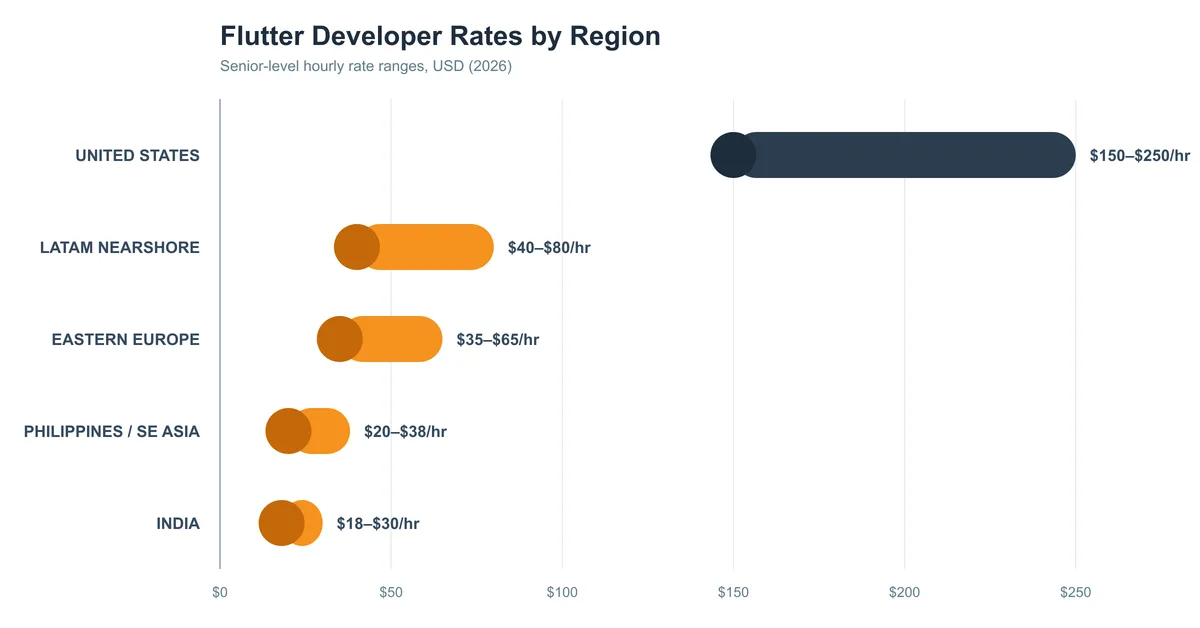
| Region | Annual Cost (Senior) | Hourly Rate | vs US Cost | Timezone |
|---|---|---|---|---|
| United States | $145,000–$220,000 | $150–$250/hr (agency) | Baseline | EST/PST |
| Eastern Europe | $30,000–$55,000 | $35–$65/hr | 55–70% lower | CET (6–8 hr ahead) |
| LATAM Nearshore | $25,000–$48,000 | $40–$80/hr | 45–65% lower | EST/CST aligned |
| India | $7,800–$18,000 | $18–$30/hr | 75–90% lower | IST (9.5–12.5 hr ahead) |
| Philippines / SE Asia | $18,000–$35,000 | $20–$38/hr | 70–85% lower | PHT (12–15 hr ahead) |
One note on hourly rates: the offshore numbers above reflect what you pay through a managed team or dedicated BPO model. Agency rates in the same regions run higher because the agency adds its own margin on top. A $25/hr developer in a Bangalore agency will often appear as a $45/hr line item on your invoice.
The 8 Top Flutter Development Outsourcing Companies for US Startups, Ranked
These eight companies are scored and ranked against five criteria that determine whether a Flutter engagement actually works past month three: engagement continuity, cost transparency, compliance and employment handling, technical specialization depth, and time zone alignment. The weightings favor what matters most for startups building past an MVP — continuity and cost clarity carry the most weight, since those are what break down first in a project-based engagement. Every score below is explained in the entry, including where a company loses points.
| Criterion | Weight | What It Measures |
|---|---|---|
| Engagement Continuity | 30% | Does the model support 12+ months of ongoing product work without a team or context reset |
| Cost Transparency | 20% | Is the rate you’re quoted the rate you pay, or is there an agency markup layered on top |
| Compliance & Employment Handling | 15% | Does the provider handle HR, benefits, and local employment law, or does that sit with you |
| Technical Specialization Depth | 20% | SDK-level expertise, vertical-specific experience, architecture complexity handled |
| Time Zone Alignment | 15% | Real-time overlap with a US working day, whether by geography or by hours worked |
| Rank | Company | Model | Score |
|---|---|---|---|
| 1 | Kore BPO | Dedicated Offshore Team | 8.9/10 |
| 2 | Very Good Ventures | Agency, US-Based | 6.6/10 |
| 3 | Near (HireWithNear) | Nearshore Matching | 6.2/10 |
| 4 | Lemon.io | Marketplace | 6.0/10 |
| 5 | Binary Studio | Agency, Eastern Europe | 5.9/10 |
| 6 | DOIT Software | Agency, Eastern Europe | 5.7/10 |
| 7 | Vivasoft | Agency, Offshore | 5.6/10 |
| 8 | Agicent Technologies | Agency, India | 5.0/10 |

How to Vet Any Flutter Outsourcing Partner Before You Sign
Most vetting mistakes happen at the proposal stage. The agency looks great in the deck. Then three months in, you realize the senior Flutter engineer who presented is not the one writing your code. Ask these before you commit.
- Ask for live App Store links, not portfolio PDFs. Download the app. Run it on two devices. A team that ships polished, stable Flutter apps has proof right there in the store. An agency that sends you screenshots of apps that no longer exist is telling you something important. According to Pangea’s Flutter vetting guide, this is the single fastest signal of real delivery capability.
- Ask about state management, specifically. In 2026, a credible Flutter team has a clear, reasoned position on state management. Riverpod and BLoC are the professional standard for production apps. If the answer is “we use what the client wants” without any reasoning behind it, that’s a team that hasn’t built enough production Flutter to have formed a real opinion. Not a dealbreaker. Worth probing further.
- Find out who actually builds vs. who sells. Ask directly: is the engineer on this call the one who will write code for my project? Salespeople and senior engineers are different people at most agencies. One team built the portfolio. Another team builds yours. Request a 30-minute technical call with the actual developer who will be assigned to your work before signing anything.
- Check the IP ownership clause before anything else. Your Flutter code should belong to you on day one, not upon final payment, not after a 90-day warranty period. If an agency resists straightforward IP assignment language, that’s a structural risk.
- Use time-and-materials with milestone-based payment releases rather than a single fixed-price contract. Fixed-price contracts create incentives to cut corners on the back half of a project. Milestone payments align the agency’s revenue with your delivery schedule.
- Ask what happened the last time a Flutter app they built broke in production. What was the bug? How long did it take to diagnose? How did they handle the client relationship during the outage? The answer tells you more about how they’ll behave when things go wrong for you than any portfolio can.
Looking for a Dedicated Flutter Engineer?
Kore BPO places offshore Flutter developers as permanent team members. No per-sprint billing. No project handoffs.
When Does Outsourcing Flutter Actually Make Sense?
Not always. And the answer changes based on where your startup is in its lifecycle. Getting this decision wrong in either direction is expensive.
Pre-seed founder with $150,000 in runway and an unvalidated product idea? Outsource. You can’t afford a US-based Flutter engineer, and you don’t need one. You need an MVP shipped in 14 to 18 weeks at 40 to 60% of domestic cost, which cuebytes.com’s founder guide consistently documents as achievable through offshore agencies for straightforward mobile builds.
Series A startup with $3M in the bank, a CTO who’s shipped five mobile apps, and 40,000 daily active users? The case for in-house gets stronger. You have the runway, the technical leadership, and the product complexity that benefits from a full-time internal engineer who deeply owns the architecture.
Most startups between those two points belong in dedicated offshore territory. You’ve validated the product. You need a Flutter developer who stays, learns the codebase, and iterates alongside the team. That’s not what an agency project delivers, and it’s not what a freelance marketplace sustains across 18 months.
| Stage | Runway / Situation | Recommended Model | Why |
|---|---|---|---|
| Pre-seed | Under $300K, unvalidated | Project Agency (offshore) | Fast MVP at minimum cost; don’t over-invest before product-market fit |
| Seed | $500K–$2M, early traction | Dedicated Offshore Team | Permanence without US salary burn; developer grows with the product |
| Series A | $3M+, strong PMF | Hybrid or In-house | Enough runway to hire senior talent locally if the CTO prefers direct control |
| Any stage | Short-term augmentation | Marketplace (Lemon.io) | Fill a specific gap without committing to a long-term engagement |
The smartest pattern we’ve seen works like this: outsource the first version through an agency or marketplace, then transition to a dedicated offshore engineer once the product has real users and real direction. That way you’re building what’s already validated, not guessing at architecture while burning through runway. It’s not the only sequence that works. But it’s the one that fails least often.
Questions Founders Ask Before Outsourcing Flutter
How much does it actually cost to outsource Flutter development?
Depends on the model and region. A project agency in Eastern Europe or India runs $25 to $65/hr for senior Flutter work. A US-based agency like Very Good Ventures starts around $150/hr. For a meaningful Flutter MVP (300 to 400 hours of development), that works out to roughly $10,000 to $26,000 through an offshore agency, versus $45,000 to $100,000 at US rates. Dedicated offshore team models cost more than pure project rates because you’re paying for continuity, not just hours. But the annual equivalent typically lands 60 to 75% below a US full-time hire’s fully-loaded cost.
Flutter vs. React Native for outsourcing — does the framework choice affect who you can hire?
Short answer: Flutter is now easier to staff offshore than React Native, which is the reverse of what it was three years ago. The Stack Overflow 2024 survey put Flutter at 46% adoption versus React Native’s 35% in the cross-platform category. Offshore talent pools, particularly in India, the Philippines, and Eastern Europe, have grown significantly since Flutter 3.0 and null safety landed. You’re more likely to find a credible Flutter engineer in Southeast Asia today than a React Native one. What’s harder to find: senior Flutter engineers with Riverpod + BLoC + custom rendering experience. That combination is still scarce regardless of region.
Realistically, how long does an outsourced Flutter MVP take?
14 to 18 weeks for most well-scoped builds, assuming you go into discovery with a clear feature list and don’t change the core scope mid-build. That’s the consistent figure from cuebytes.com’s 2026 outsourcing guide. The projects that blow past 18 weeks almost always share one of three characteristics: scope added after development started, integration dependencies on third-party APIs that weren’t documented in discovery, or a misaligned definition of “MVP” between the founder and the agency. The fix for all three is a tightly scoped discovery phase before development starts, not during.
How do you protect IP when working with an offshore Flutter team?
Three things: a mutual NDA before any technical discussion, an explicit IP assignment clause in the contract (not a work-for-hire assumption, an explicit assignment), and maintaining your own Git repository with access revoked upon project completion. The contract language matters. “Work for hire” assumptions don’t hold uniformly across jurisdictions. If your Flutter partner is in India, Ukraine, or the Philippines, the IP assignment needs to be explicit in the agreement, not implied. For dedicated offshore team models through a US-managed BPO like Kore BPO, the employment structure already places IP ownership on your side as the end client. For project agencies, have your attorney review the IP clause before you sign.
Agency vs. dedicated offshore team — what’s the real difference in practice?
The difference shows up around month four. An agency team finishes your project, hands off the code, and moves to the next client. Six months later, when you need a feature added or a bug traced through an architecture decision made eight months ago, you’re starting from scratch with whoever is available. A dedicated offshore engineer built the same code. They remember the decision. They know which third-party integration caused the authentication edge case. That context doesn’t cost nothing. It’s actually worth two or three weeks of onboarding time on any future change. For products that live past an MVP, the dedicated model compounds in ways the project model doesn’t. The math usually flips in favor of dedicated around the 12-month mark.
Disclosure: Kore BPO is the publisher of this article and ranks #1 using the scoring criteria disclosed above. Those criteria were designed around what determines long-term Flutter engagement success and reflect Kore BPO’s own dedicated offshore model, which we believe is a genuine advantage, not a hidden thumb on the scale. All seven other companies were independently researched and scored against the same five criteria. Rate data references Glassdoor salary figures as of 2026 and publicly available agency rate information. No paid placements.
Related Articles



Building with Flutter? Start with the Right Team.
Kore BPO places dedicated offshore Flutter engineers for US startups. Your developer, your codebase, your standups. No agency overhead.
See Flutter Engineer Roles