Data Scientist vs ML Engineer Offshore: Which Role Solves Your Actual Business Problem?


A data scientist finds the insight buried in your data. An ML engineer builds and runs the system that keeps insight working in production. Hire the first for open questions. Hire the second to make a model reliable at scale.
We get some version of this question almost every week from clients screening offshore data roles for the first time. “We need someone who knows machine learning, does that mean a data scientist or an ML engineer?” Wrong question, slightly. Every time. The right one is what’s actually broken in your business right now.
Most comparisons of data scientist vs ML engineer are written for someone choosing a career, not someone staffing a team. They rank skills, degrees, and salaries and leave you to guess which one fixes your problem. That’s backward. At Kore BPO, we vet and place both roles for clients across finance, ecommerce, and SaaS, and the pattern we see is consistent. Teams that hire based on job title instead of the problem in front of them end up re-hiring within six months. Twice, sometimes.
This guide skips the career-path framing entirely. It starts with the business problem, walks through what each role does day to day, and ends with a straight answer on which one to staff first, and when you genuinely need both.
What a Data Scientist Actually Does
A data scientist turns messy, disconnected data into an answer a business can act on. The job is exploration first, forming a hypothesis, testing it against real numbers, and explaining what the data actually says before anyone builds anything on top of it.
Strip away the job board buzzwords and the daily work looks like this. Pull data from three systems that were never designed to talk to each other. Clean it. Tedious part. Run a regression, a clustering model, or a simple A/B test, whichever answers the question fastest. Write up what it means in language a VP of Sales can act on Monday morning. Repeat with a slightly different question next week.
Good data scientists are strong in Python or R, comfortable with SQL, and fluent in statistics, but the real differentiator is judgment. Knowing which question is worth three weeks of analysis and which one is a dead end after two hours. That instinct doesn’t show up on a resume. Not on paper. We test for it directly in our screening process, usually with a messy, real-world dataset and a vague business question, because a clean textbook prompt tells you nothing about how someone handles ambiguity.
Best fit is churn analysis, pricing experiments, customer segmentation, forecasting, and any question where the answer is a decision, not a deployed system.
What an ML Engineer Actually Does
An ML engineer takes a model, whether built by a data scientist or off the shelf, and makes it run reliably in production. The job is software engineering with machine learning as the domain, covering deployment, monitoring, retraining, and keeping a model from quietly degrading while nobody’s watching.
Where a data scientist asks “what does this data tell us,” an ML engineer asks “how do we ship this and keep it alive.” Different question. Different skill set entirely, even though both roles get lumped under “AI talent” in most job postings. Nothing alike, really.
Day to day, that means containerizing a model with Docker, building the pipeline that feeds it fresh data, setting up monitoring so someone gets paged when accuracy drifts, and rebuilding the retraining loop when the world changes underneath the model, which it always does. Stanford lecturer and O’Reilly author Chip Huyen frames the split as research versus production, and that’s the cleanest version of it we’ve found. PyTorch or TensorFlow, Kubernetes, CI/CD pipelines, cloud infrastructure. Different toolkit entirely. None of that shows up in a data scientist’s typical stack, and that’s the point.
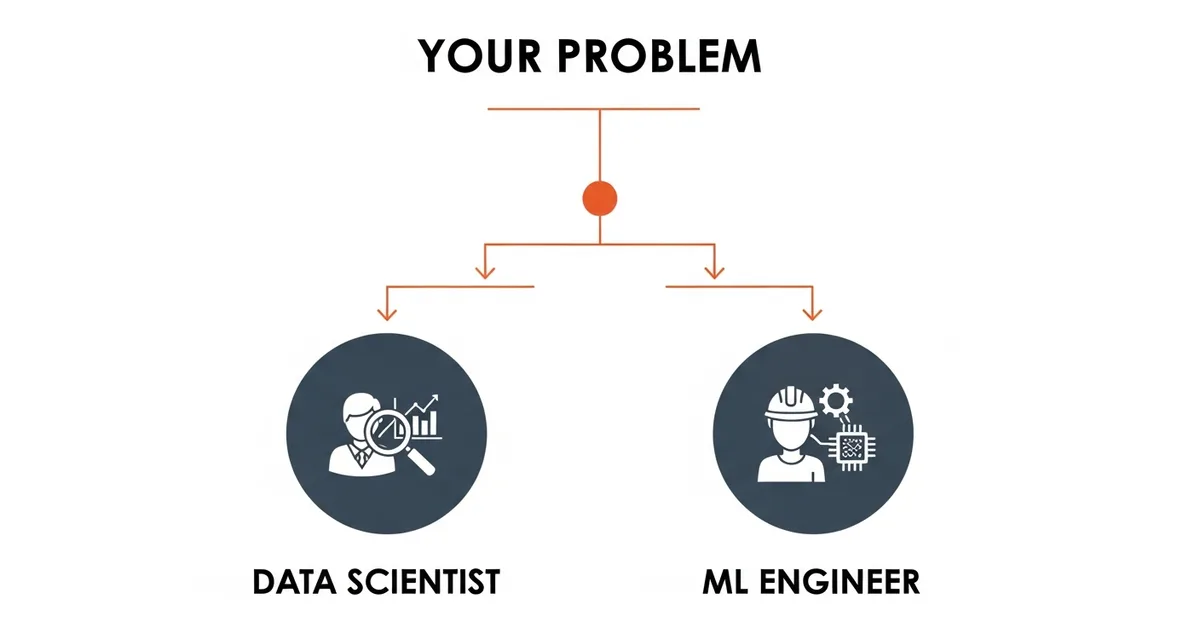
A data scientist without engineering support usually can’t deploy their own model into a live system. An ML engineer without a data scientist upstream usually has nothing worth deploying. Neither role replaces the other, no matter what a job posting titled “Data Scientist / ML Engineer” implies.
The Real Difference: Insight vs. Production
Here’s the split that actually matters, and it’s not skills or salary. It’s what happens to their work after it’s done. A data scientist’s output is a finding. An ML engineer’s output is a running system. One ends in a slide deck. The other ends in an API endpoint that has to work at 3am without anyone watching it, no matter how quiet the office got the night before. Two very different jobs.
That difference explains why the hiring market has quietly moved. In a 2025 review of 1,000 machine learning job postings by Powerdrill, “Machine Learning Engineer” was the single most listed title, appearing 243 times. “Data Scientist” showed up 116 times, roughly half as often. Production roles are winning the job board. Simple as that.
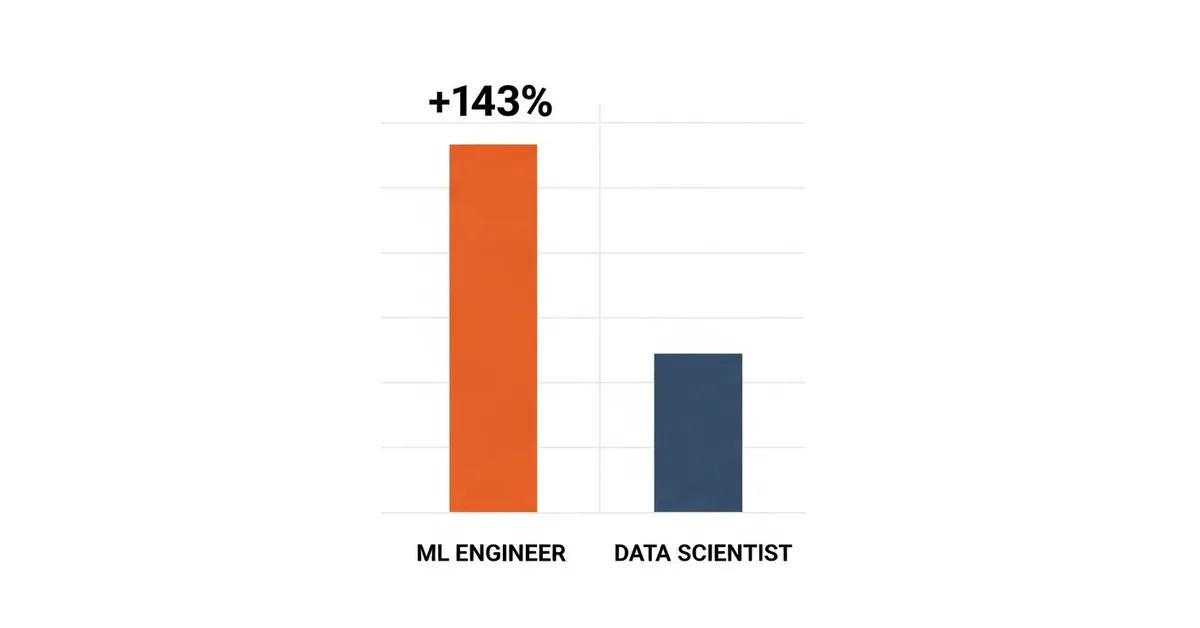
LinkedIn’s numbers back that up from a different angle. Its 2026 Jobs on the Rise report ranks AI Engineer, essentially the production-focused ML role, as the number one fastest-growing job title in the US, with postings up 143% year over year in 2025. Meanwhile BLS still projects data scientist employment growing 34% through 2034, well above average for all occupations, and that gap between the two projections is exactly what you’d expect once you accept that one role answers questions and the other keeps answers alive. Both roles are growing. Not evenly, though. One is growing faster because companies have already answered their exploratory questions and now need someone to keep the resulting models alive.
Worth a caveat here. There’s no official BLS occupation code for “ML Engineer” specifically. The closest government proxy, Computer and Information Research Scientists, projects 20% growth through 2034, itself well above average. The government’s classification hasn’t caught up to how fast this specific title split off from “data scientist.” The market has moved faster than the taxonomy tracking it. Taxonomy lags reality.
Which Role Solves Your Actual Problem?
Match the hire to what breaks if the work is wrong. If a bad answer costs you a bad decision, hire a data scientist. If a broken system costs you a bad Tuesday, or a bad quarter, hire an ML engineer.
Forget the resume comparison for a second. Ask what happens if this role’s work fails. A data scientist’s wrong hypothesis wastes a few weeks and gets corrected in the next analysis. An ML engineer’s broken deployment pipeline can take a revenue-generating feature down in production while customers are actively using it. Same general skill area. Very different blast radius. Worth remembering.
| Your Business Problem | Hire This Role | Why |
|---|---|---|
| “We don’t know why churn spiked last quarter” | Data Scientist | Open-ended question, needs exploratory analysis before anything gets built |
| “Our recommendation engine needs to go live and stay live” | ML Engineer | Deployment, monitoring, and uptime are the actual job here |
| “We have a hunch about pricing but no way to test it” | Data Scientist | Hypothesis testing and statistical rigor come first |
| “Our fraud model’s accuracy keeps dropping” | ML Engineer | Model drift and retraining pipelines are an engineering problem, not a research one |
| “We need someone to build a proof of concept, then own it in prod” | Both, staged | Data scientist proves the concept, ML engineer takes it live and maintains it |
Notice the pattern. Questions point toward a data scientist. Systems point toward an ML engineer. If you’re staring at a dashboard trying to understand a number, that’s exploration. Simple test, really. If you’re staring at an uptime alert, that’s production. Most SMB teams we work with only have one of these problems at a time, which makes the first hire more obvious than they expect once they name it out loud.
Ready to see who fits? Browse the offshore data scientist role for exploration-first hires, or the offshore ML engineer role for production-first hires. If your need is really just dashboards and recurring reporting rather than modeling of either kind, an offshore data analyst is usually the cheaper, faster-to-place fit.
Not Sure Which Role Fits Your Problem?
We’ll walk through your use case and match you with the right offshore profile. $0 upfront.
When You Need Both (or Neither Yet)
Nobody writes about this part, and it’s the part that actually trips teams up. Plenty of companies hire a data scientist, get a genuinely useful finding, and then have no one on staff who can turn it into a running system. The insight sits in a Jupyter notebook forever. Expensive notebook.
The reverse happens too, and it’s worse. A company hires an ML engineer expecting them to also do the exploratory legwork, discover the pattern, frame the hypothesis, validate it statistically, then also deploy it. That’s two full jobs stacked on one person. It works for a while. Not forever. Then it doesn’t, usually around the time the backlog of “should we investigate this” questions outgrows what one person can carry alongside on-call duty.
Here’s a useful gut check before you hire either role. Ask where you actually stand right now.
- Already have a validated model, or even just a strong hypothesis, sitting somewhere? You probably need an ML engineer to operationalize it.
- Still asking “why is this happening” with no hypothesis yet? Start with a data scientist, full stop.
- No data pipeline, no clean dataset, no defined question at all? Neither role helps you yet, and you need a data engineer to build the plumbing first.
We’ve seen clients skip that last step and hire a data scientist who then spends two months just getting access to clean data before doing any actual science. Common mistake.

Bias disclosed, since we place both roles for a living. Fair warning. We’re not saying you need to hire two people. If you only have one problem right now, one hire, staged correctly, gets you further than two people working past each other on ambiguous scope.
What Offshore Hiring Actually Costs for Each Role
Offshore data scientists and ML engineers both typically run 60 to 70% below equivalent US salaries, with candidate profiles delivered in 2 to 5 business days through Kore BPO. Full placement for a data scientist role usually lands in 2 to 4 weeks.
The Stack Overflow Developer Survey put the 2025 US median salary for AI and ML engineering roles at $189,500, notably a category the survey folded data scientist and ML engineer titles into together this year, which is itself a small data point about how blurred these titles have gotten in practice. BLS puts the median data scientist wage at $112,590 as of May 2024. Either way you slice it, US-based hires for both roles run six figures before benefits, equity, or recruiting fees. Not cheap, either way.
Offshore doesn’t erase that cost. It compresses it. That’s the honest framing. Most offshore data scientist and ML engineer placements through Kore BPO come in at 60 to 70% below the US figures above, depending on region and seniority. That’s not a discount code. Same bar, different zip code. It’s the same talent pool, screened the same way, at a market rate that reflects where they’re based rather than where your headquarters happens to sit.
McKinsey research finds 77% of companies say they lack the data talent they need for mission-critical work. That gap doesn’t close by waiting for the US labor market to loosen up. It closes by widening the geography you’re willing to hire from, and vetting harder within it, since a bigger candidate pool only helps if the screening process is actually good enough to separate real talent from a well-formatted resume. Simple math, really.
The short version. Data scientists answer questions. ML engineers keep answers running. Most companies think they need one when they actually need the other, and a fair number don’t need either yet because the data plumbing underneath isn’t ready. Name your actual problem before you write the job description. The title follows the problem, not the other way around.
If you’re ready to staff either role, or you’re still not sure which one fits, start with our offshore roles overview or reach us directly at 214-347-8509.
What People Ask Before They Hire
Can one person do both jobs, data science and ML engineering?
At a very small startup, sometimes, for a while. Not for long, though. Once you have more than one or two models in production, the exploration and the engineering work start competing for the same person’s calendar, and one of them loses. Usually the engineering side, since deployed systems generate urgent fires that beat out slower research work every time.
Which pays more, data scientist or ML engineer?
ML engineer roles generally command a premium in the US market, partly because production ownership carries more operational risk than exploratory analysis. Stack Overflow’s 2025 survey put the combined AI/ML engineering median at $189,500 in the US. Offshore, that gap narrows since both roles typically price 60 to 70% below US rates regardless of title.
Do offshore data scientists need a master’s or PhD?
Not always. A bachelor’s in statistics, computer science, or a related field covers most SMB use cases fine. We reserve the PhD requirement for genuinely research-heavy roles, novel model architecture, publication-grade statistical work, that kind of thing. For most churn, pricing, and forecasting projects, a strong bachelor’s or master’s candidate with real project experience outperforms a credentialed generalist.
What’s the real day-to-day difference between the two roles?
A data scientist’s calendar is full of analysis blocks and stakeholder readouts. An ML engineer’s calendar is full of deploy windows, monitoring dashboards, and on-call rotation. Same underlying domain, machine learning, almost entirely different rhythm to the actual week.
Should a startup hire the data scientist or the ML engineer first?
Depends on what already exists. No validated hypothesis yet, start with a data scientist. Already have a working model sitting in a notebook that nobody’s deployed, start with an ML engineer. Most early-stage teams default to “ML engineer” because the title sounds more technical, then discover six months in that nobody ever answered the underlying business question in the first place.
Is an ML engineer just a data scientist who can code better?
Wrong question, slightly. Both roles code. The difference is what the code is for. A data scientist writes code to answer a question once. An ML engineer writes code to keep a system answering correctly every time, indefinitely, under load, while people are asleep. That’s a software engineering discipline that happens to specialize in machine learning, not a coding upgrade on top of data science.
Related Articles



Hire the Role That Fits Your Problem, Not the Job Title
Kore BPO screens and places offshore data scientists and ML engineers matched to your actual use case. Pre-screened profiles in 2 to 5 days.
Browse Offshore Roles