Most “build vs offshore” conversations about data transformation start in the wrong place. They start with which tool is more powerful, when the real question is which one survives a handoff to someone who didn’t write it.
Same question. Every time. That’s the actual decision sitting in front of you if you’re staffing up an offshore data team and choosing between dbt, hand-rolled SQL scripts, and database stored procedures. All three can turn raw, loaded data into something a dashboard can use. Only one of them makes it obvious, to a stranger, six months from now, what changed and why.
This isn’t a tooling debate. It’s a risk allocation problem. Get the sequencing wrong and you’ll spend your first offshore quarter untangling a 400-line stored procedure nobody documented, instead of shipping anything new.
What “Data Transformation” Actually Means Here
“Data transformation” is the layer that turns raw, loaded data into analysis-ready tables: joins, deduplication, business logic, aggregations. dbt, SQL scripts, and stored procedures are three different ways to write and run that same logic. None of them change what the data becomes. Same output. Different risk profile entirely. What changes is who can read the logic later, how confidently they can touch it, and how much of that confidence depends on the original author still being in the room.
dbt wraps plain SQL SELECT statements in a framework: version control through Git, automated tests, auto-generated documentation, and a dependency graph that shows what breaks if you change something upstream. SQL scripts are just files. No framework enforces how they’re organized, reviewed, or tested, so whatever discipline exists has to come from your team. Stored procedures live inside the database itself, written in a database-specific procedural language like T-SQL or PL/pgSQL, and they run without leaving the database at all.
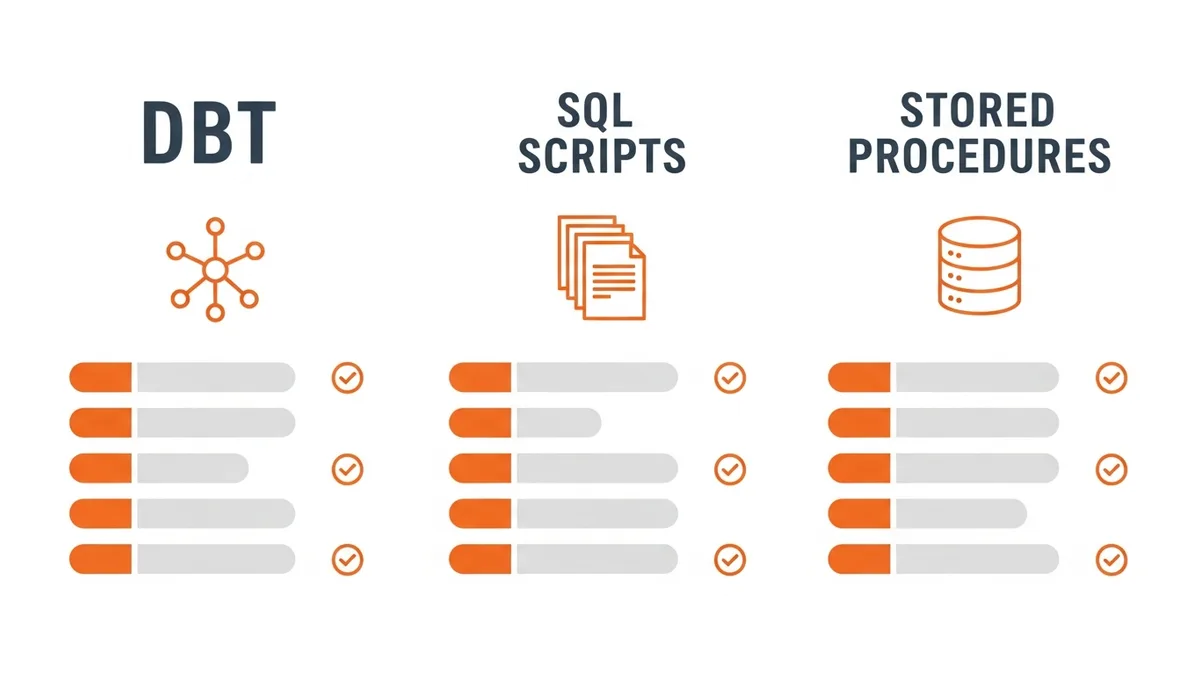
| Dimension | dbt | SQL Scripts | Stored Procedures |
|---|---|---|---|
| Version control | Native, via Git | Manual, if the team enforces it | None built in |
| Built-in testing | Yes | No | No |
| Documentation | Auto-generated from the code | Whatever someone writes separately | Drifts from the code fast |
| Where the logic lives | Git repository | Git repository, if disciplined | Inside the database |
| Review workflow | Pull request, before merge | Depends entirely on the team | Often direct to production |
| Best fit | Analytical, batch transformations | One-off or lightly governed jobs | Procedural logic, loops, temp tables |
dbt: Built for a Team That Didn’t Write the Code
dbt is the safest starting point for an offshore handoff because every model lives in Git, goes through a reviewable pull request, and runs against automated tests before it reaches production. That structure hands a new hire guardrails on day one instead of a folder of unlabeled queries. No mystery folder. No guesswork required.
A broken test fails the build the moment someone opens a pull request, before it ever touches a shared warehouse or a downstream dashboard anyone actually looks at. It doesn’t fail quietly three weeks later when a VP asks why last month’s revenue number looks wrong. One dbt Cloud customer documented by dbt Labs went from 65% pipeline uptime to 99.9% after migrating off stored procedures. That’s not a rounding error. That’s the difference between a pipeline that quietly breaks every few days and one nobody has to think about.
Kahan Data Solutions makes a similar point about modularity: each transformation step lives as its own model, which means an offshore engineer can own one piece without needing to understand the entire pipeline before they’re productive. That’s a meaningfully lower bar to clear on week one. Onboarding gets shorter. So does the list of things that can go catastrophically wrong while someone is still learning your data.
None of this means dbt is flawless. Nowhere close. It requires Git workflows, YAML configuration, and Jinja templating, none of which every SQL-only analyst already knows, and it doesn’t support temporary tables, which matters for a specific slice of procedural logic covered below.
Raw SQL Scripts: Flexible, But You Own the Entire Review Burden
SQL scripts are just files. Nothing about the tool decides how they’re organized, tested, or reviewed. Whatever discipline exists has to come from your team, not the platform. That’s fine when the person writing the script is you, and you catch your own mistakes before anyone downstream sees them.
It’s a different story when the person writing it is someone you hired two weeks ago and haven’t watched work yet. Different person. Different risk.
With dbt, a broken model fails a CI check before it ships. With a raw SQL script, a broken transformation fails in production, and you find out from a Slack message asking why last month’s numbers moved. There’s no framework standing between a mistake and your dashboard. There’s only whoever happens to review the pull request, if there’s a pull request at all.
Scripts still make sense in narrow situations: a small in-house team with one senior engineer who personally reviews every change, or a one-off analysis that will never run twice. Neither of those describes a new offshore hire touching production data for the first time. Handing raw scripts to someone you haven’t built trust with yet is handing them the review job too, whether you meant to or not.
Stored Procedures: Fast, But the Black Box Risk Is Real With a New Team
Stored procedures run inside the database and skip network round trips entirely, which makes them genuinely faster for certain procedural logic. That speed comes with a cost most teams don’t notice until it’s their problem. There’s no built-in version control, so an offshore hire inherits code history that nobody wrote down. No changelog. No trail to follow.
As one data engineering migration guide puts it, stored procedures tend to be controlled by the few people who dare to edit them, with little enforced review before changes go live. That’s manageable when your team is three people who’ve worked together for years. It becomes a real liability the moment you add someone new who doesn’t know which line of a 400-line procedure is load-bearing and which is a leftover from 2023.
Stored procedures aren’t obsolete, though. Not even close. Hevo’s comparison notes that procedures still win for highly procedural logic involving loops, transactions, or temp tables, none of which dbt handles natively. If your pipeline genuinely needs that, keep the procedure. Just narrower than most teams assume. Don’t hand it to a new offshore hire as their first task with no documentation and no one to ask.
See Kore BPO’s Data Engineering Roles
Vetted offshore data engineers and dbt developers, resumes in 2 to 5 business days.
Which to Offshore First, by Team Maturity
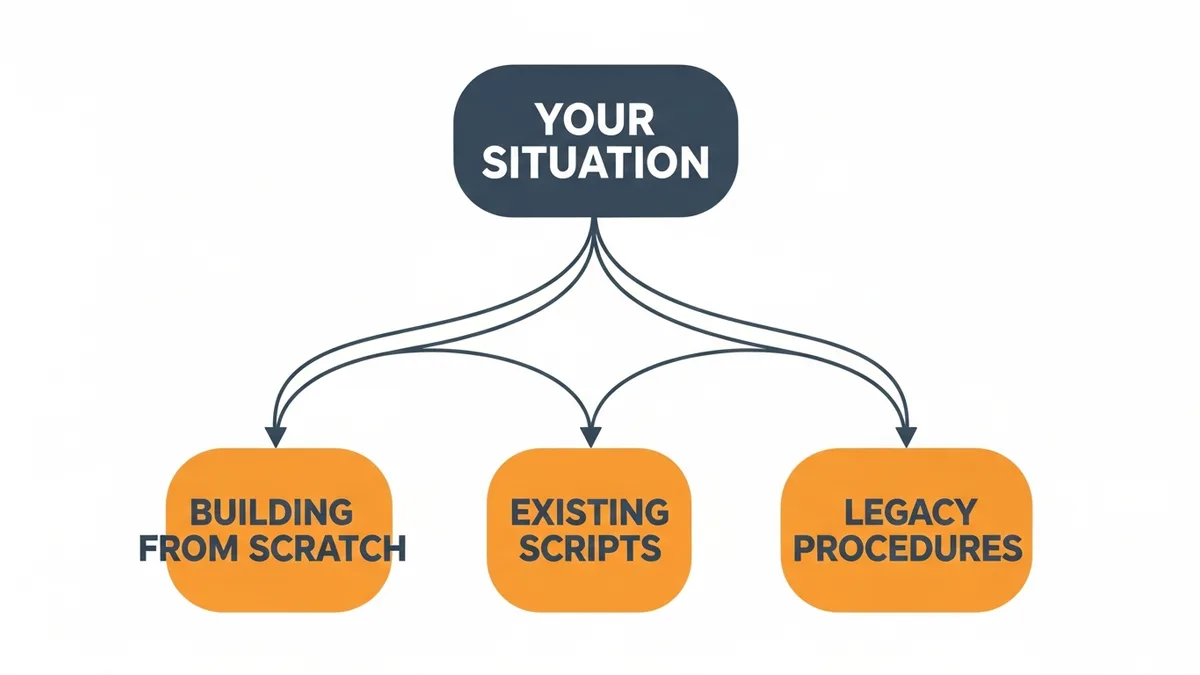
The right first move depends less on the tool and more on what you already have running. Three situations cover most companies.
No transformation layer yet, building from scratch: start with dbt. No legacy code. No baggage to migrate, so you skip the hardest part of any modernization project and go straight to the version-controlled, testable version. This is the cleanest offshore onboarding path there is, because the first thing a new hire touches already has guardrails.
Existing SQL scripts, adding offshore headcount: a supervised dbt migration is a safer offshore project than ongoing script maintenance. Scripts without structure are hard for anyone to inherit safely. Turning them into dbt models, one at a time, gives an offshore data engineer a bounded, reviewable task instead of open-ended access to unreviewed production logic. Small steps. Reviewed steps.
Legacy stored procedures, mission-critical, no appetite to migrate yet: don’t start with a rewrite. Start by having an offshore database developer document what the procedures actually do, add monitoring, and stabilize what’s there. Migrate later, once someone besides the original author actually understands the system. Order matters here. Skipping this step is how “modernization projects” turn into six-month outages.
Who this framework is for: engineering leaders staffing their first offshore data hire, or teams that already have one offshore engineer and are deciding what to hand them next. Who it’s not for: teams with zero in-house SQL competency at all. If nobody internally can read the transformation logic today, offshoring it first just moves the knowledge gap somewhere else. Fix that baseline before you hire.
What This Looks Like With a Real Offshore Hire
In practice, the handoff usually breaks down before the code does. Same pattern, every time. Across the offshore data engineering placements Kore BPO has staffed, the projects that stumbled early almost always started the same way: a stored procedure with no comments, and a one-paragraph Slack message as the entire onboarding document.
Compare that to how it goes with dbt. A new offshore database developer gets read access to a Git repo, a docs site generated straight from the model definitions, and a first task scoped to one model with its own test suite. They open a pull request. Someone reviews it before it merges. Nobody hands over the production database password on day one, because nobody needs to.
That’s not a small difference. Not a marginal one either. It’s the difference between an onboarding process and a leap of faith.

Handoff Mistakes That Turn a Good Tool Choice Into a Bad Outcome
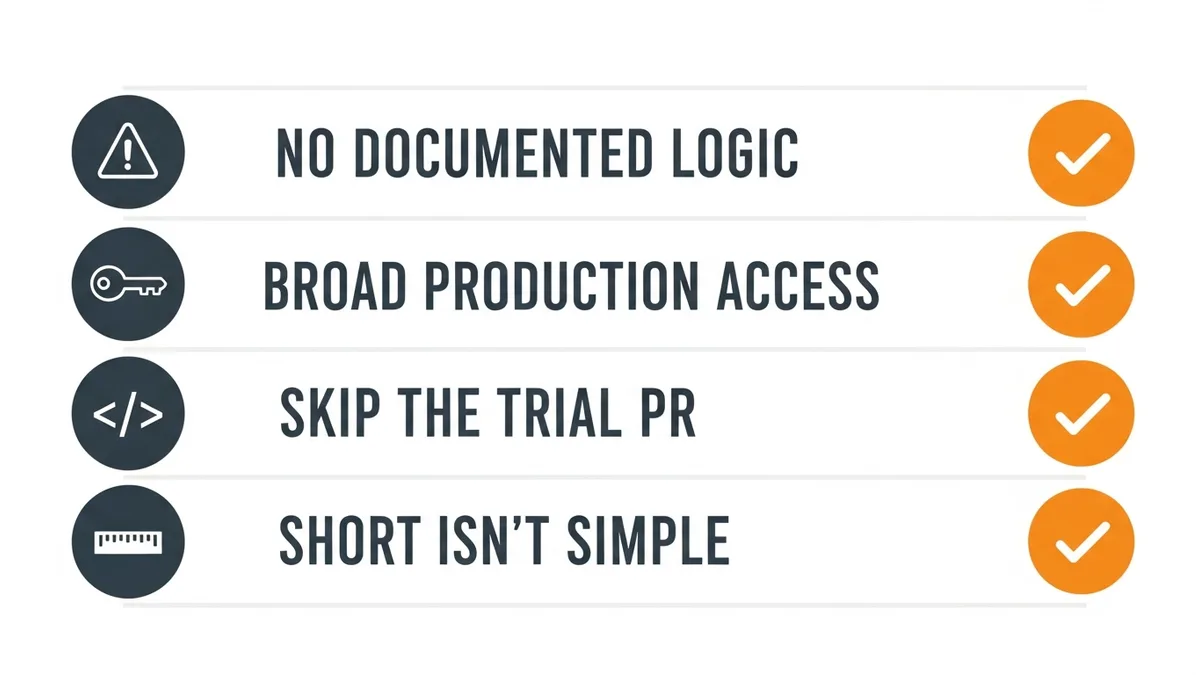
Even the right tool choice fails if the handoff itself is sloppy. Four mistakes. All preventable. These show up more than any others.
None of the three approaches is universally right. dbt wins for teams building or rebuilding a transformation layer with an offshore hire in mind from the start. Stored procedures still earn their place for procedural logic dbt can’t touch. SQL scripts work when someone senior is watching every line, which stops being true the moment you scale headcount offshore.
Pick the approach that survives a handoff, not the one that’s fastest to write today. That’s the whole decision. Nothing more complicated than that.
If you’re staffing a data engineering role around this decision, Kore BPO places vetted offshore data engineers, database developers, and dbt specialists who’ve done this handoff before. Start at korebpo.com/offshore-roles to see current roles and typical placement timelines.
What Teams Ask Before Offshoring Their Transformation Layer
Can dbt replace stored procedures entirely?
Mostly, but not completely. dbt covers the vast majority of analytical, batch-style transformations well. It doesn’t support temporary tables natively, and it isn’t built for procedural logic full of loops and conditional branching. Most teams end up running dbt for 90% or more of their transformation logic and keeping a handful of stored procedures for the specific cases that need them. Full replacement is technically possible on Snowflake and a few other platforms with workarounds. Rarely worth forcing, though.
Is dbt hard to learn for someone who’s only written stored procedures?
Not particularly, if they already know SQL well. The syntax itself is plain SQL with Jinja templating layered on top for reusability. The real learning curve is the Git workflow: branches, pull requests, code review. That part takes most engineers one to two weeks to feel natural, longer if they’ve never used version control for anything beyond saving files.
Do stored procedures still make sense anywhere in 2026?
Yes. Highly procedural logic, multi-step transactions, and anything requiring temp tables still favor stored procedures over dbt. Performance-critical operations that benefit from running entirely inside the database, with zero network round trips, are another case where procedures hold up. The mistake isn’t using stored procedures. It’s using them for everything, including analytical work dbt handles better.
Realistically, how long does a stored-procedure-to-dbt migration take?
Anywhere from six weeks to six months, depending on how many procedures exist and how well documented they are. A pipeline with 20 to 30 well-understood procedures might convert in six to eight weeks with a dedicated engineer. A legacy system with 200 undocumented procedures written over a decade by people who’ve since left the company is a different project entirely, and rushing it is how migrations turn into outages.
What should you ask an offshore data engineer about their dbt experience?
Skip “do you know dbt” entirely. Ask them to walk through how they’d structure a staging, intermediate, and mart layer for a specific dataset you describe. Ask what tests they’d add and why. Ask how they’d handle a model that suddenly breaks a downstream dashboard. Candidates who’ve only read the docs give generic answers. Candidates who’ve actually shipped dbt in production get specific fast, usually within the first follow-up question.

Related Articles



Ready to Offshore Your Data Transformation Layer?
Kore BPO places vetted offshore data engineers, database developers, and dbt specialists for US companies. Resumes in 2 to 5 business days.
See Offshore Roles