
Ask ten business owners what their data engineer does all day, and most will say something like “moves data around.” Fair enough. But there’s a decision buried inside that job description that almost nobody asks about directly, and it’s the one that quietly decides whether your reporting is fast, your infrastructure bill is reasonable, and your compliance team can sleep at night.
That decision is ETL vs ELT. It sounds like a technical footnote. It isn’t. It shapes what your pipeline costs to run, how fast your team sees fresh numbers, and, more to the point of this article, what skills you actually need when hiring an offshore data engineer to build and run it. Confuse the two and you either hire the wrong skill set or pay for infrastructure you don’t need.
This isn’t another engineer-to-engineer explainer. Every top-ranking page on this topic is written for someone who already has the job. This one is written for the person about to hire for it.
What ETL and ELT Actually Mean
Both are three-letter acronyms for the same three verbs in a different order, and that order is the entire story. Order matters. That’s the whole article, really.
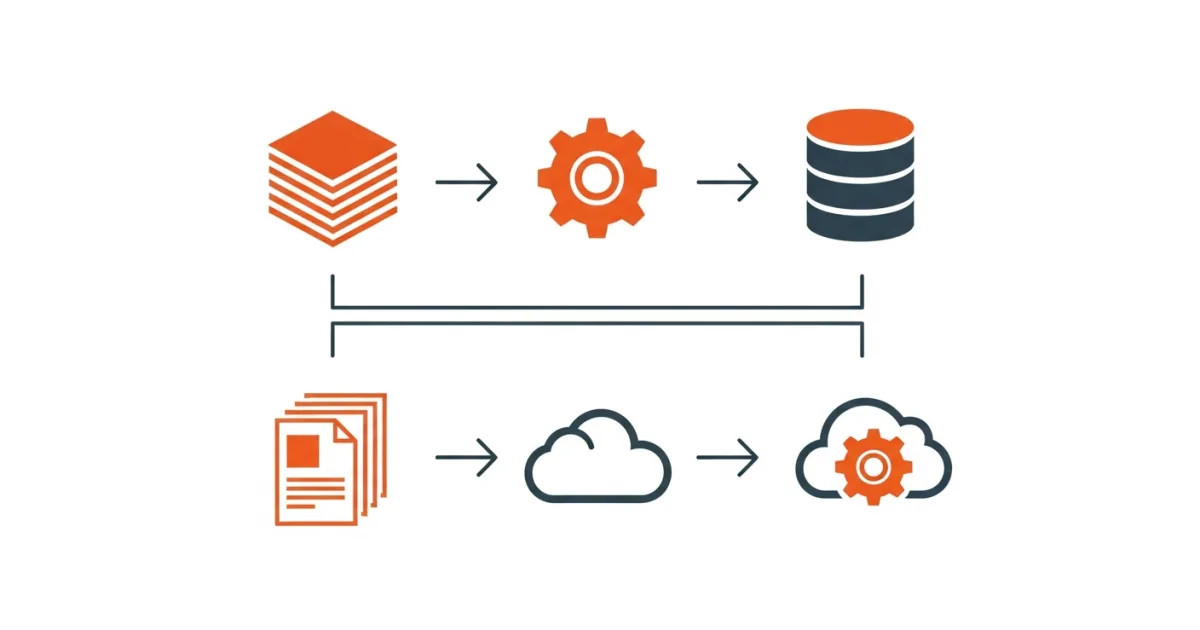
ETL stands for Extract, Transform, Load. Data gets pulled from its source (a CRM, a billing system, a spreadsheet nobody admits still exists), cleaned and reshaped in a separate staging area outside the warehouse where a dedicated engine handles the reformatting before anything moves further downstream, and only then loaded into its final destination. The transformation happens before the data ever touches your warehouse.
ELT flips the last two steps. Extract, Load, Transform. Raw data gets pulled and dropped into the warehouse as-is, messy formatting and all, and the cleanup happens afterward, inside the warehouse itself, using the warehouse’s own processing power instead of a separate machine somebody has to provision, patch, and pay for every month.
That’s it. That’s the whole difference on paper. Where the real difference shows up is in cost, speed, and who you need sitting behind the keyboard. Every time.
The Core Difference in Plain English
Here’s the 40-second version a non-technical founder actually needs. No jargon. ETL cleans before it stores. ELT stores before it cleans. Everything else, the tooling, the pricing, the hiring implications, follows from that one sequencing choice.
| Factor | ETL | ELT |
|---|---|---|
| When transformation happens | Before loading, in a staging server | After loading, inside the warehouse |
| Best data volume | Smaller, structured datasets | Large, mixed structured and unstructured data |
| Speed to first insight | Slower, transformation is a bottleneck upfront | Faster, raw data lands immediately |
| Sensitive data handling | Stronger, PII can be masked before storage | Weaker by default, raw data sits exposed until cleaned |
| Infrastructure needed | Separate transformation server or engine | Just warehouse compute (Snowflake, BigQuery, Redshift) |
| Typical 2026 use case | Legacy systems, healthcare, finance | Cloud-native SaaS, analytics-heavy teams |
Neither one is objectively better. Truly. Not a hedge. That’s the part most comparison articles gloss over because “it depends” doesn’t make for a satisfying headline, and headlines sell better than honesty most days of the week. It genuinely depends here, and the next two sections tell you which side of that line your business actually sits on.
When Your Business Should Still Use ETL
ETL isn’t legacy junk waiting to be replaced. It still works. It’s the right call in a specific, common set of situations, and the businesses that skip this section tend to find out the hard way, usually during an audit.
- Your company handles healthcare, financial, or other regulated data under HIPAA, GDPR, or CCPA and needs to mask or strip personally identifiable information before it lands anywhere permanent.
- Your infrastructure is still largely on-premises, without the elastic compute a cloud warehouse gives you for cheap in-warehouse transformation.
- Your data volume is genuinely small and structured. A few relational databases feeding a couple of reports don’t need a lakehouse.
- Your business logic and reporting requirements are stable and don’t change quarter to quarter, so building the transformation logic once upfront is efficient rather than repetitive.
The compliance angle gets missed constantly. If company policy says raw PII should never land in a data lake unmasked, that’s not a preference. That’s a requirement that points you straight at ETL, or at minimum a hybrid where sensitive fields get tokenized pre-load even if everything else runs ELT.
Not a small niche. None of that is a small niche, either. Roughly 39% of the market still runs traditional ETL for exactly this reason, according to Mordor Intelligence’s 2026 data integration analysis. Anyone telling you ETL is dead is selling something. Not even close.
When ELT Is the Right Call
ELT wins when you have the cloud compute to absorb the transformation cost after loading, and in 2026, that’s most growing businesses.
Cheap compute changed everything. Cloud data warehouses like Snowflake, BigQuery, and Redshift made ELT the practical default because they made in-warehouse transformation cheap and fast at scale. You’re no longer paying for a separate transformation server. You’re using compute you already own. Our own cloud data warehousing guide for SMBs walks through picking the right warehouse if you haven’t landed on one yet.
ELT also handles the messy stuff ETL struggles with. JSON blobs, event logs, IoT sensor streams, unstructured text. Load it all first, decide how to shape it later. That flexibility is exactly why fast-moving SaaS and analytics-heavy teams default here without a second thought. No debate needed.
The tradeoff is real, though. Raw, unmasked data sits in the warehouse until someone transforms it, which means access controls, row-level permissions, and governance policy all matter more, not less, especially once more than a couple of people can query the raw tables directly. An offshore database developer who understands warehouse-side permissions and row-level security is doing real risk management, not just writing SQL.
Most companies we work with don’t run pure ETL or pure ELT. They run a hybrid, ELT for the bulk of analytics data, with a thin ETL layer bolted on for anything touching PII. If someone tells you it has to be one or the other, they’re oversimplifying.
What’s Actually Running Under the Hood
Knowing the acronym is one thing. Knowing what tool your future hire will actually open every morning is another, and this is where a lot of hiring conversations fall apart before they start.
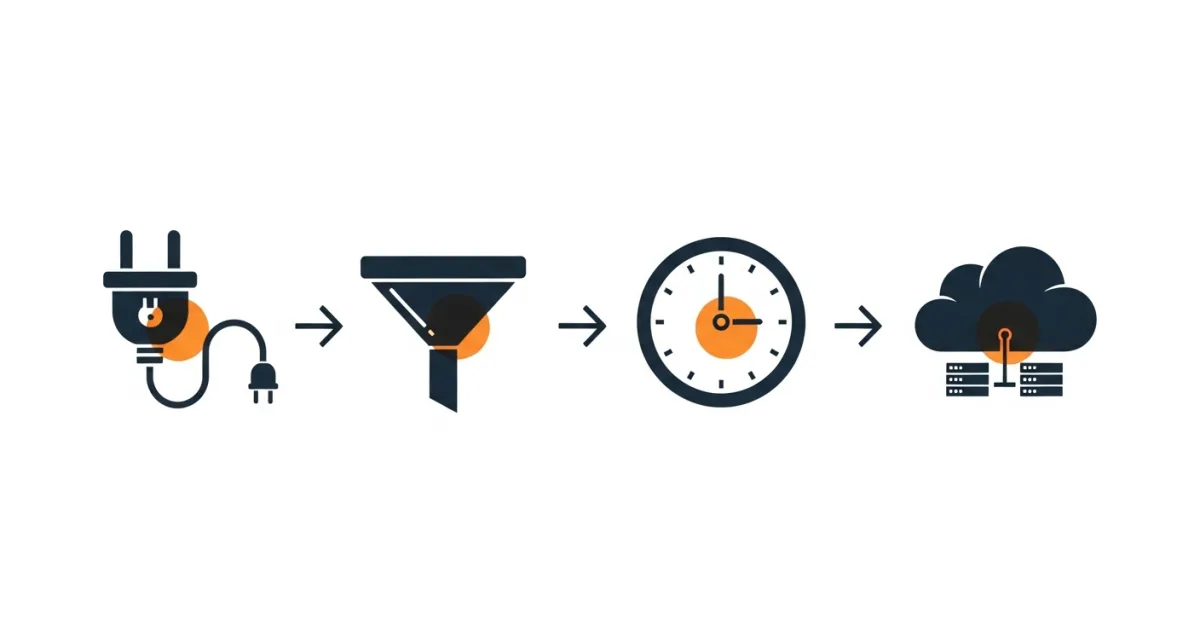
Three layers. That’s really all it is. A modern ELT stack usually breaks into three layers, and knowing the names helps you sanity-check a resume in about ten seconds.
- Ingestion (the E and L) uses tools like Fivetran or Airbyte to pull data from sources and land it in the warehouse. Fivetran is managed and fast to set up. Airbyte is open-source and favored by teams that want more control.
- Then there’s transformation (the T), and this is almost always dbt now. dbt doesn’t move data anywhere. It writes the SQL logic that reshapes what’s already sitting in the warehouse.
- Orchestration ties it together. Apache Airflow schedules and sequences the whole pipeline so nothing runs out of order at 3am and quietly breaks a dashboard.
Names matter here. A resume that lists “ETL” with no tool names attached tells you almost nothing. Nothing at all. A resume that says Fivetran, dbt, and Airflow, or the ETL-side equivalents like Informatica or SSIS, tells you exactly what stack this person has actually touched, and it gives you something concrete to ask about in the very next interview question.
Not Sure Which Stack Fits Your Business?
Kore BPO is a US-owned offshore hiring partner that places pre-screened data engineers matched to your actual stack, ETL, ELT, or hybrid, in 2 to 5 days.
Reverse ETL, Explained Simply
Here’s the piece almost nobody explains to a business owner, and it’s worth the detour because you’ll hear the term eventually, usually from a vendor trying to sell you a platform that does it. Worth knowing first.
Reverse ETL does the opposite of everything above. Instead of moving data into your warehouse, it takes the cleaned, modeled data that’s already there and pushes it back out into the tools your team uses daily, your CRM, your email platform, your support desk.
Simple example. Say your warehouse calculates a customer health score every night. Reverse ETL is what gets that score into Salesforce so your sales rep sees it without ever opening a dashboard. Data flows in, gets modeled, flows back out to where decisions actually get made. Closed loop.
You probably don’t need this on day one. Most companies don’t. But if your team keeps exporting spreadsheets from the warehouse to manually update the CRM, that’s the exact pain reverse ETL exists to kill.
What This Means When You’re Hiring a Data Engineer
Here’s the part that actually matters to you as the person signing the offer letter, not the person writing the SQL. Read this part twice.

Simple test. If you’re building on a modern cloud warehouse and your data is mostly structured business data, hire for ELT fluency first. That means dbt, SQL depth, and comfort with Fivetran or Airbyte. If you’re in a regulated industry or running legacy on-prem systems, weight the interview toward ETL platform experience and data masking discipline instead.
Bias disclosed, we place data engineers for a living, so take this as an operator observation and not a pitch. Small mistake. Expensive one. The one we see constantly is a company hiring a generic “data engineer” without specifying which side of this line they need, then discovering three months in that their new hire has never touched dbt, or worse, has never handled PII masking in an industry that requires it.
- Map your compliance requirements first, before anything else, because retrofitting masking rules into a pipeline that’s already live is far more expensive than designing around them from day one. If PII masking is non-negotiable, that shapes the entire job description before you post it.
- Confirm your warehouse choice. The engineer you need for Snowflake isn’t identical to the one you need for a legacy on-prem SQL Server.
- Ask for specific tool names in the interview, not just “ETL experience.” Vague answers here are the single biggest red flag we see in screening.
- Decide if you need a generalist or a specialist. A five-person startup usually needs one engineer who can do both. A 200-person company with regulated data usually needs someone dedicated to each side.
That’s a real gap. Kore BPO exists to solve exactly this matching problem for US small and mid-sized businesses that don’t have an in-house recruiter who speaks fluent data engineering. We’re a US-owned offshore hiring partner, and our job is finding the specific engineer who already knows your stack, not a generalist who’ll learn on your dime. See the full range of offshore data roles we place, or start with our country-by-country rate guide if budget is the first question on your mind.
The acronym war isn’t really a war. Not much of one. ETL still owns compliance-heavy and legacy environments. ELT owns everything cloud-native and fast-moving, which is most of the market now, and the growth numbers back that up. What actually changes your outcome is whether you hire the engineer who matches the side you’re on, not the one whose resume happened to land first.
If you’re not sure which side that is, that’s a fifteen-minute conversation, not a six-month project. Start there. Reach out to Kore BPO and tell us your stack. We’ll tell you what to hire for.
Common Questions
Is ELT always better than ETL now that cloud warehouses are everywhere?
No, and anyone who says otherwise is skipping the compliance conversation. ELT wins on speed and flexibility for most cloud-native businesses. But if you’re required to mask or strip PII before it lands anywhere, ETL still does that job better by design. Most mature companies end up running both, ELT for the bulk of analytics data and a thin ETL layer for anything sensitive.
Does choosing ELT actually save money over ETL?
Usually, yes, at small to mid scale. You skip paying for a separate transformation server and use warehouse compute you’re already paying for anyway. That gap narrows the bigger your data gets, and at petabyte scale the cost difference between approaches gets much smaller. Under most SMB workloads, though, ELT is the cheaper starting point.
Do I need a data engineer who knows both ETL and ELT?
Not necessarily. A five to fifty-person company usually does fine with one engineer who’s comfortable on both sides, since the underlying SQL and pipeline logic transfers reasonably well. Larger companies with real compliance requirements tend to split the roles, one engineer focused on cloud-native ELT pipelines and one focused on the compliance-heavy ETL side.
What’s the difference between ELT and reverse ETL?
Direction, mostly. ELT moves data into your warehouse and transforms it there. Reverse ETL takes data that’s already been cleaned in the warehouse and pushes it back out into operational tools like your CRM or support desk. Think of ELT as filling the tank and reverse ETL as putting that fuel to use where your team actually works.
How do I know which one my business actually needs?
Start with three questions. Do you handle regulated data that needs masking before storage? Are you already running a cloud warehouse like Snowflake, BigQuery, or Redshift? Is your data volume large and mixed, or small and structured? Regulated plus small and structured points toward ETL. Cloud-native plus large and mixed points toward ELT. Most businesses land somewhere in between, which is exactly why a hybrid approach is so common.

Related Articles



Tell Us Your Stack. We’ll Find Your Engineer.
Kore BPO staffs offshore data engineers matched to ETL, ELT, or hybrid pipelines. Pre-screened profiles in 2 to 5 days.
See Offshore Data Engineers