HR Outsourcing for Seasonal Businesses: What It Covers and When It’s Worth It


Most seasonal business owners don’t have an HR problem. They have a math problem.
You hire 30, 40, sometimes 60 people over a 6-week stretch. Onboarding paperwork, I-9 verification, payroll setup for variable hours, multi-state compliance checks. All of it at once, all of it urgent. Then the season ends, staff shrinks back, and if you were paying a full-time HR manager to carry you through that spike, you’re sitting on $180,000+ in annual overhead for work that was intense for maybe 4 months.
That’s the mismatch. HR outsourcing services exist to fix it. Businesses that outsource at least one HR function now represent 68% of US companies, up from 52% in 2019. For seasonal operators, the argument is sharper than it is for anyone else.
This guide covers what HR outsourcing actually does during a seasonal cycle, where the cost math makes sense, and what to check before signing with a provider.
What HR Functions Actually Spike During Peak Season?
Payroll volume, onboarding paperwork, compliance tracking, and benefits inquiries spike hardest during peak hiring. These are exactly the functions an outsourced HR provider handles without requiring full-time headcount on your payroll year-round.
The rest of the year, your lean team manages normal operations fine. Then 45 seasonal hires arrive and there’s a paper mountain. New hire documentation, benefits enrollment decisions, direct deposit setup, tax withholding forms, state-specific compliance requirements. Each task takes real time. Add variable-schedule, part-time workers potentially coming in across multiple states and the administrative weight compounds fast.
According to Journey Payroll HR’s 2025 seasonal analysis, the functions that consume the most HR time for seasonal businesses:
- Onboarding 30-60 people in the same 2-week window, each needing documentation processed and payroll configured
- Variable-hour payroll setup where rates, shifts, and schedules change week to week
- State-by-state compliance checks, especially if you hire across state lines during peak
- Fielding benefits eligibility questions that catch most owners completely off guard
- End-of-season offboarding, W-2 prep, and re-hire documentation before next year’s ramp-up
Retail and wholesale carry the highest turnover rate of any sector at 24.9%, per Corporate Navigators’ 2026 industry data. Hospitality isn’t far behind. For those operators, seasonal HR work isn’t a brief disruption to normal operations. It basically is normal operations, compressed into a short window.
| Season Stage | Peak HR Functions | Volume Level |
|---|---|---|
| Pre-Season (8-12 weeks out) | Job posting, screening, offer letters, I-9 prep | Medium |
| Peak Season Surge | Mass onboarding, payroll configuration, compliance filing, benefits inquiries | High |
| Mid-Season | Time tracking, payroll processing, employee relations | Medium |
| Off-Season Wind-Down | Offboarding, final paychecks, W-2 setup, re-hire documentation | Medium-High |
The Seasonal HR Lifecycle: Four Stages Where Outsourcing Pays
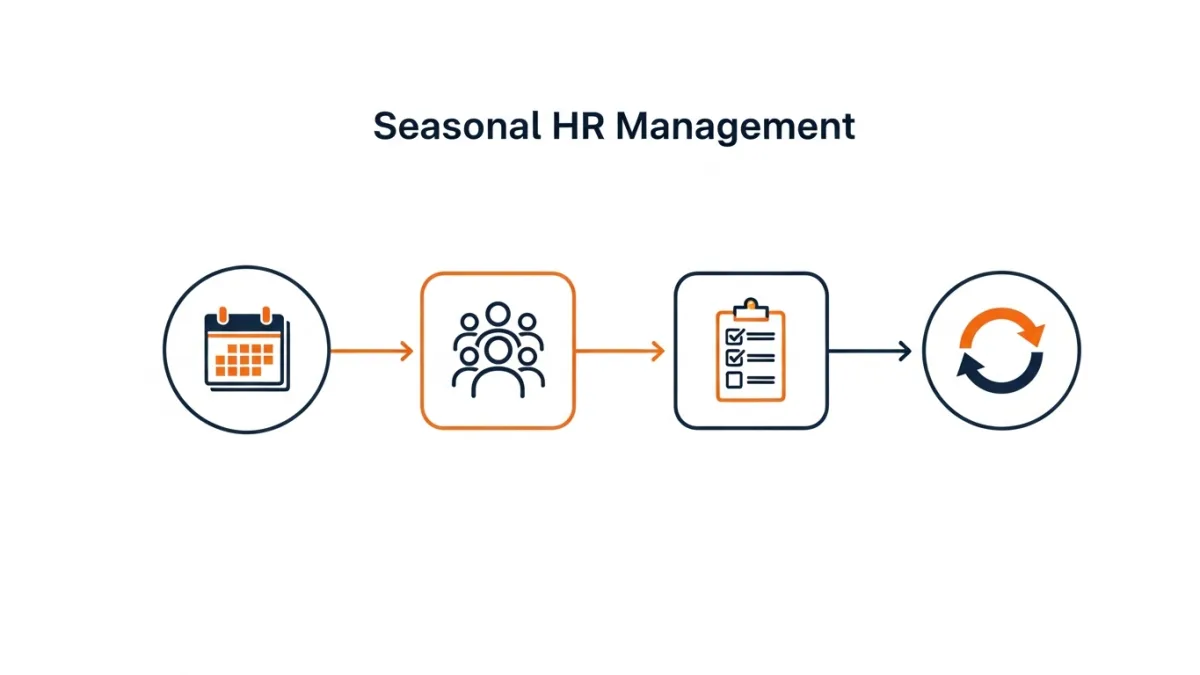
Most HR outsourcing conversations start and stop at peak surge management. That’s the right instinct, but it misses what actually makes the model work. The value isn’t just handling the volume. It’s having a team that already knows your systems, your compliance requirements, and your onboarding process before the season opens.
Pre-Season Preparation (8-12 Weeks Out)
Eight to twelve weeks out is where the best seasonal operators separate from the rest. Most businesses wait until 3 weeks before opening day to think about HR. Then they’re scrambling to build offer templates, verify I-9 procedures, and configure payroll systems while also trying to fill 40 positions at once.
An outsourced HR team handles this runway properly. Job descriptions, screening criteria, onboarding checklists, and payroll configurations are ready before the first hire walks in. ADP’s 2026 seasonal hiring guide finds that businesses building pre-season hiring plans at least 8 weeks out consistently see faster worker productivity in weeks one and two of the surge.
The Peak Season Surge
Volume. Speed. Not messing up compliance under pressure. Those are the three things that matter here.
The biggest risk during the surge isn’t administrative slowness. It’s misclassification. If you’re classifying a seasonal worker as a 1099 contractor because it feels simpler, and that worker meets the legal definition of an employee, you’re looking at back taxes, penalties, and potential audits. An outsourced HR provider builds classification checks into the intake workflow before any paperwork error can compound.
Omni HR’s onboarding research shows businesses can process seasonal staff up to 5x faster using standardized digital workflows. Not just faster for your HR team. Faster for the worker, who shows up on day one actually ready to contribute instead of spending the first morning filling out forms.
Off-Season Wind-Down
Off-season isn’t idle. That’s the trap seasonal businesses fall into.
Final paychecks, W-2 setup, benefits termination, system access removal. Handle any of these inconsistently, or late, and you’re exposed to wage claims and compliance audits. Re-hire documentation is the one most businesses skip entirely: which employees performed well, how to reach them, and whether they’d return. An outsourced HR team manages exit processing systematically so you’re not reconstructing records from memory in February.
Return Season: Rehiring Last Year’s Staff
This is where the model compounds. Properly managed off-season means returning workers have current documentation, clean payroll records, and system access that just needs reactivation. No starting from scratch. For a business that rehires 60-70% of its seasonal workforce each year, that’s a real reduction in pre-season workload and cost.
Scale Your HR Without Adding Headcount
Kore BPO places offshore HR and admin staff for US seasonal businesses: onboarding support, compliance tracking, and payroll admin at 60-70% below US market rates.
The Compliance Risk That Catches Seasonal Businesses Off Guard
Around 40% of small-to-midsize businesses get hit with payroll penalties each year. Seasonal employers are disproportionately exposed because of rapid onboarding, multi-state hiring, and inconsistent worker classification.
That figure comes from Horizon Payroll’s seasonal compliance research, and the average penalty runs $845. Doesn’t sound catastrophic. Stack three or four in a single season, add the staff time responding to notices, and the real cost is a lot higher than the face value of any single fine.
Two traps catch most seasonal operators.
Worker misclassification. Seasonal businesses often default to 1099 status because it feels simpler: no benefits to manage, no payroll taxes to remit. But the IRS and most state labor agencies use a behavioral control test to determine classification. If you control when, where, and how someone works, they’re almost certainly an employee regardless of what your contract says. Getting that wrong costs more than a full HR engagement would have.
Multi-state compliance is the other one. If you operate a resort in one state and recruit workers from two others, you may have three different minimum wage requirements, three different overtime rules, and different leave mandates. An outsourced HR provider that handles multi-state compliance as a standard service resolves this without requiring you to become an employment law specialist.
Minimum compliance checks before your first seasonal hire arrives, per Extensis HR’s seasonal hiring guide:
- Verify minimum wage and overtime rules for every state where you’ll employ workers this season
- Run worker classification criteria against IRS and state agency behavioral control tests before posting roles
- Review I-9 documentation requirements and build a hard-deadline verification process before hiring starts
- Check benefits eligibility thresholds by state (several states require coverage for workers above a specific hours threshold, regardless of seasonal status)
- Set a final pay schedule and confirm it meets every operating state’s timing requirements
The Cost Math for Seasonal Businesses
A full-time HR manager costs more than $180,000 annually when you factor in salary, benefits, software, and overhead. For a business that genuinely needs intensive HR support for 4-5 months a year, that math rarely pencils out.
The median HR manager salary sits at $127,220, per ProService’s in-house vs. outsourced HR cost analysis. Add employer-side benefits and software costs and you’re well north of $150,000 before a single license fee. For a seasonal business running at reduced headcount for 7 months of the year, most of that overhead is sitting idle.
Domestic HR outsourcing typically runs $30-$150 per employee per month. At 50 seasonal employees for 5 months, that’s $7,500-$37,500 for the peak window. A fraction of the full-time alternative.
Offshore HR support takes the savings further. Kore BPO places offshore HR and administrative staff at 60-70% below US market rates. For the administrative functions that dominate seasonal HR work (payroll processing, onboarding documentation, compliance record-keeping), an offshore-supported model handles significantly more volume at significantly lower cost.
Run the numbers for your specific headcount and season length with the Kore BPO outsourcing ROI calculator. Takes under 2 minutes.
| Model | Est. Annual Cost | Scales with Season | Compliance Coverage | Onboard Speed (50 workers) |
|---|---|---|---|---|
| Full-time in-house HR manager | $180,000+ | No | Yes (with expertise) | Moderate |
| Domestic HR outsourcing (PEO) | $18,000-$90,000/season | Yes | Yes | Fast |
| Offshore HR support | $6,000-$25,000/season | Yes | Yes (US overlay) | Fast |
| Owner-managed | $0 direct | No | Risk-exposed | Slow |
See a full breakdown of HR outsourcing costs for small businesses, including pricing models by headcount and scope.
Which Seasonal Industries Get the Most from HR Outsourcing
Not every seasonal business has the same HR pressure. The intensity depends on how fast you scale, how many states you hire across, and how compliance-sensitive your industry is.
| Industry | Typical Peak | Primary HR Challenge | Outsourcing Value |
|---|---|---|---|
| Retail | October-January | Mass onboarding, variable hours payroll | High |
| Hospitality and Tourism | Summer and holidays | Multi-state hiring, tip compliance, high turnover | High |
| Agriculture | Spring-fall (varies) | Worker classification, housing rules, overtime exemptions | Very High |
| Logistics and E-commerce | Q4 | Volume onboarding speed, safety certification tracking | High |
| Construction and Landscaping | Spring-summer | Contractor vs. employee classification, workers’ comp | Medium-High |
Agriculture sits at “Very High” for a reason. The regulatory environment for agricultural workers (H-2A visa program compliance, DOL housing requirements, specific overtime exemptions) is dense enough that most small agricultural operations can’t build that compliance expertise in-house cost-effectively.
Logistics during Q4 is the other pressure point. Replacing a single departed seasonal worker now costs an average of $45,236 in 2026, per Capital Analytics. For an operation cycling through 100+ seasonal workers in a 10-week window, onboarding quality isn’t optional. It’s a direct retention lever that pays for itself.
What to Look for in an HR Outsourcing Partner for Seasonal Work
Not all HR providers are built for seasonal scale. Many are structured for stable enterprises with consistent headcount, and they charge annual minimums that don’t make sense for a business running at 10 employees in January and 80 in July.
A few things worth asking directly before signing:
Is there a monthly minimum or annual contract commitment? For seasonal operations, you need to be able to scale your engagement up during peak and drop to a maintenance retainer during the off-season. A provider that requires full-year pricing regardless of headcount isn’t the right fit here.
Does payroll come with the HR service, or are they separate vendors? Splitting HR and payroll across two providers creates coordination gaps. During a hiring surge, that gap shows up as delays and errors when speed matters most.
Who handles multi-state compliance if your hiring crosses state lines? State employment law varies enough that a provider without multi-state experience will eventually get something wrong. Ask for a specific example of how they’ve handled it for another client.
What’s the onboarding turnaround time for new hires? Get a number, not a description. “We work quickly” doesn’t help you plan a 40-person surge. If a provider can’t give you a specific processing window, their onboarding process isn’t standardized.
Can you walk through your offboarding workflow? Many providers have strong onboarding and thin offboarding. For seasonal businesses, offboarding is half the workload. It deserves the same attention as intake.
Providers that include offshore administrative support alongside HR functions can handle documentation-heavy work at a cost that domestic PEOs simply can’t match. Compliance oversight still sits with a US-qualified team, but the administrative volume gets routed where it’s most cost-efficient.
The case for outsourcing doesn’t get cleaner than it does for seasonal businesses. Fixed overhead, variable demand. You can staff for the peak and overpay for 7 quiet months, or you can outsource for the peak and pay proportionally for the rest of the year. The math isn’t subtle.
The real value isn’t just cost. It’s having a team that already knows your workflows before your season starts. Not a new team you’re onboarding under deadline pressure every April or October.
If you’re heading into a peak hiring period in the next 60-90 days, run your numbers with the outsourcing ROI calculator. If you want to talk through what an offshore-supported HR function looks like for your headcount and season length, see Kore BPO’s HR outsourcing pricing models or reach the team directly.
What Seasonal Employers Actually Ask About HR Outsourcing
Do seasonal employees need to be enrolled in benefits, and who manages that?
Depends on hours and state. Under the ACA, employers with 50 or more full-time equivalent employees must offer coverage to workers averaging 30+ hours per week, even seasonal ones. Several states set lower thresholds. An outsourced HR provider tracks these eligibility windows and handles enrollment automatically, so you don’t get hit with a retroactive penalty for a worker who crossed the hours threshold 8 weeks ago without you realizing it.
What’s the difference between a PEO and an HR outsourcing firm for seasonal work?
Co-employment versus pure service delivery. A PEO becomes a co-employer: workers appear on the PEO’s payroll and you share employer liability with them. An HR outsourcing firm manages HR functions while you stay the sole employer of record. For seasonal businesses, that distinction matters when evaluating cost flexibility. PEOs typically require annual commitments and per-employee fees that don’t scale well with a business at 10 headcount in January and 80 in July.
Can an outsourced HR team manage workers hired across multiple states?
Usually yes. Verify it before you sign, though. Multi-state employment compliance involves different minimum wages, overtime calculations, leave mandates, and termination notice requirements. A provider that routinely handles multi-state payroll treats this as standard operating procedure. One that doesn’t will call it a special project, and you’ll pay for that both in fees and in eventual errors.
Realistically, how fast can an outsourced HR team get 30 new hires through onboarding?
48 to 72 hours with a provider using digital onboarding workflows. That window covers documentation collection, I-9 verification, payroll setup, and system access provisioning. A manual or paper-based provider will say a week. For a seasonal surge where workers need to be productive on day three, that’s not close to fast enough, and it costs you more in lost productivity than the provider fee would have.
What happens to my HR support during the off-season?
Most providers offer a maintenance tier rather than a full contract pause. That typically covers payroll for your year-round staff, compliance monitoring, and record management at a reduced monthly fee. Any provider that insists on full-rate pricing year-round regardless of headcount isn’t built for seasonal operations, and you should keep looking.
Is misclassifying a seasonal worker as a contractor actually a serious risk?
Yes. The IRS doesn’t factor in intent when calculating penalties. Back taxes, interest, and per-worker fines for misclassification can run several thousand dollars per employee, and state labor agencies frequently run separate assessments on top of federal penalties. Most reputable HR outsourcing providers build classification audits into their standard onboarding workflow, not as an optional add-on.
Related Articles



Ready to Staff Your Peak Season?
Kore BPO places dedicated offshore HR and admin professionals for US seasonal businesses. Pre-screened resumes in 2 to 5 days, $0 until you hire.
See HR Outsourcing Services