
Onshore vs Nearshore vs Offshore: Which Outsourcing Model Is Right for US SMBs?


- 01What the Three Models Actually Mean
- 02The Real Cost Comparison
- 03When Offshore Works (and When It Quietly Doesn’t)
- 04When Nearshore Is Worth the Premium
- 05When Onshore Still Makes Sense
- 06The Hybrid Model Most Posts Don’t Mention
- 07A 4-Question Diagnostic for Your Specific Function
- 08Questions SMBs Ask Before Choosing a Model
Last updated: June 22, 2026
The wrong question is “should I outsource?” For most US SMBs evaluating their BPO options and service models, that ship has sailed. The real question is which geographic model. And most founders pick based on the wrong variable.
They pick based on hourly rate. That’s a mistake.
The model that saves you the most per hour isn’t necessarily the one that saves you the most money. It’s definitely not always the one that gets the work done right. This guide compares all three models honestly — what they are, where each one breaks, and a four-question diagnostic at the end so you can match your specific function to the right model instead of guessing.
We’ve placed over 6,200 hires across offshore, nearshore, and onshore arrangements for 257 US clients. Most of what’s written about this topic is vague. We’ll be specific.
What “Onshore,” “Nearshore,” and “Offshore” Actually Mean
Three models. Plain English. No jargon you don’t need.
Onshore: An external team based in the United States. Same timezone, same legal framework, same cultural reference points. Also the most expensive of the three by a meaningful margin.
Nearshore: For US companies, this almost always means Latin America — Colombia, Mexico, Costa Rica, Argentina, Brazil. You’re looking at 0 to 4 hours of timezone difference depending on the country, which means real workday overlap with any US team. Rates run 30 to 50% below US equivalents. According to ScaleUpAlly’s 2025 nearshore analysis, the nearshore market hit $2.67 billion and is now the fastest-growing segment of the global outsourcing industry.
Offshore: A team based 8 to 12 time zones away — the Philippines, India, Vietnam, and similar markets. Headline rates are the lowest of the three, often 60 to 70% below US equivalents. But headline and actual are not the same number. That gap is where most outsourcing decisions go wrong.
One note worth flagging: “nearshore” gets used loosely in vendor marketing sometimes. A US company calling an Eastern European team nearshore is not using the term accurately by its geographic definition. For US companies reading this, nearshore means LATAM. Eastern Europe is better described as offshore with somewhat less extreme timezone gaps.
The Real Cost Comparison (Not Just Hourly Rates)
Offshore looks like a bargain on a rate card. It often doesn’t after 90 days. Here’s the side-by-side.
| Dimension | Onshore (US) | Nearshore (LATAM) | Offshore (Asia/PH) |
|---|---|---|---|
| Typical hourly rate | $100–$180 | $60–$95 | $30–$55 |
| Headline savings vs. US | — | 30–50% | 60–70% |
| Real TCO savings (after overhead) | — | 25–45% | ~20% (knowledge work) |
| Timezone overlap with US East Coast | Full | 6–8 hrs | 0–2 hrs |
| Collaboration model | Real-time | Real-time | Async relay |
| Ramp speed (first hire to productivity) | 4–6 wks | 4–6 wks | 6–10 wks |
| Hidden cost risk | Low | Low | High for iterative work |
Source: DistantJob 2026 rate breakdown; SETA International TCO analysis
The table gives you the rate picture. Here’s what the rate comparison misses.
A 10-hour timezone gap turns every question into a 24-hour wait. A quick clarification that a nearshore engineer could handle in a 10-minute Slack exchange becomes a next-morning blocker when your offshore team finishes their workday at noon your time. One-day delays per question, compounded across an entire sprint, compound fast. SETA International’s TCO analysis found that headline offshore savings of 60 to 70% frequently shrink to approximately 20% in total cost of ownership once management overhead, rework costs, and communication lag are factored in. That’s still savings. It’s just not the number on the rate card.
Nearshore costs more per hour. For most knowledge-intensive work, it costs less per completed deliverable. That math is worth sitting with before you make a decision based on rate comparison alone.
When Offshore Works (and When It Quietly Costs More)
Offshore isn’t broken. It works brilliantly when the conditions match the model.
High-volume, well-defined, async-friendly work is where offshore delivers its full promise. Data entry. Document processing. Tier 1 technical support following scripted workflows. Back-office bookkeeping on structured templates. Software testing against fixed pass/fail criteria.
What those functions share: low ambiguity, high repeatability, minimal real-time collaboration required. Your offshore team works through their day, hands off a completed batch, and you review it in the morning. The relay works cleanly when the baton is clearly defined and doesn’t change shape mid-handoff.
Where offshore quietly costs more: anything iterative. Software development running Agile sprints. Customer-facing roles requiring cultural judgment. Functions where the work scope changes frequently. Marketing copy requiring US audience sensibility. Recruitment where you need real-time candidate engagement. As Talently’s offshore risk research notes, communication breakdown is the single most underestimated cost in offshore IT arrangements — one ambiguous requirement can stall an entire sprint by 24 hours per iteration.
Bias disclosed: Kore BPO places teams across both offshore and nearshore models and benefits from both. That said, the offshore engagements that failed for our clients failed almost universally for the same reason. Someone chose offshore for work that needed real-time problem-solving. Not a talent problem. A model mismatch. The vendor couldn’t fix it because the model was wrong before anyone hired anyone.
When Nearshore Is Worth the Premium
Colombia is one hour ahead of Eastern Standard Time. Mexico City runs Central Time. Peru shares East Coast hours almost exactly.
Not a small thing.
A 9am standup in New York has your whole team on the same workday. A Slack question at 2pm doesn’t sit until morning. Agile ceremonies — sprint planning, daily standups, retrospectives — function the way they were designed to function. That’s the real advantage. It’s not marketing. It’s just timezone math.
HireSouth’s LATAM timezone analysis confirms that Colombia and Peru share near-full workday overlap with the US East Coast, which McKinsey research suggests can increase project efficiency by up to 25% for collaborative roles. Meanwhile, the LATAM talent pool sits at approximately 2 million software developers as of 2024, growing steadily. Senior engineers in Colombia or Argentina typically run $68 to $100 per hour — meaningfully below US equivalents at $130 to $180, with collaboration overhead that approaches onshore-level efficiency on the functions that need it.
Best fit for nearshore: software development requiring Agile iteration, customer-facing BPO where cultural alignment matters, marketing and creative work needing US-adjacent sensibility, and finance or HR functions that require real-time coordination with your US team. If the role involves frequent judgment calls and daily back-and-forth, the timezone alignment pays for the rate premium and then some.
Not Sure Which Model Fits Your Function?
Walk through our outsourcing ROI calculator to run the real numbers before you call a vendor.
When Onshore Still Makes Sense
Three scenarios where onshore is the right answer. Not the expensive fallback. The right answer.
Small number of scenarios. But real ones. The mistake is treating onshore as the default you settle for when you’re not comfortable with alternatives — rather than the deliberate choice it should be for the specific functions above.
The Hybrid Model Most Comparison Posts Don’t Mention
Pure-play anything rarely optimizes all your functions simultaneously. Your data processing team and your customer success team have different collaboration requirements. Forcing them into the same model because you want a single vendor relationship costs you on at least one end — usually both.
What hybrid looks like in practice: high-volume, async-friendly work routes to an offshore team in the Philippines or India. Customer-facing support, software engineers, and finance functions go with a nearshore partner in LATAM. Different functions, different models, managed through clean handoff protocols.
Across our 257 US clients at Kore BPO, the companies that scale most cleanly treat outsourcing model selection as a function-by-function decision, not a company-wide policy. A 20-person company running data entry offshore and customer support nearshore isn’t overcomplicated. It’s matched. Here’s how the function mapping typically shakes out.
| Business Function | Recommended Model | Why |
|---|---|---|
| Data entry / document processing | Offshore | High volume, well-defined, async-friendly |
| Tier 1 scripted customer support | Offshore | Script-driven, repeatable, 24/7 coverage |
| Software development (Agile) | Nearshore | Daily collaboration, iterative scope |
| Judgment-heavy customer support | Nearshore | Cultural alignment, real-time escalation |
| Finance and accounting (structured) | Offshore or Nearshore | Depends on reporting cadence and complexity |
| Marketing and creative work | Nearshore or Onshore | US audience fluency required |
| HR administration | Nearshore | Frequent team coordination needed |
| Regulated or sensitive data functions | Onshore | Compliance, jurisdiction, data sovereignty |
The top outsourcing options for small businesses almost always involve some combination of models rather than a single geographic approach. That’s not a complexity problem. It’s just matching the tool to the job.
A 4-Question Diagnostic to Pick Your Model
Before you call a vendor, answer these four questions about the specific function you’re looking to outsource. Not your company in general. The function.
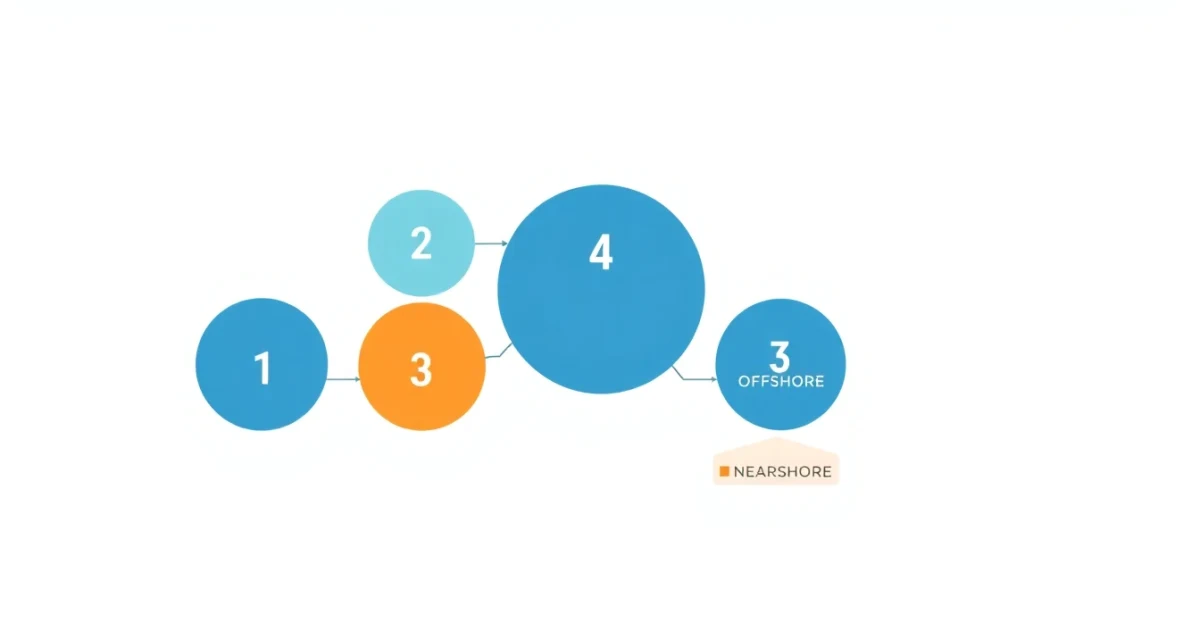
Map your function against those four answers. Most will sort cleanly. The ones that don’t — usually finance functions with complex reporting requirements — are the hybrid candidates. Run the offshore option for the structured volume work and nearshore for anything requiring frequent input from your US leadership.
If you want help running this diagnostic across multiple functions before you commit, our small business outsourcing team does exactly this kind of function-by-function mapping as part of our engagement process.
The Short Version
Most outsourcing comparisons present three equally valid options and leave the decision to you. Not useful.
What our experience placing over 6,200 hires across these models tells us: the model mismatch is what sinks most early outsourcing attempts. Not the vendor. Not the talent. The wrong model for the work.
For US SMBs with collaboration-heavy functions, nearshore is usually the right starting point. High-volume, well-defined back-office work — offshore delivers its full headline savings. Regulated industries or executive-level functions — onshore. Most growing companies, honestly, end up using some combination of all three.
If you’re ready to map your specific functions to the right model, explore our full BPO solutions and services or work through our complete guide to outsourcing to get the full picture before making a call.
Is nearshore outsourcing the same as offshore?
No. Not even slightly. Nearshore refers to geographically close countries — for US companies, typically Latin America — with a timezone difference of 0 to 4 hours and meaningful workday overlap. Offshore means distant markets like India or the Philippines, sitting 8 to 12 hours away. That timezone gap changes everything about how the work is managed: communication cadence, sprint structure, escalation paths, and ultimately how much of your headline cost savings you actually keep after accounting for coordination overhead. The terms get used interchangeably by vendors sometimes. They shouldn’t be.
What’s the actual timezone overlap between the US and Latin America?
Colombia and Peru run on Eastern-equivalent time zones. Mexico City is Central Time. Argentina sits 1 to 2 hours ahead of the East Coast depending on the season. In practice, a US company on Eastern time shares 6 to 8 working hours of overlap with most LATAM locations. You can hold a morning standup, a mid-day review, and an afternoon wrap with your full team on the same calendar day — the same way you would with a US-based team, but at 30 to 50% lower cost.
Can a small business run both nearshore and offshore simultaneously?
Yes, and many should. The key is treating model selection as a function-by-function decision rather than a company-wide one. A 20-person company might run data entry and document processing offshore while keeping customer support and software development nearshore. Two vendor relationships means some additional coordination overhead — but it’s modest compared to the cost of forcing all work through a single model that doesn’t fit half your functions. The larger risk is assuming uniformity is simpler when it’s actually just cheaper to manage badly.
Which functions work best offshore?
High-volume, well-defined, async-friendly work. Data entry, document processing, structured bookkeeping, Tier 1 scripted support, software testing against fixed criteria. If the work has documented SOPs, predictable volume, and doesn’t require real-time problem-solving or cultural judgment, offshore typically delivers its full headline savings. If the scope changes frequently, the work requires daily collaboration, or the customer relationship demands cultural nuance — expect the savings to erode toward that 20% TCO figure.
How much does a nearshore BPO engagement actually cost to start?
Depends almost entirely on the function and seniority. A nearshore customer support agent in Colombia typically runs $12,000 to $20,000 per year fully-loaded. A senior LATAM software engineer runs $80,000 to $100,000. Both land 30 to 50% below US equivalents. The more useful number isn’t the starting cost — it’s total cost of ownership over 12 months, including vendor management overhead, onboarding time, and your own internal coordination hours. That calculation almost always favors nearshore over offshore for knowledge-intensive functions even when the hourly rate comparison looks like it shouldn’t.
Disclosure: Kore BPO provides offshore and nearshore hiring and BPO services. The comparisons in this post reflect our direct experience placing over 6,200 hires for US clients across all three models. Cost ranges cited are drawn from third-party published sources as linked; individual client outcomes vary based on function, seniority, and vendor.
Related Articles



Which Model Is Right for Your Business?
Tell us your functions and budget. We’ll show you exactly which model — offshore, nearshore, or hybrid — makes sense before you commit.
Talk to Our TeamNo pitch. Just the right answer for your situation.