In-House Paralegal vs LPO Provider: Risk, Cost and Quality Comparison for SMBs in 2026


Most firms don’t compare an in-house paralegal against an LPO provider on cost alone, even though cost is usually where the conversation starts. They end up comparing it on something closer to risk tolerance. Can this firm absorb a bad hire, a resignation letter six months in, or a quiet quality slip on a document review nobody catches until opposing counsel does?
We build outsourced legal and back-office support teams for US firms through our BPO solutions, and the question we get from managing partners isn’t usually “what does LPO cost.” It’s “how do I know I’m not trading one set of headaches for a worse one.” That’s a fair question, and it deserves a framework, not a sales pitch.
This article is that framework. If you want the definitional side first, what LPO covers and what the ABA rules actually allow, our companion piece on legal process outsourcing for SMBs and law firms covers that ground. Here, we’re answering a narrower question: given your actual caseload, budget, and risk appetite, which model comes out ahead.
The Real Cost of an In-House Paralegal
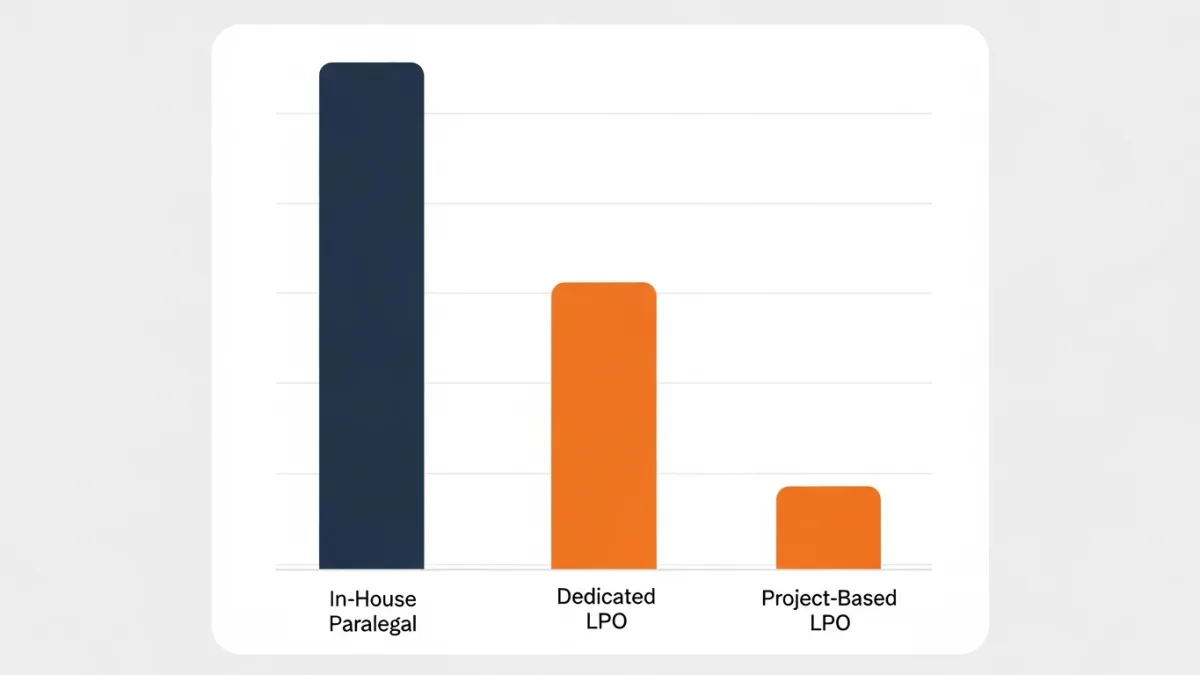
The salary line on a job posting is never the real number. A paralegal’s base pay nationally runs somewhere between $59,200 and $69,700 depending on the source, but that figure excludes the costs that actually determine what a hire runs a firm each year.
Add payroll taxes, health benefits, retirement matching, a workstation, practice management software licenses, and the management time it takes to supervise someone still learning your file systems, and the fully loaded number in major metros commonly lands between $75,000 and $100,000. That’s before anything goes wrong.
And something usually does. Voluntary turnover among non-attorney legal staff hit 25% across midsize firms in 2025, up from 21% two years earlier. Paralegal unemployment sits at roughly 1.9 to 3.6%, which means a firm that loses a paralegal isn’t refilling that seat in a few weeks. It’s competing for candidates in one of the tightest talent markets in the legal profession, often for two to four months before someone starts, plus another month or two before they’re fully productive on your matters.
None of that shows up in a salary line. It shows up in overtime for the attorneys covering the gap, in delayed filings, and in a hiring cycle that eats partner time nobody billed for.
What an LPO Partner Actually Costs
LPO pricing runs on a different logic entirely, and it comes in roughly two shapes.
Project or hourly pricing charges by the task, typically $75 to $400 a day or $30 to $75 an hour depending on complexity and the provider’s location. This fits overflow work, a single large document review, or a firm testing outsourcing for the first time without committing to anything ongoing.
Dedicated FTE pricing assigns one offshore legal support professional to your firm full time for a fixed monthly rate, commonly landing in the $19,000 to $30,000 annual range once bundled with the provider’s overhead. This model behaves more like a hire than a vendor relationship. Same person on your matters every day, familiar with your files, just billed differently and supervised under a services agreement instead of a W-2.
The hidden costs sit in the same place they always do with outsourcing. Onboarding time, the software access setup, revision cycles while a new resource learns your formatting standards, and the management hours needed to review output, especially in the first month. A provider quoting $22 an hour with no ramp-up plan and no named point of contact is usually cheaper on paper and slower in practice.
Where the Breakeven Actually Sits
Here’s the part most cost comparisons skip. The answer isn’t a single number, it moves with case volume.
| Monthly Case Volume | In-House Paralegal | LPO Provider | Likely Better Fit |
|---|---|---|---|
| Low, under 15 active matters | Underused, fixed cost regardless of volume | Project pricing scales down with demand | LPO |
| Steady, 15 to 40 matters | At full capacity, predictable workload | Dedicated FTE pricing competitive, less oversight needed | Either, depends on budget |
| High or seasonal spikes | Overtime or a second hire, slow to scale | Add capacity in days, not months | LPO |
| High, sustained growth | Cost predictable, deepens firm institutional knowledge | Dedicated model still works, but coordination overhead grows | In-house |
A firm running under fifteen active matters a month is paying full-time overhead for part-time need if it hires in-house. A firm scaling past forty matters with sustained growth starts getting real value from institutional knowledge that only builds when the same person has sat in the seat for two years. Most SMB firms fall in the middle, where the honest answer is that either model works and the tiebreaker becomes risk tolerance and quality control, not cost.
Risk Comparison
Cost is the easier conversation. Risk is where the decision usually actually gets made.
| Risk Factor | In-House Paralegal | LPO Provider |
|---|---|---|
| Confidentiality exposure | Direct employee, standard NDA and firm access controls | Requires a separate signed data processing agreement and access controls, verify before signing |
| Continuity risk | High, one resignation reopens the hiring cycle | Lower, provider typically backfills or reassigns without a full restart |
| Subcontracting risk | None, work stays with the employee you hired | Real risk if the provider subcontracts, confirm this in writing before signing |
| Accountability if something goes wrong | Direct, firm supervises and corrects immediately | Depends entirely on SLA terms and how fast escalation actually happens |
Subcontracting is the risk most firms miss. If your provider quietly routes work to a second vendor, you’ve lost visibility into who’s actually touching client files. Ask directly whether the provider ever subcontracts, and get the answer in the contract, not just on a sales call.
For the full breakdown of what’s ethically outsourceable under the ABA Model Rules, including confidentiality obligations under Rule 1.6 and supervision requirements under Rule 5.3, see our companion guide on legal process outsourcing for SMBs and law firms. The short version: an LPO relationship doesn’t reduce a supervising attorney’s ethical responsibility, it just changes where the underlying labor happens.
Quality and Control Comparison
Quality risk isn’t really about talent. Both models can produce excellent work or sloppy work. It’s about supervision structure, and that’s the part firms tend to underbuild on both sides.
An in-house paralegal sits down the hall, which makes informal supervision easy and structured supervision easy to skip. Attorneys catch errors in passing conversation, which works until the attorney is in trial for two weeks and nobody’s actually reviewing anything.
An LPO provider forces the supervision question into the open, because there’s no hallway to rely on. That’s actually an advantage if the firm builds a real review workflow. A weekly quality check, a defined escalation path, and a named point of contact on the provider side turn outsourced work into something more consistently reviewed than the ad hoc version most small firms run in-house.
Talent quality on the LPO side has also shifted. Offshore legal support hubs, particularly the Philippines, produce thousands of law graduates annually, many trained in common law systems and vetted specifically for legal terminology, attention to detail, and confidentiality discipline before they’re placed on US matters. The gap between “offshore paralegal” and “US paralegal” in raw skill has narrowed considerably. What hasn’t narrowed is the need for a documented supervision workflow, on either side of the comparison.
Unauthorized Practice of Law Applies Regardless of Model
This rule doesn’t change based on who’s doing the work. Whether the paralegal sits in your office or works through an LPO provider, only a licensed attorney can interpret law, evaluate case outcomes, or recommend a course of action to a client. Both an in-house paralegal and an outsourced one must work under genuine attorney supervision, not a rubber stamp. The difference is that LPO agreements typically spell this supervision structure out in writing, where an in-house arrangement often runs on assumption.

The Decision Framework
Score your firm against these four factors. Whichever column collects more points is the model that actually fits, not the one that sounds better in the abstract.
- Caseload predictability. Steady and predictable leans in-house. Seasonal, project-based, or growing unevenly leans LPO.
- Time to capacity. If you need help this month, in-house hiring cycles of two to four months rule it out on timing alone. LPO providers can typically start within one to two weeks.
- Budget flexibility. Fixed annual budget with no room for a bad hire favors LPO’s lower commitment. Budget for long-term institutional investment favors in-house.
- Internal supervision bandwidth. A firm with an underused senior paralegal or ops manager who can run a review workflow gets full value from LPO. A firm with no one available to build that structure should lean in-house, where oversight happens more informally.
Many SMB firms end up running both, a lean in-house core for the matters that need someone physically present, and an LPO partner for document-heavy overflow and litigation support. That hybrid model is common enough that it’s worth planning for from the start rather than treating the decision as strictly either-or.
Once you’ve decided LPO fits, the next step is vetting providers on the specifics, security certifications, SLA terms, subcontracting policy, and trial engagement options. Our guide on how to choose the right BPO partner walks through that evaluation process in full.
Common Questions on In-House vs LPO Paralegal Support
Is it cheaper to hire a paralegal or use an LPO provider?
Usually LPO, on a pure cost basis. A fully loaded in-house paralegal often runs $75,000 to $100,000 a year once benefits and overhead are included, while a dedicated LPO resource typically costs $19,000 to $30,000. The gap narrows for firms with high, sustained caseloads where institutional knowledge adds enough value to offset the cost difference.
Can a small law firm run both an in-house paralegal and an LPO provider at the same time?
Yes, and it’s common. A lean in-house team handles client-facing and time-sensitive work, while an LPO partner absorbs document review, research, and overflow during busy periods. This hybrid model gives firms cost flexibility without losing the continuity of a dedicated in-office resource.
Does using an LPO provider increase confidentiality risk compared to an in-house hire?
It changes the risk rather than simply increasing it. In-house hires carry standard employment-based confidentiality protections. LPO providers require a separate signed data processing agreement, access controls, and a written subcontracting policy. Firms that put these safeguards in place before signing see no meaningful increase in confidentiality exposure.
How fast can an LPO provider actually start work compared to hiring a paralegal?
Most LPO providers can start a dedicated resource within one to two weeks. Hiring an in-house paralegal typically takes two to four months given how tight the paralegal labor market currently is, plus additional ramp-up time once someone starts.
What case volume makes an in-house paralegal the better choice over LPO?
Firms with high, sustained caseloads, generally above forty active matters a month with steady growth, tend to get more value from an in-house hire, since institutional knowledge and immediate availability start to outweigh the cost savings of an outsourced model.
Related Articles



Ready to Build Your Legal Support Team?
Kore BPO places dedicated offshore paralegals and legal support professionals for US firms. Pre-screened resumes in 2 to 5 days.
See BPO Solutions