
Here’s a scene that plays out in small businesses every single week. Someone pulls a sales number from the CRM. Someone else pulls what they think is the same number from QuickBooks. The two don’t match. Nobody knows why. A meeting gets spent arguing about whose spreadsheet is right instead of deciding anything.
That’s not a reporting problem. It’s a data transformation problem, and it’s exactly the kind of gap the offshore data specialists Kore BPO places spend their days closing.
You don’t need a computer science degree to understand this. You need about ten minutes and a willingness to think about your spreadsheets the way you’d think about a messy filing cabinet. That’s really what this is.
So What Does “Data Transformation” Actually Mean?
Data transformation is the process of taking raw data sitting in different places, in different formats, and reshaping it into one consistent structure that people (and software) can actually use. According to IBM, it’s a core part of data management that ensures compatibility between systems and improves overall data quality and usability.
Strip away the vendor language and it’s simpler than that. Your point-of-sale system logs a sale as “07/14/2026.” Your accounting software logs the same sale as “14-Jul-26.” Your inventory tool calls the same product “SKU-4471” while your sales team calls it “Blue Widget, Large.” None of these systems are wrong. They just don’t speak the same language to each other.
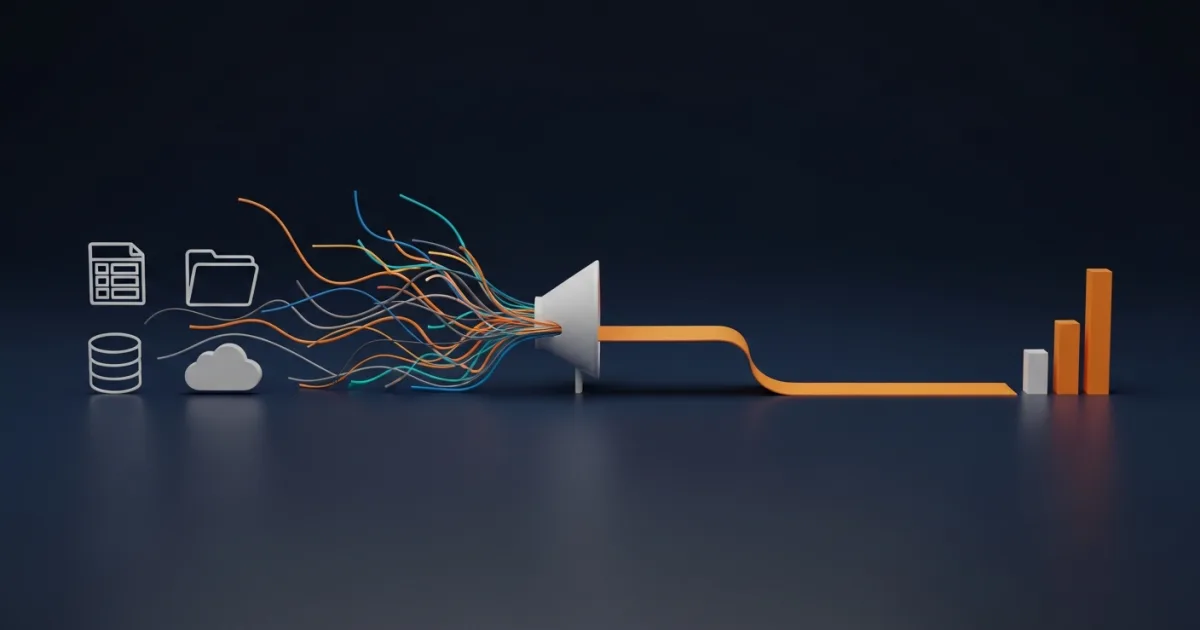
Transformation is the translation layer. It cleans up duplicates and errors, standardizes formats so dates and currencies match everywhere, and maps everything to one shared definition of “this is a sale,” “this is a customer,” “this is a product.” Once that’s done, a report pulling from three systems actually adds up.
It’s not glamorous. It’s plumbing. But bad plumbing floods the basement eventually, and bad data does the same thing to a growing company.
What Does This Actually Look Like for a Small Business?
Abstract definitions don’t stick. Here are three situations that show up constantly in companies with 10 to 100 employees.
The multi-tool sales report. A 22-person e-commerce brand runs Shopify for online orders, Square for a physical pop-up, and a separate spreadsheet for wholesale accounts. At month end, someone manually copies numbers from all three into one master sheet. It takes six hours. It’s wrong about a third of the time because copy-paste errors are inevitable at that volume. Transformation means automatically pulling all three sources into one dataset with matching product IDs, matching date formats, and matching currency fields, so the report builds itself.
The customer that exists four times. A services company’s CRM has “Jonathan Ung,” “J. Ung,” “Jon Ung – ABC Corp,” and “jonathan.ung@abccorp.com” as four separate contact records. Nobody merged them because nobody had time. Every report about “how many customers do we have” is wrong until someone standardizes and deduplicates those records into one clean profile.
The inventory count that never matches. A distributor’s warehouse system says 340 units on hand. The e-commerce store says 310 are available for sale. The gap is real, caused by returns processed in one system and never synced to the other. Transformation, paired with proper integration, closes that gap so both numbers are the same number.

Why Should a Non-Technical Owner Care About Any of This?
Because bad data doesn’t just create annoying meetings. It creates bad decisions, and bad decisions compound.
Companies that thoroughly use their data are 5% more productive and 6% more profitable than their closest competitors, according to MIT Sloan Management Review. That’s not a rounding error at the size most SMBs operate. Six points of margin is real money.
Here’s the flip side nobody likes to say out loud. 64% of organizations rate poor data quality as their single biggest data challenge, per Integrate.io’s 2026 research. Most of them aren’t short on data. They’re short on trustworthy data. Those are different problems with different fixes.
Faster, more confident decisions. Fewer meetings that turn into arguments about whose number is correct. A team that trusts the dashboard instead of re-checking it in a spreadsheet before every board meeting. That’s the actual payoff, and none of it requires you to become a data person yourself.
Should You Build This In-House, or Bring in Outside Help?
Honest answer? It depends on how messy things already are, and how much of your own time you’re willing to spend fixing it.
Tools like Zapier or a well-organized spreadsheet are enough if you’re connecting two or three simple apps with low data volume and nobody downstream is making six-figure decisions off the output. Plenty of 5 to 15-person companies run fine this way for a while.
You need a dedicated person once you’re pulling from four or more systems, once the volume gets into the thousands of records, or once “the numbers don’t match” starts happening more than once a month. At that point, no-code tools start to strain, and someone needs to own the pipeline the way someone owns your books.
This is usually where the build-versus-hire conversation happens, and it’s rarely about whether you need the skill. It’s about whether you can justify a full-time US salary for a function that, once set up correctly, doesn’t need constant hands-on management. A dedicated offshore data engineer builds and maintains the pipelines that move and clean your data automatically. If the mess is specifically inside your databases, structure, and record quality rather than the pipelines connecting them, an offshore database developer is the better-fit specialist. Both roles exist inside Kore BPO’s broader offshore roles directory, alongside the analysts and architects that pick up once the foundation is clean.
I’ll say the biased part out loud. We place these roles, so of course this is where I’d point you. But if your data problem is genuinely two spreadsheets and one Zapier connection, you don’t need any of this yet. Save the hire until the mess earns it.
What Does a Data Transformation Project Actually Cost?
Depends entirely on scope and who’s doing the work. A one-time cleanup project for a single messy dataset might run a few thousand dollars with a freelancer. A dedicated, ongoing hire is a different budget line entirely, and it scales with where that person sits.
| Staffing Model | Typical Rate | Best Fit |
|---|---|---|
| US in-house data engineer | $95,000 to $140,000/yr fully loaded | Complex, high-stakes pipelines, tight in-office collaboration |
| Nearshore data engineer | $40,000 to $65,000/yr | Same time zone, moderate savings, faster live handoffs |
| Offshore data engineer | $18,000 to $38,000/yr | Ongoing pipeline builds and maintenance at the lowest fully-loaded cost |
| Freelance one-off cleanup | $1,500 to $8,000/project | A single messy dataset, no ongoing maintenance needed |
The math writes itself once you put the fully-loaded US number next to the offshore one. That gap is exactly why Deloitte’s Global Outsourcing Survey consistently finds cost reduction among the top reasons companies bring in outside help for functions like this, even as access to specialized skill has caught up as an equally common reason.
One thing worth naming plainly. Cheap and good aren’t the same thing here. A $12/hour data contractor with no vetting can do more damage to your database than the mess you started with. Price the role, but vet the person harder than you price the rate.
The Mistakes Most SMBs Make With Their Data
Watch for these. They show up constantly, and every one of them is fixable before it becomes expensive.
Skipping data quality to chase speed. Owners who rush straight to dashboards and reports without cleaning the underlying data first end up with a beautiful chart built on garbage. It looks credible. It isn’t, and everyone downstream trusts it anyway because it looks finished.
Treating it as a one-time project instead of ongoing hygiene. Data decays. New tools get added, old ones get dropped, someone renames a field in the CRM without telling anyone. A cleanup done once in 2024 doesn’t cover 2026 unless someone owns it continuously.
Buying a tool before fixing the process. No-code platforms like dbt and similar tools are genuinely useful, per Matillion’s process breakdown, but they automate whatever process you feed them. Automate a broken process and you just get broken results faster.
See Who Builds These Pipelines
Browse the offshore data and engineering roles Kore BPO places for growing US companies.
Data transformation isn’t a project you finish once and forget. It’s closer to bookkeeping for your information, quiet, unglamorous, and the reason everything built on top of it either holds up or doesn’t.
Start small. Pick the one report that causes the most arguments in your company right now and trace where the numbers actually come from. Nine times out of ten, that’s where the mess lives.
And if the mess is bigger than a weekend project, the offshore roles built for exactly this problem, from data engineers to database developers, are worth a look before you spend another quarter reconciling spreadsheets by hand.
Things SMB Owners Ask Before Touching Their Data
Isn’t this basically the same as data integration or ETL?
Close, but not identical. Data integration is the umbrella term for combining data from different sources into one view. ETL, extract, transform, load, is one specific method for doing that. Transformation is the “T” in the middle of both. Think of integration as the whole moving job and transformation as making sure everything fits through the same door once it gets there.
Do I need to hire someone, or can my current team just handle it?
Depends on the volume, honestly. If it’s two tools and a monthly spreadsheet, a sharp office manager with a no-code tool can probably manage it. Once you’re past four data sources or your team is spending more than a few hours a week reconciling numbers, that’s usually the signal to bring in someone whose actual job this is.
Realistically, how long does a first transformation project take?
2 to 6 weeks for a first pass at a typical SMB setup, assuming 3 to 5 data sources of moderate complexity. Simple two-tool cleanups can wrap in under two weeks. Anything touching legacy systems, custom-built software, or years of undocumented spreadsheet history runs longer. Budget more time than you think, then be pleasantly surprised if it finishes early.
What happens if I just skip this and connect my tools with Zapier anyway?
Works fine for a while. Zapier and similar no-code connectors move data between tools, but they don’t necessarily clean or standardize it along the way. You’ll get data moving between systems faster, sitting there in whatever messy shape it arrived in. It’s a real short-term fix. It’s not a substitute for the cleanup underneath it.
Is this only relevant for companies doing heavy data analysis?
No, and that’s the most common misconception. Any business running more than two disconnected software tools already has a transformation problem, whether or not anyone’s building dashboards. A restaurant group syncing POS data across five locations needs this as much as a company running predictive analytics. The scale changes. The underlying need doesn’t.
What should I budget if I’m under 50 employees?
$1,500 to $8,000 for a one-time cleanup project, or $18,000 to $38,000 annually for a dedicated offshore data engineer who builds it once and maintains it going forward. Most companies this size start with the one-time project to prove the value, then decide whether ongoing maintenance justifies the dedicated hire. That sequencing keeps the first bill small while you find out if the problem is actually solved.

Related Articles



Ready to Fix Your Data Pipeline?
Kore BPO places dedicated offshore data engineers and database developers for US small businesses. Pre-screened resumes in 2 to 5 days.
See Offshore Roles