Offshore Software Development Pricing, What It Actually Costs in 2026


In fact, every company shopping for offshore talent gets the same shock. The rate in the proposal looked great, then the real bill showed up. At Kore BPO, we build offshore engineering teams for US companies every week, and pricing confusion is the number one thing that stalls a deal.
Where the Extra Cost Actually Goes
So here’s the pattern. A CTO gets quoted $30 an hour for a senior backend engineer, does the math against a $90-an-hour US contractor, and assumes they just found a 66% discount. Three months later, the project management overhead, the extra QA cycles, and the ramp-up time have eaten most of that gap. Not all of it. So where does the rest of that discount actually go? Offshore is still cheaper, usually by a wide margin. Just not by the number on the first invoice.
This guide walks through what offshore software development pricing actually looks like in 2026: rates by region, how the three main pricing models work, where the hidden costs live, and how to build a budget that survives contact with reality.
How Offshore Software Development Pricing Actually Works
Although an offshore developer’s quoted hourly rate is the starting number, it’s not the ending one. It covers the engineer’s time, but nothing else. It doesn’t cover onboarding, project management, tooling, communication overhead, or the rework that happens when requirements get misread across a time zone gap.
That gap between quoted rate and delivered cost is real, and since you’ve run enough engagements, it’s predictable. Factor in ramp-up, coordination, and the inevitable revision cycle, and a $30-an-hour quote tends to land somewhere between $42 and $54 an hour in practice. Still a fraction of onshore cost. Just not the sticker price.
Actually, three things drive that multiplier up or down. How well-defined your requirements are before work starts. How experienced the offshore team is with your tech stack. And whether you’re paying for a staffed employee or a project shop billing by the ticket. Vague requirements and unfamiliar frameworks push the multiplier toward 1.8x. A dedicated engineer who already knows your stack, closer to 1.4x.
Offshore Developer Rates by Region in 2026
| Region | Typical Hourly Rate | Best For |
|---|---|---|
| India | $15–$45/hr | Budget-conscious builds, large talent pool, strong English proficiency |
| Philippines & Southeast Asia | $10–$50/hr | Support-heavy roles, QA, full-stack generalists |
| Latin America | $25–$55/hr | US timezone overlap, real-time collaboration |
| Eastern Europe | $35–$70/hr | Senior engineering, complex architecture, EU-adjacent hours |
| Western Europe / US benchmark | $80–$200+/hr | Onshore comparison point only |
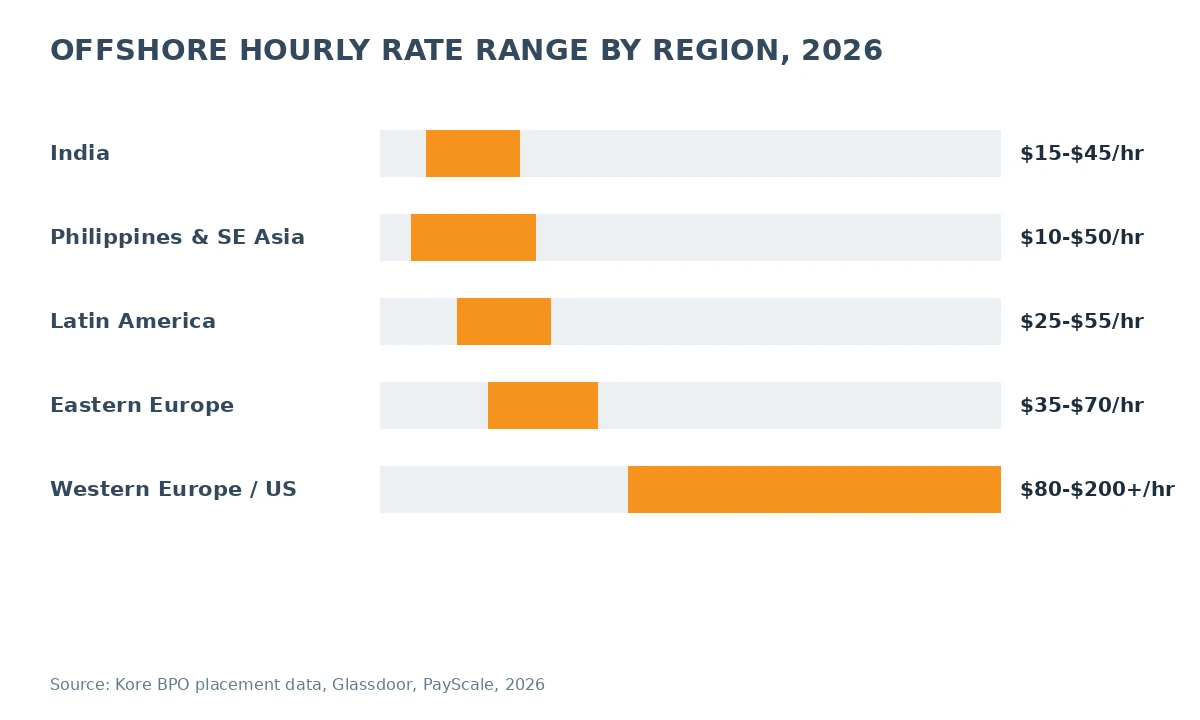
Even so, India remains the deepest bench for pure cost efficiency. Glassdoor’s India salary data puts average software developer compensation well under US levels even before accounting for currency exchange, and PayScale’s Philippines data shows a similar pattern across Southeast Asia. Consequently, that gap is exactly why the hourly rate holds up across specializations. Hyderabad, where Kore BPO runs one of its three offices, has built an entire tech corridor around this exact dynamic.
Instead, we’re not going to re-run the full country-by-country breakdown here. If you want the granular numbers by country, tech stack, and seniority tier, Kore BPO’s rate breakdown by country covers that in detail. What matters for budgeting purposes is the band you’re in and what drives movement within it, which is what the rest of this guide covers.
Pricing Models Compared, Fixed Price vs. Time and Material vs. Dedicated Team
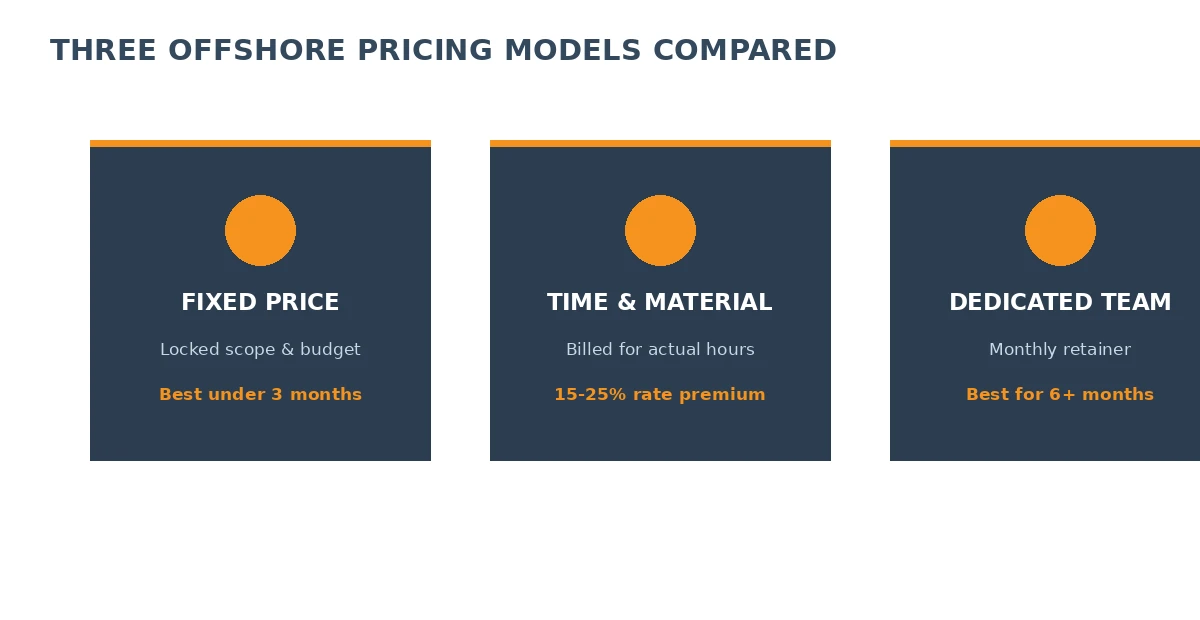
Generally, three engagement models cover almost every offshore contract. Pick wrong and the pricing structure fights against your actual project shape.
Fixed price works when scope is locked. You agree on a deliverable and a number before anyone writes code. However, it’s clean, predictable, and it falls apart the moment requirements shift, which they almost always do somewhere past week six.
Meanwhile, time and material bills for actual hours worked. Rates run 15% to 25% higher than fixed-price contracts because the vendor is absorbing less risk, but you’re not paying a change-order tax every time the product team learns something new.
Similarly, dedicated team puts engineers on retainer as an extension of your own team, usually billed monthly. This is the model for anything running longer than six months, and it’s the one that scales cleanest, because you’re not renegotiating scope every sprint.
| Model | Best For | Typical Cost Behavior |
|---|---|---|
| Fixed Price | Small, well-defined projects under 3 months | Predictable upfront, expensive change orders |
| Time & Material | Evolving scope, active product development | 15–25% rate premium, flexible |
| Dedicated Team | Long-term builds, ongoing product work, 6+ months | Lowest blended rate at scale, monthly retainer |
Most of the companies we place engineers with land on dedicated team within the first year, even if they start with fixed price to test the relationship. Makes sense. Once you trust the team, renegotiating scope every two weeks stops being worth the friction.
The Hidden Costs Nobody Puts in the Quote
Here’s where the “offshore is 70% cheaper” pitch starts to crack. It’s directionally true. It’s also not the whole picture.
Particularly, quality assurance is the biggest one. When an offshore team ships code that doesn’t meet spec, someone has to catch it, and rework almost always costs more than getting it right the first time. Teams that skip a dedicated QA layer to save money end up paying for it twice, once in the original build and again in the fix.
Additionally, project management overhead is the second big line item. Someone has to own communication, translate business requirements into engineering tickets, and keep the offshore team and the US stakeholders reading from the same page. That’s not free labor. It’s either a role you staff internally or a service your offshore partner bundles in, and either way it shows up in the real cost.
Kore BPO’s dedicated staff augmentation model bundles project coordination into the placement itself rather than billing it as a separate line item. That’s one of the overhead costs on this list you can negotiate away entirely, depending on how your contract is structured.
Costs That Catch Teams Off Guard
A few more that catch people off guard.
- Time zone friction slows decision-making, not because anyone’s slow, but because a same-day answer becomes a next-day answer when the question lands after the offshore team’s workday ends
- 2 to 6 weeks. That’s the typical ramp-up window on a new hire depending on stack complexity, and you’re paying for that runway either way
- Tooling and infrastructure costs (VPN access, dev environments, licensing) rarely show up in the hourly quote
- Turnover replacement, if your vendor doesn’t guarantee placements, means starting the ramp-up clock over
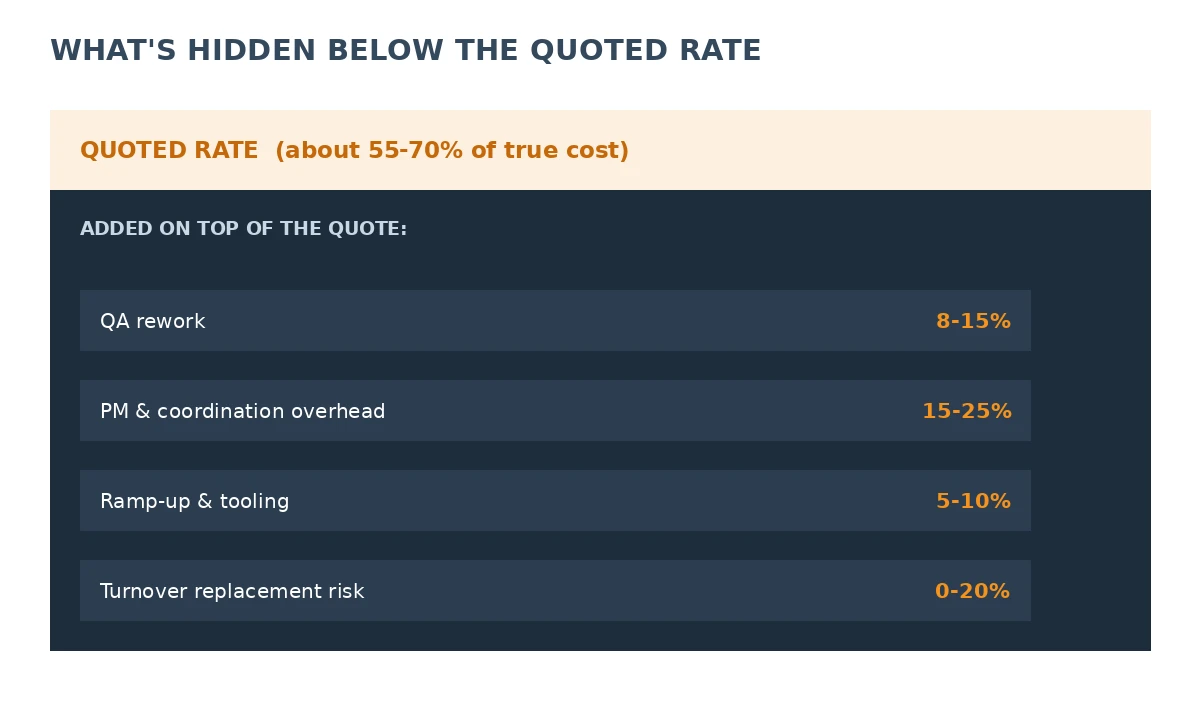
None of this means offshore doesn’t save money. It does, reliably. It just means, however, that the quote you get in the first call isn’t the number you should budget around. Build in 25% to 40% on top of the headline rate and you’ll be closer to reality than the sales deck suggests.
See What Your Offshore Build Actually Costs
Compare your current in-house developer costs against offshore rates by region. Takes under 2 minutes.
In-House vs. Offshore, the Real Total Cost of Ownership
The Bureau of Labor Statistics puts the 2026 median US software developer salary at $133,080. Then add payroll taxes, benefits, recruiting cost, and office overhead, and a fully loaded US hire typically runs 1.25x to 1.4x base salary, landing somewhere around $166,000 to $186,000 a year. Divide that across a working year and you’re looking at roughly $80 to $90 an hour, fully loaded, before the developer writes a line of code.
An offshore developer at $35 an hour, run through the 1.4x to 1.8x real-cost multiplier from earlier in this guide, lands at $49 to $63 an hour fully loaded. That’s still a 30% to 45% reduction against the US number, even after every hidden cost gets counted honestly. Even so, the gap shrinks under scrutiny. It doesn’t close.
| US In-House Hire | Offshore Developer | |
|---|---|---|
| Base rate | $64/hr (BLS median annualized) | $15–$70/hr by region |
| Fully loaded rate | $80–$90/hr | $21–$126/hr (region and role dependent) |
| Time to hire | 6–10 weeks average | 2–5 business days for first candidates |
| Benefits/overhead | 25–40% of base salary | Typically bundled into placement fee |
That time-to-hire line matters more than most budgets give it credit for. In contrast, Kore BPO delivers candidate resumes in 2 to 5 business days, against a US hiring cycle that Indeed’s salary and hiring data suggests regularly stretches past two months once interviews, offers, and notice periods get factored in. Two months of an open seat costs more than most people’s spreadsheets admit.
What Actually Moves Your Price Up or Down
Region sets the band. However, these four things decide where you land inside it.
Firstly, seniority is the obvious one. A junior developer three years out of school and a staff-level engineer who’s shipped production systems at scale aren’t the same line item, even in the same country, even at the same company.
So why does the same country produce a $20 quote and a $65 quote for what looks like the same job title on paper? For example, domain expertise is a big part of the answer, and it adds a premium almost everywhere. Fintech, healthcare, and logistics all carry compliance and integration complexity that generalist developers haven’t touched, and rates reflect it. If your project needs someone who’s worked with HIPAA-adjacent systems before, you’re not hiring at the bottom of the regional band.
Likewise, project complexity is the one people underestimate. Real-time processing, multiple third-party integrations, high-scale infrastructure. All of that pushes toward more senior talent, which pushes the rate up regardless of region.
Additionally, the engagement model itself, covered above, shifts blended cost by 15% to 25% depending on which one you pick.
A Simple Framework for Budgeting Your Offshore Team
Skip the spreadsheet gymnastics. Four steps get you a workable number.
First, pick your region based on what you actually need. Namely, real-time overlap with US hours points toward Latin America. Meanwhile, deep senior bench points toward Eastern Europe. Similarly, pure cost efficiency at scale points toward India or the Philippines.
Secondly, price the role at the regional midpoint, not the floor. The cheapest quote in any region is usually cheapest for a reason, and that reason shows up later as rework.
Third, apply the 1.4x to 1.8x real-cost multiplier from earlier in this guide to get your true hourly number, not the marketing number.
Fourthly, decide your engagement model based on project length, not upfront cost. A six-month-plus build almost always wins on total cost with a dedicated team, even though the sticker price looks higher month one.
Overall, we’ve watched this framework play out across a lot of client builds at Kore BPO. The teams that budget honestly up front, however, rarely blow past their number. Conversely, the teams that anchor to the cheapest quote almost always end up back at the negotiating table by month four.
How Kore BPO Prices Offshore Talent Differently
Basically, Kore BPO is a staffing and BPO firm that places offshore data and software talent with US companies, drawing from a bench built across our Hyderabad, India office and supported by teams in Dallas and San Jose, Costa Rica. Namely, we solve one specific problem. US companies need engineering talent fast, and the traditional offshore staffing model buries the real cost in vague monthly markups nobody can audit.
Instead, we run differently. $0 upfront fees. Resumes back in 2 to 5 business days. Unlike typical vendors, there are no markup games layered on top of a quoted rate that quietly balloons once the contract’s signed.
Where We’re Not the Right Fit
I’ll say the biased part out loud. We benefit when you hire through us instead of building an internal offshore recruiting function from scratch. That’s true. It’s also true that if you’re only hiring one or two roles a year, building your own pipeline probably makes more sense than a staffing partner. We’re not the right fit for every situation, and pretending otherwise wouldn’t help either of us.
Still, what we do have is scale behind the numbers in this guide. Indeed, we’ve placed 6,236 hires across 257 clients, which means our rate data isn’t theoretical. It’s what companies are actually paying, adjusted for what actually gets delivered. If you want to see how that plays out in practice, our recent placement case studies walk through real engagements, not composite examples.
Frequently Asked Questions
So what does an offshore developer actually cost per hour in 2026?
Generally, $15 to $120 depending on region and seniority, with most mid-level hires landing between $25 and $55. The number that matters more is the fully loaded cost after management and ramp-up, which runs 1.4x to 1.8x the quoted rate.
Is nearshore actually worth the higher rate compared to offshore?
Sometimes. Nearshore developers in Latin America run $50 to $90 an hour against offshore’s $20 to $50, but real-time overlap cuts revision cycles and speeds decision-making. If your team needs daily standups in US hours, that premium often pays for itself. If your workflow is async anyway, it usually doesn’t.
What’s a fair markup for a staffing partner to charge?
Actually, it depends heavily on the model. In short, a transparent placement fee structure, where you know exactly what you’re paying and why, beats an opaque monthly markup you can’t audit. Ask any vendor to break down their number line by line. If they won’t, that’s the answer.
How long does it actually take to stand up an offshore team?
2 to 5 business days for first candidate resumes with a staffing partner that already has a bench built. In contrast, building your own pipeline from zero, closer to 8 to 12 weeks once sourcing, vetting, and onboarding get counted.
A Few More Common Questions
Does offshore development actually save money once you count everything?
Yes, but not as much as the headline rate suggests. Overall, a fully loaded offshore developer typically lands 30% to 45% below a fully loaded US hire once every hidden cost gets counted honestly. Real savings. Just not the 70% number in most sales decks.
Do I need a dedicated project manager for an offshore team?
Generally, for anything beyond a small, well-scoped project, yes. Someone has to own the communication layer between your product team and the offshore engineers, and skipping that role tends to show up later as expensive rework instead of a line item you can see coming.
Related Articles



Building an Offshore Team? Get Real Numbers First.
Kore BPO places dedicated offshore developers from Hyderabad and Costa Rica inside US teams. Pre-screened candidates in 2–5 business days. $0 upfront.
Talk to Our Team