Latin America Staffing Pricing: What US Companies Actually Pay in 2026


A Real Pricing Example
Consider a finance director we talked to this spring who had three quotes on his desk for the same role, a mid-level backend developer, all in Latin America. $28 an hour. $41 an hour. $52 an hour. Same skill level, roughly, same time zone advantage. He assumed the cheapest one was hiding something, and he was half right. In fact, it wasn’t hiding a lower-quality candidate at all. Instead, it was hiding a country he hadn’t priced correctly and a fee structure he hadn’t asked about.
In short, that gap is the whole story of Latin America staffing pricing in 2026. Country matters. Role and seniority matter more. And the model you use to hire, staff augmentation, an employer of record, or a direct placement, moves your 12-month total more than any of that. This guide breaks down what companies actually pay across Colombia, Mexico, Argentina, Brazil, and Costa Rica, what’s baked into that number, and where the real costs hide once the headline rate stops telling the whole story.
What Latin America Staffing Actually Costs in 2026
Latin America staffing costs $16 to $90 an hour in 2026 across the roles and countries we track most, with support and admin work at the low end and senior software engineering at the high end. That’s a wide band, and it should be, because a customer service rep in Costa Rica and a senior backend engineer in Argentina aren’t remotely the same purchase.
Notably, software developer pay drives most of the conversation right now. Junior developers across the major LATAM markets run roughly $18,000 to $36,000 a year, mid-level developers land between $35,000 and $66,000, and senior engineers stretch from $55,000 up past $92,000 depending on country and specialization. Support, back-office, and customer service roles sit in a much narrower band, typically $7 to $22 an hour fully loaded.
Why Two Quotes Can Differ by 20 Percent
However, none of that accounts for the fee model wrapped around it. For example, two companies hiring the identical role in the identical country can land on 12-month totals that differ by 20% or more, purely because one picked hourly staff augmentation and the other picked a flat monthly employer-of-record fee. So which number should you actually trust when two quotes look nothing alike? Neither, on its own. Region sets the floor. Structure decides how far above it you actually land.
Want a Country-Specific Estimate?
Kore BPO breaks down base pay, benefits, and fees separately, no bundled guesswork.
Pricing by Country Across Colombia, Mexico, Argentina, Brazil, and Costa Rica
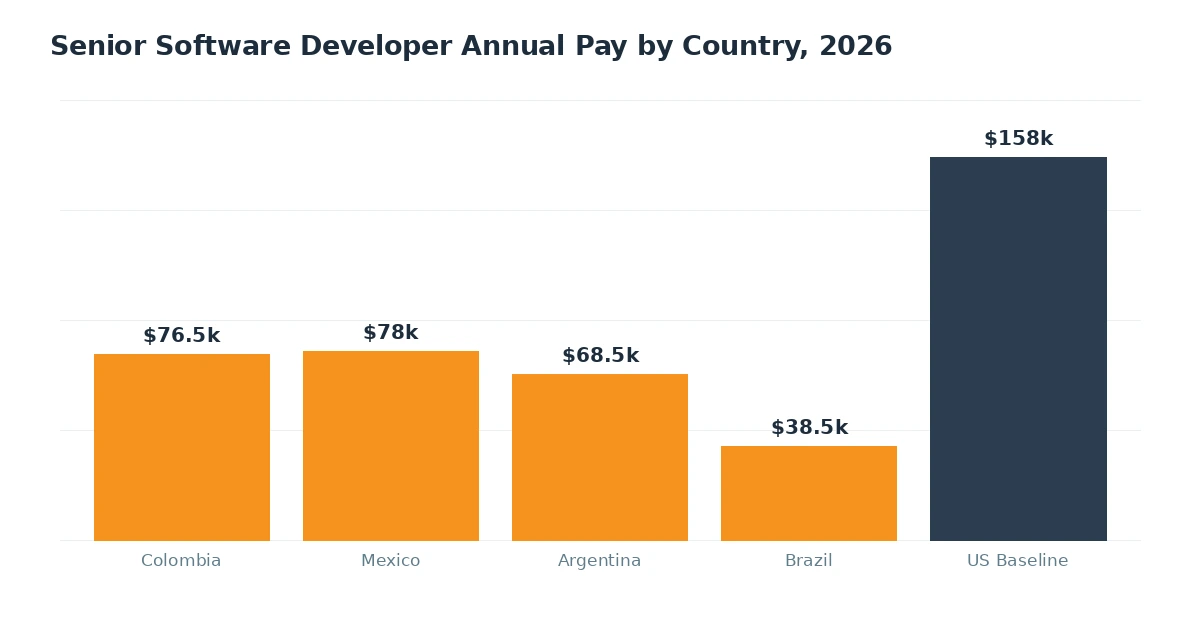
Overall, country accounts for a real chunk of the spread, but not the whole thing. Here’s roughly where 2026 pay clusters, pulled from SalaryExpert, PayScale, and Glassdoor compensation data rather than any single agency’s rate card.
| Country | Junior Dev (annual) | Mid-Level Dev (annual) | Senior Dev (annual) |
|---|---|---|---|
| Colombia | $25k-$41k | $41k-$66k | $61k-$92k |
| Mexico | $24k-$42k | $42k-$66k | $66k-$90k |
| Argentina | $27k-$37k | $35k-$55k | $55k-$82k |
| Brazil | $18k-$25k | $25k-$32k | $32k-$45k |
| US (baseline) | $85k-$105k | $105k-$135k | $136k-$180k+ |
Colombia
Specifically, Colombia’s mid-level developers earn $40,920 to $66,495 a year, with senior talent running $61,380 to $92,070, according to ERI SalaryExpert’s 2026 Colombia data. Typically, Bogota runs slightly above the national average. Colombia has also become the single most popular LATAM hiring destination for US companies this year, which is pushing senior rates up faster than the other markets.
Mexico
Similarly, Mexico’s overall average software engineer salary sits near $55,894 a year, per PayScale’s 2026 Mexico benchmarks. Mexico City, Guadalajara, and Monterrey carry a premium over smaller cities, and the three-hour time zone spread across the country means West Coast and East Coast teams get different degrees of overlap.
Argentina
Meanwhile, Argentina consistently prices as the region’s premium market. PayScale’s Argentina data puts full stack developer pay between $27,420 for entry-level and $82,260 for senior talent, driven by strong English fluency and a deep bench of experienced engineers. Because peso volatility complicates the picture, most serious contracts are priced and paid in USD regardless of where the worker lives.
Brazil
Brazil is the outlier on the low end for IT roles, with ERI’s IT Engineer benchmark putting the average annual salary between roughly BRL 112,715 and BRL 199,746, translating to about $21,000 to $37,000 USD at current exchange rates. It also has the region’s deepest talent pool, so the lower average price tag isn’t a scarcity discount. It’s just a bigger market.
Costa Rica
By contrast, Costa Rica prices differently than the software-heavy markets above, leaning more toward back-office, contact center, and support roles built on a university-educated, STEM-heavy workforce. Glassdoor’s Costa Rica compensation data shows a market that trends a step above Mexico and Colombia for equivalent support and admin work, which tracks with what we see in practice. You’re not hiring Costa Rica because it’s the cheapest option. You’re hiring it because the retention and English proficiency numbers are strong enough to justify the premium.
What Actually Drives the Rate You Pay
Country picks the range. Four other things pick where you land inside it.
First, seniority moves the number more than anything else. The gap between a junior and senior hire in the same country, same city even, can be triple the pay. That’s not a Latin America quirk. It’s true everywhere. It just gets flattened in headline rate comparisons that only quote one number per country.
Skill Scarcity and Demand Shifts
Meanwhile, skill scarcity matters too, and it’s not always the skill you’d expect. For instance, generic React or Node developers are abundant across the region right now. In contrast, specialized AI infrastructure engineers and senior DevOps talent are not, and rates for those roles have climbed faster than the general market. Generative AI course enrollment across Latin America jumped 425% in 2025, which tells you demand is outrunning supply for anyone who’s actually applied that training on the job.
Additionally, the staffing model changes the math more than people expect walking in. Hourly billing exposes you to fluctuating hours. Flat monthly fees are easier to forecast but harder to compare across vendors unless you ask what’s bundled inside. We’ll get into that in the next section, because it deserves its own space.
What the Skills Shortage Means for Rates
And then there’s the OECD’s skills-shortage finding, which is the uncomfortable backdrop to all of this. The OECD’s Latin American Economic Outlook 2025 found that companies in the region are 13 times more likely to report performance issues tied to skills shortages than companies in East Asia. In other words, rates aren’t rising because agencies got greedier. They’re rising because the good ones are genuinely harder to find than they were three years ago.
Rule of thumb we use internally. Specifically, budget for the 60th to 70th percentile of a country’s published range, not the median. Median rates assume you’ll take whoever’s available. Most companies actually want someone closer to the top of the pool.
Staffing Models Compared, Staff Augmentation, EOR, Direct Placement, and BPO
In total, four models cover most of how US companies bring on Latin America talent, and they price completely differently even for the identical role.
- Staff augmentation bills an hourly or monthly rate that bundles the worker’s pay, recruiting cost, and a margin into one number. That works well for ongoing project work where you want one vendor handling payroll and compliance without a permanent hire.
- In contrast, an employer of record, or EOR, charges a flat fee per employee per month on top of actual salary, usually $400 to $800, to handle local payroll, tax filings, and legal compliance. You manage the person day to day. The EOR is the legal employer on paper.
- Likewise, direct placement works like traditional recruiting. One fee, typically 15% to 25% of first-year salary, paid once when the hire closes. No ongoing markup after that, but you take on full local employer responsibilities yourself unless you already have an entity in-country.
- Finally, full BPO engagements bundle the role into a managed service, priced per seat or per outcome rather than per hire, common for contact center and back-office functions where the process matters as much as the individual worker.
Comparing the Trade-Offs in Practice
Here’s the part that trips people up. For example, a $45/hr staff augmentation rate and a $600/month EOR fee on top of a $65,000 salary can land at nearly the same annual total, but they behave completely differently if the engagement scales up or winds down mid-year. Staff augmentation flexes with hours worked. EOR and direct placement assume a full-time, ongoing relationship. Pick based on how certain you are about headcount twelve months from now, not just which number looks smaller today.
Latin America Staffing vs Traditional US Staffing Agencies
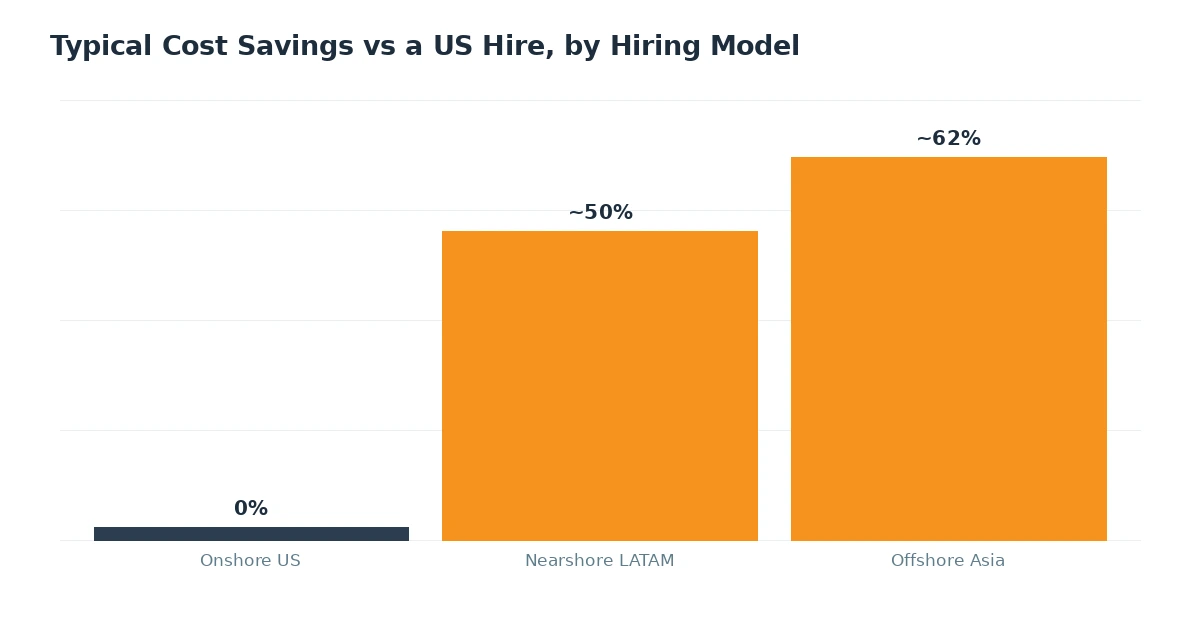
By comparison, a traditional US staffing agency filling the same backend developer role typically bills $75 to $150 an hour once markup is included, benchmarked against a median US software developer salary of $135,980 reported by the Bureau of Labor Statistics in its May 2025 release. Compare that to $41 to $92 an hour for an equivalent senior LATAM hire, and the savings case writes itself before you even factor in time zone overlap.
So why doesn’t everyone just chase the lowest hourly rate on the sheet? The part that doesn’t show up in a rate comparison is coordination cost. In practice, a developer working two to three hours off US Eastern time joins the same standups, ships in the same sprint cycle, and doesn’t force async handoffs the way an offshore hire ten time zones away can. That’s not a number on the invoice. It’s the reason 90% of companies that make the nearshore switch don’t go back to a fully offshore model, based on what we’ve seen across our own client base moving off pure offshore arrangements.
When This Model Might Not Fit
Bias disclosed here, since we place this kind of talent for a living. We benefit when a company decides Latin America staffing fits. That said, it doesn’t change the math. If you’re filling one part-time role for a three-month project, a freelance platform will probably serve you better than a full staffing relationship. Latin America staffing earns its cost advantage on ongoing, collaborative roles, not one-off gigs. For a deeper breakdown of how nearshore and offshore agency pricing compare specifically, see our guides to nearshore staffing agency pricing and offshore staffing agency pricing.
Latin America vs Offshore Asia, Where the Real Savings Land
In comparison, offshore markets in Asia typically undercut Latin America by another 15% to 30% on pure hourly rate. Cheaper on the invoice. However, it’s not always cheaper on the project.
Specifically, the gap comes down to overlap hours. A Latin America hire shares most of the US workday. An offshore hire eight to thirteen time zones out shares almost none of it, which pushes coordination into async handoffs, delayed code reviews, and QA passes that wouldn’t be necessary with real-time collaboration. As a result, companies that priced purely on hourly rate and picked offshore over nearshore often find the coordination tax eats a meaningful chunk of the discount by month six.
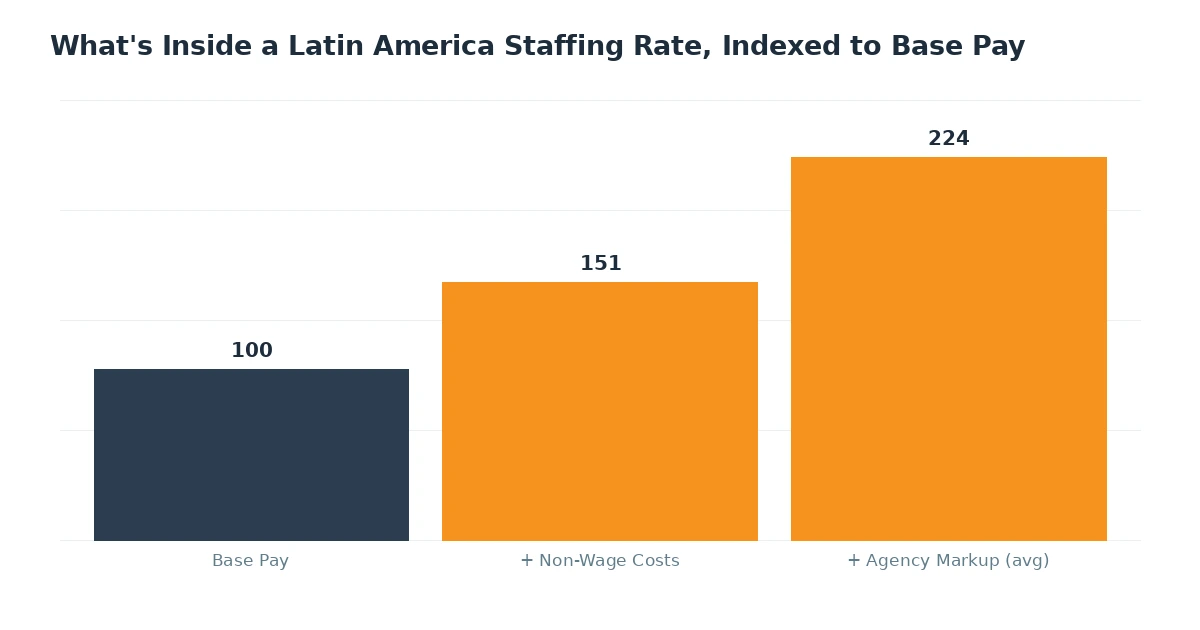
That 51.1% figure, from the IDB’s ten-year update on salaried labor costs, applies broadly across Latin America and varies by country. It’s a useful gut-check when a hourly quote seems suspiciously close to what you’d expect from a much cheaper offshore market. If the math looks too close, someone’s absorbing a compliance cost that isn’t showing up on your invoice yet.
Hidden Costs and How to Budget for Latin America Staffing
The headline rate is never the whole number. In practice, four things routinely get left off.
Onboarding time. Even for a strong hire, it typically takes two to six weeks to reach full productivity depending on the role’s complexity. Budget that ramp period as a cost, not a bonus.
Attrition and replacement. Even with good vendors, turnover still happens, and it’s a cost worth planning for. A replacement search on short notice can cost more than the original placement did, especially if the role sat vacant for weeks while you scrambled. Because of that, ask upfront what a vendor’s replacement guarantee actually covers and for how long.
Equipment and setup. For instance, laptops, secure VPN access, and compliance tooling get billed separately by some vendors and folded into the base rate by others. Neither approach is wrong. Not knowing which one you signed up for is the problem, and it’s a five-minute question that saves a surprise invoice later.
FX exposure. Since contracts are priced in local currency but invoiced in USD, costs can shift 3% to 8% year over year depending on peso or real volatility. Ask which side of the contract absorbs that swing before you sign, not after the first renewal notice.
Also, watch for automatic renewal escalators buried in the fine print, typically 5% to 8% a year. They’re legal, common, and almost never mentioned out loud during the sales conversation.
Building a Realistic Budget
To budget accurately, take the country’s published rate, add roughly 50% to account for non-wage labor costs and markup combined, then add a one-time onboarding buffer equal to two to four weeks of pay. That won’t be exact. Ultimately, it’ll be close enough to avoid the sticker shock that hits companies who budgeted off the headline number alone.
In our experience, Kore BPO is a US-owned staffing partner that’s placed more than 6,200 hires for 257 clients across accounting, tech, marketing, and operations, with resumes typically delivered in two to five business days. We break out base pay, statutory costs, and markup separately on every quote. Explore our offshore staffing agency overview if you’re comparing Latin America against Asia-based options, or see our nearshore recruiting cost and offshore recruiting cost guides for the recruiting-fee side of this same decision.
Questions People Ask About Latin America Staffing Pricing
How much does Latin America staffing actually cost per hour?
In short, roughly $16 to $90 an hour in 2026, depending on country, role, and seniority. Costa Rica’s back-office and support rates start near $16-$22/hr, while senior software engineers in Colombia and Argentina can run $50-$90/hr. Support and admin roles across the region sit well below that, often $7-$14/hr fully loaded.
Is Latin America staffing actually cheaper than hiring in the US?
Yes, usually 40% to 65% cheaper than an equivalent US hire once you compare it against the median US software developer salary of $135,980 reported by the Bureau of Labor Statistics. The gap narrows for premium markets like Argentina and widens for Mexico and Brazil, so the savings aren’t identical across the region.
Which Latin American country has the lowest staffing costs?
Notably, Brazil and Mexico generally price lowest for comparable software roles, based on SalaryExpert and PayScale data, while Argentina and Costa Rica trend higher. Cheapest on paper doesn’t always mean cheapest delivered. In practice, turnover and management overhead vary by market too, and a cheaper hire who leaves in four months isn’t actually cheaper.
More Questions on Staffing Models and Costs
What’s the difference between staff augmentation, EOR, and direct placement pricing?
Specifically, staff augmentation bills an hourly or monthly rate bundling recruiting, payroll, and a margin into one number. An employer of record charges a flat monthly fee per worker, usually $400 to $800, on top of salary. Direct placement charges a one-time fee, typically 15% to 25% of first-year salary, with no ongoing markup after that. Pick based on how certain your headcount plans are twelve months out.
What hidden costs should I budget for beyond the hourly rate?
Notably, non-wage labor costs average 51.1% of formal wages across Latin America according to the Inter-American Development Bank. That covers payroll tax, mandatory benefits, and severance reserves. Add equipment, a realistic onboarding ramp, and an attrition buffer before you finalize a number, or the actual invoice will run ahead of what you planned.
Comparing Quotes and Reading the Fine Print
How do I compare Latin America staffing quotes fairly across vendors?
Ultimately, convert every quote to a 12-month total, not a per-hour number. Ask each vendor to itemize base pay, statutory benefits, markup, and any setup fees separately, in writing. Ultimately, a quote that won’t break down into those four pieces is usually hiding something in the bundle. That’s not cynicism. It’s just what a couple hundred client conversations have taught us.
Rate ranges in this post reflect mid-2026 Latin America staffing market data for dedicated placements. However, freelance platform rates and short-term project quotes may differ. Figures are pre-overhead unless otherwise noted and do not include client-side management time. Kore BPO internal figures refer to aggregate placement outcomes from 2024-2025.
Related Articles



Ready to See What Latin America Talent Actually Costs?
Kore BPO gives you an itemized quote across Colombia, Mexico, Argentina, Brazil, and Costa Rica, base pay, taxes, and markup broken out separately.
Get an Itemized Quote