Nearshore Staffing Agency vs Traditional Staffing Agency: Which Fits Your Hiring Need in 2026


Every hiring manager who has run a search through a traditional staffing agency knows the drill. You submit the requisition, wait two to three weeks for a shortlist, interview four candidates who are all roughly the same price, and then pay a placement fee equal to a quarter of that person’s first-year salary. It works, but it is slow and it is not cheap, and in 2026 it is competing against a model that did not exist at meaningful scale a decade ago.
We run nearshore placements for US companies through our nearshore BPO services, and the question we get most from operations leaders is not “does nearshore work.” It is “when does it actually make more sense than the staffing agency we already use.” That is the right question, because neither model is universally better. They solve different problems, and the wrong choice shows up later as budget waste or a role that took too long to fill.
This article breaks down what separates the two models on cost, speed, time zone fit, and compliance, then gives you a straightforward way to decide which one fits the role you are trying to fill right now.
Prefer to watch it? Here is the video breakdown of nearshore vs. staffing agency costs.
What a Nearshore Staffing Agency Does
A nearshore staffing agency recruits, vets, and places professionals from countries close to the US, most commonly across Latin America, into roles that function as an extension of your in-house team. The candidate is not a vendor’s employee working on a detached task list. They join your daily standups, use your tools, and report to your managers, just like a domestic hire would, except the agency handles recruiting, payroll, benefits administration, and local compliance on the back end.
The model exists because of a specific gap. US companies want the accountability and integration of a direct hire without paying US salary bands for every seat, and they want it without the multi-month timeline a domestic search usually takes. Nearshore agencies fill that gap by drawing from a talent pool that is deep, increasingly specialized, and priced for a different cost of living than the US market, while staying close enough in time zone that daily collaboration does not break down.
What a Traditional Staffing Agency Does
A traditional staffing agency sources, screens, and presents domestic candidates for temporary, contract, or direct-hire roles. The agency’s value is speed within the local labor market and reduced recruiting overhead. You describe the role, the agency runs it against its existing candidate database and active sourcing channels, and you interview a shortlist within a couple of weeks.
This model is built for the US labor market specifically, and it carries the constraints of that market. Every candidate is priced at US wage levels, every placement fee reflects the cost of recruiting in a tight domestic pool, and availability depends entirely on how many qualified people happen to be looking for work in your city or willing to relocate. When a role requires niche technical skill or the local market is thin, timelines stretch well past the typical two to three week estimate.
Cost Comparison: Markup, Fees, and Real Numbers
Cost is where the two models diverge most sharply, and the difference is not close. Traditional staffing agencies use one of three fee structures depending on the placement type: direct hire fees run 15 to 30% of the candidate’s first-year base salary, executive search runs 25 to 35%, and temporary or contract placements carry an hourly bill rate marked up 30 to 75% over the worker’s pay. On top of the agency fee, the average total cost per hire in the US reached roughly $4,700 across all industries in 2026, according to SHRM, climbing well past $28,000 for executive-level roles.
Nearshore staffing runs on a different cost structure entirely. Because the underlying salary is benchmarked against the hire’s home country rather than the US, a fully loaded nearshore placement, inclusive of recruiting, payroll, benefits, and agency management, typically lands 50 to 70% below what an equivalent US-based hire would cost. A role that might run $65,000 to $75,000 loaded in the US often lands in the high teens to low $30,000s nearshore for comparable output, depending on seniority and specialization.
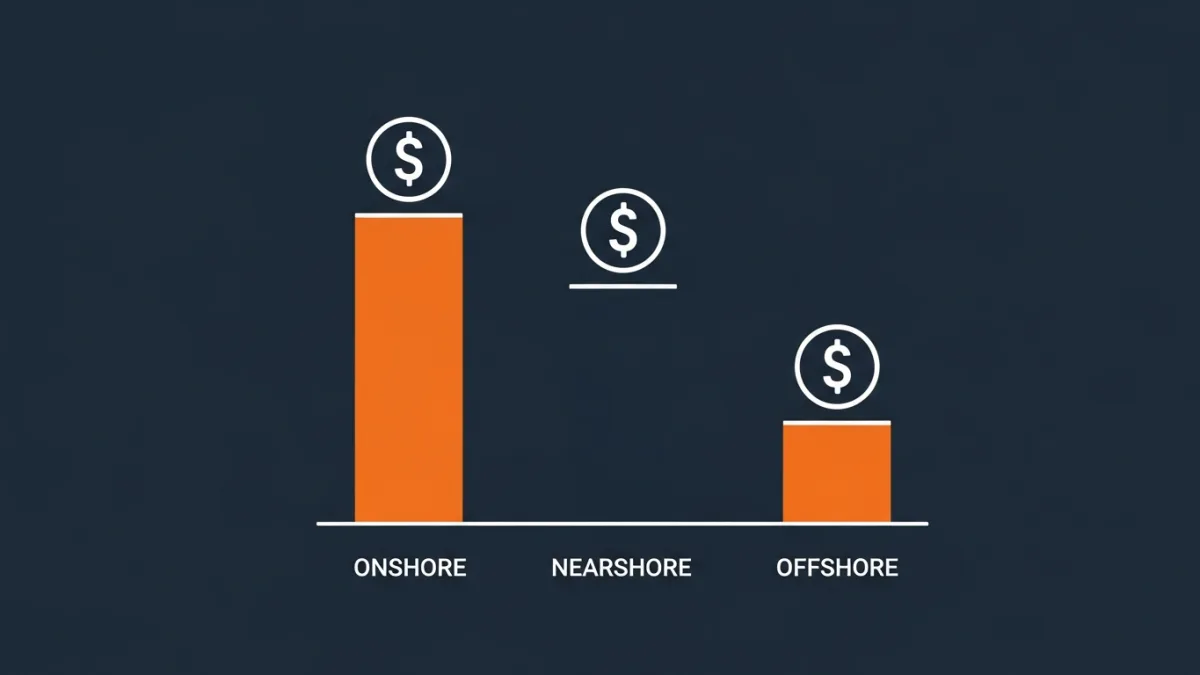
That gap does not mean traditional staffing is a bad deal. For a single urgent local hire, the fee buys you speed and local market knowledge that a nearshore agency cannot replicate for an on-site, US-only role. The gap matters most when you are filling recurring or scalable positions, where the savings compound every month the seat is filled rather than one time at placement.
For the full breakdown of nearshore fee models, country-by-country rates, and the hidden fees that close this gap faster than expected, see our nearshore staffing agency pricing guide.
Speed to Hire: Days vs Weeks
A fully managed nearshore staffing agency typically moves from an initial scoping call to a candidate’s first day of work in 5 to 10 business days. That timeline is possible because the agency maintains a standing, pre-vetted talent pipeline rather than starting a search from zero for every request.
Domestic hiring through a traditional staffing agency runs on a longer clock, typically 4 to 8 weeks from job posting to start date, and that estimate assumes a reasonably deep local candidate pool. With the total number of unfilled job vacancies nationwide sitting above 7 million and the labor force shrinking as experienced workers retire faster than younger workers enter it, that timeline is getting longer for specialized roles, not shorter.
Time Zone and Communication Overlap
This is the factor that separates nearshore from offshore, and it is also where nearshore holds a real advantage over some assumptions people carry about outsourcing generally. Most Latin American time zones sit within one to three hours of major US business hours, which typically produces six to eight hours of overlapping work time each day. That is enough overlap to run daily standups, hold live client calls, and resolve a blocker the same afternoon it comes up, rather than waiting until the next business day.

A traditional staffing agency placement is, by definition, already in your time zone, so this is not a factor you weigh against nearshore directly. It matters more when a company is deciding between nearshore and offshore models, where the offshore option often trades a lower rate for a communication gap that a nearshore hire does not carry.
Compliance and Risk: What Each Model Owns
A traditional staffing agency operates entirely inside US employment law, which is familiar ground for most HR teams. Tax withholding, benefits eligibility, and termination rights all follow a rulebook your company likely already knows.
A nearshore staffing agency introduces a second jurisdiction, which raises the compliance bar rather than lowering it. Employment law, tax obligations, and termination rights in the hire’s home country all need to be handled correctly, and a reliable agency structures this through an employer-of-record arrangement so your company is not the one navigating foreign labor law directly. What you should verify before signing with any nearshore partner: who is the legal employer of record in-country, how disputes and terminations are handled, and how intellectual property and data protection are addressed in the contract. A vendor that cannot answer those questions clearly is not one to build a team through.
Ask any nearshore staffing partner for their employer-of-record structure in writing before signing. An agency that treats every hire as an independent contractor rather than a properly employed worker in their home country is pushing compliance risk back onto you.
Which Model Fits Your Hiring Need
Neither model wins every scenario. The right choice depends on how long you need the role filled, how tight your timeline is, and how much budget flexibility you actually have.
| Hiring Scenario | Better Fit | Why |
|---|---|---|
| Urgent, one-off local role | Traditional agency | Local market knowledge and same-week candidate availability |
| Sustained, embedded team role | Nearshore agency | Lower loaded cost every month the seat is filled, same-day collaboration |
| Highly regulated on-site work | Traditional agency | Physical presence and jurisdiction-specific licensing requirements |
| Budget-constrained scaling | Nearshore agency | 50 to 70% lower fully loaded cost frees budget for more seats |
| Short-term coverage under 90 days | Traditional agency | Faster local temp placement without a longer-term commitment structure |

A useful way to frame it: traditional staffing agencies are built for transactions, filling a specific opening as fast as the local market allows. Nearshore staffing agencies are built for relationships, embedding a person into your operation for the long haul at a materially lower cost. Many growing companies end up running both, using a traditional agency for the rare local hire that has to be on-site, and a nearshore partner for the roles that scale with the business, like customer service, operations, and administrative functions covered in our broader BPO solutions. See how Kore BPO structures the nearshore side of that arrangement on our nearshore staffing agency page. If you are still deciding whether outsourcing fits your business at all, our guide on what BPO actually is covers the fundamentals before you commit to either model.
Common Questions on Nearshore vs Traditional Staffing
Is nearshore staffing cheaper than a traditional staffing agency?
Yes, in most cases. A traditional staffing agency charges 15 to 30% of first-year salary for direct hire or a 30 to 75% hourly markup for temp roles, on top of US wage levels. A fully loaded nearshore hire typically costs 50 to 70% less than an equivalent US-based hire, since the underlying salary reflects the cost of living in the hire’s home country.
How fast can a nearshore staffing agency fill a role compared to a traditional agency?
A managed nearshore agency typically moves from scoping call to first day of work in 5 to 10 business days, using a standing pre-vetted talent pipeline. Domestic hiring through a traditional staffing agency usually takes 4 to 8 weeks, longer for specialized or hard-to-fill roles.
Is nearshore staffing legal and compliant for US companies?
Yes, when structured correctly. A reliable nearshore staffing agency employs the worker through an employer-of-record arrangement in their home country, handling local labor law, tax withholding, and benefits so your company is not directly navigating foreign employment regulations. Always confirm the employer-of-record structure and intellectual property terms in writing before signing.
What is the main difference between nearshore and traditional staffing?
A traditional staffing agency sources domestic candidates for local roles, priced at US wage levels with full time zone alignment by default. A nearshore staffing agency sources talent from nearby countries, mainly Latin America, at a significantly lower fully loaded cost while still keeping a one to three hour time zone overlap for daily collaboration.
Should a small business use nearshore or traditional staffing first?
It depends on the role. A small business filling a single urgent, on-site position is usually better served by a traditional agency’s local speed. A small business building a recurring function, like customer support, bookkeeping, or ongoing technical work, typically gets more value from a nearshore agency, since the cost savings compound with every month the role stays filled.
Related Articles



Ready to Build Your Nearshore Team?
Kore BPO places dedicated nearshore professionals for US companies. Pre-screened resumes in 2 to 5 days.
See BPO Solutions