KPO vs BPO vs LPO vs RPO: Breaking Down Every Outsourcing Type in Plain English


Four acronyms. One confusing conversation.
BPO. KPO. LPO. RPO. If you’ve sat through enough vendor pitches, you know the feeling. By the time someone finishes explaining the third one, you’ve lost the thread on the first. Push back and ask which one your company actually needs, and the answer is usually “it depends,” which is about as useful as nothing.
Here’s what nobody says clearly. These four types aren’t competing options you pick between. They form a hierarchy. Understanding that relationship changes how you evaluate proposals, scope engagements, and avoid overpaying for expertise you don’t yet need. In the broader outsourcing landscape, this kind of structural confusion costs companies real money and real time.
Kore BPO works with US companies from 10 to 200 employees. Usually the CEO or COO is evaluating this personally, not a procurement team. This post is for them.
What Are BPO, KPO, LPO, and RPO?
Short version first. Four types, four sentences.
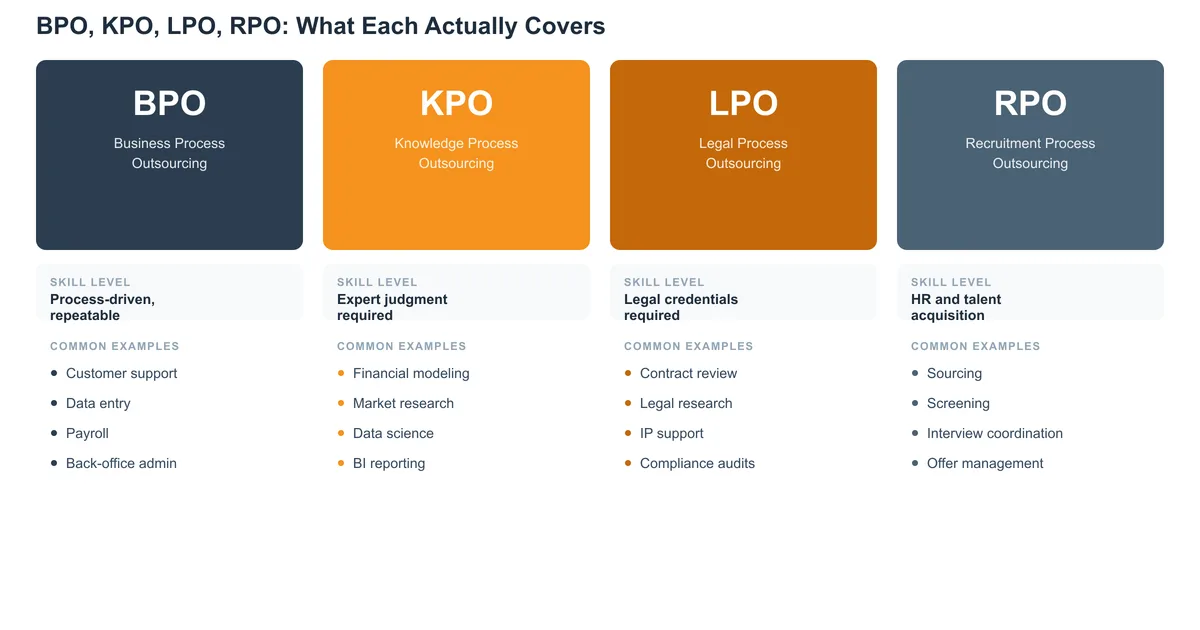
BPO (Business Process Outsourcing) is the umbrella. Any business function you hand to a third party is, by definition, BPO. Customer support, payroll, data entry, back-office finance. All of it lives here.
KPO (Knowledge Process Outsourcing) is the knowledge-intensive tier. These are functions that require expertise, analytical judgment, and domain credentials. Not just task completion. Think market research, financial modeling, data science, technical analysis.
LPO (Legal Process Outsourcing) is KPO applied to legal work. Contract review, legal research, compliance audits, patent support. It’s a specialized slice aimed at law firms and in-house legal teams.
RPO (Recruitment Process Outsourcing) means handing your hiring pipeline (or a defined portion of it) to an external provider who manages sourcing, screening, and coordination. You set the bar. They fill the funnel.
| Type | Full Name | Skill Level | Common Examples |
|---|---|---|---|
| BPO | Business Process Outsourcing | Process-driven, repeatable | Customer support, data entry, payroll, back-office admin |
| KPO | Knowledge Process Outsourcing | Expert judgment required | Financial modeling, market research, data science, BI reporting |
| LPO | Legal Process Outsourcing | Legal credentials required | Contract review, legal research, IP support, compliance audits |
| RPO | Recruitment Process Outsourcing | HR and talent acquisition | Sourcing, screening, interview coordination, offer management |
BPO: The Broad Base
Start here. Everything else branches off this.
Business Process Outsourcing is the practice of contracting a third party to handle specific functions your team would otherwise run in-house. IBM breaks it into two lanes: front-office work (customer-facing functions like support, sales, and marketing) and back-office work (internal operations like HR, payroll, IT, and compliance). Most companies start with whichever lane has the highest headcount pressure.
The scale of BPO is genuinely massive. Fortune Business Insights put the global BPO market at roughly $358 billion in 2026, growing at a 9.7% compound annual growth rate through 2034. That number reflects everything from call center operations in the Philippines to offshore accounting teams serving construction firms in Texas.
What qualifies as BPO? Practically anything that’s process-driven, repeatable, and doesn’t require deep domain credentials. If you could write a standard operating procedure for it and train someone to follow it in two weeks, it’s BPO territory. What BPO actually covers for a US small business runs deeper than most founders expect when they first start looking.
KPO: Expertise, Not Just Execution
KPO is where the work gets harder.
Knowledge Process Outsourcing handles functions that require real expertise, not just completion. The difference isn’t effort. It’s the nature of the output. A BPO team answers your support tickets. A KPO team analyzes your competitor landscape and builds a financial model off it.
Common KPO functions include market research, equity and financial analysis, business intelligence reporting, data science, engineering analysis, technical writing, and IP research. These are roles where the deliverable requires judgment, not just a completed task. According to 1840 & Co.’s 2026 KPO guide, the market is set to expand by $205 billion between 2026 and 2030, at a 20.5% annual growth rate, nearly triple BPO’s pace.
Why that gap? Partly because more companies are finding that senior-level analytical work doesn’t require a senior-level US salary. You can hire offshore knowledge workers with finance or data science credentials for 40 to 60% of what the same role costs domestically. Time Doctor’s 2026 KPO breakdown covers the staffing models and credential requirements if you want a closer look at how vendors typically structure these teams.
One thing that catches people off guard: KPO still requires strong management oversight on your side. You’re not outsourcing the decision. You’re outsourcing the analysis that feeds it. That’s a meaningful distinction when scoping any engagement.
LPO: The Legal-Specific Subset
Think of LPO as KPO with a law degree.
Legal Process Outsourcing is a specialized form of knowledge outsourcing applied to legal work. Contract review, legal research, patent and trademark support, compliance reporting, document drafting, litigation preparation. None of this falls to a generalist BPO team. It requires lawyers or trained legal professionals. That’s what LPO providers offer. Kore BPO’s legal process outsourcing services cover this exact range of work for US law firms and in-house legal teams, staffed under the client’s own supervising attorneys.
LPO is well-established in India, the Philippines, and South Africa. According to T-Best Services, offshoring legal work through an LPO provider can cut costs by up to 50 percent on high-volume tasks. For law firms managing hundreds of contracts per month, or companies running large-scale due diligence packages, that math compounds fast.
Worth being direct here: LPO isn’t for every US business. If you sign a handful of agreements per year and have solid general counsel, you don’t need it. But if your legal team is buried in document review (structured, repeatable work that doesn’t need a partner-level call), LPO almost always represents a smarter spend than keeping it in-house.
RPO: Taking Hiring Off Your Plate
RPO is different from the other three in one important way. It’s already well-known in HR circles, which means it sometimes gets treated as if it belongs in a completely separate category. It doesn’t.
Recruitment Process Outsourcing means handing your hiring pipeline (or a defined piece of it) to an external provider who manages sourcing, screening, coordination, and often onboarding logistics. You set the criteria. They work the funnel.
Technavio’s 2026 market analysis documents strong growth across the RPO space, with the National Law Review projecting the market hits $16.4 billion by 2030 at a 14.6% CAGR. That growth reflects a specific, painful problem. Companies need to hire faster than their internal teams can support.
For US SMBs scaling past 25 employees, RPO often solves a real operational bottleneck. Hiring is time-intensive. If your ops lead is spending 30% of the week on recruiting logistics, that’s a capacity problem, not a talent problem. Our RPO vs BPO vs HRO comparison goes deeper on where these models diverge and which one fits different staffing situations.
Not Sure Which Model Fits?
Kore BPO scopes engagements for US companies at 10 to 200 employees. We start with where your friction is highest.
The Hierarchy Nobody Explains
Here’s what almost nobody lays out clearly.
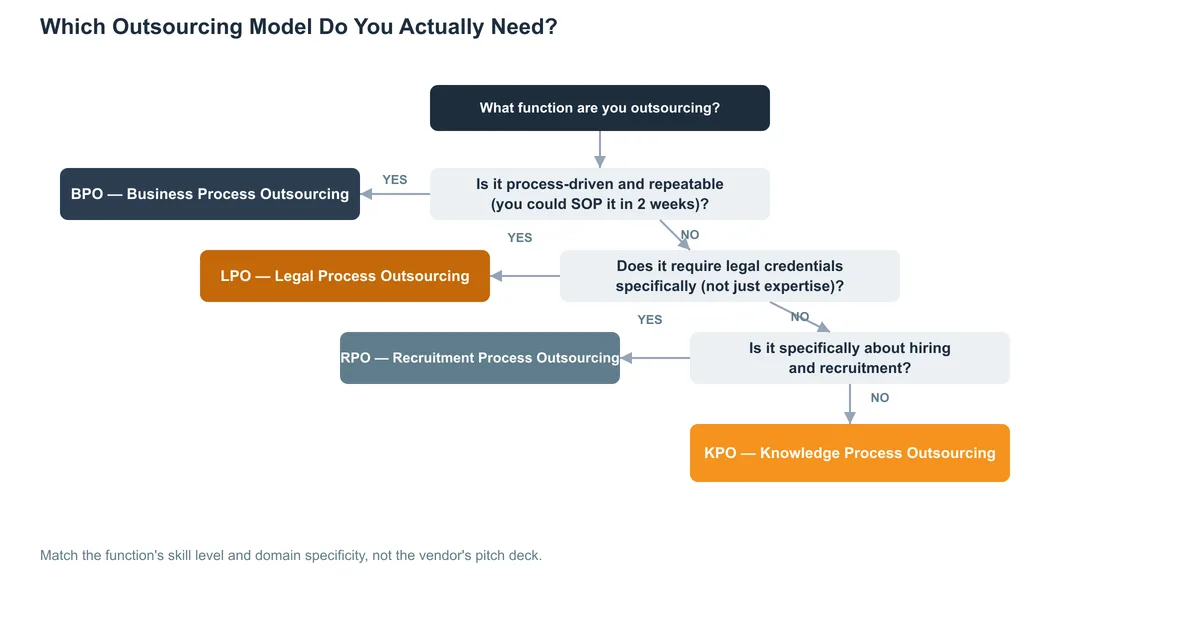
BPO is the outer shell. KPO is a knowledge-intensive subset that lives inside it. LPO is a legal-specific version of KPO. RPO sits closer to HRO (Human Resources Outsourcing) than to KPO, technically under the BPO umbrella, though several analysts and providers treat it as a standalone category. Honestly, that’s not an unreasonable read either. The vendor landscape operates that way.
So the question isn’t “BPO or RPO?” It’s “What level of skill and domain specificity does this function actually require?” Once you frame it that way, most decisions get simpler.
We see the mismatch play out constantly. A company gets pitched on KPO-level services because the vendor used that framing in the deck. What they actually needed was solid BPO with a strong operations structure. Overpaying for expertise your business doesn’t yet require is exactly as costly as buying the wrong tier. You’re just bleeding money from a different direction.
Admitted bias: Kore BPO is a BPO provider, so this framing favors starting with BPO and specializing as volume grows. But the math supports it for most SMBs. We’ve placed over 6,200 hires for 257 US clients. The majority started with one function and expanded from there, not the other way around.
Which Type Does Your Business Actually Need?
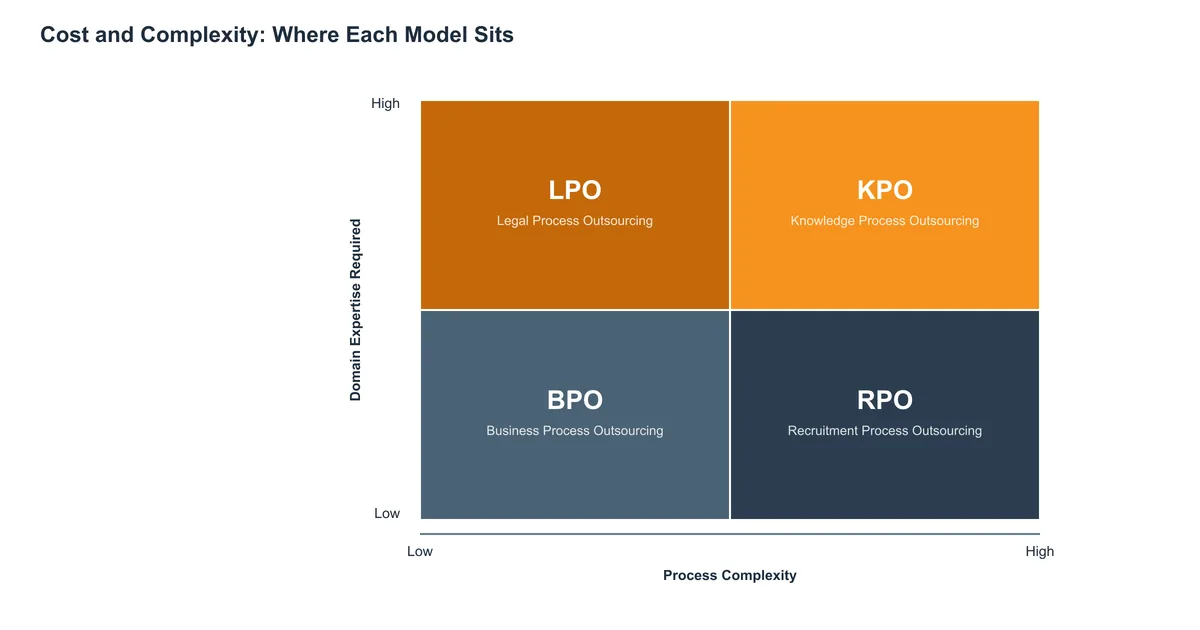
Run through these scenarios. One of them will fit.
You have high-volume, repeatable tasks that slow your team down (data entry, customer support tickets, scheduling, payroll processing). That’s BPO. Start there.
Analytical output that drives real decisions is a different ask. Financial models, market research reports, business intelligence dashboards, technical analysis a senior person has to interpret. That’s KPO.
Your legal volume is too high to justify what you’re paying in billable hours for routine work (contract review, compliance audits, patent searches). That’s LPO.
Your hiring pipeline is a bottleneck. Time-to-fill is too long, coordination is eating your ops team’s calendar, or you’re scaling fast enough that internal recruiting simply can’t keep up. That’s RPO.
Not sure where to start? Most US SMBs are better off beginning with BPO and identifying the right subset as their needs clarify. Stealth Agents’ 2026 data puts cost reduction as the primary driver for 59% of small businesses that outsource, and BPO is almost always the fastest path to that outcome.
The SBA’s list of commonly outsourced functions is worth scanning if you’re still mapping out where to start. For a more practical read on what US SMBs actually hand off first, our first-time outsourcing guide covers seven things most founders miss. And if you’re ready to scope something specific, Kore BPO’s solutions page walks through the functions we handle and how we size initial engagements.
Four Types. One Umbrella.
BPO is the baseline. Process-driven work that doesn’t require domain credentials.
KPO is the knowledge tier. Expert-level analysis that does require them.
LPO and RPO are domain-specific subsets, legal and recruiting respectively. Specialized enough to have their own names. Still inside the BPO family.
Most US SMBs don’t need to choose between all four. They start with the function causing the most friction and add layers as their operations grow. Knowing the hierarchy stops you from buying the wrong level and overpaying for expertise you’re not yet ready to absorb.
If you’re mapping out which functions to hand off first, our BPO solutions page covers what Kore BPO handles and how we structure initial scoping for US companies at 10 to 200 employees.
Is RPO part of BPO?
Technically, yes. RPO sits under the BPO umbrella as a specialized subset focused on recruiting and talent acquisition. That said, many RPO providers operate independently and market themselves as a distinct category, which is partly why the confusion exists. If your vendor separates them in their pricing, that’s a commercial distinction, not a structural one.
What’s the real difference between KPO and BPO? Isn’t all outsourcing some form of knowledge work?
Fair pushback. The gap is the nature of the output. BPO workers follow a defined process and produce consistent task completion. KPO workers apply judgment, expertise, and domain credentials to produce analytical outputs that require interpretation. A BPO team closes support tickets. A KPO team builds the model that tells you why the tickets are coming in at all. Different outputs, different hiring requirements, different price points.
Do I need KPO, or just really good BPO?
Probably just really good BPO, honestly. Most US SMBs overestimate how much domain expertise their outsourced functions actually require. If you need someone to pull reports from a defined data set on a weekly cadence, that’s BPO. If you need someone to determine what gets measured, build the framework, and interpret the output, that’s KPO. Ask what kind of output you actually need first, then match the tier to that answer.
Can a US SMB actually afford LPO?
More affordable than most expect. LPO providers in India and the Philippines typically bill at $15 to $40 per hour for trained legal professionals, compared to $150 to $300 per hour for US associates on routine work. The caveat: LPO makes sense at volume. Fewer than 20 contracts per month, and the coordination overhead may not justify it. For companies running due diligence packages, high-volume compliance review, or contract-heavy operations, the savings compound quickly.
What happens if I pick the wrong outsourcing model?
You overpay or underbuy. Choose KPO when you need BPO, and you’re paying for expertise that sits idle. Choose BPO when the function requires real judgment, and you get outputs that don’t actually inform decisions. Neither kills a business outright, but both slow it down. The fix is usually re-scoping after 60 to 90 days. Most good providers will do that without a lot of friction.
Where does IT outsourcing fit in this framework?
ITO (Information Technology Outsourcing) is its own branch under the BPO umbrella, alongside KPO. It covers managed IT services, infrastructure, software development, and technical support. It’s typically discussed separately because the vendor landscape is distinct and the technical depth required differs from pure knowledge process work. If your primary outsourcing need is IT, ITO is the right framing, even though software development clearly involves expert knowledge.
This post reflects Kore BPO’s operational experience working with US SMBs across BPO, KPO, and RPO engagements. Market data sourced from Fortune Business Insights, 1840 & Co., National Law Review, and Stealth Agents. Updated June 2026.
Related Articles



Not Sure Where to Start?
Kore BPO helps US companies figure out which outsourcing model fits, then scopes engagements that start lean and grow with you.
Talk to Our Team