Nearshore Software Developers vs Traditional Staffing, What Actually Changes When You Hire Direct


- 01What Traditional Staffing Bills You for One Developer
- 02What Hiring a Nearshore Developer Directly Looks Like
- 03Cost Comparison, Markup vs Direct Rate
- 04Speed to Add or Remove a Developer
- 05Who Legally Employs the Developer
- 06Real-Time Collaboration and Timezone Overlap
- 07Which Model Fits Your Situation
- 08What Hiring Managers Actually Ask
A traditional staffing agency bills a markup on every invoice, then charges a separate conversion fee if you keep the developer. Hiring a nearshore developer directly through staff augmentation folds both into one flat rate, runs 55 to 65% cheaper, and puts the developer inside your own team and tools from day one.
Why the Real Cost Gets Missed
Ask a hiring manager what a traditional staffing agency actually costs per developer, and most can’t answer past the bill rate. That’s by design. In fact, the invoice bundles pay, taxes, and margin into one number, and the real cost only shows up the day someone tries to convert a contractor to full time and gets hit with a fee nobody flagged up front.
Hiring a nearshore software developer directly changes that math, but not in the vague “cheaper offshore labor” way the pitch usually gets reduced to. In other words, it’s a different employment model entirely. One developer, added to your own team, on your own tools, without a staffing agency sitting in the middle of the relationship.
This isn’t the broader outsourced-team argument Kore BPO already covers in the nearshore software development vs staffing agency comparison. That post looks at handing off an entire project to a delivery team. This one, however, is narrower on purpose, one developer, added through staff augmentation, set against what a traditional staffing agency actually bills for the same single hire.
The Bottom-Line Numbers at a Glance
 Traditional Agency$205K–$284K/yr
Direct Nearshore Hire$94K–$177K/yr
Traditional Agency$205K–$284K/yr
Direct Nearshore Hire$94K–$177K/yr
First-year cost for one mid-to-senior developer, traditional staffing agency contract-to-hire vs a directly hired nearshore developer.
What Traditional Staffing Bills You for One Developer
A staffing agency invoice for a single contract developer folds three things into one line. First, the developer’s actual pay. Second, the employer costs of carrying them on a W2. And finally, the agency’s margin, which almost never gets itemized unless a client pushes for it directly.
For IT roles, that markup runs 30 to 75%, most commonly landing between 35 and 50%, according to Top Echelon’s recruiting industry fee-structure data. If the client decides to convert the contractor to a direct hire, a separate placement fee applies, typically 15 to 25% of first-year salary, sometimes higher for specialized roles, per altLINE’s staffing markup breakdown. As a result, on a $140,000 developer role, that conversion fee alone lands at $21,000 to $35,000, charged the moment a company decides to keep someone it was already paying to have on the team.
Run the full math on one developer over a year, bill rate markup, conversion fee, and the internal hours spent screening agency submissions, and a contract-to-hire developer through a traditional agency costs $205,000 to $284,000 in year one. That’s not a rounding exercise. It’s what the invoice adds up to once every line item gets counted instead of just the headline bill rate.
Where the Full-Year Cost Actually Lands
| Cost Category | Low Estimate | High Estimate |
|---|---|---|
| Agency bill rate (mid-to-senior developer, annualized) | $182,000 | $245,000 |
| Conversion fee if hired full time | $21,000 | $35,000 |
| Internal time spent screening agency submissions | $2,000 | $4,000 |
| Total first-year cost, contract-to-hire | $205,000 | $284,000 |
None of that is a knock on staffing agencies as a category. Short, defined engagements are exactly what that model was built for. However, the problem shows up when a company needs a developer for the long haul and keeps paying agency economics for a relationship that stopped being temporary months ago.
What Hiring a Nearshore Developer Directly Looks Like
Direct nearshore hiring, usually structured as staff augmentation, works differently at the root. Specifically, the developer joins your daily standups, works inside your codebase and your project management tools, and reports to your engineering lead, not to an account manager at a staffing firm checking in once a month.
The company retains day-to-day control over priorities and output. Meanwhile, what changes is who handles employment infrastructure in the developer’s home country, payroll, local tax withholding, statutory benefits, and compliance with local labor law. A nearshore staffing partner absorbs that piece so the client never needs a legal entity in Costa Rica, Colombia, or Mexico just to hire one developer there.
That’s a meaningfully different relationship than a staffing agency supplying a rotating bench of contractors, since the developer answers to the client, not to an account manager. Deloitte’s research on nearshoring notes that outsourcing has shifted from a pure cost play toward partners who function as an extension of the internal team rather than a vendor managing a handoff. In other words, direct nearshore hiring is that shift applied to a single developer instead of an entire department.
See What a Direct Nearshore Hire Would Cost You
Kore BPO places nearshore software developers directly on your team. Pre-screened resumes in 2 to 5 days. $0 until you hire.
Cost Comparison, Markup vs Direct Rate
Nearshore developer rates in Latin America run $45 to $85 an hour for mid-to-senior talent, depending on country and specialization, based on current regional rate data. For instance, annualized at a standard 2,080-hour work year, that’s $94,000 to $177,000 fully loaded, with no conversion fee waiting at the end of the engagement.
That figure already includes the staffing partner’s fee for handling local employment infrastructure. Consequently, there’s no second invoice six months in. The number quoted at the start of the engagement is the number that holds, whether the developer stays three months or three years.
The gap doesn’t shrink as a company adds developers, either. Every additional agency contractor carries its own markup and its own eventual conversion fee. A direct nearshore hiring model doesn’t compound that way, because there’s no conversion event built into the pricing structure to begin with.
Speed to Add or Remove a Developer
According to SHRM’s 2025 Recruiting Benchmarking Report, the average time to fill a role in the US runs around 44 days, and specialized engineering positions commonly stretch longer than that average. However, a traditional staffing agency can sometimes beat that with an existing bench, and the moment a role needs a specific skill set, sourcing time creeps right back up.
A nearshore staffing partner with an active, pre-screened candidate pipeline moves faster because the sourcing work already happened before the search started. Kore BPO delivers pre-screened nearshore developer resumes in 2 to 5 business days, with a developer typically onboarded and writing code within 10 to 14 days of a signed engagement.
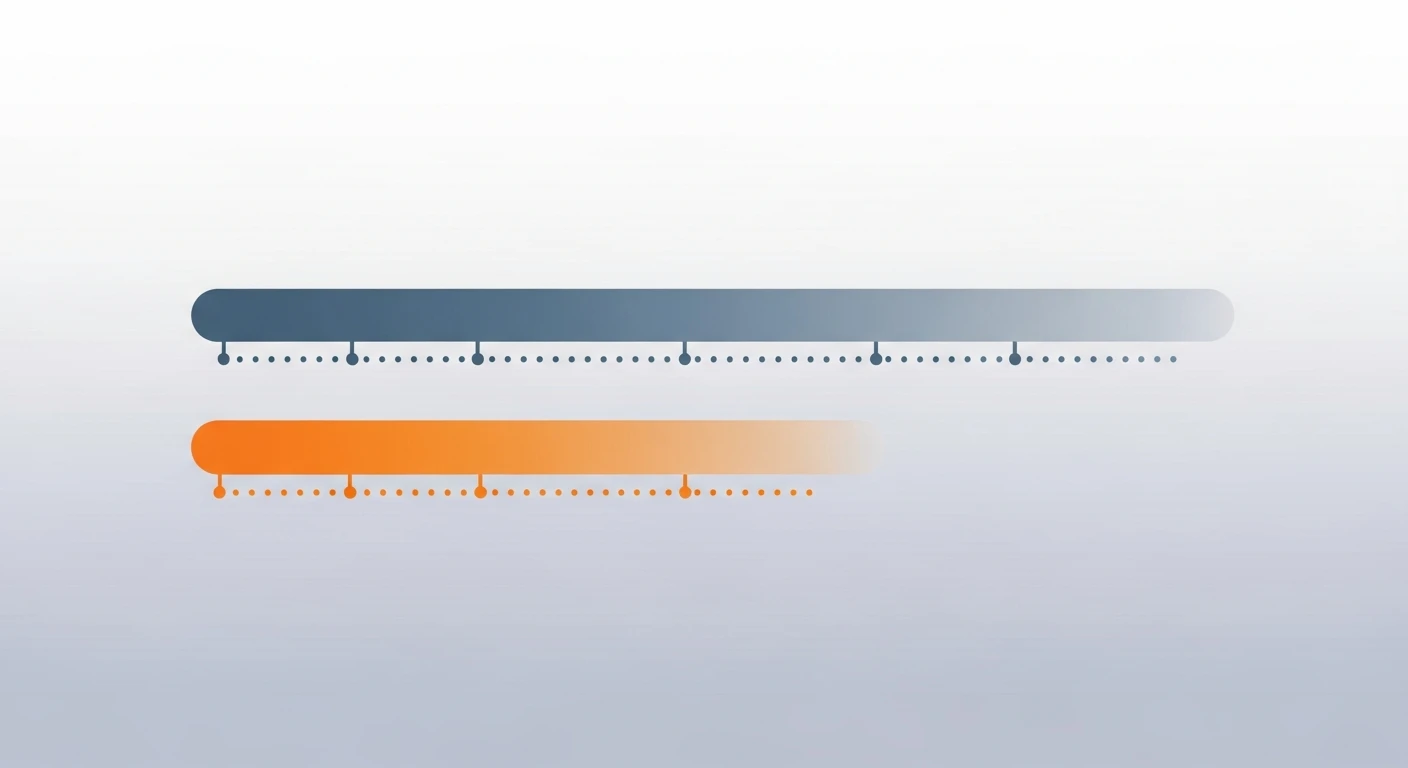 Traditional Agency44–62 days
Direct Nearshore Hire10–14 days
Traditional Agency44–62 days
Direct Nearshore Hire10–14 days
Typical time from decision to onboarded developer, traditional staffing agency vs a direct nearshore hire.
Similarly, the reverse matters just as much. Scaling down is a phone call and a defined notice period with a staff augmentation model, not a termination process tangled up in a staffing agency’s contract terms and re-placement clauses. That flexibility is part of why direct hiring fits companies whose headcount needs shift with the roadmap rather than staying fixed.
Who Legally Employs the Developer
This is the part most cost comparisons skip, since it’s the piece that actually determines risk exposure, not just price.
Typically, a traditional staffing agency is the legal employer of record for the contractor it places. Since the agency handles payroll and carries the compliance burden domestically, that is exactly what a company is paying the markup for.
A nearshore staffing partner plays a similar role, but across a border. It functions as employer of record in the developer’s home country, managing local payroll, statutory benefits, and labor law compliance the client has no practical way to handle without a local entity. The client directs the work. The partner owns the legal employment relationship and the country-specific compliance that comes with it.
A nearshore developer hired without proper employer-of-record structure can expose a US company to misclassification risk in the developer’s home country, including back pay and statutory benefit penalties. Confirm how a staffing partner structures employment before signing, not after.
The distinction that actually matters for budgeting purposes, an agency bills for the search and the staffing relationship. In other words, a nearshore staff augmentation partner bills for the search, the staffing relationship, and the cross-border employment infrastructure, all inside one flat rate instead of a rate plus a future conversion fee.
Real-Time Collaboration and Timezone Overlap
A traditional US staffing agency naturally solves timezone alignment, since the contractor works domestically. By comparison, nearshore hiring has to earn that same alignment, and in Latin America, it largely does. Notably, Costa Rica, Colombia, and much of Mexico share 85 to 100% of a standard US business day, depending on the specific state or region on both ends.
That overlap is what makes a nearshore developer functionally indistinguishable from a domestic hire in a daily standup. For example, real-time code review, same-day unblocking, and live sprint planning all depend on shared working hours, not just a lower rate. Consequently, an offshore model on the other side of the globe can’t replicate that without someone working a shifted schedule long term.
 Costa Rica~100% overlap
ColombiaET/CT aligned
MexicoCT/MT aligned
Costa Rica~100% overlap
ColombiaET/CT aligned
MexicoCT/MT aligned
Working-hour overlap between the continental US and common nearshore developer hubs.
Which Model Fits Your Situation
Cheaper on paper isn’t automatically the right call for every hiring situation. Ultimately, the two models solve different problems, and picking the wrong one usually shows up as a budget surprise later, not a bad hire up front.
- The engagement is genuinely short, under 90 days, where onboarding a new employment structure never pays for itself.
- The role requires a specific US visa status, security clearance, or physical office presence.
- You need same-week domestic bench availability for a narrow, highly specialized skill set.
- Contractual or regulatory terms require the developer to be a US taxpayer.
- You’re adding sustained, ongoing capacity, not filling a short gap. The markup-plus-conversion math only gets worse the longer an agency contractor stays.
- Real-time collaboration with your existing team matters more than lowest possible rate.
- Cost per developer directly limits how much of the roadmap you can staff this year.
- You want the flexibility to scale the developer’s engagement up or down without a re-placement clause.
 Sustained, ongoing need
Real-time collaboration needed
Cost per hire is the constraint
Short engagement or US-only requirement
Sustained, ongoing need
Real-time collaboration needed
Cost per hire is the constraint
Short engagement or US-only requirement
Quick decision checklist, traditional staffing agency vs a direct nearshore software developer hire.
Bias disclosed. Kore BPO places nearshore developers directly with US companies, so this isn’t a neutral comparison. The markup and time-to-fill figures above come from third-party recruiting industry data, not internal sales material. Ultimately, pull your own agency’s invoices and run the numbers before deciding either way.
Key Takeaways Before You Decide
Three things worth carrying out of this comparison.
In fact, the savings are real and bigger than a flat “cheaper labor” headline suggests, once the conversion fee and embedded markup get counted against the agency side. The employment structure matters as much as the rate. A direct nearshore hire only works cleanly when the staffing partner genuinely handles employer-of-record compliance in the developer’s country, not just payroll on paper.
Match the model to the shape of the need. A short, US-bound engagement still favors a traditional agency. Meanwhile, a sustained, cost-constrained developer hire favors going direct nearshore, and the gap between the two only grows the longer the role stays filled.
What Hiring Managers Actually Ask Before They Switch
Is a direct nearshore developer hire actually cheaper once everything is counted?
Usually, by a wide margin. A direct nearshore hire runs $94,000 to $177,000 a year fully loaded, against $205,000 to $284,000 for a comparable traditional agency contract-to-hire engagement over 12 months. The gap narrows on short engagements under 90 days, where the agency’s speed offsets the higher long-run cost.
What’s the real difference between staff augmentation and a traditional staffing agency?
In short, it comes down to control and pricing structure. Staff augmentation embeds the developer inside your team, using your tools and priorities, for one flat rate with no conversion event. However, a traditional staffing agency supplies a contractor from its own bench, bills a markup on top of pay, and charges a separate fee if you convert them to full time.
Who’s legally responsible for the developer’s employment in a nearshore hire?
The nearshore staffing partner, functioning as employer of record in the developer’s home country. It handles local payroll, statutory benefits, and labor law compliance. The client directs day-to-day work but never needs its own legal entity in that country to make the hire.
More Questions From Hiring Teams
How fast can a company actually add a nearshore developer?
2 to 5 business days for pre-screened resumes is standard with an active bench in the target country. Onboarding to a developer’s first day of real work typically lands within 10 to 14 days of a signed engagement, faster than the 44 to 62 day average for a specialized engineering hire.
Does the timezone overlap actually hold up for daily collaboration?
In Latin America, yes, country by country. For example, Costa Rica and Colombia align closely with US Eastern and Central time, while Mexico spans Central to Mountain depending on the state. As a result, that overlap is what makes daily standups and real-time code review workable without anyone working an overnight shift.
Where a Traditional Agency Still Wins
When does a traditional staffing agency still make more sense than hiring direct?
Short, defined engagements under 90 days, roles requiring a specific US visa or security clearance, or situations needing same-week domestic bench access. Because direct nearshore hiring is built for sustained, ongoing capacity, it isn’t the right fit for a quick, one-off gap fill.
Disclosure. Kore BPO is a nearshore and offshore staffing company. Cost and market figures in this post are sourced from third-party research, including SHRM, Top Echelon, altLINE, Deloitte, Grand View Research, the Bureau of Labor Statistics, and CompTIA. Internal figures reflect Kore BPO’s aggregated placement data.
Related Articles



Ready to Hire a Nearshore Developer?
Kore BPO places nearshore software developers directly on your team. Tell us the role and stack. We’ll send pre-screened resumes in 2 to 5 days.
Contact Us