How to Choose Nearshore Software Development


Choose a nearshore software development partner by verifying their technical vetting process, confirming ISO 27001 or SOC 2 compliance, requesting a paid trial sprint before committing, and asking for engineer retention data instead of a sales pitch. If they dodge any of those four, that’s your answer.
Every nearshore development company says the same four things on the first call. Real-time collaboration. Cultural alignment. Senior-level talent. Cost savings without the offshore trade-offs. None of it is false, exactly. It’s also not a reason to sign anything.
Why the Sales Pitch Isn’t the Evaluation
The actual decision comes down to what happens after the contract, not what gets said before it. Choosing nearshore software development talent well means testing claims instead of accepting them, and knowing which five questions separate a real engineering partner from a reseller with a slick deck. That’s what this guide walks through.
We’ll cover the criteria that actually predict a good outcome, where nearshore beats offshore and onshore (and where it doesn’t), the red flags that should end a conversation immediately, and what a realistic 2026 budget looks like by seniority level.
What Does Nearshore Software Development Actually Mean?
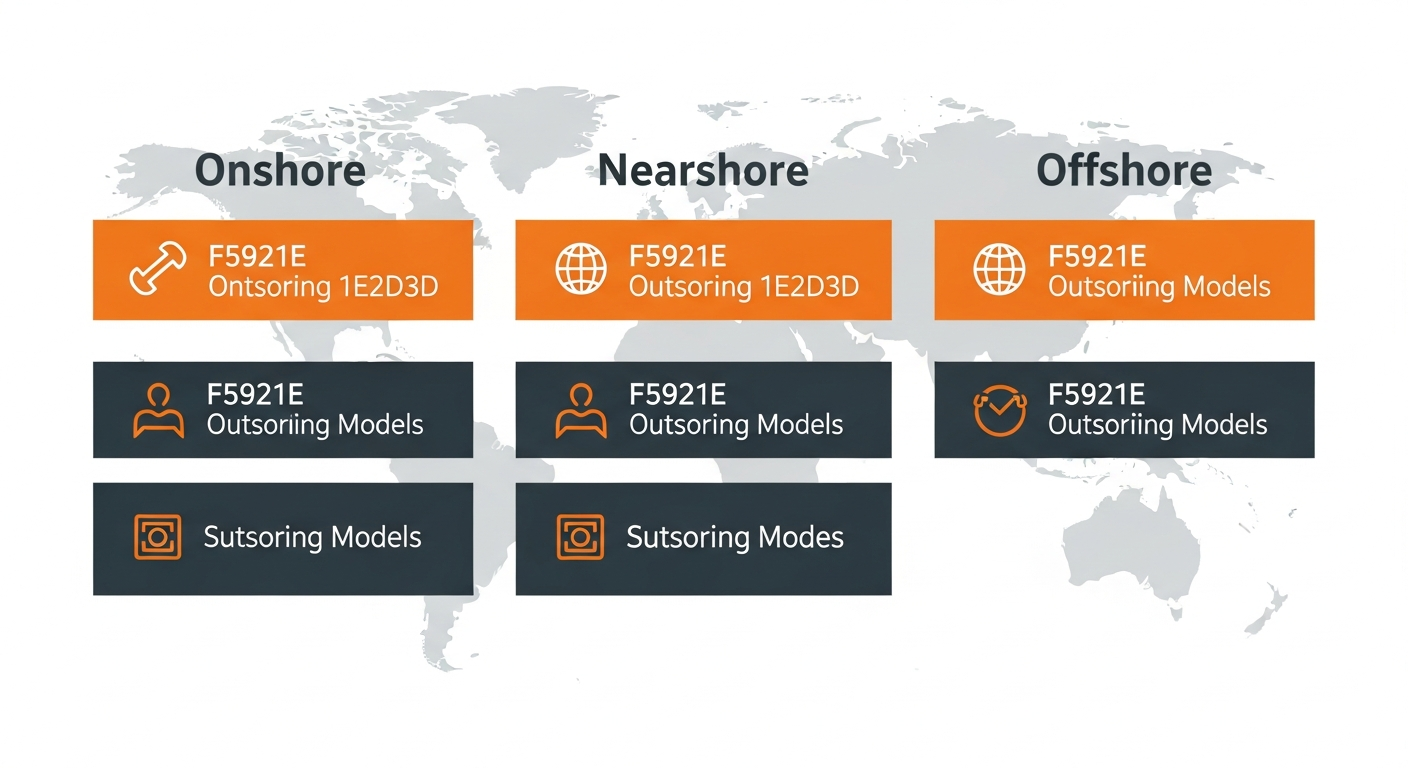
Nearshore software development means hiring engineers from a nearby country in a compatible time zone, most often Latin America for US companies, so the team can attend the same standups, join live code reviews, and respond inside normal business hours instead of overnight. It’s the middle ground between onshore (same country, highest cost) and offshore (distant region, biggest time-zone gap).
The distinction matters more than it sounds. An offshore engineer in India or the Philippines works 10 to 13 hours removed from US Eastern or Central time, which pushes collaboration into an async pattern by necessity, not choice. A nearshore engineer from Costa Rica, Mexico, or Colombia sits 0 to 2 hours off US time zones. Same sprint, same meeting, no message sitting unanswered until tomorrow.
What the Market Data Shows
Everest Group reports that over 40% of new outsourcing contracts now include a nearshore component, up sharply as companies weigh geopolitical risk and real-time collaboration needs against pure labor-cost arbitrage. That shift shows up in Deloitte’s Global Outsourcing Survey too. Only 34% of enterprises now cite cost-cutting as their top outsourcing driver, down from 70% a few years earlier. Companies are buying reliability now, not just a lower hourly rate.
Nothing about that makes nearshore automatically the right call for every team. It’s the right call for teams that need engineers embedded in daily standups, agile sprints, and live architecture decisions. Async, well-documented, cost-first work still has a real case for offshore. Picking the wrong model for the work is a more common mistake than picking a bad vendor within the right model.
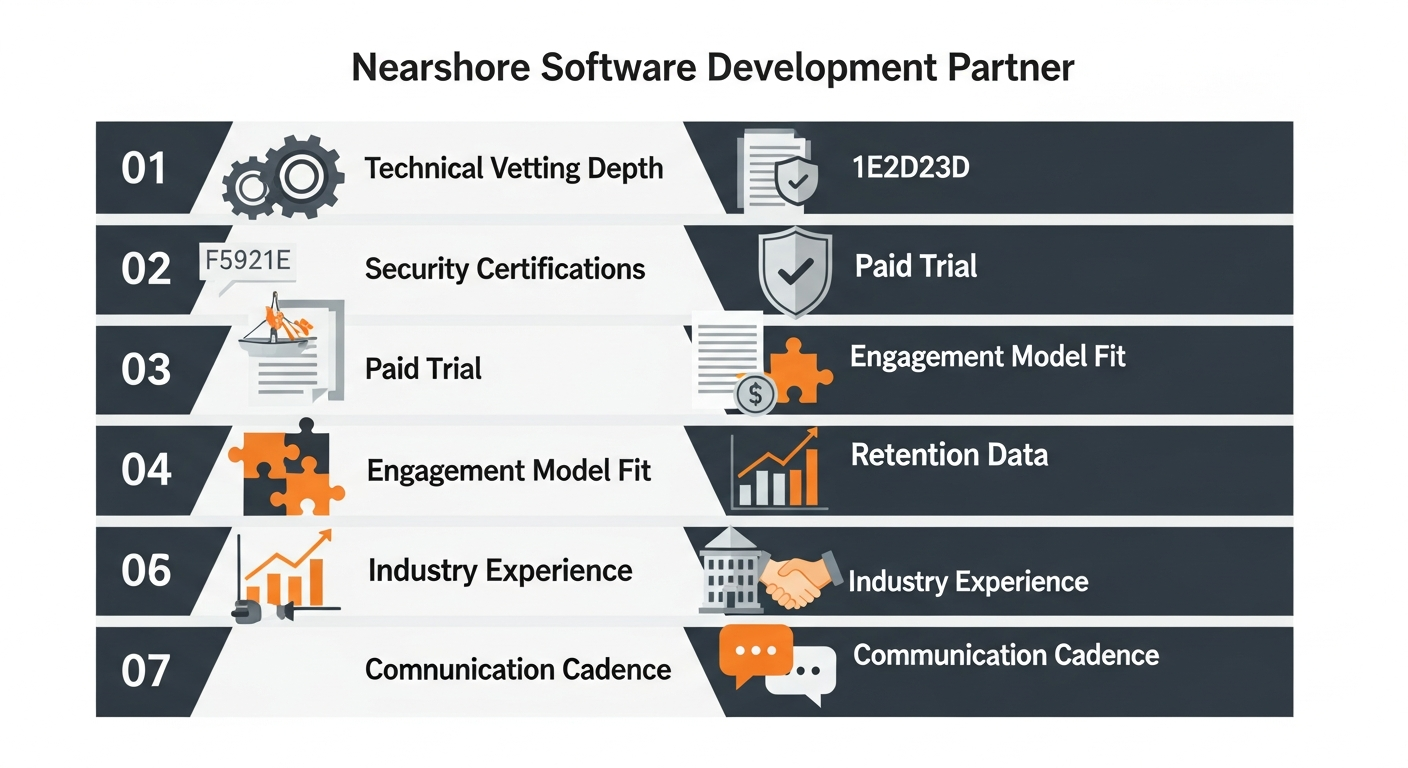
7 Criteria for Evaluating a Nearshore Software Development Partner
Run every partner through these seven before a contract goes anywhere near a signature. Skip one, and you’re gambling on the part you skipped.
Two More Questions Before You Move Forward
The Signals That Separate Real Partners From Resellers
Nearshore vs. Offshore vs. Onshore: When Nearshore Actually Wins
These three models aren’t ranked best to worst. They’re suited to different kinds of work, and the biggest mistake buyers make isn’t picking a bad vendor, it’s picking the wrong model for the task in front of them.
| Factor | Onshore (US) | Nearshore (LatAm) | Offshore (Asia) |
|---|---|---|---|
| Time zone overlap | Full | 0 to 2 hours | 10 to 13 hours |
| Typical hourly rate, senior engineer | $150 to $180+ | $55 to $80 | $20 to $50 |
| Collaboration style | Real-time, no gap | Real-time, minor overlap loss | Mostly async |
| Best fit | IP-sensitive, regulated builds | Agile, collaborative product work | Well-documented, async-friendly tasks |
| Typical annual attrition | Low, high cost of turnover | Often under 15% | Frequently 20 to 30%+ |
Nearshore wins whenever the work depends on live back-and-forth: sprint planning, architecture decisions made in real time, a Slack question that can’t wait eight hours for an answer. Offshore still wins on raw cost for scoped, async-friendly work where detailed documentation can substitute for live conversation. Onshore still wins when IP sensitivity or regulatory exposure makes proximity worth the premium. For the full breakdown of where each model fits, see our onshore vs. nearshore vs. offshore comparison.
We’ve watched teams try to force an offshore, fully-async workflow onto a fast-moving product build, and the friction shows up within a month. Standups get skipped because nobody’s awake to run them live. A decision that should take an hour stretches into a full business day because the person who can approve it is asleep. Nearshore closes exactly that gap.
Red Flags That Mean Walk Away
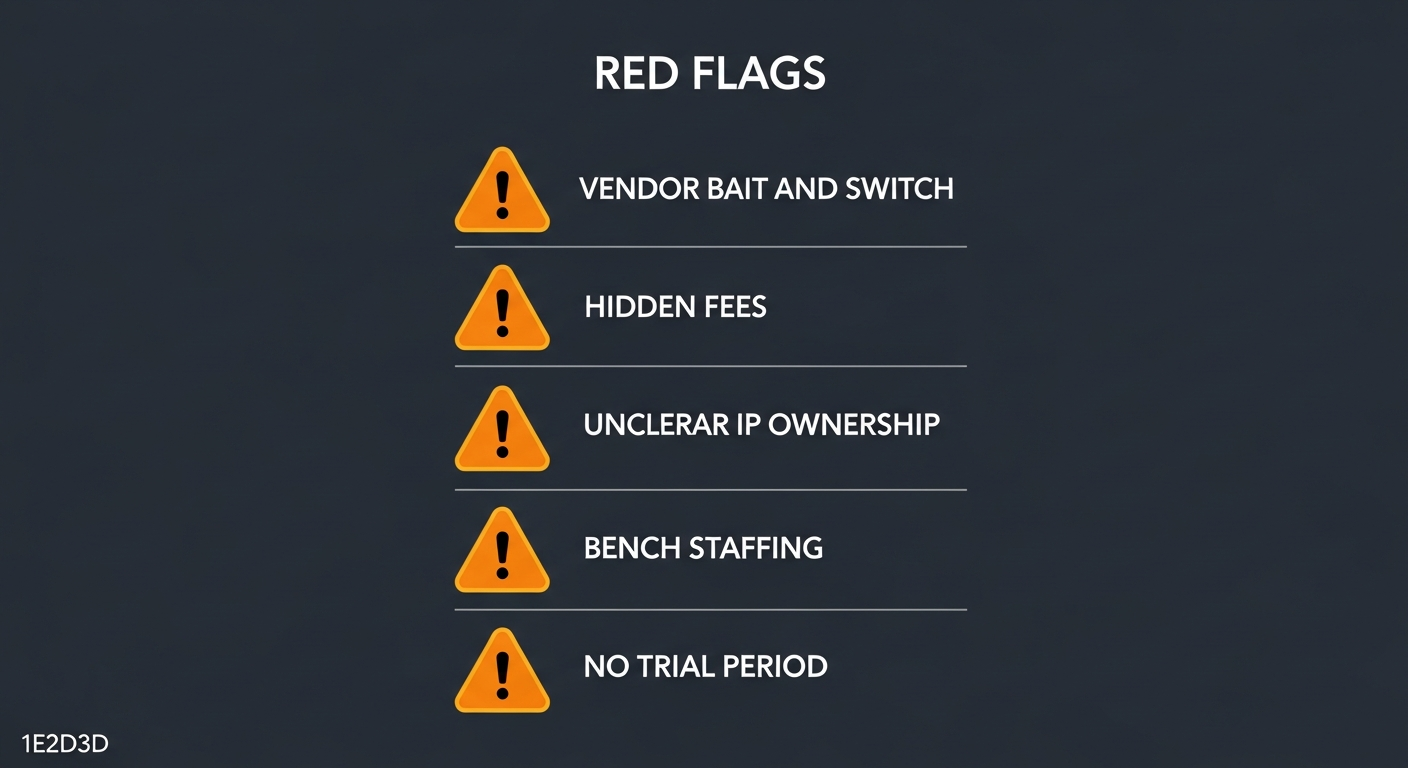
Most bad nearshore engagements were avoidable. The warning signs show up before the contract, not after, if you’re actually looking for them.
If three or more of these show up in the same sales cycle, that’s not a coincidence worth negotiating around. Walk.
Questions to Ask on the Sales Call
Bring these to the first real conversation. The specificity of the answer tells you more than the answer itself.
- Who is the exact engineer or tech lead assigned to my project, and can I speak with them before signing?
- What does your technical vetting process check, stage by stage?
- Can you break the monthly rate into salary, benefits, and management fee?
- What’s your average engineer tenure on client projects past 12 months?
- Will you run a short paid trial before I commit to a longer engagement?
- What happens, specifically, if the assigned engineer leaves mid-project?
See How Kore BPO Answers These Questions
Costa Rica-based nearshore engineers, transparent rate breakdowns, and a vetting process you can ask about directly.
What Nearshore Software Development Actually Costs in 2026
Rates shift by seniority, stack, and country, but the ranges below hold up as a general benchmark for Latin America-based nearshore engineering talent in 2026.
| Seniority | Nearshore Hourly Rate | US-Based Equivalent |
|---|---|---|
| Mid-level (3 to 5 yrs) | $38 to $58 | $85 to $120 |
| Senior (5 to 8 yrs) | $55 to $80 | $150 to $180+ |
| Lead / architect (8+ yrs) | $72 to $100 | $190 to $230+ |
For context on the US side, the Bureau of Labor Statistics puts the median annual wage for US software developers at roughly $133,080 as of May 2024, before benefits, payroll tax, and overhead stack on top. Fully loaded, that figure typically runs 1.5 to 1.85 times the base salary. Nearshore doesn’t close that gap to zero. It narrows it substantially while keeping the overlap hours that offshore can’t offer.
Worth saying directly. Outsourcing firms, ours included, benefit when a company can’t fully solve a hiring problem in-house. That’s not a reason to distrust every pitch. It’s a reason to verify the specific claims instead of taking the deck at face value. Deloitte’s outsourcing survey data backs this up. Cost is still a factor. It’s just not the only one that decides whether a specific engagement actually works out.
What People Ask Before Signing With a Nearshore Development Partner
Coin flip or real advantage, is nearshore actually worth the premium over offshore?
Depends on the work. If the project needs constant back-and-forth, sprint planning, live troubleshooting, product decisions made in the moment, the 0 to 2 hour overlap nearshore offers usually pays for itself in avoided delay. If the work is well-documented and genuinely async, offshore’s deeper discount is harder to argue against. Most teams get this wrong not by picking a bad vendor, but by matching the wrong model to the work.
How long does it realistically take to get a nearshore team started?
10 to 28 days for most standard engineering roles at a mature partner, from first call to start date. Senior or highly specialized roles run longer simply because the qualified pool is thinner. A timeline stretching past six weeks with no clear reason is usually a sourcing problem, not thoroughness.
Contract and Budget Questions
Should the contract include a replacement guarantee?
Yes, in writing, not described verbally on a call. A 90-day free-replacement window is a reasonable industry baseline. If a partner is vague about what happens when a placement doesn’t work out, that vagueness is telling you something about how much they stand behind their own vetting.
Is a lower hourly rate always the smarter choice?
Not automatically. A rate meaningfully below the ranges in this guide is more often a sign of a thin vetting process, missing certifications, or a bench-staffing model than a genuine deal. A partner with strong retention at a slightly higher rate consistently outperforms a cheaper one with constant turnover, once you account for ramp time on every replacement.
One Last Question Worth Asking
Can a small team with just one or two open roles justify going nearshore?
Often, yes, and sometimes with a stronger case than a larger company makes. One bad in-house engineering hire can cost a small team months of runway and momentum it doesn’t have to spare. Spreading that risk across a partner’s vetting process, even for a single seat, frequently pays for itself the first time it prevents a mis-hire. The math shifts at scale. It doesn’t disqualify small teams from using the model.
The partners worth signing with aren’t the loudest ones on the sales call. They’re the ones who answer the uncomfortable questions, vetting process, retention data, IP terms, without reaching for a vague talking point.
Run every nearshore software development partner you’re evaluating through the seven criteria above, ask the six sales-call questions, and treat any hedge on compliance, retention, or trial terms as a hard stop. Most bad nearshore engagements were preventable at the contract stage, not the onboarding stage.
If you want to see how Kore BPO structures nearshore engineering, from vetting through delivery, start at korebpo.com/nearshore-roles. You can also explore our broader nearshore staffing services if you’re evaluating beyond engineering roles.
Related Articles



Ready to Hire Nearshore the Right Way?
Kore BPO answers every question in this guide directly, named tech leads, transparent rates, no vague pitch language.
See Nearshore Roles