How to Choose a Colombia Staffing Agency


The right Colombia staffing agency names the specific legal entity or employer of record handling payroll in Colombia, tests English proficiency directly rather than assuming it, shares real time-to-fill and tenure numbers instead of a “great culture fit” line, and puts a replacement window in writing before you sign. Any hedge on those four points is your answer.
Every Colombia staffing agency pitch sounds the same by the third sales call. Same time zone as the US. Lower cost than a domestic hire. A deep bench in Bogotá and Medellín. All three claims are usually accurate. None of them tell you whether the specific firm on the call actually delivers once the contract is signed, the invoice clears, and the new hire’s first rough week happens without anyone from the agency on the phone.
Colombia isn’t interchangeable with the rest of Latin America, and treating it that way is how buyers end up with a placement that never fit the role. This guide covers what to actually check before you sign, what changed in Colombia’s labor law heading into the second half of 2026, and the questions worth asking before a contract gets anywhere near a signature.
Why Colombia Specifically, Not Just “Latin America”
Colombia sits on Colombia Time, UTC-5, and doesn’t observe daylight saving. That means it stays within an hour of US Eastern time all year, a meaningfully tighter overlap than Mexico’s Central alignment or the multi-hour drift you get with parts of South America further south. For teams running daily standups or live client calls, that’s the difference between a real-time conversation and a message answered a full day later.
The talent base backs up the pitch. ProColombia, the country’s official investment promotion agency, reports the software and IT sector is now the third largest in Latin America behind Brazil and Mexico, supporting close to 110,000 working software engineers and roughly 37,000 new technology graduates entering the market every year. Sector exports grew at an average annual rate of 23% between 2016 and 2023, and the country’s BPO sector overall employs more than 600,000 workers. That’s not a market still proving it can staff technical and operational roles at scale. It already has.
Cost is real too, though it shouldn’t be the headline. Senior developer rates in Colombia typically run 40 to 60% below equivalent US salaries, which puts the country in the same competitive band as Peru and slightly below Brazil, Mexico, and Argentina at the senior level. The gap matters, but it’s the part every agency leads with, precisely because it’s the easiest thing to say without proving anything about how they screen or manage a placement afterward.
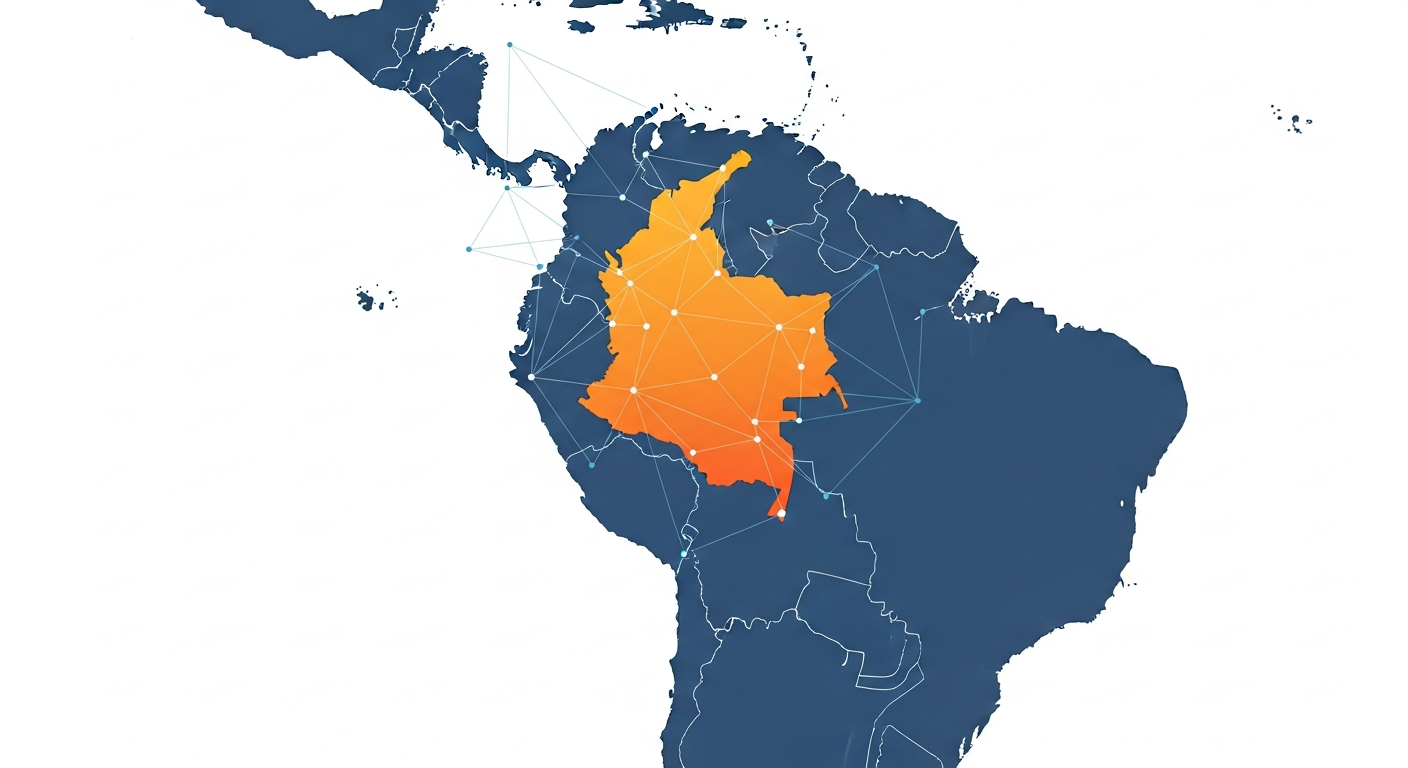 Colombia, UTC-5, no DST
40-60% below US senior rates
Colombia, UTC-5, no DST
40-60% below US senior rates
What a Colombia Staffing Agency Actually Does
“Staffing agency” gets used loosely, and the differences between what firms actually own matter more than the label. Three models show up under the same marketing language.
Some firms only source and screen. They send you candidates, you extend an offer, and you handle payroll, benefits, and compliance yourself, usually through a separate employer of record or your own Colombian entity. Other firms bundle sourcing with a named EOR relationship, so the agency finds the candidate and a third-party EOR legally employs them in Colombia on your behalf. A smaller group operates its own local entity in Colombia, meaning the same company that vetted the candidate also runs payroll, statutory benefits, and termination under Colombian law directly.
None of the three is automatically the right answer. A pure sourcing firm can work well if you already have a compliance structure in place. But if a firm can’t clearly explain which of these three models it runs, that’s worth treating as a serious gap, not a minor detail to sort out after signing.
The 2026 Compliance Load You’re Hiring Into
Colombia’s labor rules shifted meaningfully this year, and any agency that hasn’t updated its pitch to reflect it is working from an outdated playbook. Under Law 2101, the country’s maximum legal workweek dropped in stages from 48 hours down to 42, with the final step taking effect nationwide on July 15, 2026. Employers can’t cut pay to offset the shorter week, and daytime overtime is capped at two hours a day and twelve a week.
WageIndicator’s coverage of the reform notes it also tightened contractor classification rules and raised Sunday work premiums, on top of employer social contributions that already run roughly 30% of salary and a mandatory 13th-month bonus, known locally as the Prima. Every new hire also triggers several separate social contribution registrations before the first payslip goes out.
None of this makes Colombia a difficult place to hire. It makes it a country where compliance has gotten measurably more detailed in the last twelve months, and where an agency quoting last year’s overtime math or workweek cap hasn’t kept its own house in order, let alone yours.
If a Colombia staffing agency can’t speak to the 42-hour workweek change or the current employer contribution rate without pausing, that’s a signal worth noting before you go further, not after.
 ~30% employer contributions + 13th-month Prima
42-hour workweek, effective July 15, 2026
~30% employer contributions + 13th-month Prima
42-hour workweek, effective July 15, 2026
The 6-Point Framework for Vetting a Colombia Staffing Agency
Run every firm through these six checks before a contract gets close to a signature. Skip one, and you’re betting on the part you didn’t verify.
 Named Colombian entity or EOR
Real English and technical screening
Fee tied to placement
Time-to-fill and tenure data disclosed
Current on 2026 labor law
IP and data terms in writing
Named Colombian entity or EOR
Real English and technical screening
Fee tied to placement
Time-to-fill and tenure data disclosed
Current on 2026 labor law
IP and data terms in writing
Bogotá vs Medellín vs Other Cities, Does It Matter Who You Hire From
Colombia’s talent isn’t evenly spread, and a firm that treats every city as interchangeable usually has shallow reach outside its home base. Bogotá carries the deepest bench by volume. It’s home to roughly 220 tech companies and has produced the majority of the country’s software and tech graduates over the past five years, with a heavier concentration in enterprise software, finance-adjacent engineering, and cloud platform work.
Medellín has built a different reputation. The city entered the global top 130 in the 2026 Global Startup Ecosystem Index for the first time, climbing 15 positions, and now leads every city in Latin America for startup density. That density tends to favor product-focused engineering talent and founders who’ve worked inside leaner, faster-moving teams, a different profile than Bogotá’s larger enterprise base. Smaller hubs like Cali and Barranquilla carry real but thinner benches, generally stronger for support, back-office, and operations roles than for specialized senior engineering.
| City | Known For | What to Watch |
|---|---|---|
| Bogotá | Largest bench, enterprise and cloud engineering | Higher senior-level demand tightens supply |
| Medellín | Startup density, product-focused engineering talent | Smaller enterprise bench than Bogotá |
| Cali | Growing operations and support talent pool | Thinner senior technical bench |
| Barranquilla | Emerging BPO and back-office hub | Limited specialized engineering depth today |
 Bogotá, ~220 tech companies
Medellín, top LatAm startup density
Bogotá, ~220 tech companies
Medellín, top LatAm startup density
Ask any Colombia staffing agency where its actual candidate pipeline is concentrated, not where its office happens to be. A firm with real bench depth in a given city can describe how sourcing there differs from the rest of the country. One without it usually just repeats the same national statistics regardless of which city you ask about.
See How Kore BPO Vets Colombia Talent
Sourcing, English and technical screening, and compliance handled end to end, with resumes back in 2 to 5 business days.
Questions to Ask on the Sales Call
Bring this list to the first real conversation. A confident, specific answer to each tells you more than anything on the agency’s homepage.
- Who legally employs the candidate in Colombia, your own entity, a named EOR, or the agency directly?
- What does your English and technical screening process actually look like, step by step?
- What’s the replacement window if this placement doesn’t work out, in writing?
- What’s your average time-to-fill and 12-month tenure for a role like this one?
- How does your contract address Colombia’s current labor law and data handling rules specifically?
- Can I speak with a current client hiring a similar role in Colombia?
That last question is the tiebreaker. A published case study gets polished before it goes live. A live reference call doesn’t.
Red Flags That Should End the Call
Most bad Colombia placements were avoidable, and the warning signs almost always show up before the contract, not after the hire starts.
For the broader picture across the region, see our guide to choosing a Latin America staffing partner, our overview of what Latin America staffing actually means for US buyers, and the full Latin America staffing pricing breakdown by role and country.
The Colombia staffing agencies worth signing with are rarely the ones with the smoothest pitch deck. They’re the ones that name the employing entity without hesitation, test English instead of assuming it, and share real time-to-fill and tenure numbers instead of a line about culture fit.
Run every firm you’re considering through the six-point framework above, ask the sales-call questions, and treat any hedge on compliance or replacement terms as a hard stop. If you’d like to see how we structure Colombia staffing at Kore BPO, from screening through compliance, start at korebpo.com/contact.
What People Ask Before They Sign With a Colombia Staffing Agency
What makes Colombia different from other Latin America staffing options?
The time zone overlap is the clearest differentiator. Colombia runs on UTC-5 year-round with no daylight saving, staying within an hour of US Eastern time. Combined with a software and IT sector that ProColombia ranks third-largest in Latin America, Colombia offers real-time collaboration alongside a genuinely deep technical talent pool, not just a lower price tag.
Is English proficiency actually a concern when hiring in Colombia?
It’s a real variable to screen for, not assume away. Colombia’s national EF English Proficiency Index score sits in the “Low” band, though Bogotá and the major tech hubs score meaningfully above the national average. A staffing agency that runs a direct English assessment as part of its screening process manages this risk. One that skips it is passing the gap on to you.
How did Colombia’s 2026 labor reform change hiring costs?
The maximum legal workweek dropped to 42 hours nationwide in July 2026 under Law 2101, without any reduction in pay. Employer social contributions still run roughly 30% on top of salary, and the mandatory 13th-month Prima bonus remains unchanged. The reform doesn’t make Colombia meaningfully more expensive to hire in, but it does mean an agency working from last year’s numbers is already out of date.
Should I hire from Bogotá or Medellín specifically?
It depends on the role more than the city. Bogotá carries the largest overall bench and tends to skew toward enterprise and cloud engineering talent. Medellín has built real depth in product-focused engineering roles and now leads Latin America in startup density. A staffing agency with genuine reach in both should be able to explain which fits your specific role, rather than defaulting to wherever its own office happens to sit.
How fast can a Colombia hire realistically start?
For a firm with an active, pre-vetted pipeline, expect a shortlist within days and a start date inside two to three weeks for most standard roles. Specialized senior engineering roles in high-demand categories can run longer simply because that specific pool is thinner. If a standard mid-level role is quoted at six weeks or more with no clear reason, ask why before assuming it reflects thoroughness.
Related Articles



Ready to Hire Colombia Talent the Right Way?
Kore BPO handles sourcing, English and technical screening, and compliance for Colombia hires, so you’re not gambling on any of the six criteria in this guide.
Book a Free Consultation