What Is Latin America Staffing? A 2026 Guide for US Companies


- 01What Latin America Staffing Actually Means
- 02Why US Companies Are Turning to LatAm Now
- 03The Real Cost Savings
- 04The Timezone and Communication Edge
- 05Best Countries to Staff From
- 06Legal and Compliance Considerations
- 07How to Choose a Staffing Partner
- 08How Kore BPO Staffs LatAm Differently
- 09Common Questions
A CFO asked me last month why her company’s “Latin America hire” came with three completely different explanations from three different vendors. One called it staff augmentation. One called it an EOR arrangement. One just said “nearshore” and left it there. All three were describing the same basic idea, wearing different paperwork.
Why the Same Hire Gets Three Different Labels
Latin America staffing is the practice of filling US roles with workers based in Mexico, Colombia, Argentina, Brazil, and neighboring countries, through a staffing partner, an employer of record, or a BPO firm that handles the legal and payroll side. It’s not one thing. It’s a category that covers several hiring models, and which one fits depends on how many people you’re hiring, in how many countries, and for how long.
Instead, this guide breaks down what the term actually covers, why the shift toward Latin America accelerated hard in the last three years, what it really costs once every hidden fee is counted, and how to tell a staffing partner worth using from one that isn’t.
What Latin America Staffing Actually Means
Three models get lumped under the same label, and they’re not interchangeable. Staff augmentation adds a LatAm-based worker to your existing team as an embedded hire, usually through a staffing firm that handles recruiting and payroll while you manage the work day to day. Employer of record (EOR) is narrower. A third-party legal entity formally employs the worker in their home country so you don’t need to stand up your own local entity. A BPO partner goes further still, often owning entire functions like customer support or back-office operations rather than just supplying headcount.
Here’s the part that trips people up. The pricing conversation and the compliance conversation are two separate conversations, and vendors love to blur them. A staffing firm quoting you a monthly rate is usually bundling recruiting, payroll, and a management fee into one number. An EOR is quoting you something closer to actual employment cost plus a flat service fee. Neither is wrong. They’re just answering different questions, and knowing which one you’re being quoted matters more than the sticker price. If the timezone-overlap piece of this is the part you care about most, our breakdown of what a nearshore staffing agency actually does goes deeper on that specific model.
Most of Kore BPO’s LatAm placements run through the staff augmentation model, sourced through our San Jose, Costa Rica office and matched against roles in data, software, and back-office operations. The worker becomes part of your team. We handle the sourcing, vetting, and administrative layer underneath it.
Why US Companies Are Turning to Latin America Right Now
Three things are converging at once, and none of them are temporary.
First, the trade math shifted under everyone’s feet. Forbes reported that Mexico became the United States’ top trading partner in 2023, and Axios confirmed the same shift using US Census Bureau trade figures, with Mexico overtaking China for the first time in over a decade. That’s not a staffing statistic on its own. However, supply chains and talent pipelines tend to move together, and companies already restructuring their vendor relationships around Mexico and the wider region found it a short jump to restructure their hiring the same way.
Second, the talent pool actually got deep enough to matter. OECD education data puts Mexico’s engineering and technical graduate pipeline at roughly 130,000 a year over the last five years, and ProColombia reports the country’s software and IT export sector grew 23% annually between 2016 and 2023. That’s not a rounding error. It’s the difference between “we might find someone eventually” and “we have three qualified candidates by Friday.”
Third, and this one’s less talked about, Deloitte’s research on nearshoring found that 68% of executives believe the model reduces cost while also improving output quality, not one or the other. That combination used to feel like a contradiction, since cheaper and better rarely showed up in the same sentence. Now it does, often enough that boards stopped asking whether nearshoring works and started asking why it took this long to try it.

The Real Cost Savings
Most Latin America hires cost 30% to 60% less than an equivalent US hire once everything is counted honestly. Not the number in the first pitch deck. The number after payroll taxes, benefits, and the staffing partner’s fee all get added back in.
The Bureau of Labor Statistics puts the 2026 median US software developer salary at $133,080. Add the standard 25% to 40% for payroll taxes, benefits, and overhead, and a fully loaded US hire lands somewhere between $166,000 and $186,000 a year. A comparable mid-level developer sourced from Colombia or Mexico runs $40,000 to $70,000 fully loaded, staffing fee included.
| Role | US Fully Loaded Cost | Latin America Fully Loaded Cost |
|---|---|---|
| Mid-level software developer | $166,000–$186,000/yr | $40,000–$70,000/yr |
| Data analyst | $95,000–$115,000/yr | $28,000–$48,000/yr |
| Customer support rep | $58,000–$72,000/yr | $16,000–$26,000/yr |
| Operations coordinator | $82,000–$100,000/yr | $18,000–$28,000/yr |
Add it up across a five-person team and the gap stops looking like a rounding exercise and starts looking like a second hire you didn’t have budget for. US companies save an average of $35,000 to $64,000 a year per Latin America hire. Run that across five roles and you’ve effectively funded a sixth position for free.
The gap isn’t free money, though. A staffing partner’s monthly markup typically runs 15% to 40% on top of the worker’s base compensation, and vendors that won’t break that number down line by line are usually hiding something in it. Ask. If they hedge, that’s your answer.
The Timezone and Communication Edge
Real-time overlap is the thing offshore staffing in Asia can’t offer, and it’s a bigger deal than most cost comparisons give it credit for.
Most Latin American countries sit within 1 to 3 hours of major US time zones. Colombia runs on Eastern time year-round. Mexico spans Central to Pacific depending on the state. Compare that to a typical offshore arrangement in India, where the gap runs 10.5 to 13.5 hours, and the difference isn’t subtle. A Slack message sent at 2pm Eastern gets a same-day answer from Bogota. From Hyderabad, it waits until tomorrow.
 LatAm: 1–3 hrs from US
India: 10.5–13.5 hrs from US
LatAm: 1–3 hrs from US
India: 10.5–13.5 hrs from US
That overlap changes how work actually gets done, not just how fast messages travel. Same-timezone teams complete iterative product work meaningfully faster because a blocked developer can ask a question and get unblocked within the hour instead of losing a full day to the gap. Standups happen live instead of over recorded video. Code review happens same-afternoon instead of next-morning.
None of this means offshore is wrong for every workload. Async-friendly work, overnight QA runs, 24-hour support coverage, all of it plays to offshore’s strengths in ways nearshore can’t match on cost. But collaborative, iterative work, the kind where a team is actively building something together in real time, tends to run smoother with LatAm’s timezone overlap than it does across a half-day gap.
Best Countries to Staff From in Latin America
Four countries cover most of the region’s staffing demand, and each one solves a slightly different problem.
Mexico offers the tightest proximity to US operations, spanning Pacific to Central time depending on the state, backed by that OECD-confirmed pipeline of roughly 130,000 new engineering and technical graduates every year. It’s the default pick when West Coast overlap matters or when a company wants scale without sacrificing time zone alignment. See the full breakdown in our Mexico staffing guide.
Colombia runs on Eastern time year-round, which makes scheduling dead simple for East Coast teams, and its tech workforce has grown around 20% annually. Bogota and Medellin have both built real software and BPO hubs over the last decade, not just call centers. See the full breakdown in our Colombia staffing guide.
Argentina consistently produces the strongest English proficiency scores in the region and a deep bench of senior engineering talent, though its currency volatility adds a layer of contract structuring that Mexico and Colombia don’t require. See the full breakdown in our Argentina staffing guide.
Brazil has the largest developer population in Latin America by a wide margin, which matters most when a role needs a specific, narrow skill set that smaller talent pools simply can’t supply at volume. See the full breakdown in our Brazil staffing guide.
Costa Rica pairs strong English proficiency with the tightest political and economic stability in the region, and its free trade zone incentives make it a common landing spot for companies scaling a full offshore office rather than a handful of remote hires. See the full breakdown in our Costa Rica staffing guide.
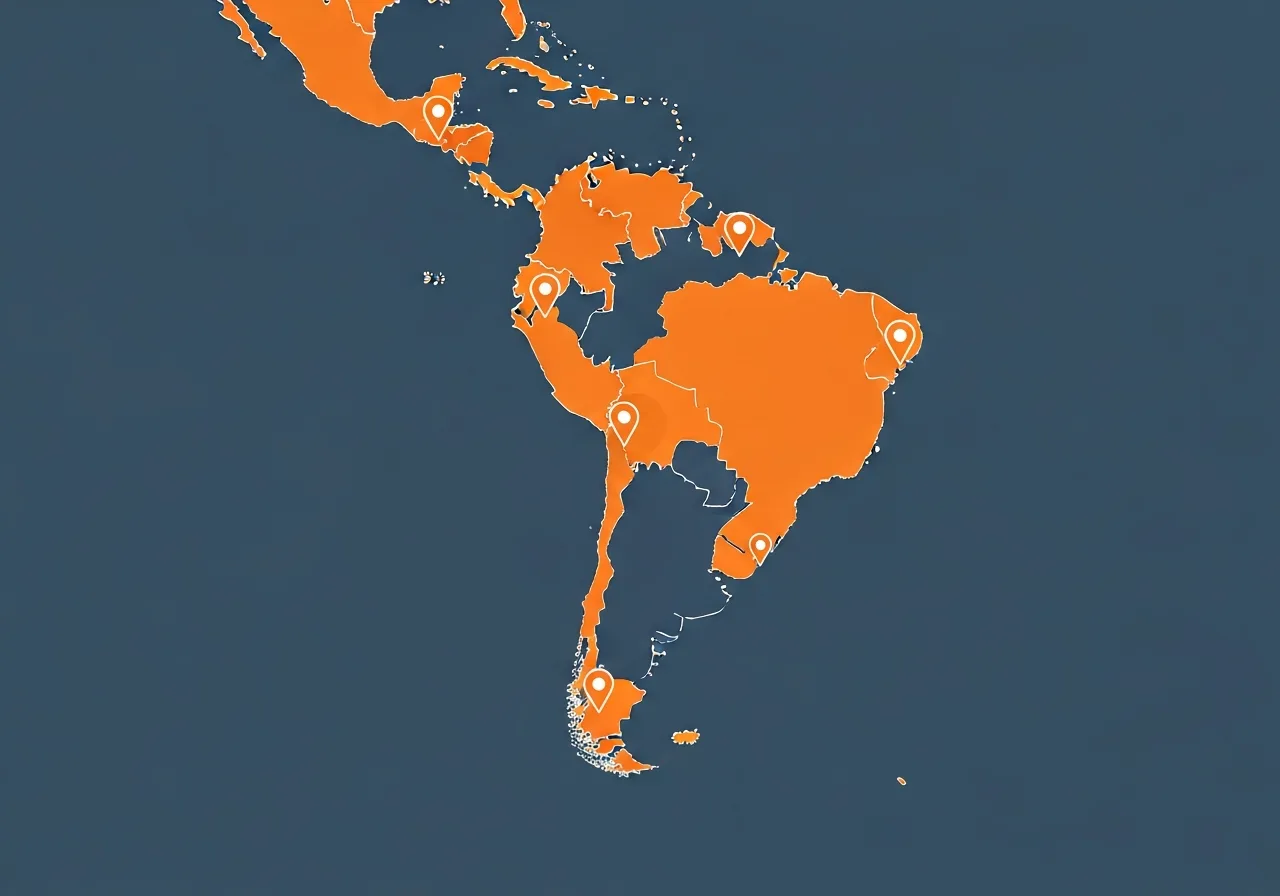
Picking the wrong country for the job is a more common mistake than people expect. A company chasing the absolute lowest rate sometimes lands in a smaller market with a thin bench for their specific stack, then spends three extra months re-sourcing after the first candidate falls through. Match the country to the skill depth you actually need, not just the rate card.
Not Sure Which Country Fits Your Team?
Compare your role requirements against Kore BPO’s Latin America talent bench in a quick call.
Legal and Compliance Considerations
Every major Latin American market carries mandatory statutory obligations that a US-style offer letter simply doesn’t account for, and skipping this step is how companies end up with a compliance problem instead of a hire.
Thirteenth-month bonuses, known as aguinaldo in Mexico and SAC in Brazil, are legally required in nearly every country in the region, not a perk you can opt out of. Brazil alone requires an 8% severance fund contribution (FGTS) on top of base salary, and that’s before the 13th salary, vacation bonus, and social security contributions get layered in. Employer-side costs on top of base pay vary meaningfully by country, and a partner who can’t walk you through the specific breakdown for the country you’re hiring in shouldn’t be handling your compliance.
Data privacy adds another layer. Brazil’s LGPD, as summarized by IAPP, closely mirrors the EU’s GDPR and applies to any company processing the personal data of people in Brazil, regardless of where that company is headquartered. Mexico and Colombia both run their own separate data protection frameworks with different registration and consent requirements.
An employer of record exists precisely to absorb this complexity. It’s the right call for the first 8 to 12 hires in a given country, before the volume justifies standing up your own legal entity. Beyond that, most companies eventually shift to a direct entity plus a staffing partner for sourcing, because the per-head EOR fee starts adding up faster than the entity setup cost.
The American Bar Association’s overview of Brazil’s privacy law is worth reading in full if your company handles any customer data through a Brazil-based hire, even in a support or operations role that doesn’t touch code.
How to Choose a Latin America Staffing Partner
Ask four questions before signing anything. Skip one and you’ll find out why it mattered the hard way.
- How fast can you actually deliver qualified candidates, and what’s your track record on that timeline versus what the sales deck promises?
- Break down the fee structure line by line. A vendor that won’t show you the markup is a vendor hiding something in it.
- Who owns compliance if a country’s labor law changes mid-contract? That answer should be in writing, not a verbal assurance.
- What happens if the placed worker leaves in month four? Replacement guarantees separate real staffing partners from lead-gen operations wearing a staffing label.
 Candidate delivery speed
Transparent fee breakdown
Replacement guarantee
Candidate delivery speed
Transparent fee breakdown
Replacement guarantee
A partner who can’t answer the fee question specifically, in writing, on the first call, isn’t one worth a second call.
How Kore BPO Staffs Latin America Differently
Kore BPO is a staffing and BPO firm placing data, software, and operations talent with US companies, running out of Dallas, Texas, with a bench built through our office in San Jose, Costa Rica, and a second office in Hyderabad, India, for offshore roles outside the Americas. We’ve placed 6,236 hires across 257 clients, and the Costa Rica office exists specifically because Latin America staffing needs local relationships, not a rate card managed from somewhere else on the map.
I’ll say the biased part out loud. We make money when a company staffs through us instead of building an internal LatAm recruiting pipeline from zero. That’s true, and I’m not going to pretend otherwise. It’s also true that if you’re hiring one role a year in one country, a direct staffing partner probably makes more sense than paying for the infrastructure we’ve built to handle volume across multiple countries at once. We’re not the right fit for everyone, and saying so up front costs us less than a bad reference six months later.
What we do bring is $0 upfront fees, candidate resumes back in 2 to 5 business days, and a model where the placement fee is disclosed, not buried in a monthly markup you have to request three times to see. If you want to see how that’s played out for other companies, our case studies cover real placements, not composite examples built to look good in a sales deck.
Questions Worth Asking Before You Sign
So is Latin America staffing the same thing as nearshoring?
Mostly, yes, with one distinction. Nearshoring usually refers to the timezone-alignment benefit specifically. Latin America staffing is the broader category, covering EOR, staff augmentation, and BPO models across the whole region, whether or not timezone overlap is the main driver for a given hire.
Realistically, how much cheaper is a Latin America hire than a US one?
30% to 60% less, fully loaded. Software roles tend to land toward the higher end of that range because the US benchmark salary is so much higher to begin with. Support and operations roles land lower in dollar terms but similar in percentage.
Do I need my own legal entity to hire in Mexico or Colombia?
Not right away. An employer of record can legally employ workers on your behalf without you standing up a local entity, which usually makes sense for the first 8 to 12 hires in a country. Past that volume, the math tends to favor a direct entity plus a staffing partner for sourcing.
Which Latin American country should I actually start with?
Depends on what you need. Mexico for West Coast timezone alignment and scale. Colombia for East Coast alignment and a fast-growing tech scene. Argentina for the strongest English scores and senior talent. Brazil when the role needs a narrow skill set only a bigger talent pool can supply.
Common Mistakes and Where the Model Fits
What’s the biggest mistake companies make hiring in Latin America?
Chasing the lowest quoted rate without checking the talent depth behind it. A cheaper country with a thin bench for your specific stack often costs more in the end, once you count the months spent re-sourcing after a candidate falls through.
Is Latin America staffing only for tech roles?
No. Software and data roles get most of the attention, but customer support, operations, finance, and administrative roles all staff well from the region too, often with even faster time-to-fill than technical positions.
Related Articles



Ready to Staff Your Next Role From Latin America?
Kore BPO sources vetted LatAm talent through our Costa Rica office for US teams. Pre-screened candidates in 2–5 business days. $0 upfront.
Talk to Our Team