What Is a Mexico Staffing Agency? A 2026 Guide for US Companies


A founder emailed me a few weeks back asking whether Mexico still made sense once his last two US developer hires fell through. He’d heard “nearshoring” thrown around at a conference and wasn’t sure if that word meant something different than what we’d been doing with clients for years. It doesn’t, not really. It’s the same hiring model that’s worked for a decade, wearing a newer name because the manufacturing boom pulled more attention to the country than staffing ever did on its own.
The Straightforward Definition
A Mexico staffing agency finds, screens, and places Mexico-based talent into roles for US companies, typically through a staffing partner or employer of record that manages payroll, compliance, and Mexican labor law on your behalf. Our broader guide to Latin America staffing covers the region as a whole. This one stays inside Mexico specifically, because the country’s timezone reach, manufacturing-driven tech buildout, and border proximity to the US set it apart from the rest of the region in ways worth spelling out on their own.
What follows is what the model actually covers, why Mexico City, Guadalajara, and Monterrey keep showing up on shortlists that a few years ago defaulted straight to India or the Philippines, what a Mexico hire really costs once every fee is counted honestly, and the questions worth asking before you sign with anyone.
What a Mexico Staffing Agency Actually Does
Three delivery models get sold under the same label, and mixing them up is where most of the confusion on sales calls comes from. Staff augmentation adds a Mexico-based worker to your existing team, embedded day to day in your workflow, while the agency handles sourcing and payroll behind the scenes. Employer of record is narrower. A licensed local entity formally employs the worker so you’re not forced to register a business in Mexico just to run payroll for one or two hires. A BPO arrangement goes further still, handing over an entire function, customer support or back-office finance for instance, rather than supplying a single seat on your roster.
The pricing conversation and the compliance conversation get blurred on almost every call I’ve sat in on, and it’s worth pulling them apart yourself before signing anything. A staffing firm’s monthly rate usually bundles recruiting, payroll, and a management fee into one line. An EOR quote sits closer to true employment cost plus a flat service charge. Both are legitimate ways to structure the deal. Knowing which one you’re actually being quoted, though, matters more than comparing headline numbers across two vendors who aren’t even pricing the same thing.
Most of Kore BPO’s Mexico placements run through staff augmentation, sourced against roles in software, data, and back-office operations. The worker reports into your team structure day to day. We handle the sourcing, the vetting, and the administrative layer sitting underneath all of it.
Why US Companies Are Choosing Mexico
Three forces are pulling Mexico up the shortlist right now, and none of them look like a passing trend.
The timezone math beats almost every other nearshore option on the table. Mexico sits on Central time year-round, with no daylight saving adjustment since the country dropped the practice in 2022. That keeps it within one hour of US Central, Eastern, and Mountain, and inside two of Pacific for most of the year. In other words, a company on the West Coast gets a real overlap window it wouldn’t get from Colombia or most of Central America, and a company in Chicago gets a Mexico City hire running on the exact same clock.
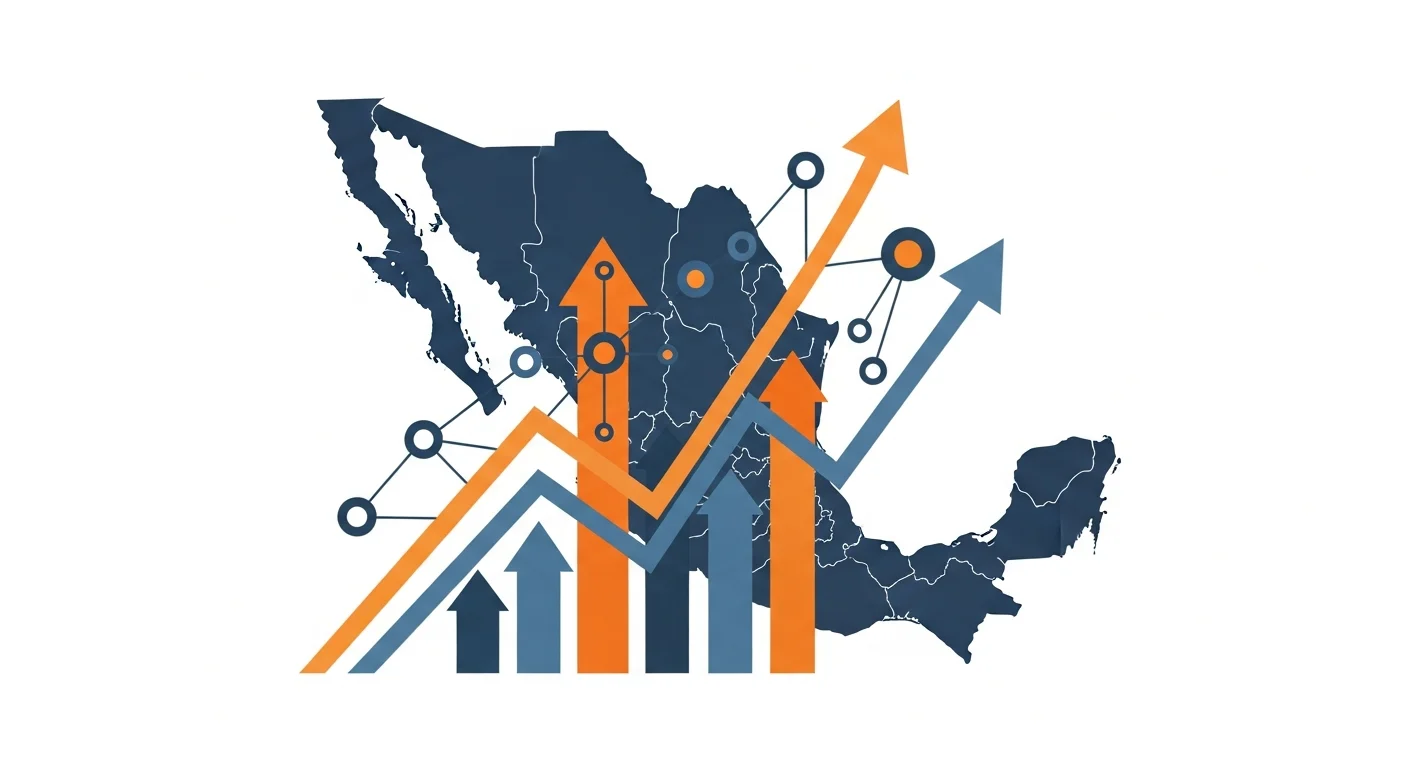
The nearshoring wave gave the talent pipeline a shove it didn’t strictly need but has clearly benefited from. Mexico’s IT services market generated in the neighborhood of $48 billion in 2025 and is tracked by Grand View Research toward roughly $37 billion in narrower IT-services spend by 2030, growing at close to 12% annually, and foreign direct investment tied to nearshoring has pulled tens of billions of dollars into the country since 2023. As a result, Mexico City, Guadalajara, and Monterrey have all expanded well past their original manufacturing-support roots into full software and data hubs in their own right.
 $35B+ nearshoring FDI since 2023
IT services market growing ~12% a year
$35B+ nearshoring FDI since 2023
IT services market growing ~12% a year
The third driver is quieter but shows up in nearly every renewal conversation we have. A company that starts with one Mexico hire to test the model rarely stops there, because the first placement worked and nobody on the US side had to relearn how to manage a distributed team from a blank page.
The Real Cost Savings
A Mexico hire typically runs 50% to 70% below an equivalent US hire once payroll taxes, benefits, and the staffing partner’s fee are all counted honestly, not just the number quoted on the first call.
The Bureau of Labor Statistics puts the 2026 median US software developer salary at $133,080. Layer on the standard 25% to 40% for payroll taxes, benefits, and overhead, and a fully loaded US hire lands between $166,000 and $186,000 a year. Independent salary benchmarking from SalaryExpert’s Mexico compensation data and Mexico’s own Data Mexico occupational statistics from the Ministry of Economy put a comparable mid-level developer’s base pay well under half that US figure before any staffing fee is added.
| Role | US Fully Loaded Cost | Mexico Fully Loaded Cost |
|---|---|---|
| Mid-level software developer | $166,000–$186,000/yr | $38,000–$62,000/yr |
| Data analyst | $95,000–$115,000/yr | $27,000–$42,000/yr |
| Customer support rep | $58,000–$72,000/yr | $15,000–$23,000/yr |
| Operations coordinator | $82,000–$100,000/yr | $17,000–$27,000/yr |
That gap narrows some once a staffing partner’s markup gets added back in, typically 15% to 40% on top of the worker’s base compensation. That markup is what pays for sourcing, payroll administration, and compliance, and it’s a fair cost to carry. A vendor that won’t itemize it for you, though, usually has a reason not to.
The Timezone Advantage
Real-time overlap is the piece a cost comparison alone never captures, and it changes how the work actually gets done, not just how fast a message travels back and forth.
Mexico runs on Central time with no daylight saving shift, so a developer in Mexico City or Guadalajara working a normal 9-to-5 is on the same clock as a team in Chicago or Dallas, one hour off from New York, and only one to two hours off from the West Coast depending on the season. Meanwhile, an offshore arrangement in South or Southeast Asia typically runs a 10 to 13 hour gap, and a message sent mid-afternoon in the US waits until the next morning there for a reply.
 Mexico: within 1 hr of every US zone
Asia: 10–13 hr gap
Mexico: within 1 hr of every US zone
Asia: 10–13 hr gap
That overlap matters most on work that’s genuinely collaborative, standups, live code review, product decisions that need a real back-and-forth. A blocked developer in Guadalajara can ask a question at 2pm and get unblocked before end of day instead of losing an entire cycle waiting on a reply. Async-friendly work, overnight QA, round-the-clock support coverage, none of that strictly needs same-timezone alignment, and offshore regions still win on raw cost there. For work that depends on people actually talking to each other during the day, though, Mexico’s overlap is close to unmatched among nearshore options.
Mexico City, Guadalajara, or Monterrey
All three cities staff well, and picking between them comes down to what kind of role you’re filling and how deep a bench the search actually needs.
 Mexico City
Guadalajara
Monterrey
Mexico City
Guadalajara
Monterrey
Mexico City is the country’s largest labor market by a wide margin, with several hundred thousand tech specialists and hundreds of active startups drawing on a dense cluster of universities. If a role needs a wide, deep pool to search against, especially anything senior or specialized, Mexico City usually has the bench for it.
Guadalajara has earned its “Silicon Valley of Mexico” nickname the slow way, through decades of electronics manufacturing that gradually pulled software and hardware engineering talent into the same metro area. The city produces roughly 9,000 new software engineers a year, and its fintech and enterprise IT scene runs deep enough that a well-connected recruiter rarely comes up empty.
Monterrey is the newer story, with tech employment there growing more than 100% in recent years on the back of its industrial base and a strong push into IoT and enterprise systems. It sits closer to the US border than either of the other two, which shows up in a cultural fluency with American business norms that some clients notice within the first few weeks of a placement.
None of the three is the automatic right answer for every search. A company chasing the lowest quoted rate sometimes lands in a market with thinner coverage for their specific stack, then spends an extra month or two re-sourcing after a candidate falls through. Match the city to the skill depth the role actually needs, not to whichever name comes up first in a sales deck.
Not Sure Which City Fits Your Role
Compare your requirements against Kore BPO’s Mexico talent bench in a quick call.
Legal and Compliance
Mexico’s Federal Labor Law carries mandatory obligations a US-style offer letter doesn’t account for, and getting this wrong turns a hire into a liability instead of an asset.
Every formal employee is owed an aguinaldo, a year-end bonus equal to at least 15 days of salary, due no later than December 20 each year and paid proportionally if someone leaves mid-year. Employers also owe PTU, a statutory profit-sharing payment equal to 10% of the company’s pre-tax profits, split among eligible employees. Neither of these is negotiable or optional, so a partner who glosses over either one isn’t managing your risk properly.
Baker McKenzie’s 2026 insight on Mexico’s workweek reduction covers the country’s phased cut of the standard workweek from 48 to 40 hours, one of the more consequential labor changes employers need to plan around this year. Employer-side social security and payroll contributions on top of base pay typically add a meaningful percentage once every mandatory line item, IMSS coverage included, is counted.
Unjustified termination triggers a separate obligation entirely, 90 days of integrated salary plus 20 days for every year of service and a seniority premium, on top of any unpaid vacation, vacation premium, or proportional aguinaldo owed at separation. An employer of record exists to absorb this complexity without you standing up a legal entity in Mexico, which is the right call for a company’s first handful of hires there. Past roughly 10 to 15 hires, the math usually starts favoring a direct entity paired with a staffing partner for sourcing, since the per-head EOR fee compounds faster than the one-time cost of setting up an entity.
Choosing a Mexico Staffing Partner
Four questions separate a real staffing partner from a lead-gen operation wearing a staffing label. Skip one and you tend to find out why it mattered later, at a worse time than now.
- How fast can candidates actually reach you, and does that timeline match the sales deck or run longer once you’re a live client?
- What does the fee structure look like broken down line by line? A vendor unwilling to show the markup is usually protecting a bigger one than they’d admit to.
- Who’s on the hook if Mexican labor law changes mid-contract, and is that answer written down anywhere you can point back to later?
- What happens if the placed worker leaves in month three? A real replacement guarantee is the clearest signal you’re dealing with a staffing partner, not a resume-forwarding service.
Get a straight answer to all four on the first call, in writing. A partner who hedges on even one of them isn’t worth a second call.
How Kore BPO Staffs Mexico
Kore BPO is a staffing and BPO firm placing data, software, and operations talent with US companies, based in Dallas, Texas, with a Latin America bench built through our office in San Jose, Costa Rica, and a second office in Hyderabad, India, for offshore roles outside the Americas. We’ve placed 6,236 hires across 257 clients, and Mexico has become one of the fastest-growing single-country sources in that bench over the past year.
I’ll say the biased part out loud. We make money when a company staffs through us instead of building a Mexico recruiting pipeline internally from nothing. That’s true, and pretending otherwise wouldn’t survive the first follow-up question. It’s also true, though, that a company hiring one role a year in one country is often better served by a smaller, direct partner than by the infrastructure we’ve built for volume across multiple countries at once. We’re not the right fit for everyone, and saying that plainly costs us less than a bad reference does six months later.
What we bring is $0 upfront fees, candidate resumes back in 2 to 5 business days, and a placement fee that’s disclosed on request rather than buried in a markup you have to ask about three times. Our broader Latin America staffing page covers how that model extends across the rest of the region, and our case studies cover real placements rather than a composite example built to look good in a deck.
What Clients Usually Ask First
Is a Mexico staffing agency the same thing as a Latin America staffing agency?
Not exactly, though the two overlap heavily. Latin America staffing is the broader category, covering Mexico, Colombia, Argentina, Brazil, and neighboring countries under the same set of hiring models. A Mexico staffing agency focuses specifically on Mexico-based talent, usually because a company already knows it wants Mexico’s border proximity and near-total US timezone overlap rather than a regional mix.
How much does a Mexico hire actually save compared to a US hire?
50% to 70% less, fully loaded, once payroll taxes, benefits, and the staffing partner’s fee are all counted. Software and data roles tend to land toward the higher end of that range because the US benchmark salary starts so much higher to begin with.
Do I need a legal entity in Mexico to hire there?
Not right away. An employer of record can legally employ workers in Mexico on your behalf without you registering a local entity, which usually makes sense for a company’s first handful of hires. Past roughly 10 to 15 hires, a direct entity plus a staffing partner for sourcing tends to be the cheaper long-run option.
Practical Questions About Getting Started
Mexico City, Guadalajara, or Monterrey, which one should I hire from?
Mexico City has the deepest overall bench and the widest range of specialties, which matters most for enterprise or senior technical roles. Guadalajara has decades of engineering depth built on its manufacturing base, particularly strong for fintech and enterprise IT. Monterrey sits closest to the US border and has grown fastest recently in industrial and IoT-adjacent roles. Match the city to the specific skill depth the role needs rather than defaulting to whichever comes up first.
What Mexican labor obligations should I know about before hiring?
Every formal hire is owed an aguinaldo, a mandatory year-end bonus equal to at least 15 days of salary, plus statutory PTU profit-sharing equal to 10% of pre-tax profits. Mexico is also phasing in a shorter standard workweek. A staffing partner or EOR should manage all of this without you having to track it yourself.
What’s the biggest mistake companies make hiring in Mexico?
Chasing the lowest quoted rate without checking talent depth for the specific role. A cheaper option with a thin bench for a particular stack often ends up costing more once you count the months spent re-sourcing after a candidate doesn’t work out.
The Bottom Line on Mexico Staffing
Related Articles



Ready to Staff Your Next Role From Mexico
Kore BPO sources vetted Mexico talent for US teams. Pre-screened candidates in 2–5 business days. $0 upfront.
Talk to Our Team