
Social Media Management Outsourcing FAQ and 2026 Trends
 Jithin KumarDirector · Kore BPO

This outsourced social media management FAQ covers what the work actually costs, what’s included, and how 2026 trends are changing it. Pricing typically runs $500 to $10,000 a month depending on platform count and posting volume. It works best when you keep brand voice, approvals, and reporting cadence in writing before signing. Heading into 2026, the work is shifting fast toward AI-assisted production paired with human strategy, social search optimization, and short-form video as the default content format.
- The global social media management outsourcing market is on pace to reach $22.75 billion by 2034, growing at a 12.1% CAGR from 2025.
- 79% of social media managers now use AI tools daily, but over 30% of consumers say they trust a brand less when its content looks visibly AI-generated.
- See the full social media management outsourcing services breakdown for scope, deliverables, and team structure.
- Full-service agency retainers average $2,000 to $5,000 a month for 3 to 5 platforms, against $120,000 to $160,000 a year fully loaded for one in-house hire.
What Social Media Management Outsourcing Actually Covers
Social media management outsourcing means handing the day-to-day operation of your brand’s social channels to an outside team, covering content planning, post production, scheduling, community replies, and reporting. It’s not the same as hiring a single freelance poster. A real outsourced setup gives you a small team, usually a strategist, a content creator, and a community manager, all working from one calendar. The work keeps moving when any one person is out sick or on vacation.
Our full social media management outsourcing services page breaks down exactly what’s included at each tier, from single-platform posting up through full-funnel content, paid social coordination, and influencer outreach. The short version is simple. The deeper the engagement, the more it looks like an embedded marketing department rather than a vendor relationship.
Scope questions come up constantly, and they deserve straight answers before you sign anything. Will the team write captions in your brand voice from day one, or is there a ramp-up period? Who approves posts before they go live? What happens to community replies on a Saturday night when something goes sideways in the comments? A credible provider answers all three without hedging.
How Common Outsourcing Has Become
Outsourcing has become the default path for a large share of the market. Services, meaning end-to-end campaign management, scheduling, analytics, and community moderation bundled together, account for 61.4% of the global social media management outsourcing market. Retail and e-commerce brands make up the single largest industry vertical at 34.2% of demand (Market.us, 2026). North America holds the largest regional share at 37.4%. That tracks with how many US small and mid-size businesses have shifted social work off their own payroll in the last three years.
If you’re still deciding whether outsourcing or an in-house hire fits your stage of growth, the detailed in-house vs. outsourced social media management comparison walks through the breakeven math by headcount and posting volume.

What Good Outsourced Teams Include by Default
- A written content calendar with approval checkpoints, not a surprise post the night before it’s live
- Platform-specific formatting instead of one asset dropped onto five networks unchanged
- A documented escalation path for negative comments, PR issues, or a customer service complaint that lands in the DMs
- Monthly reporting tied to actual business outcomes, like saves, shares, link clicks, and inbound leads, not just follower counts
- A named point of contact who knows your account, rather than a rotating queue of whoever’s free
2026 Trends Reshaping Outsourced Social Media Management
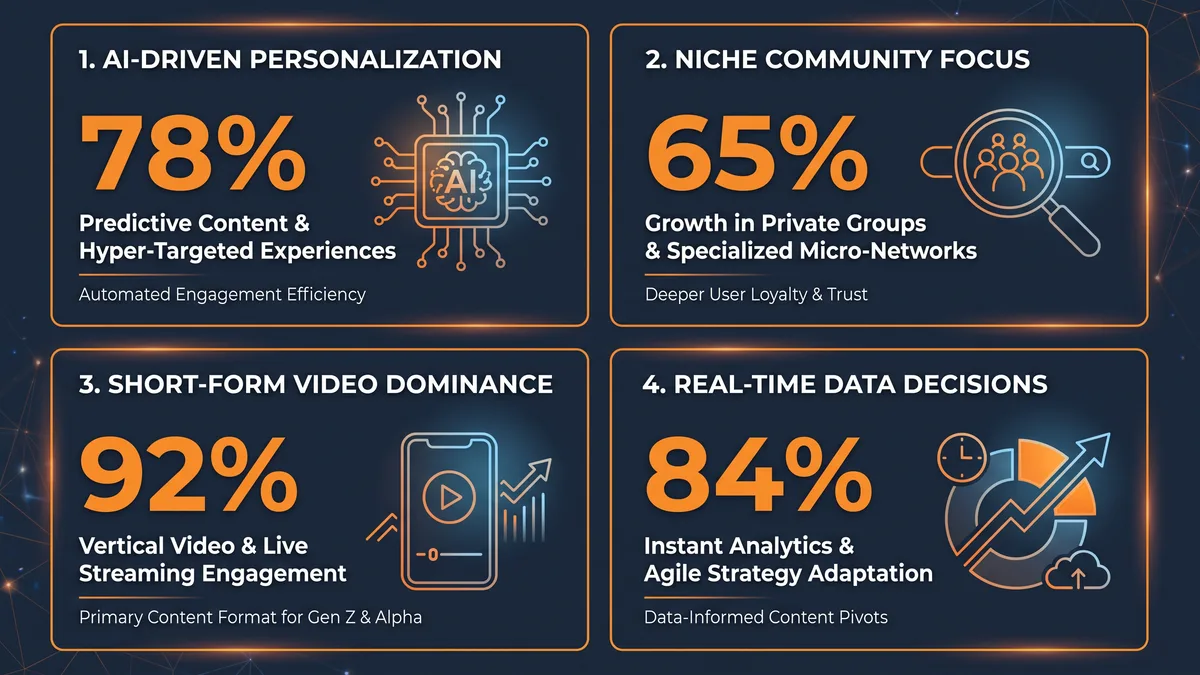
Social media management in 2026 looks meaningfully different from even two years ago, and the shift changes what you should expect from any outsourced partner. Four trends stand out as the ones actually affecting scope, pricing, and day-to-day output right now.
AI handles production, people handle judgment
79% of social media managers now use AI tools daily for drafting, resizing, and scheduling content, up sharply from a few years ago (Hootsuite Social Trends 2026). Here’s the catch. More than 30% of consumers say they’re less likely to choose a brand whose ads look visibly AI-generated. The outsourcing partners winning in 2026 use AI to speed up the mechanical parts of the job and keep a human writing captions, picking tone, and deciding what not to post.
Social platforms are becoming search engines
More than 60% of product discovery now happens on platforms like TikTok, Instagram, and YouTube instead of traditional search (Sprout Social 2026 Content Strategy Report). That means captions, alt text, and on-screen text now carry real SEO weight. An outsourced team that still treats captions as an afterthought is leaving discovery traffic on the table.
Platform dynamics keep shifting under brands’ feet
Threads crossed 141.5 million daily active users in January 2026, officially passing X’s 125 million (Hootsuite Social Trends 2026). Brands that outsource benefit from a team that’s already testing new platforms and reallocating budget, instead of a single in-house hire stretched too thin to keep up with every shift.
Marketing budgets are tight, and social still gets a cut
CMOs allocated 7.8% of company revenue to marketing in 2026, barely up from 7.7% the year before and well below the levels of four years ago. Paid media climbed to a five-year high of 31.4% of marketing spend, and social advertising held steady at 15.7% of the digital budget (Gartner 2026 CMO Spend Survey). Flat budgets are a big part of why outsourcing keeps gaining ground. It buys a full specialist team without the fixed cost of new headcount.
None of this means the fundamentals changed. Consistency, a real brand voice, and fast replies to real customers still drive the outcomes that matter. What changed is the toolset and the platform mix a competent outsourced team needs to run well. If you’re vetting partners against these shifts, the guide to choosing a social media management outsourcing partner lists the specific questions to ask about AI use, platform coverage, and reporting before you sign.
Cost and Model Comparison: Agency, Freelancer, or In-House
Pricing is where most of the confusion lives, mainly because “social media management” covers wildly different scopes of work depending on who’s quoting you. Here’s how the three common paths actually compare on cost.
| Model | Typical Monthly Cost | Best Fit |
|---|---|---|
| Outsourced agency or BPO team | $500–$10,000 | Businesses wanting a full team: strategy, content, and community in one engagement |
| Freelancer | $500–$10,000 (hourly billed, $35–$350/hr) | Narrow, single-platform work with light oversight needs |
| In-house hire (fully loaded) | $10,000–$13,300 | Brands needing someone embedded daily in internal meetings and product launches |
A full-service outsourced team managing 3 to 5 platforms, with strategy, 20 to 30 posts a month, community management, and monthly reporting included, typically runs $2,000 to $5,000 a month for the businesses hiring one (AgencyAnalytics, 2026). Compare that to the real, fully loaded cost of one in-house social media manager. Base salary runs $50,000 to $70,000. Once benefits, payroll taxes, onboarding, and software get added in, the true annual cost lands between $120,000 and $160,000, or roughly $10,000 to $13,300 a month, for one person covering everything (GrowthAssistant, 2026).
Why the Gap Pushes Companies to Outsource First
That gap is exactly why so many mid-size brands outsource first and hire in-house later, once volume justifies a dedicated headcount. The BLS projects 7% growth for market research and marketing specialist roles through 2035, with about 82,000 openings a year nationally and a median wage of $78,760 (U.S. Bureau of Labor Statistics, 2025). That gives a sense of how competitive and expensive in-house marketing hiring has become even before benefits and overhead are added.
For a full line-item breakdown of what drives price up or down, including platform count, content volume, and whether paid social management is bundled in, see the dedicated social media management outsourcing pricing guide.

Ready to see what a real outsourced social team costs for your specific platform mix and posting cadence? Talk to Kore BPO about building your social media team and get a scoped quote back within a few business days.
Common Questions
What’s included in a typical outsourced social media management package?
A standard package includes a monthly content calendar, caption writing, graphic or short-video production, scheduling across agreed platforms, basic community management (replying to comments and DMs), and a monthly performance report. Higher tiers add paid social coordination, influencer outreach, and real-time crisis response coverage.
How much does it cost to outsource social media management in 2026?
Expect $500 to $10,000 a month, with $2,000 to $5,000 covering a full-service team managing 3 to 5 platforms at 20 to 30 posts a month. Freelancers charge $35 to $350 an hour depending on experience and scope. Compare that to $120,000 to $160,000 a year for one fully loaded in-house hire.
Is outsourced social media management as good as having an in-house team?
It depends on the provider, not the model itself. A well-structured outsourced team gives you specialists in strategy, content, and community management working together, something a single in-house generalist often can’t match. The tradeoff is that outsourced teams need clear brand guidelines and approval workflows up front, since they aren’t sitting in your internal meetings by default.
Can an outsourced team actually match our brand voice?
Yes, when onboarding is done right. A credible provider asks for brand voice guidelines, past high-performing posts, and sample customer interactions before writing a single caption, then runs a short calibration period with extra review rounds. If a provider skips this step entirely, that’s a warning sign, not a shortcut.
How involved does our team need to stay once we outsource?
Less than most people expect, but not zero. Plan on a monthly strategy call, quick approval turnaround on content batches, and someone internal available to answer product or policy questions the outsourced team can’t answer alone. The goal is removing daily execution work, not removing your brand’s judgment from the process entirely.
Which social platforms should a small business outsource first?
Start with whichever one or two platforms your actual customers use most, confirmed through your own analytics rather than assumption. Instagram and Facebook are the usual starting point for small businesses, with TikTok or LinkedIn added once the first two are running consistently and showing measurable return.
How is AI changing what outsourced social media teams deliver?
AI now handles a lot of the mechanical work, including first-draft captions, resizing assets for different platforms, and scheduling. What hasn’t changed is that over 30% of consumers say they trust a brand less when content looks visibly AI-generated. The best outsourced teams use AI to move faster while keeping a human finalizing tone, captions, and anything customer-facing.
Do outsourced teams handle negative comments and PR issues?
A properly scoped engagement should include a written escalation protocol covering what the team can respond to directly, what gets flagged to you immediately, and expected response time. Get this in writing before signing. An agency that can’t describe its escalation process clearly probably doesn’t have one.
What’s the difference between a social media agency and a BPO-style outsourced team?
Traditional agencies often bill premium rates for strategy-heavy, campaign-based work and may staff your account with junior talent rotating in and out. A BPO-style outsourced team, like Kore BPO’s model, runs a dedicated, consistent pod for day-to-day execution at a lower cost basis. Strategy support gets layered on top rather than billed as a separate, expensive line item.
How do we measure whether outsourcing is actually working?
Track metrics tied to business outcomes, not vanity numbers. Saves and shares indicate content resonates enough for people to act on it. Link clicks and inbound DMs tied to specific posts show real funnel movement. A provider that only reports follower growth and impressions without tying anything to leads or sales isn’t measuring the right things.
How long does it take to see results after outsourcing?
Expect a 30 to 60 day onboarding and calibration window before output fully matches your brand voice and posting rhythm. Measurable engagement shifts usually show up within 60 to 90 days. Real pipeline or sales impact takes 90 to 180 days, depending on your sales cycle and how much of your funnel social actually touches.
What should be in the contract before we sign with an outsourced provider?
A solid contract spells out exact deliverables per month, the approval workflow and turnaround times, and who owns content and creative assets after the contract ends. It should also include a termination clause with reasonable notice and reporting frequency. See the full checklist in the guide to choosing a social media management outsourcing partner before signing anything.
Related Articles


Social Media Management Outsourcing Services Pricing: What It Costs in 2026
Read
Ready to Outsource Your Social Media?
Kore BPO builds dedicated social media pods for strategy, content, and community management, scoped to your platforms and budget, with transparent monthly pricing.
Get a Scoped Plan