7 Best Countries to Hire Offshore Machine Learning Engineers in 2026

Last updated: July 16, 2026
The US median salary for an AI and machine learning engineer hit $189,500 in 2025, more than $50,000 above the global median, according to Stack Overflow’s 2025 Developer Survey. Roles that touch model deployment, inference optimization, or production ML pipelines sit even higher, and most of them stay open for months because the domestic pool hasn’t caught up to demand.
That’s why more companies are looking offshore for this specific role. Not a data scientist. Not a generalist Python developer. An offshore machine learning engineer who can take a model out of a notebook and keep it running in production, under load, without falling over at 2am. That’s a narrower skill set than most rate-comparison guides account for, and it changes which country actually fits your search.
This guide ranks the 7 countries worth evaluating in 2026, with real rate ranges, what each market is actually strong at building, and a framework for matching the country to the specific type of ML work you’re hiring for.
What the Rate Card Skips
An ML engineer isn’t a data scientist with a deployment plugin. The two roles sit next to each other on an org chart and get lumped into the same offshore search constantly, which is the first place companies go wrong. A data scientist explores and models. An ML engineer builds and operates the system that keeps that model serving predictions in production, which means the job leans harder on software engineering, containerization, and infrastructure than most rate charts suggest.
Four things matter more than the hourly number: GPU and infrastructure fluency, production experience versus tutorial-level framework knowledge, onboarding time, and timezone overlap for incident response. Miss any of these and the quoted rate stops meaning anything.
GPU and infrastructure access separates candidates who’ve only trained models locally from candidates who’ve actually shipped one. Someone who lists PyTorch and TensorFlow on a resume but has never touched Docker, Kubernetes, or a model-serving framework like TorchServe or Triton isn’t an ML engineer yet, no matter what the title says. That distinction is harder to screen for remotely, and it’s exactly where offshore mismatches happen most.
Operator note: Kore BPO has placed ML engineers where the client’s first technical screen was a take-home model deployment exercise, not a whiteboard question. Candidates who’d only worked in notebooks self-selected out within the first round. The ones who stayed were the ones worth the interview time. Skipping that step is the single most common reason offshore ML hires stall around month two.
Onboarding runs longer for this role than for a general backend hire. Four to ten weeks is realistic depending on how mature your existing ML infrastructure is. A model-serving pipeline that already has documented deployment patterns onboards faster than one where the new hire has to reverse-engineer tribal knowledge from a departed engineer’s notebooks.
Timezone overlap matters differently here than it does for a standard developer. Production ML systems break in ways that need a human awake to diagnose them: a model drifting on live traffic, a GPU cluster running out of memory during a batch job, an inference endpoint timing out under load. Fully async works fine for research and training work. It works less well when something’s on fire in production and the person who owns it is asleep.
7 Countries at a Glance: Offshore ML Engineer Comparison
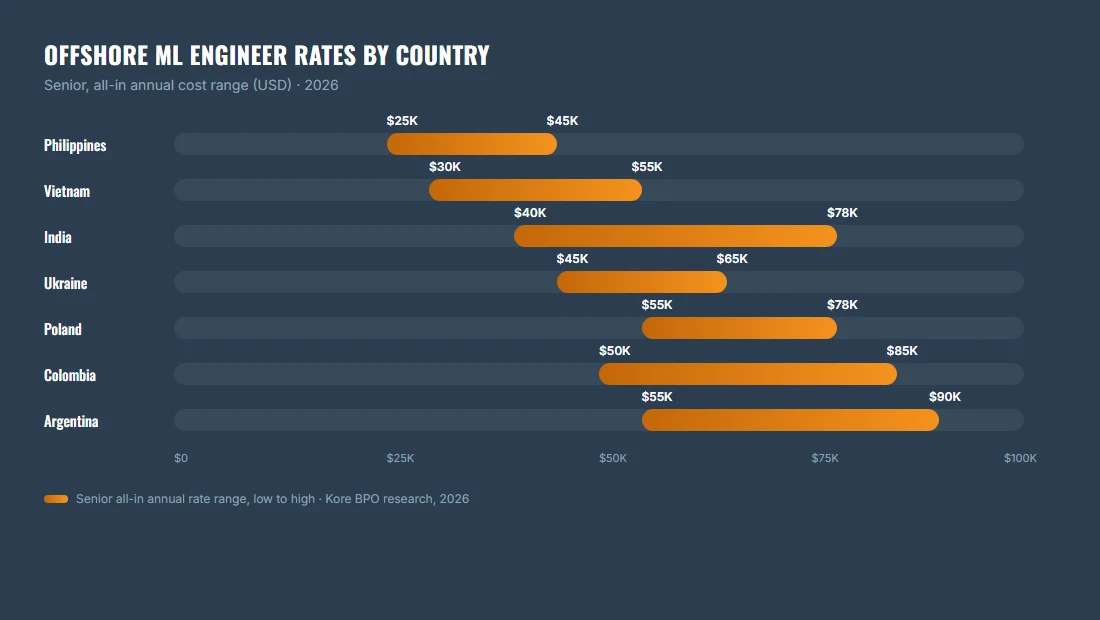
Quick reference before the country-by-country breakdown. Rates reflect senior, all-in loaded cost for a dedicated hire, not junior or marketplace freelance pricing.
| Country | Senior All-In (USD/yr) | US Timezone Overlap | ML Strength | Best For |
|---|---|---|---|---|
| India | $40,000–$78,000 | 0 hrs (9.5–12.5 gap) | MLOps, LLM deployment, scale | Production ML at volume |
| Poland | $55,000–$78,000 | 2–4 hrs (6–9 gap) | Research-grade ML, GDPR | EU compliance, senior architecture |
| Ukraine | $45,000–$65,000 | 3–4 hrs (7–8 gap) | Computer vision, applied ML | CV workloads at lower cost than Poland |
| Vietnam | $30,000–$55,000 | 0–1 hrs (11–14 gap) | Transformer models, fast-growing | Async-heavy deployment work |
| Philippines | $25,000–$45,000 | 0–1 hrs (12–13 gap) | Model monitoring, MLOps support | Cost-efficient production support |
| Colombia | $50,000–$85,000 | 6–8 hrs (0–2 gap) | Applied ML, government-backed AI | Real-time incident response |
| Argentina | $55,000–$90,000 | 5–7 hrs (1–3 gap) | NLP, research-track ML | Complex modeling with live overlap |
Deployment and MLOps specialists price 15 to 30% above these base ranges in every market on this list. GPU cost optimization, distributed training experience, and LLM inference work are the specific skills driving that premium, and the premium isn’t compressing anywhere.
For the role definitions and hiring framework behind these numbers, see the offshore machine learning engineer page. If you’re still deciding between a modeling hire and a deployment hire, the data scientist vs ML engineer breakdown walks through which one solves your actual problem first.
1. India: MLOps Depth and Scale
India has the largest machine learning engineering pool in the world and the deepest bench for production deployment work specifically. Senior ML engineers run $40,000 to $78,000 all-in, with MLOps-focused specialists sitting at the top of that range. PayScale’s 2026 data shows MLOps compensation climbing faster than general ML roles as Indian product companies shift from experimentation to production-scale systems.
Bengaluru and Hyderabad are where the deployment talent concentrates. Engineers here work daily with containerized model serving, Kubernetes-based inference scaling, and increasingly LLM deployment pipelines. NASSCOM puts India’s total tech workforce at 5.8 million, and the share doing production ML rather than research-only work has grown steadily as global companies establish GCCs specifically for this function.
The tradeoff is screening difficulty. India’s market produces both genuinely production-ready ML engineers and a large volume of candidates whose PyTorch experience stops at course projects. The gap between the two doesn’t show up on a resume. It shows up in the first real deployment task, which is why a hands-on technical screen matters more here than in almost any other market on this list.
Time zone runs 9.5 to 12.5 hours ahead of US Eastern depending on the specific city and daylight saving alignment. Zero real-time overlap for standard business hours. That’s workable for training and pipeline development work. It’s a genuine constraint for anyone who needs a human available during a live production incident on US business hours, which is worth planning around before you hire.
Best for: Production ML at volume, LLM deployment pipelines, and teams that need deep MLOps bench strength and can run an async-first incident response process.
Watch out for: Wide quality variance between candidates with real deployment experience and candidates with tutorial-level framework knowledge. Run a hands-on deployment exercise, not a whiteboard interview, before you extend an offer.
2. Poland: Research-Grade ML Under EU Compliance
Poland is the market to hire when the work needs statistical rigor, GDPR-native data handling, or architecture-level ML judgment. Senior ML engineers run $55,000 to $78,000 all-in, based on ERI SalaryExpert’s 2026 country data and corroborated by Levels.fyi’s Poland compensation figures.
Warsaw and Kraków hold the concentration. Polish computer science and mathematics graduates carry a research-track background more often than most offshore markets, and it shows in the quality of architectural decisions on complex systems, not just implementation speed. Poland also ranks second globally in Python skills according to HackerRank’s developer assessments, and Python remains the primary language for production ML tooling.
The GDPR angle deserves its own line. Polish engineers build under EU data protection law by default. If your ML system touches European customer data or you’re preparing for an EU launch, that compliance discipline is baked into how the team already operates rather than something you retrofit later.
Best for: EU-compliant ML systems, senior architecture-level hires, and complex production pipelines where research depth changes the output quality.
Watch out for: Not the cheapest option on this list, and the senior pool is smaller than India’s. If cost is the primary driver and the work is straightforward deployment rather than architecture, Ukraine or the Philippines fit better.
Time zone sits 6 to 9 hours ahead of US Eastern. Late afternoon in Warsaw overlaps with mid-morning on the US East Coast, enough for one real daily sync without anyone working an unreasonable schedule.
3. Ukraine: Computer Vision Strength at a Discount to Poland
Ukraine gives you Eastern European ML engineering quality at 15 to 25% below Polish rates, with a specific and well-documented strength in computer vision. Senior engineers run $45,000 to $65,000 all-in. IT Ukraine Association data puts the country’s IT workforce at roughly 307,000 specialists generating $6.66 billion in exports in 2025, up 3.3% year-over-year despite the operating environment.
The computer vision depth isn’t accidental. Years of defense-technology and industrial-automation work have produced a concentration of engineers comfortable with real-time image and video processing pipelines, a specialization that’s genuinely harder to find at this price point anywhere else on this list. IT Ukraine’s own sector mapping projects generative AI model work growing more than 80% in 2026, ahead of nearly every other technology category tracked.
The honest caveat, the same one every guide covering this market has to include: geopolitical volatility is real and it’s an operational risk, not just a headline risk. Most Ukrainian engineering teams now work fully remotely from stable regions or from Poland, the Czech Republic, and Germany. The skill hasn’t gone anywhere. Build a continuity plan into the contract before you start, and don’t skip that step because the rate looks good.
Best for: Computer vision and applied ML work where Poland-level quality at a lower price point matters, and teams willing to structure a continuity plan around geopolitical risk.
Watch out for: Confirm the specific team’s location before signing. Operational continuity risk is real and needs a documented backup plan, not an assumption that it won’t affect your project.
4. Vietnam: The Fastest-Growing Bench for Transformer Work
Vietnam’s ML engineering talent pool is growing faster than any other market in this guide, with real, verifiable production experience rather than academic-only exposure. Senior engineers run $30,000 to $55,000 all-in. NVIDIA maintains active AI model development roles based in Hanoi and Ho Chi Minh City, and that kind of direct multinational investment is a stronger signal of real market depth than most rate guides capture.
Ho Chi Minh City and Hanoi hold the concentration. What stands out about Vietnam’s current cohort specifically is transformer-model exposure: a meaningful share of screened candidates in this market now carry direct hands-on experience with transformer architectures, not just classical ML, which puts the country ahead of where most Southeast Asian markets sat even two years ago.
Building an Offshore ML Engineering Team?
Kore BPO places pre-vetted machine learning engineers for US companies across deployment, MLOps, and production ML roles. Resumes in 2 to 5 days.
The constraint is timezone, and it’s a real one. Eleven to fourteen hours behind US Eastern is a full business day of separation. Teams that succeed here build genuinely async workflows: documented deployment runbooks, asynchronous code review, and no expectation of same-hour response during US business hours. Teams that try to force real-time collaboration end up scheduling calls at midnight local time, which burns out the relationship fast.
Best for: Async-first deployment and MLOps work, transformer-model implementation, and teams prioritizing cost efficiency with a documented handoff process already in place.
Watch out for: The full-day timezone gap demands real async discipline from day one. If your team has never run async-first before, Vietnam will expose every documentation gap within the first month.
5. Philippines: The Cost-Efficient Production Support Layer
The Philippines carries the strongest English proficiency in Southeast Asia, and for ML engineering specifically, it’s strongest in the production support layer: model monitoring, pipeline maintenance, retraining triggers, and the ongoing operational work that keeps a deployed model healthy after the initial build. Senior practitioners run $25,000 to $45,000 all-in, among the most cost-efficient options on this list.
There’s a real distinction worth naming here. Building a novel model architecture and keeping an existing production system running are different skill sets, and the Philippines is genuinely strong at the second one. Model monitoring dashboards, drift detection, retraining pipelines, and the operational discipline of a production ML system, that’s where Filipino ML talent consistently delivers, backed by a communication style that tracks closely to US business norms.
Where it gets more complicated is novel architecture work. If the role calls for designing new model architectures, deep research-level statistical work, or frontier LLM fine-tuning, the specialization depth in the Philippines is still building relative to India, Poland, or Ukraine. That’s changing as the country’s broader IT sector, which crossed $2.5 billion in 2025, continues shifting toward higher-value technical work.
A structure that works well in practice: a senior ML engineer from India or Eastern Europe owns model architecture and initial deployment, and a Philippines-based engineer owns ongoing monitoring, retraining, and pipeline maintenance. Neither role gets stretched past its real depth, and the blended cost usually comes in well below a single senior hire covering both functions.
Best for: Production model monitoring and maintenance, retraining pipelines, and teams that want a cost-efficient layer supporting a smaller senior architecture team.
Watch out for: Novel model architecture and deep research work isn’t the market’s current strength. Pair with a senior architecture hire elsewhere rather than expecting one Philippines-based engineer to cover both ends.
6. Colombia: Real-Time Collaboration for Production Incidents
Colombia is the strongest LATAM option for ML engineering roles where someone needs to be reachable during US business hours, not just async-available. Senior engineers run $50,000 to $85,000 all-in, with 0 to 2 hours of separation from US Eastern.
Medellín has become a genuine AI and ML hotspot, backed by a government commitment that goes beyond talking points. Colombia’s public AI policy allocates roughly $120 million through 2030, and the country holds a World Economic Forum Centre for the Fourth Industrial Revolution partnership established in 2024, aimed specifically at strengthening applied AI research capacity and ethical deployment standards.
For production ML systems specifically, the timezone advantage changes what’s operationally possible in a way that’s easy to underrate until you’ve lived without it. A model drifting on live traffic at 10am US Eastern gets a same-hour response from a Colombia-based engineer. The same incident with an India-based team waits until the next Indian business day starts, or gets escalated to whoever’s on call at an unreasonable hour.
Best for: Production ML systems needing real-time incident response, applied ML work with US stakeholder collaboration, and teams that have outgrown a fully async operating model.
Watch out for: The senior research-track ML bench is thinner than India, Poland, or Argentina. Strongest for applied production work, not novel architecture design or deep theoretical research.
7. Argentina: NLP Depth With Live Overlap
Argentina pairs a genuine research tradition in NLP and theoretical ML with 1 to 3 hours of separation from US Eastern, a combination no other market on this list matches. Senior ML engineers run $55,000 to $90,000 all-in, the highest range in this guide, reflecting both the specialization depth and the collaboration advantage.
Buenos Aires holds the concentration, with a technical culture shaped by decades of academic ML and NLP research. Globant and BairesDev, two of the region’s largest technology companies, are both headquartered here, and the local senior engineering pool reflects that maturity. Practitioners with published research or open-source ML contributions show up more often in Argentina’s senior tier than in most other offshore markets.
Economic volatility is the practical caveat, and it’s a contracting issue more than a talent-quality one. Currency instability means payment terms, contract currency, and cost escalation clauses need more upfront clarity than a comparable Colombia or Mexico engagement. That’s a paperwork problem to solve before signing, not a reason to avoid the market.
Best for: NLP and research-track ML work, complex modeling that benefits from live stakeholder collaboration, and teams that value published research or open-source depth in senior candidates.
Watch out for: Currency volatility requires clear contract terms upfront around payment currency and cost adjustment. Get this documented before work starts, not after the first renewal conversation.
Matching Country to Your ML Workload
Not every “machine learning engineer” role is the same job. Four distinct workload types typically hide under that title, and the best-fit country shifts depending on which one you’re actually hiring for.
| Workload Type | What the Work Actually Is | Top Countries | Where It Breaks Down |
|---|---|---|---|
| MLOps / Platform | Model serving, CI/CD for ML, infrastructure automation, GPU cost management | India, Vietnam | Philippines lacks deployment depth for novel infra; Argentina overqualified and pricier for pure ops work |
| Applied Production ML | Building and shipping models at scale, feature pipelines, real-time inference | Colombia, India | Poland is overqualified for straightforward production work; Vietnam needs strong async discipline first |
| Computer Vision | Image and video model pipelines, real-time detection systems | Ukraine, India | Philippines and Colombia still building depth here; Argentina thinner than its NLP bench |
| NLP / LLM Research | Fine-tuning, RAG architecture, novel model design, theoretical work | Poland, Argentina | Philippines and Vietnam not there yet for research-grade work; India has depth but needs harder vetting |
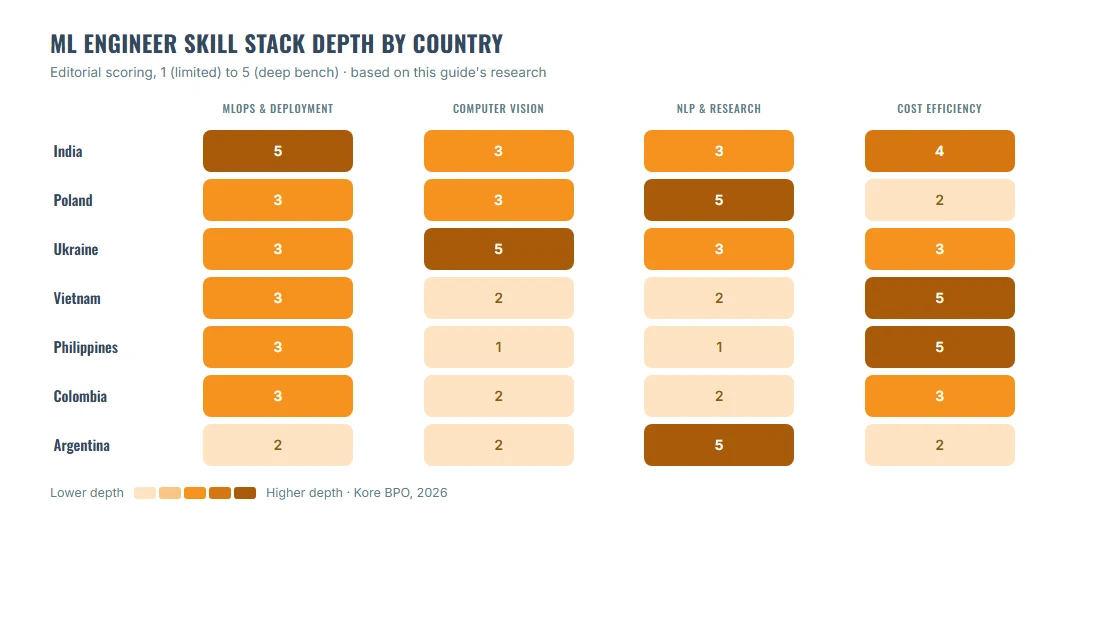
Run your actual job description through this table before you post the role. Most offshore ML mismatches trace back to a company posting “ML engineer” while meaning MLOps, then interviewing research-track candidates who match the title on paper but not the actual day-to-day work. By the time that surfaces, you’ve usually spent 60-plus days in the process and started over.
Not sure whether the role is closer to data science or ML engineering in the first place? The data scientist vs ML engineer guide breaks down the distinction before you write the job post. And if the case for offshoring the function at all still needs building internally, the machine learning outsourcing guide for SMBs covers when it makes sense and when it doesn’t.
Country mismatches cost more than a slower domestic search does. A research-track ML hire dropped into a pure MLOps role, or an ops-focused hire expected to design novel model architecture, runs at partial output for months and often exits within the year. Use the workload table above before the job goes live, not after the first round of interviews falls flat.
India for MLOps scale and deployment depth. Poland for EU compliance and research-grade architecture. Ukraine for computer vision at a real discount. Vietnam for async-first teams that need transformer-model implementation on a budget. Philippines for the cost-efficient production support layer. Colombia and Argentina for the workloads where live collaboration and research depth both matter.
Kore BPO places vetted offshore machine learning engineers across India, Eastern Europe, and LATAM. Resumes in 2 to 5 business days, $0 until you hire. For the country-by-country comparison on the data science side of the org, see best offshore countries for data scientists, or browse the full offshore roles directory to see every position Kore BPO places.
What Companies Ask Before Hiring an Offshore ML Engineer
Which country is genuinely best for LLM deployment and inference optimization work?
India, with Poland as the alternative when EU data handling is a requirement. India has the deepest bench for GPU-aware deployment work, distributed inference, and the infrastructure automation that keeps an LLM serving predictions cost-effectively at scale. Expect to pay 20 to 30% above standard senior ML rates for this specific profile, and run a real deployment exercise in the interview process rather than a conceptual discussion. Candidates who’ve only fine-tuned a model in a notebook and never managed the serving infrastructure around it won’t perform the same job.
How is hiring an ML engineer different from hiring a data scientist offshore?
The screening process looks different and the countries that win shift accordingly. A data scientist interview tests statistical reasoning and modeling judgment. An ML engineer interview needs to test production experience: containerization, model serving frameworks, monitoring, and how the candidate handles a system that’s actively breaking. Countries strong in one aren’t automatically strong in the other. India and Colombia lean toward production ML strength. Poland and Argentina carry more research depth. Match the interview and the country to the actual job, not the job title.
Realistically, how long does it take to vet and place an offshore ML engineer?
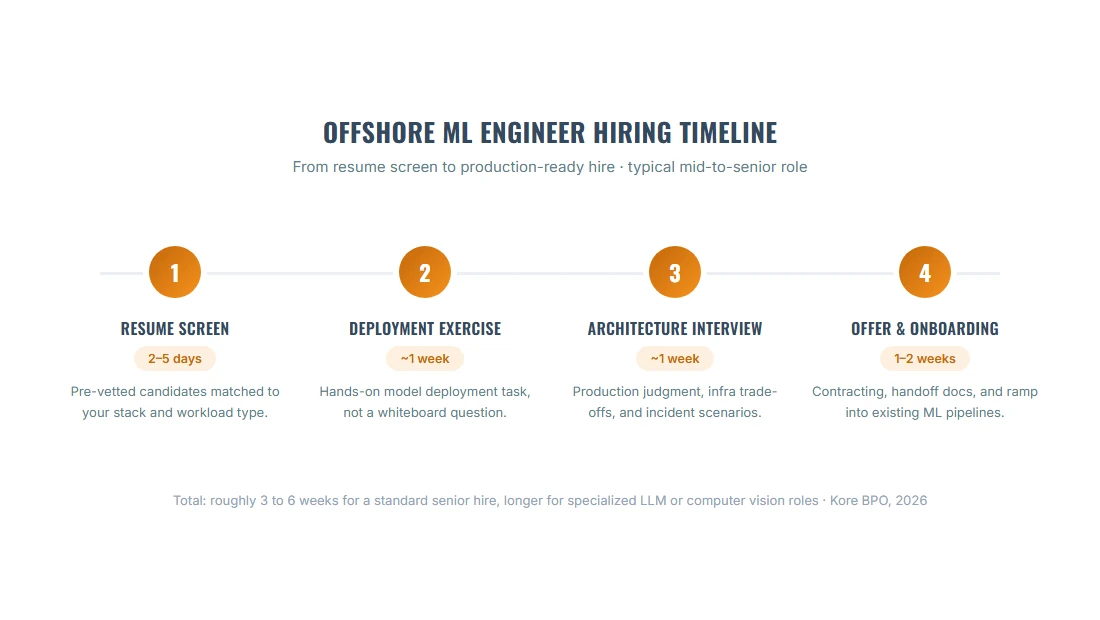
3 to 6 weeks for a standard mid-to-senior production ML role, longer for specialized LLM deployment or computer vision positions. The extra time versus a general developer hire comes from needing at least one hands-on technical round: a real deployment task, an architecture walkthrough, or a production debugging scenario. Kore BPO typically delivers pre-screened resumes in 2 to 5 days; the client-side interview and technical assessment process from there usually runs 3 to 5 weeks depending on how many rounds are involved.
Is Ukraine still a reasonable choice given the ongoing geopolitical situation?
For companies willing to build a continuity plan into the engagement, yes. The engineering talent, particularly in computer vision, remains genuinely strong, and most teams now operate fully remotely from stable locations. The honest framing: this is an operational risk to plan around with contract terms and a backup arrangement, not a reason to categorically avoid the market. Companies that skip that planning step are the ones who get caught off guard. Companies that build it in from day one generally do fine.
What does a 12-hour timezone gap actually cost an ML engineering team?
More during incidents than during normal development. For training, pipeline development, and research work, a large timezone gap barely matters if the workflow is genuinely async. The cost shows up specifically in production support: a model degrading on live traffic at 9am US Eastern won’t get a response from an India or Vietnam-based engineer until their next business day starts, unless you’ve built an on-call rotation to cover it. If your ML system runs in production and needs same-hour incident response, that’s the deciding factor that should push you toward Colombia or Argentina over South or Southeast Asia, regardless of the rate difference.
Colombia vs India for a straightforward production ML role. Which one actually wins?
Depends on whether incident response speed or cost is the bigger constraint. India costs less and has a deeper MLOps bench for complex deployment architecture. Colombia costs more but gives you 0 to 2 hours of separation from US business hours, which matters directly for how fast a production issue gets diagnosed and fixed. Straightforward production role with a documented on-call process and cost as the primary driver, India wins. Role where the engineer needs to be reachable during a live incident without an overnight wait, Colombia’s timezone advantage is worth the premium.
Related Articles



Ready to Hire an Offshore ML Engineer?
Kore BPO places vetted machine learning engineers across India, Eastern Europe, and LATAM. Pre-screened resumes in 2 to 5 days.
View ML Engineer Profiles