How to Choose a Mexico Staffing Agency


The right Mexico staffing agency names its REPSE registration number without hesitation, tests English directly instead of assuming it, shares real time-to-fill and tenure numbers, and puts a replacement window in writing. A hedge on any of those four points is your answer.
Every Mexico staffing agency pitch hits the same three notes by the second call. Same working hours as the US. Lower cost than a domestic hire. A deep bench in Mexico City, Guadalajara, or Monterrey. All three are usually true. However, none of them say whether the specific firm on the call screens candidates properly, keeps up with a labor system that got noticeably stricter this year, or sticks around once the invoice clears.
What This Guide Covers
Mexico isn’t a smaller, cheaper version of Latin America staffing in general, and treating it that way is how buyers end up with a hire who never really fit the role. Specifically, this guide covers what to check before signing, what changed in Mexico’s outsourcing and labor rules heading into the back half of 2026, and the exact questions worth asking before a contract lands anywhere near a signature.
Why Mexico Specifically, Not Just “Latin America”
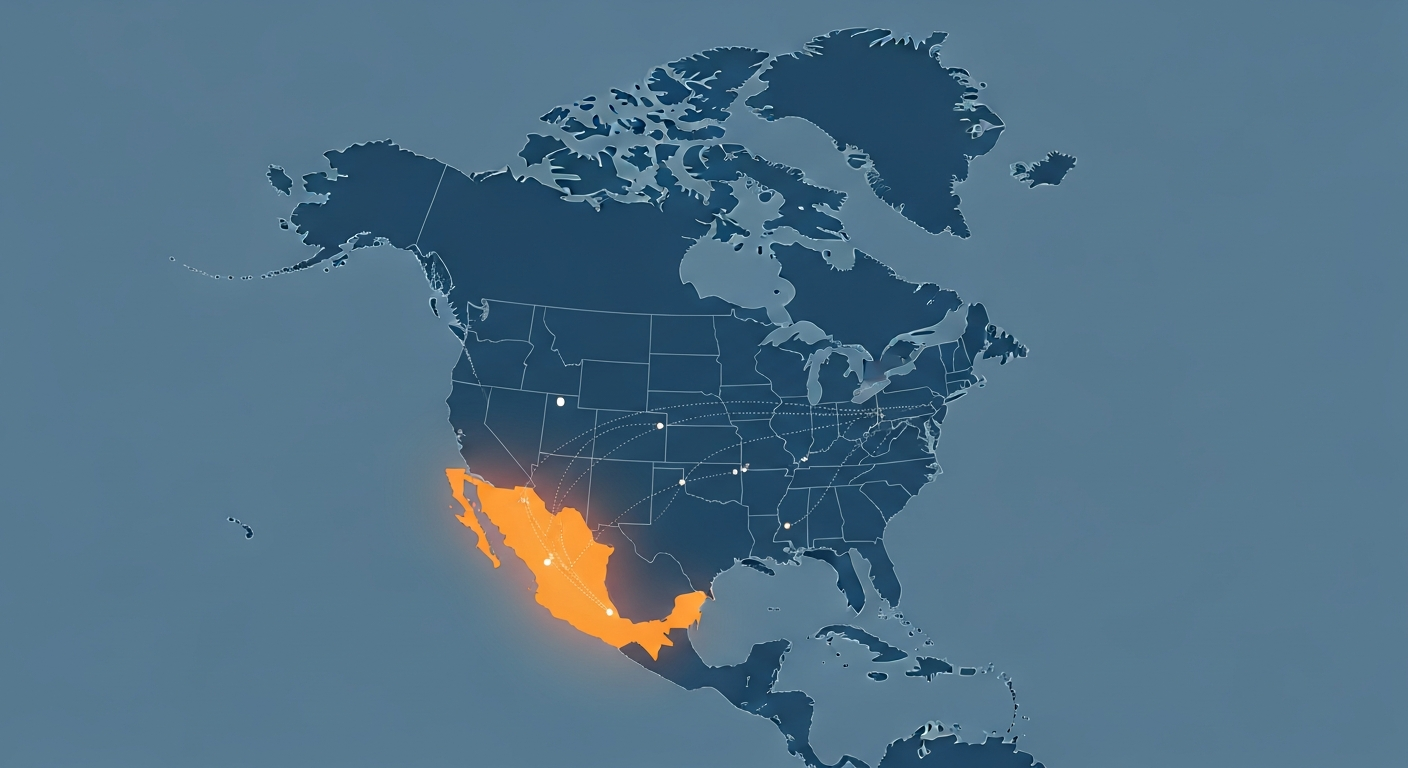
Most of Mexico runs on Central Time and has held it steady since the country did away with seasonal clock changes in 2022. For a Dallas or Chicago team, that’s a full working day overlap. Even for teams on the coasts, it’s close enough that a 9am standup doesn’t need anyone to dial in early or stay late. As a result, that overlap alone puts Mexico ahead of most Asia-based outsourcing on pure logistics, no contract clause required.
The talent base is the part agencies undersell. For instance, the Mexican federal government reports a tech workforce well past 700,000 professionals, with more than 130,000 engineering graduates entering the labor market every year. That’s not a country still trying to prove it can staff technical roles at scale. Rather, it already does, across software, data, and increasingly AI-adjacent work as companies build out nearshore capacity closer to home.
Cost still does the heavy lifting in most pitches, and for good reason. Specifically, senior technical hires in Mexico typically run 50 to 70% below the fully loaded cost of an equivalent US employee once salary, benefits, and overhead are counted together. That’s a real number. However, it’s also the easiest one for a weak agency to lead with, since it requires nothing about how they actually screen or manage a placement once the offer’s signed.
 Central Time, full-day US overlap
50-70% below US senior hiring cost
Central Time, full-day US overlap
50-70% below US senior hiring cost
What a Mexico Staffing Agency Actually Does
The term “staffing agency” covers three genuinely different setups, and the gap between them matters more than the marketing language suggests.
Some firms only source and screen. They send you candidates, you make the offer, and you handle payroll and compliance yourself, usually through your own Mexican entity or a separate employer of record. Other firms pair sourcing with a named REPSE-registered service arrangement, so the agency finds the talent and legally provides the specialized labor under its own registration. A smaller group runs its own entity in Mexico outright, meaning the firm that vetted the candidate is the same one running payroll, statutory benefits, and termination under Mexican labor law.
None of the three models is automatically wrong. A pure sourcing firm can work fine if you’ve already got a compliance structure in place. But a firm that can’t clearly say which of these three it runs, or dodges the question with something vague about “full-service support,” is telling you it hasn’t had to answer that question honestly before.
The 2026 REPSE and IMSS Load You’re Hiring Into
Mexico’s outsourcing rules didn’t just change on paper this year. Enforcement did. Under the REPSE system run by the Secretaría del Trabajo y Previsión Social, any firm providing specialized labor services to a client must hold an active registration verifiable on the official STPS portal, and in September 2025 the STPS rolled out a formal Inspection Protocol on Subcontracting that standardizes how inspectors verify compliance. 2026 is the first full year that protocol has been running at scale, and the shift from paper rules to active inspection is the part most agency pitches still haven’t caught up to.
The financial side moved too. Mexico’s IMSS employer contribution for the Cesantía en Edad Avanzada y Vejez branch, the severance and old-age insurance tier, now runs on a gradual scale that reaches roughly 3.15% to 7.51% depending on an employee’s salary base, with the daily UMA reference value set at $113.14 MXN for 2026. Add the mandatory aguinaldo year-end bonus and vacation premium on top, and total employer cost still lands 30 to 40% above base salary, in line with the rest of Latin America. None of that is a warning sign on its own. It’s just the actual math, and an agency that hasn’t updated it since last year is working from a stale playbook.
If a Mexico staffing agency can’t produce its REPSE registration number on request, that’s not a paperwork delay. It means the arrangement may not be legal to operate under Mexican labor law at all.
 REPSE active inspection since Sept 2025
IMSS CEAV 3.15 to 7.51% of SBC, 2026
REPSE active inspection since Sept 2025
IMSS CEAV 3.15 to 7.51% of SBC, 2026
The 6-Point Framework for Vetting a Mexico Staffing Agency
Generally, run every firm you’re considering through these six checks before a contract gets close to a signature. If you skip one, you’re betting on the part you didn’t verify.
The Second Three Checks
 Active REPSE registration named
Real English and technical screening
Fee tied to placement
Time-to-fill and tenure disclosed
Current on 2026 REPSE enforcement
IP and data terms in writing
Active REPSE registration named
Real English and technical screening
Fee tied to placement
Time-to-fill and tenure disclosed
Current on 2026 REPSE enforcement
IP and data terms in writing
Mexico City vs Guadalajara vs Monterrey, Does the City Matter
Generally, Mexico’s talent isn’t spread evenly, and a firm that treats every city the same usually only has real reach in one of them. Mexico City carries the deepest bench by far. More than half of the country’s developers work there, alongside more than 8,000 startups and tech companies, with fintech, e-commerce, and digital media driving most of the demand. That concentration is also creating a quieter problem, since the same nearshoring boom pulling companies into CDMX is thinning out its own local supply of senior talent as competition for the same names intensifies.
Guadalajara has earned its “Mexico’s Silicon Valley” label honestly. The city hosts Talent Land, one of the largest tech conferences in Latin America, and leads the country’s fintech scene with more than 110 active startups. Lower cost of living than CDMX and a milder climate keep drawing engineering talent that might otherwise migrate to the capital. Monterrey plays a different game entirely. Its industrial and manufacturing base has grown a genuinely strong software layer on top, and supply-chain and industrial-tech roles there often carry base salaries 8 to 12% above CDMX rates, a detail most generic “Mexico staffing” content skips entirely.
A Ranking That Surprises Most Buyers
Here’s the part that surprises most buyers. Mexico’s own 2026 Global Startup Ecosystem Index ranking actually slipped, not grew. Monterrey fell 15 spots to 198th globally and Guadalajara dropped 49 spots to 269th, even as Latin America’s ecosystem overall grew nearly 15%. That’s not a reason to avoid either city. It’s a reason to ask any agency how they’re adapting sourcing strategy to a market that’s tightening, instead of repeating the same “booming tech hub” pitch from three years ago.
| City | Known For | What to Watch |
|---|---|---|
| Mexico City | Largest bench, fintech and enterprise software | Senior talent competition tightening fast |
| Guadalajara | Fintech density, lower cost than CDMX | 2026 startup ranking slipped 49 spots |
| Monterrey | Manufacturing-tech, supply-chain specialization | Salaries run 8-12% above CDMX for the niche |
 Mexico City, 8,000+ tech companies
Guadalajara, 110+ fintech startups
Monterrey, +8-12% supply-chain tech pay
Mexico City, 8,000+ tech companies
Guadalajara, 110+ fintech startups
Monterrey, +8-12% supply-chain tech pay
Ask any Mexico staffing agency where its actual candidate pipeline sits, not where its sales office happens to be. A firm with real depth in a given city can tell you how sourcing differs there. One without it just repeats the same national numbers no matter which city you ask about.
See How Kore BPO Vets Mexico Talent
Sourcing, English and technical screening, and REPSE-aligned compliance handled end to end, with resumes back in 2 to 5 business days.
Questions to Ask on the Sales Call
Bring this list to the first real conversation, since a specific, confident answer to each one tells you more than anything on the agency’s homepage.
- What’s your REPSE registration number, and can I verify it myself right now?
- What does your English and technical screening process actually look like, step by step?
- What’s the replacement window if this placement doesn’t work out, in writing?
- What’s your average time-to-fill and 12-month tenure for a role like this one?
- How does your contract address Mexican data protection and IP assignment specifically?
- Can I speak with a current client hiring a similar role in Mexico right now?
That last one is the tiebreaker. A polished case study gets edited before it’s published. A live reference call doesn’t.
Red Flags That Should End the Call
Generally, most bad Mexico placements were avoidable, and the warning signs almost always show up before the contract, not after the new hire’s first rough week.
Contract-Level Red Flags
For the broader picture across the region, see our guide to choosing a Latin America staffing partner, our breakdown of Latin America staffing pricing by role and country, and what to expect from a nearshore staffing agency more broadly.
The Mexico staffing agencies worth signing with aren’t the ones with the smoothest deck. Instead, they’re the ones that hand over a REPSE number without a pause, test English instead of assuming it, and share real time-to-fill and tenure numbers instead of a line about culture fit.
Run every firm you’re considering through the six-point framework above, ask the sales-call questions, and treat any hedge on compliance or replacement terms as a hard stop. If you’d like to see how we structure Mexico staffing at Kore BPO, from screening through REPSE-aligned compliance, start at korebpo.com/contact.
What Companies Ask Before They Sign With a Mexico Staffing Agency
What makes Mexico different from other Latin America staffing options?
Scale and proximity, mostly. Mexico’s tech workforce runs past 700,000 professionals with over 130,000 new engineering graduates a year, and most of the country holds Central Time year-round with no seasonal clock changes. Colombia and Argentina edge out Mexico on average English fluency and senior-level depth, but nothing in the region matches Mexico’s combination of raw talent volume and physical proximity to the US.
Is English proficiency actually a concern when hiring in Mexico?
Yes, more than most pitches admit. Mexico’s national EF English Proficiency Index score fell to 440 in the 2025 edition, ranking 103rd of 123 economies, and only 3 to 4% of recent graduates test as professionally fluent. Guadalajara’s tech sector and Mexico City’s international-facing teams both test well above that national average, but a staffing agency that assumes fluency instead of testing for it is passing the risk straight to you.
What actually changed with REPSE enforcement in 2026?
Enforcement, not the law itself. REPSE registration has been required since the 2021 outsourcing reform, but the STPS rolled out a formal Inspection Protocol on Subcontracting in September 2025, and 2026 is the first full year it’s running at real scale. Inspectors are now actively verifying that companies are contracting only with valid, currently registered providers, which means an unregistered or lapsed agency is a materially bigger risk this year than it was two years ago.
City Choice and Hiring Speed
Should I hire out of Mexico City, Guadalajara, or Monterrey specifically?
Depends more on the role than the skyline. Mexico City carries the largest overall bench, particularly for fintech and enterprise software. Guadalajara runs deep on fintech-specific talent at a lower cost of living. Monterrey’s strength sits in supply-chain and manufacturing-tech roles, where salaries actually run 8 to 12% above CDMX. A staffing agency with genuine multi-city reach should be able to explain which fits your role, not just default to wherever its office happens to be.
Realistic Hiring Timelines
How fast can a Mexico hire realistically start?
For a firm with an active, pre-vetted pipeline, expect a shortlist within days and a start date inside two to three weeks for most standard roles. Specialized senior roles in high-demand categories, especially in CDMX right now given the tightening senior bench, can run longer simply because that specific pool is thinner. A standard mid-level role quoted at six weeks or more deserves a follow-up question before you assume it’s just thoroughness.
Related Articles



Ready to Hire Mexico Talent the Right Way?
Kore BPO handles sourcing, English and technical screening, and REPSE-aligned compliance for Mexico hires, so you’re not gambling on any of the six criteria in this guide.
Book a Free Consultation