

- India’s tech industry is projected to reach $315 billion in revenue for FY26, growing 6.1% year over year, per NASSCOM’s Strategic Review 2026
- Mid-level India developer rates span roughly Rs 7-28 LPA depending on stack, with React and Node.js specialists commanding the highest premiums
- Employers in India add a statutory EPFO contribution of around 12-13% of wages on top of base salary, the real “fully loaded” number
- See the full software development staffing in India overview for how Hyderabad and Bangalore teams are structured.
What Drives India Developer Staffing Pricing
India software developer staffing pricing is not one number. It is a range that shifts depending on the stack, the seniority band, the city, and whether you are hiring through a staffing partner or building a legal entity to employ someone directly. A founder pricing out a Python hire for the first time usually finds three different figures in the first ten minutes of searching, a job board average, a staffing agency’s quoted monthly rate, and a freelance marketplace bid, and none of those three numbers describe the same thing.
Four variables set the real number for any given role. The programming language or stack itself, since demand for React and Node.js developers currently outpaces supply more than it does for general full stack roles. The seniority band, junior, mid, or senior, which moves pay by a factor of five or more across a career. The city, Bangalore and Hyderabad both run slightly above the national average because that is where the deepest talent pools sit. And whether the employer cost includes statutory benefits, which in India is not optional and changes the real number by double digits once it is added in.
This guide walks through what a junior, mid-level, and senior developer actually costs by role in 2026, what “fully loaded” really means once India’s statutory employer contributions are factored in, and how that compares to building the same team onshore in the US. For the bigger picture on how Hyderabad and Bangalore teams are typically structured, see our full software development staffing in India guide, and for how Hyderabad and Bangalore compare as build locations specifically, we cover that in a companion piece, Hyderabad vs Bangalore: Where to Build Your Offshore Dev Team.
Market Rates by Role
Rates vary meaningfully by stack. Backend-heavy roles like Python and Java sit toward the lower-middle of the range because the talent pool is large and mature. Frontend and full stack roles built on React and Node.js price higher because demand has consistently outpaced the supply of developers who can move fluently between a component library and an API layer. DevOps carries one of the widest ranges in the market because a mid-career DevOps engineer with real Kubernetes and cloud infrastructure experience is still scarce relative to demand.
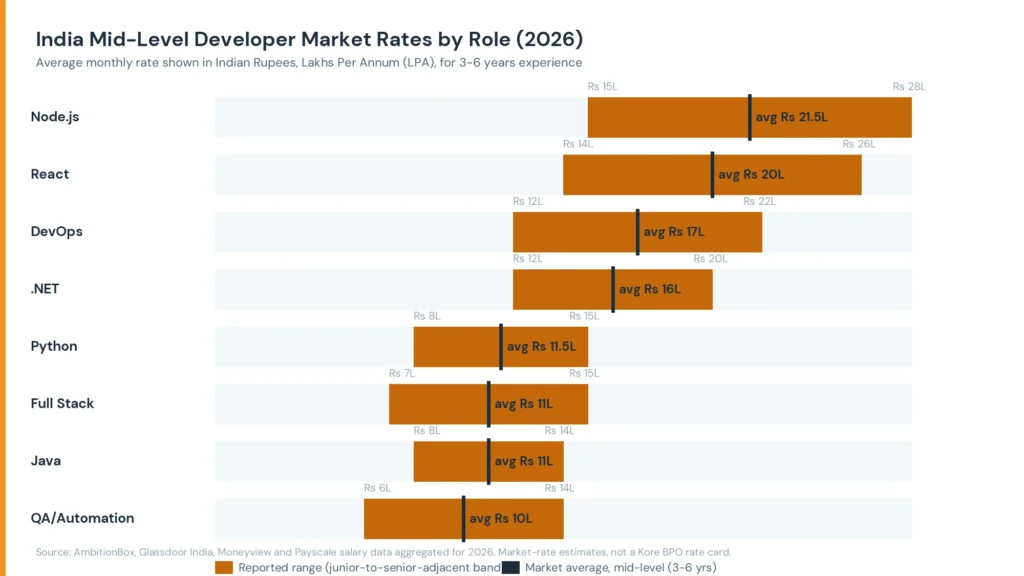
| Role | Junior (0-2 yrs) | Mid-Level (3-6 yrs) | Senior (6-10+ yrs) |
|---|---|---|---|
| Python Developer | Rs 3-5 LPA | Rs 8-15 LPA | Rs 18-30 LPA |
| Java Developer | Rs 3-5 LPA | Rs 8-14 LPA | Rs 16-28 LPA |
| .NET Developer | Rs 4-7 LPA | Rs 12-20 LPA | Rs 22-40 LPA |
| Full Stack Developer | Rs 3-5 LPA | Rs 7-15 LPA | Rs 16-28 LPA |
| React Developer | Rs 6-12 LPA | Rs 14-26 LPA | Rs 28-48 LPA |
| Node.js Developer | Rs 6-12 LPA | Rs 15-28 LPA | Rs 30-52 LPA |
| DevOps Engineer | Rs 5-9 LPA | Rs 12-22 LPA | Rs 38-65 LPA |
| QA / Automation Engineer | Rs 3.6-5 LPA | Rs 6-14 LPA | Rs 16-28 LPA |
LPA = Lakhs Per Annum (Rs 100,000/yr). Figures are aggregated 2026 market-rate estimates drawn from Moneyview’s software developer salary data, Glassdoor India, and Payscale. These are market salary ranges, not a Kore BPO rate card.
Junior vs Mid vs Senior Pricing
The jump between bands is the single biggest lever in any India developer staffing budget. A junior developer in year one or two is still building judgment, a mid-level developer with three to six years has usually shipped production code independently across at least one full product cycle, and a senior developer with six to ten-plus years is making architecture calls, not just writing to a spec. Companies that try to hire a senior-caliber developer at junior pricing almost always end up with a junior developer who happens to have a senior-sounding title, and the gap shows up fast once real production incidents start happening.
Blended across all eight roles in the table above, the typical India developer costs roughly Rs 5.85 LPA at junior level, Rs 14.75 LPA at mid-level, and Rs 31.4 LPA at senior level, before any employer statutory contributions are added. Converted to US dollars at the current exchange rate of roughly Rs 95 to $1, per Trading Economics’ USD/INR data, that is approximately $6,200, $15,500, and $33,100 a year respectively in base market salary.
The Fully-Loaded Cost Picture
The number most budgets miss is the employer’s statutory contribution under India’s Employees’ Provident Fund. Employers contribute 12% of EPF wages on top of the employee’s own 12% contribution, split between the Employees’ Pension Scheme and the EPF account, plus a small additional contribution for insurance and administrative charges that typically brings the total employer-side load to roughly 13% of wages, according to India Briefing’s 2026 EPF Scheme guide. That is not optional and it is not the only employer cost, recruiting, payroll administration, and compliance overhead sit on top of it too, but it is the single largest statutory add-on and the one most first-time buyers forget to budget for.
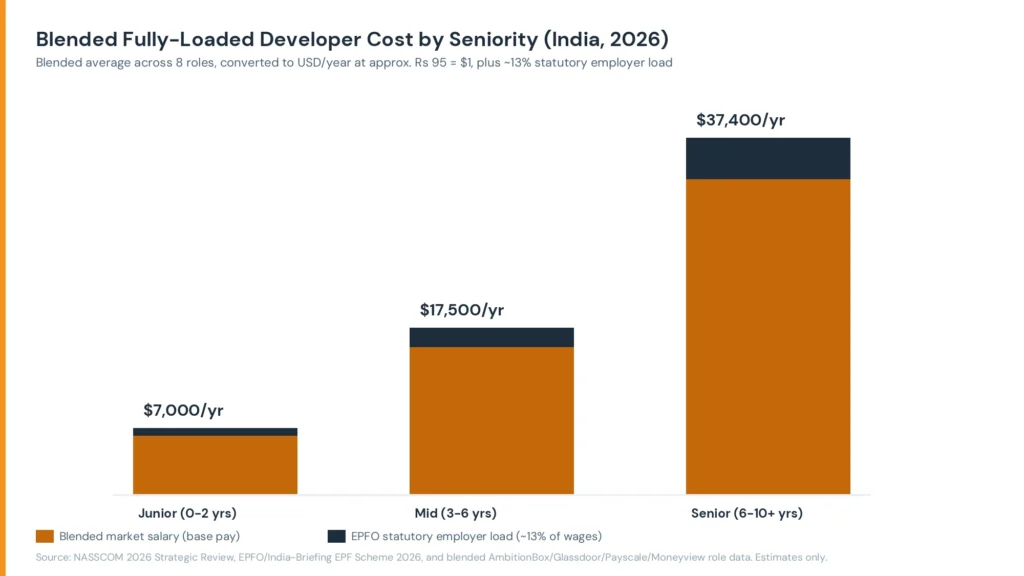
Applying that roughly 13% statutory load to the blended averages above puts fully-loaded cost at approximately $7,000 a year for a junior developer, $17,500 for mid-level, and $37,400 for senior, still well below what the same seniority band costs to build and retain in the US once benefits and overhead are added onshore.
Why the Industry Backdrop Matters
India’s broader IT sector is not shrinking while this pricing holds steady, it is growing into it. NASSCOM’s 2026 Strategic Review projects India’s technology industry will reach $315 billion in revenue for FY26, a 6.1% increase over the prior year, while headcount growth across the industry sits at a much more modest 2.3%, reflecting AI-driven efficiency gains more than a slowdown in demand for skilled developers specifically. That combination, rising industry revenue against slower headcount growth, is part of why rates for in-demand stacks like React and Node.js have climbed faster than for more commoditized backend roles.
India vs Nearshore vs Onshore, the Real Numbers
Side by side, the gap is substantial. A mid-level full stack developer in the US carries a median base salary of $135,980 a year according to the Bureau of Labor Statistics’ Software Developers occupational data, before benefits, payroll taxes, and overhead are added, which typically run another 25-40% on top. A comparable mid-level India developer, fully loaded with statutory contributions, runs roughly $17,500 a year, call it 85-90% lower in direct cost. Even accounting for time zone overlap management and onboarding ramp time that a fully remote offshore hire requires, that gap rarely closes.
This is not an argument that offshore staffing is always the right call for every role or every team. A company that needs a developer sitting in daily stand-ups at 9am Eastern with zero async tolerance may find nearshore Latin American talent, which shares more working-hour overlap with US time zones, a better operational fit even at a higher rate than offshore India staffing. The trends shaping that India-specific build decision, including EPFO changes and the DPDP Act’s data protection requirements, are covered in a companion piece, India IT Outstaffing Trends and Compliance (EPFO, DPDP Act) in 2026.
What Moves the Price Up or Down
Four factors push an otherwise-standard rate meaningfully higher or lower. Stack scarcity. Python and Java talent pools are deep and mature, which keeps rates relatively stable. React, Node.js, and DevOps talent is scarcer relative to demand, and that scarcity shows up directly in the rate card. Domain complexity. A developer who needs to understand healthcare compliance, financial services regulation, or a complex existing codebase costs more than one building a greenfield CRUD application. City. Bangalore and Hyderabad both sit above the national average because that is where the largest concentration of senior talent and MNC-trained engineers lives, while Tier 2 cities can run 10-20% lower for comparable experience. Delivery model. A dedicated full-time hire embedded in your team for twelve months prices differently than a short-term project engagement billed hourly, with dedicated hires generally offering better per-hour economics for anything longer than a few months.
How Kore BPO Prices Offshore Developer Staffing
We staff dedicated, full-time India-based developers matched to your stack and seniority requirement, not a shared contractor pool split across multiple clients. Every engagement starts with a scoping call on the role, stack, and seniority band you actually need, and we return qualified, vetted resumes in 2 to 5 business days. There is no upfront fee, you see candidates before committing to anything. Kore BPO has placed 6,236+ hires for 257+ US companies, with developers based out of our Hyderabad office working on US business hours overlap by design, not as an afterthought. If you’re also weighing Python specifically, a comparison of agencies built just for that search sits in a companion piece, Best Offshore Python Developer Staffing Agencies 2026.

Common Questions
How much does it cost to hire an offshore software developer in India in 2026?+
Market salary alone runs roughly Rs 3-5 LPA for junior developers, Rs 7-28 LPA for mid-level depending on stack, and Rs 16-65 LPA for senior developers. Add India’s statutory EPFO employer contribution of roughly 12-13% of wages for the fully-loaded figure, which converts to approximately $7,000-$37,400 a year across junior-to-senior bands at current exchange rates.
Why do React and Node.js developers cost more than Python or Java developers in India?+
Demand for React and Node.js specialists has consistently outpaced the supply of developers fluent in both, while Python and Java talent pools are larger and more mature. That supply-demand gap shows up directly in the rate, with mid-level Node.js developers commanding roughly Rs 15-28 LPA against Rs 8-15 LPA for a comparable Python developer.
Is India developer staffing still cheaper than hiring onshore in the US in 2026?+
Yes. A mid-level US software developer carries a median base salary of $135,980 a year per the Bureau of Labor Statistics, before benefits and overhead. A comparable fully-loaded India developer runs roughly $17,500 a year, an 85-90% reduction in direct cost, even after accounting for India’s statutory EPFO employer contributions.
Does Kore BPO charge a setup or recruiting fee for developer staffing?+
No. There is no upfront fee. You review qualified candidate resumes in 2 to 5 business days and only commit once you’ve seen real candidates matched to your stack and seniority requirement.

Related Articles



Get Vetted India Developer Resumes, Not a Spreadsheet of Rates
See qualified Python, Java, .NET, React, Node.js, DevOps, and QA candidate resumes matched to your stack in 2 to 5 business days.
Get Matched With a Developer