7 Best Countries to Hire Offshore WordPress Developers in 2026 [Rates + Talent]


Last updated: July 2, 2026
WordPress runs 43.5% of all websites. The developers who build and maintain those sites don’t need to sit in your office, or even your time zone.
Most US companies looking to hire a WordPress developer end up in one of two places: a US-based freelancer at $75 to $150/hr, or a random Upwork hire that looks fine in the proposal and falls apart after the first sprint. Neither is ideal. The smarter path is offshore, but “offshore” isn’t one thing. Philippines isn’t India. India isn’t Ukraine. Picking the wrong country for your project type adds cost and friction that quietly erases the savings you were trying to capture.
Our breakdown of offshore developer cost by country covers rate ranges, seniority tiers, and what pushes rates up or down across regions. This post goes one layer deeper: which of those countries makes sense specifically for WordPress work, what WP skill types each market is strongest for, and what to actually check before you hire.
What Makes a Country Worth Hiring From for WordPress?
Four signals. Just four.
WordPress-specific talent depth. Generic developer population numbers are almost useless here. You want markets with strong PHP communities, active WP developer pools, WooCommerce experience, and ideally some plugin or theme work in their portfolios. The Philippines has a strong WP community driven by BPO and agency work. India has sheer volume. Eastern Europe has depth in back-end and performance work.
Hourly rate for your build type. Senior and junior rates in the same country can be 2x apart. Knowing what tier you actually need before comparing countries saves a lot of confusion. A $20/hr hire for enterprise plugin architecture isn’t a deal. It’s a liability.
English proficiency. For client-facing agency sites and WooCommerce storefronts, this matters more than most buyers admit. For back-end plugin architecture, it matters less than technical quality. Know which you’re hiring for.
Timezone overlap with your team. If you run daily standups, async isn’t good enough. But for spec-it-build-it-review-it workflows, a 10-hour difference can actually work in your favor. They build while you sleep; you review in the morning.
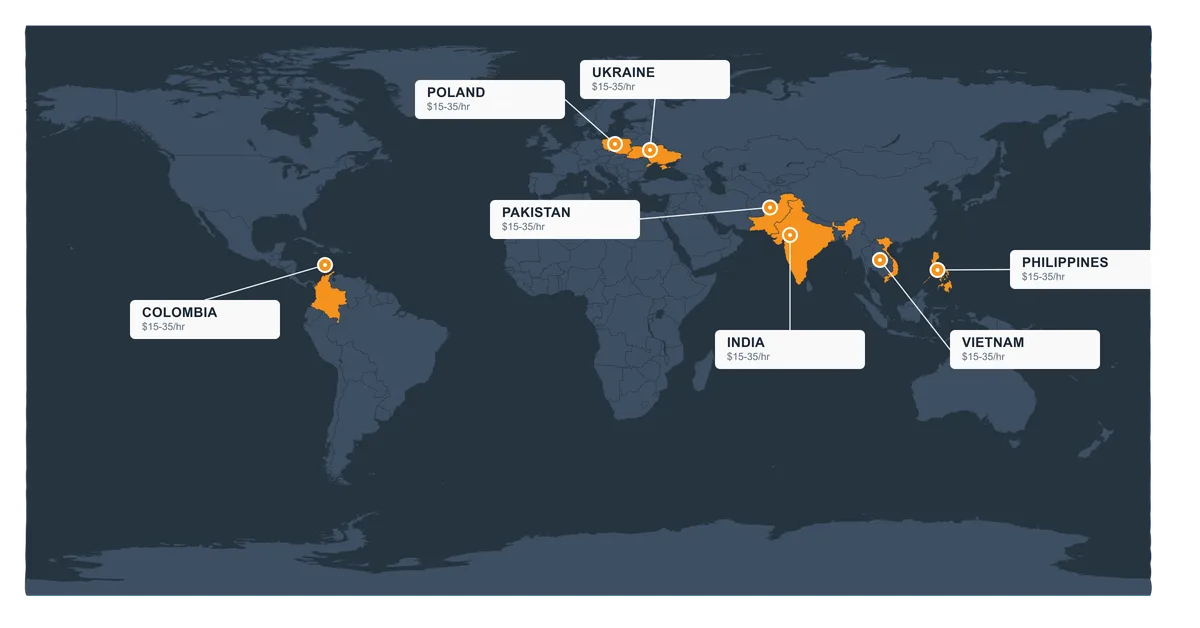
Here’s how the seven strongest markets compare across all four:
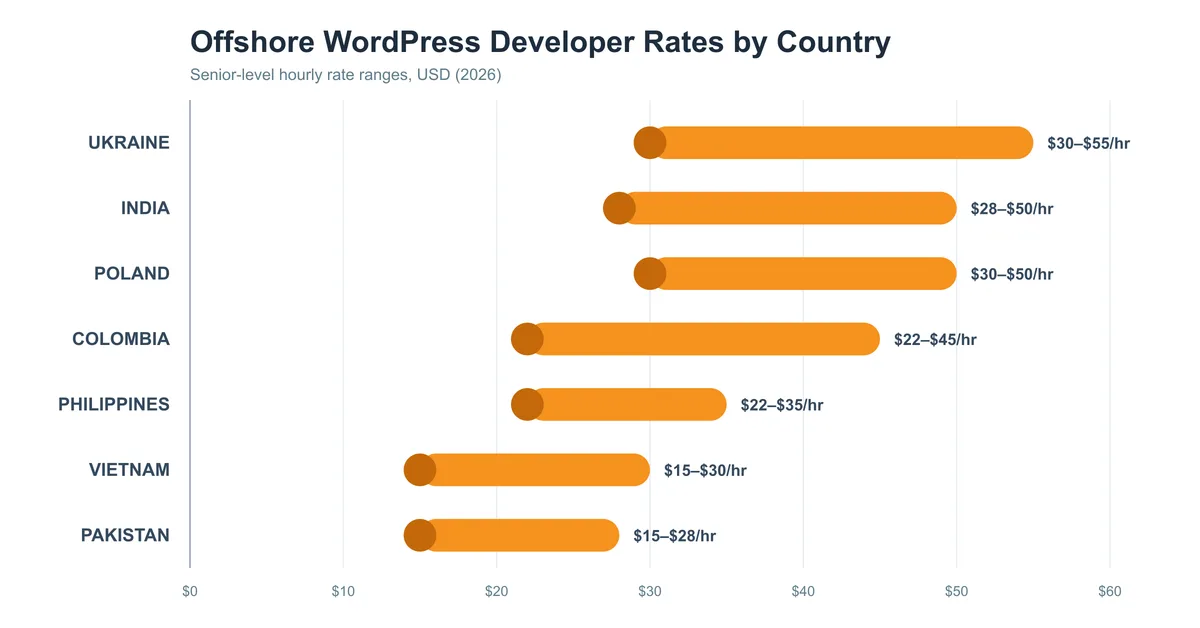
| Country | Rate (Senior WP Dev) | English | US TZ Overlap | Best WP Use Case |
|---|---|---|---|---|
| Philippines | $22–$35/hr | Exceptional | 0–3 hrs (shiftable) | Front-end, WooCommerce, content sites |
| India | $28–$50/hr | Strong | Async (9–12 hrs) | Custom plugins, back-end, volume hiring |
| Ukraine | $30–$55/hr | Strong | Partial (7–9 hrs ahead) | Enterprise builds, performance, security |
| Poland | $30–$50/hr | Very Strong (EF #12) | Partial (6–8 hrs ahead) | GDPR-compliant, EU-market sites |
| Colombia | $22–$45/hr | Growing | Same as ET | Agile teams, real-time US collaboration |
| Vietnam | $15–$30/hr | Intermediate | Async (11–12 hrs) | Front-end theming, lightweight sites |
| Pakistan | $15–$28/hr | Good | Async (10–11 hrs) | PHP-heavy WP builds, WooCommerce extensions |
The 7 Best Countries to Hire Offshore WordPress Developers
1. Philippines: Best for US-Facing Sites and WooCommerce Stores
Rates: $15–$35/hr | English: Exceptional | US Timezone Overlap: 0–3 hrs (many developers shift to US hours)
The Philippines is the obvious starting point for US businesses that need front-end WordPress work, WooCommerce storefronts, or anything where client-facing communication matters. English proficiency is genuinely strong, not just functional. Async handoffs are clean. Scope documents land without the clarification cycle you’d expect from markets where English is a second language.
Filipino developers tend to excel at front-end WordPress development, content site builds, and WooCommerce setups. The talent pool for complex back-end plugin architecture is smaller than India’s, but for the majority of WordPress projects US companies actually need, the Philippines is a strong match. The country’s BPO and web services industry created a deep pipeline of developers trained specifically on US client workflows.
One thing that surprises people: timezone isn’t the problem it looks like on paper. Many Manila developers work US business hours by choice. You can find morning-shift teams with 4 to 8 hours of overlap without paying extra for it. Browse available offshore WordPress developer roles to see what current profiles look like from this market.
2. India: Best for Complex Plugin Development and Volume Hiring
Rates: $18–$50/hr | English: Strong | US Timezone Overlap: Primarily async (9–12 hrs behind)
India has the largest WordPress talent pool on the planet. Full stop. According to the Stack Overflow 2025 Developer Survey, India has 5.8 million developers overall, and WordPress and PHP consistently rank among the most in-demand stacks in that market. If you need a niche skill, a WooCommerce developer who’s also built custom Elementor widgets, or a multi-site architect with REST API experience, India is where you’ll find the deepest bench.
Rate variance is wide. A $20/hr India developer and a $40/hr India developer aren’t just different in experience. They can be genuinely different in output quality. The mid-tier range ($28–$40/hr) tends to deliver the best value: enough experience to work independently, still cost-effective against US rates. Vetting matters here more than in most markets.
The timezone is async by default. 9 to 12 hours behind US East means real-time collaboration requires planning. For spec-driven workflows, India is hard to beat on depth and cost. For daily standups and same-day revision cycles, you’ll need to structure the engagement differently or look at LATAM options.
3. Ukraine: Best for Enterprise Builds and Performance-Critical Platforms
Rates: $25–$55/hr | English: Strong | US Timezone Overlap: Partial (7–9 hrs ahead of US East)
Ukrainian WordPress developers sit at a different price-to-quality point. You’re paying more than India or the Philippines, and getting cleaner code, stronger security practices, and deeper familiarity with performance optimization. The developer culture is closer to Western European standards than Southeast Asian markets, and it shows in code review.
Worth acknowledging directly: a significant portion of Ukraine’s tech workforce relocated to Poland, Germany, and Portugal following 2022. This hasn’t meaningfully reduced output. The talent is still accessible and billing normally through their established agencies and contractor arrangements. If you’re vetting a Ukrainian developer, ask where they’re currently based and how their workflow has been structured over the last two years. That conversation tells you a lot.
For enterprise WordPress builds, headless WP architectures, custom plugin suites, or WooCommerce with complex inventory and fulfillment logic, Ukraine remains one of the strongest markets in this list.
4. Poland: Best for EU-Compliant and GDPR-Sensitive Projects
Rates: $27–$50/hr | English: EF Rank 12 globally | US Timezone Overlap: Partial (6–8 hrs ahead of US East)
Poland has arguably the most technically rigorous developer culture in Eastern Europe. EF ranks Poland 12th globally for English proficiency, which puts it well above most offshore markets. Code quality is consistently high. EU timezone overlap means US East coast teams can get 2 to 3 hours of real-time sync in the morning without anyone working unusual hours.
For companies building WordPress sites that need GDPR compliance, serve EU markets, or require a developer who understands European data handling standards without an extensive briefing, Polish developers bring both technical skill and regulatory familiarity. That’s a real time-saver on scoped projects.
The trade-off is cost. Poland’s rates are approaching Western European levels in some segments, and the premium over India or Vietnam can be hard to justify for simpler front-end work. Reserve Polish hires for projects where code quality and regulatory fit are the binding constraints.
5. Colombia: Best for Real-Time US Collaboration (Nearshore)
Rates: $20–$45/hr | English: Growing | US Timezone Overlap: Same as ET or ET minus one hour
Colombia’s biggest selling point isn’t the rate or the talent depth. It’s the timezone. Bogotá and Medellín run on ET or ET minus one, which means real-time standups, same-day code reviews, and genuine synchronous collaboration with US product teams. Improving.com’s 2026 nearshore analysis is clear on this: when engineering and product teams share business hours, iteration cycles measurably speed up.
Colombian WordPress talent is solid for front-end work, theme development, and WooCommerce builds. The ecosystem is still maturing compared to India or Ukraine. But for US-centric operations teams that run daily Agile sprints or have clients who expect same-day responsiveness, timezone alignment is worth paying for. Colombia often gets underrated in these comparisons because people focus on the smaller talent pool and miss the real-time collaboration advantage.
6. Vietnam: Best for Budget Builds and Front-End Theming
Rates: $12–$30/hr | English: Intermediate | US Timezone Overlap: Async (11–12 hrs ahead)
Vietnam offers the lowest rates in this list without sacrificing front-end competence. For lightweight content sites, static marketing pages, or simple WooCommerce setups with standard themes, Vietnamese WordPress developers can deliver clean, usable work at rates that would make most US freelancers uncomfortable.
Where it gets thin is advanced back-end work. Custom plugin architecture, complex REST API integrations, and WooCommerce with custom logic require detailed spec sheets and usually more revision cycles than you’d see from India or Ukraine. English proficiency is functional but not fluent at most tiers, so async handoffs need clear written specs. The timezone is also fully async from the US, which limits real-time troubleshooting.
Vietnam is the right call when budget is the binding constraint and the work scope is well-defined front-end or simple WooCommerce.
7. Pakistan: Best for PHP-Heavy Builds on a Lean Budget
Rates: $12–$28/hr | English: Good | US Timezone Overlap: Async (10–11 hrs ahead)
Pakistan has built a strong WordPress developer community, particularly in Lahore and Karachi. The PHP depth is real: not just theme configuration, but actual custom post type development, hook and filter architecture, WooCommerce extensions, and REST API integrations. The country consistently ranks highly on Upwork and Freelancer for PHP and WordPress work volume.
Quality ranges widely at the lower tiers. That’s true anywhere, but the gap between a strong Pakistani WordPress developer and a weak one is wider than in more mature markets. The mid-level range ($18–$25/hr) is where genuine value exists. A test project before any longer commitment isn’t just recommended. It’s non-negotiable.
Need Pre-Vetted WordPress Developers?
Kore BPO screens WordPress developers from these seven markets. Resumes in 2 to 5 days. $0 until you hire.
How to Match Your Project Type to the Right Country
The rate isn’t the decision. The work type is. Pick the country based on what your WordPress project actually needs, then filter by rate.
| If your project needs… | Best Market | Rate Range | Why It Fits |
|---|---|---|---|
| Content site or marketing page | Philippines | $15–$30/hr | English quality + front-end depth + US timezone |
| WooCommerce store (standard) | Philippines or India | $18–$35/hr | Both markets have strong WC depth; Philippines for client comms |
| WooCommerce with complex logic | India | $28–$45/hr | Back-end depth for custom payment, inventory, fulfilment flows |
| Custom plugin architecture | India | $30–$50/hr | Deepest PHP/WP back-end talent pool globally |
| Enterprise or headless WordPress | Ukraine | $35–$55/hr | Code quality, security practices, performance focus |
| GDPR or EU-market site | Poland | $30–$50/hr | EU regulatory familiarity without extensive briefing |
| Agile team with daily standups | Colombia | $22–$40/hr | Real-time ET timezone, same-day review cycles |
| Budget front-end or lightweight site | Vietnam or Pakistan | $12–$28/hr | Lowest rates; solid for well-scoped, simpler builds |
A client came to us needing a WooCommerce developer who could also handle REST API integration for a custom inventory system. We placed from India, not the Philippines, because back-end depth was the deciding factor. The offshore software engineer skill set in that role mattered more than timezone or English rating. Work type first. Country second. Rate third.
What the Rate Ranges Don’t Tell You
Here’s the number most offshore rate guides skip: management overhead, QA rework, and async communication drag typically add 30 to 45% on top of the stated base rate, according to Qubit Labs’ 2026 rate analysis. That $20/hr invoice can cost you $28/hr in real terms once revision cycles and check-ins are factored in.
A $20/hr developer who needs 4 hours of rework for every 8 hours of output isn’t cheaper than a $30/hr developer who ships clean code the first time. That math is obvious on paper. It only works in your favor if you’ve vetted for quality, not just cost.
We see this regularly at Kore BPO with clients who’ve tried marketplace platforms first. The invoice looked reasonable. The actual cost, once you count senior engineering time spent reviewing and correcting output, often wasn’t. rtCamp’s offshore cost analysis puts the savings potential at 50 to 65% for well-managed offshore WordPress teams, but “well-managed” is doing a lot of work in that sentence.
Bias disclosed: we benefit when you use a staffing partner instead of a marketplace. That said, the numbers back it up. A vetted developer with a clean async handoff process almost always costs less in total than a marketplace hire who needs constant supervision. The 10 to 20% rate premium for pre-screened developers tends to pay for itself in the first month.

5 Things to Check Before You Hire an Offshore WordPress Developer
Generic “web developer” portfolios aren’t enough. Here’s what actually tells you something useful:
- WordPress-specific portfolio, not just web projects. Look for theme builds, custom plugins, or WooCommerce stores in their work history, not just “websites.” A React developer who moonlights in WP is a different hire from a developer who’s done WordPress exclusively for five years. The difference surfaces fast on any back-end task.
- GitHub activity or plugin repository contributions. Not everyone has public code. For mid-to-senior hires, repo activity is a useful signal. Closed-source client work with sample code available on request is acceptable. No code at all is a flag worth investigating before you proceed.
- Run a test project first. $150 to $300 for a focused task (a custom shortcode, a performance audit, a WooCommerce hook) tells you more than three interviews. What does their code look like? How many clarifying questions did they ask upfront? How did they handle the brief? Most good offshore developers expect this and don’t push back on it.
- Async handoff quality. Send a scope document. Ask for a written response before they start. The quality of that response predicts communication quality throughout the engagement. Developers who send back vague “understood, will start Monday” replies are not the same as those who flag three ambiguities and ask for clarification before touching a line of code.
- Staging workflow. Ask directly: do you push to a staging environment before production? The answer tells you immediately whether this is someone who understands client risk. Any competent offshore WordPress developer working across active offshore developer roles knows version control and staging aren’t optional.
What Buyers Want to Know Before Hiring
Which country has the largest WordPress talent pool?
India, by a significant margin. The Stack Overflow 2025 Developer Survey puts India’s developer population at 5.8 million overall, and WordPress and PHP consistently rank among the most in-demand stacks in that market. The Philippines ranks second for WordPress specifically, driven by the country’s BPO and web services industry creating a deep pipeline of WP-trained developers over the last 15 years. Eastern European markets have smaller pools but higher average seniority, which matters for certain project types.
How much cheaper is an offshore WordPress developer compared to a US freelancer?
$60,000 to $80,000 cheaper per year, on average. A mid-level US WordPress developer runs $85,000 to $110,000 annually as a salaried employee, or $75 to $120/hr as a freelancer. Mid-level offshore rates range from $22 to $40/hr depending on country and seniority. That’s a 40 to 70% reduction. The savings are real. They’re also not effortless. Some management overhead comes with any offshore hire, which is why vetted placements through a staffing partner tend to outperform raw marketplace rates when total cost is measured.
Real-time availability from an offshore WordPress developer ??? is that actually possible?
Yes, if you pick the right market. Colombia and Mexico are ET-aligned by default. The Philippines is async by default, but many developers voluntarily shift to US business hours, and finding morning-shift Manila teams with 4 to 8 hours of US overlap isn’t difficult. Ukraine and Poland offer 2 to 4 hours of US East morning overlap. If daily standups are important to how your team works, lead with Colombia or the Philippines when you’re evaluating countries.
What’s the minimum engagement to start with an offshore WordPress developer?
Most reputable staffing partners structure minimums around 20 hours/week or full-time. Marketplace hourly arrangements exist but come with higher churn and less accountability. Regardless of the engagement structure, a small test project before committing to a longer contract is worth every dollar. $150 to $300 for a targeted task tells you more about a developer’s real work output than any screening call.
Philippines vs. India for WordPress: does the gap actually matter for most projects?
Short answer: depends what you’re building. For front-end work and standard WooCommerce, the gap is minimal and the Philippines has a communication edge most US buyers prefer. For custom plugin development, complex back-end logic, or high-volume WordPress builds where you’re hiring multiple developers, India’s talent depth becomes a real advantage. Wrong question, slightly: instead of Philippines vs. India, ask what the primary skill type is. That answer tells you the country. Not the other way around.
The Philippines gives you English quality and timezone flexibility for US content and WooCommerce projects. India gives you back-end depth and volume hiring capacity for complex builds. Ukraine and Poland give you enterprise-grade quality when code itself is the highest-priority deliverable. Colombia closes the timezone gap for teams that can’t work async. Vietnam and Pakistan offer the lowest rates for projects where budget is the binding constraint and scope is well-defined.
Pick by project type first. Rate second. If you’re mapping out an offshore WordPress developer hire, view available offshore developer profiles or reach out to our team to see pre-vetted developers from the markets that match your build requirements.
Related Articles



Looking for Pre-Vetted WordPress Developers?
Kore BPO matches US companies with screened offshore WordPress developers from the Philippines, India, and Eastern Europe. Resumes in 2 to 5 days.
Contact Us