

- CCSS employer contribution rose to roughly 26.83% of gross payroll starting January 2026
- Severance (cesantía) is mandatory for no-cause terminations after 3 months, scaled by tenure and capped near 8 years of pay
- Free trade zone registration under PROCOMER gives qualifying BPO operators an 8-year full income tax exemption
- See the full customer service and back office outsourcing in Costa Rica overview for the bigger picture.
What’s Actually Changing in Costa Rica’s Call Center Market for 2026
Costa Rica’s BPO and ITES sector employs roughly 95,000 people directly, with 196,000-plus jobs tied to the broader multinational services sector, according to workforce figures from CINDE, the country’s investment promotion agency. Services exports ran about $3.9 billion in 2024, and BPO and shared services accounted for roughly $2.4 billion of that total.
Costa Rica’s call center market isn’t competing on price the way it did two decades ago. The country built its early reputation on cost savings over US-based support. But the accounts moving to Costa Rica in 2026 look different. Multi-step technical troubleshooting. Bilingual escalations that need judgment, not a script. Back-office finance and HR work where a mistake costs more than the labor arbitrage saved. A client who just wants a seat filled at the lowest possible rate is often better served elsewhere, and Costa Rica’s actual advantage in 2026 shows up in retention and the kind of agent who can handle a judgment call without hand-holding.
See the full customer service and back office outsourcing in Costa Rica guide for the complete picture on service lines, pricing, and vendor selection.
Good fit: companies running US-facing phone, chat, or email support that need native-level English and want a partner that goes beyond purely transactional ticket-closing. Worth a second look: support volume under 500 contacts a month, where smaller offshore or domestic-remote options can carry less overhead.
Payroll Costs: What the CCSS Rate Means for Your Contract
The Caja Costarricense de Seguro Social (CCSS) employer contribution rose to approximately 26.83% of gross salary starting January 2026, up from 26.67% in 2025, according to BDO Costa Rica’s analysis of the rate adjustment. That figure breaks into sickness, maternity, disability, old age, and death coverage (roughly 14.83% of the total), plus family allowance, INA training institute contributions, IMAS social assistance, and Banco Popular contributions. None of it is negotiable. It’s statutory.
Ask vendors directly whether this is already baked into your quoted rate or whether it shows up as a surprise adjustment later. A vendor quoting a flat rate that hasn’t moved since the increase took effect is a vendor who either absorbed the cost or hasn’t updated their math.
Severance and Termination Rules Your Vendor Has to Follow
Costa Rica isn’t at-will employment, and that matters for anyone budgeting a long-term BPO relationship. Cesantía (severance) becomes mandatory after 3 months of continuous service, on a sliding scale by tenure, according to costaricalaborlawyer.com‘s breakdown of Labor Code Article 29: roughly 7 days’ pay for 3 to 6 months of service, 14 days for 6 months to 1 year, and 19.5 days at the 1-year mark, scaling up from there and capping at approximately 8 years of equivalent pay.
Notice requirements run from 1 week for short-tenure employees up to 1 month once someone passes the 1-year mark. High turnover isn’t just a staffing headache for a vendor. It carries real severance cost exposure, which is exactly why a vendor with high attrition eventually either raises your rate or cuts corners somewhere else.
Aguinaldo, Vacation, and the Benefits Baked Into Your Rate
Aguinaldo, the mandatory 13th-month payment, equals 1/12 of an employee’s gross earnings from December 1 through November 30, and it has to land by December 20 with no exceptions, per qcostarica.com‘s coverage of the requirement. The only legal deduction allowed against it is court-ordered child support. Fines for skipping it run up to 23 times the monthly salary owed.
INS workers’ compensation coverage is also mandatory, running roughly 2 to 3% of salary and fully employer-paid, per costaricalaborlawyer.com. Add CCSS, aguinaldo, a severance reserve, and INS together, and a fully loaded rate on a $16/hr nominal wage commonly lands in the $22 to $24/hr range once a vendor accounts for everything the law actually requires.
Data Privacy and Law 8968: What to Ask Before Customer Data Crosses the Border
Law No. 8968, the Protection of the Person Against the Processing of Personal Data, governs how Costa Rican call centers handle customer data, and PRODHAB enforces it. The statute requires informed express consent, grants individuals access, correction, and deletion rights, and imposes registration obligations on companies that manage or distribute databases, per ksandk.com’s privacy law review. Fines run up to 30 base salaries.
In most outsourcing arrangements, the US company stays the data controller and the vendor acts as processor. The contract needs to spell out who’s responsible for breach notification, how long call recordings and transcripts get retained, and how consent gets documented. Kore BPO is a staffing and BPO agency, not a law firm, and nothing here is legal advice. Loop in Costa Rican data privacy counsel before any contract involving customer data crosses the border.
Ask your vendor how they document consent, how long they retain recordings and transcripts, and whether their systems are access-scoped by role rather than wide open to every agent on the floor.
Free Trade Zone Status: Why It Affects Pricing Stability
Under the PROCOMER Free Trade Zone regime, qualifying companies get a 100% income tax exemption for 8 years, then 50% for 4 more years, according to CINDE’s free trade zone guide. Roughly 738 companies operated under this regime as of early 2026, and business support and global business services automatically qualify as a strategic sector with no export quota requirement attached.
A vendor without active FTZ registration carries a heavier cost structure. That difference eventually shows up somewhere, whether in your rate, in agent training investment, or in how fast they scale down when margins get tight. Ask whether your vendor’s actual facility, not just their corporate entity, holds active FTZ status.

AI, Omnichannel, and the Hybrid Agent Model Costa Rica Is Building Now
AI voice agents now handle an estimated 60 to 80% of tier-1 support volume, and agent-assist tools are delivering roughly 30% improvement in average handle time for early adopters, according to Nextiva’s 2026 call center trends report. But the workforce data tells a different story than the automation headlines suggest. A Gartner survey of 163 customer service leaders in early 2025 found 95% plan to retain human agents rather than replace them with AI, and Gartner predicts that by 2027, half of organizations that planned to shrink their service workforce because of AI will abandon those plans.
Forrester’s 2026 outlook frames most of the real AI-for-customer-service work happening this year as unglamorous: building parallel teams to coach, monitor, and unblock the AI rather than replacing headcount outright. That’s the model Costa Rica’s BPO sector is actually building. AI absorbs repetitive tier-1 volume. Trained human agents handle the complex and emotional calls AI still can’t carry, and Costa Rica’s deep bilingual talent pool, the same workforce base behind the export numbers in the opening section, is exactly what makes that hybrid model workable at scale rather than theoretical.
Ask vendors what percentage of volume routes through AI versus live agents, and how the handoff works the moment AI can’t resolve something.

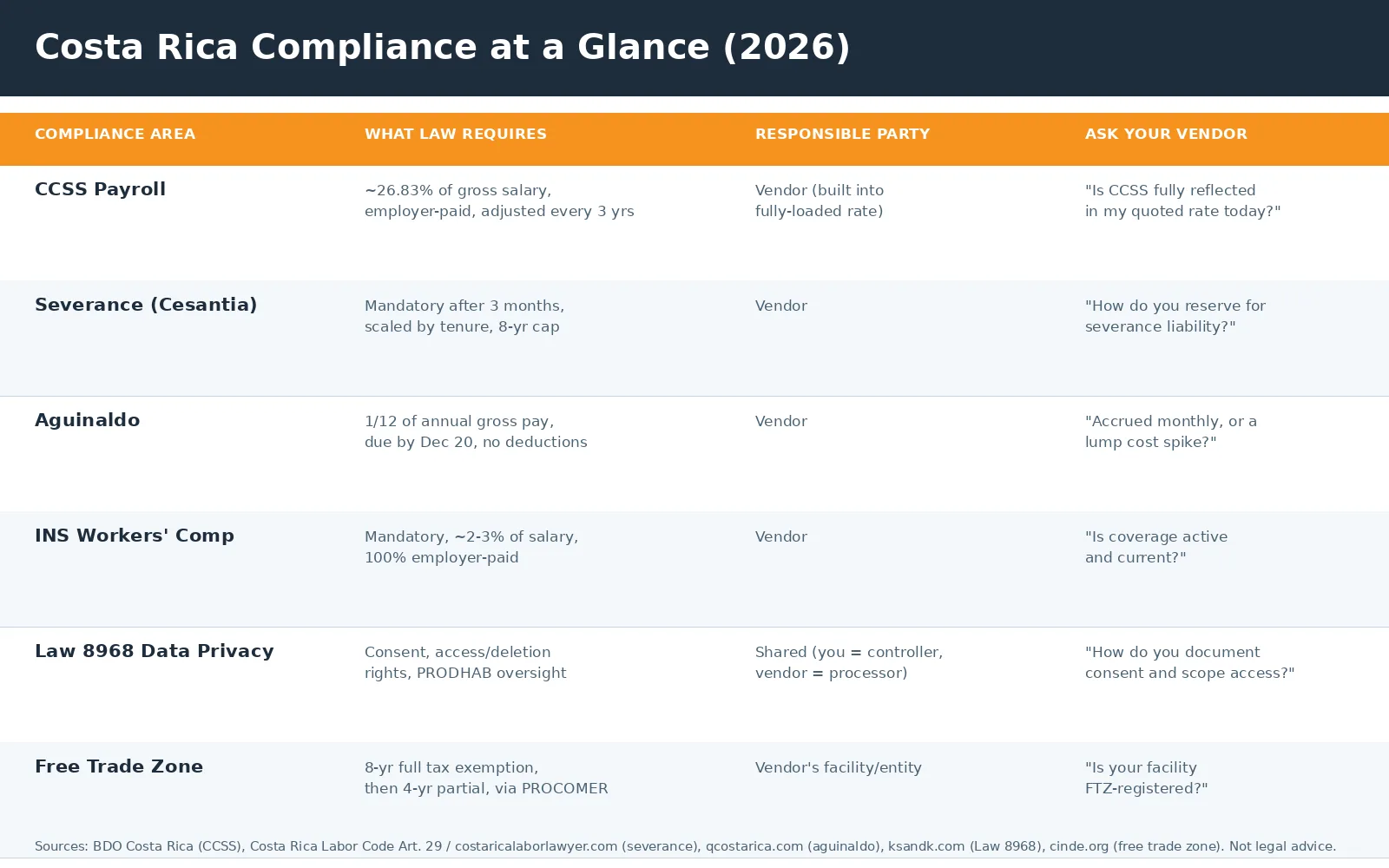
Compliance at a Glance
A quick reference for what each requirement actually means and what to ask when you’re vetting a vendor.
| Compliance area | What Costa Rican law requires | Who’s typically responsible | What to ask your vendor |
|---|---|---|---|
| CCSS payroll contribution | ~26.83% of gross salary, employer-paid, adjusted every 3 years | Vendor (built into fully-loaded rate) | “Is CCSS fully reflected in my quoted rate today?” |
| Severance (cesantía) | Mandatory for no-cause termination after 3 months, scaled by tenure | Vendor | “How do you reserve for severance liability?” |
| Aguinaldo | 1/12 of annual gross pay, due by Dec 20, no deductions | Vendor | “Is this accrued monthly or paid as a lump cost spike?” |
| INS workers’ comp | Mandatory, ~2-3% of salary, 100% employer-paid | Vendor | “Is your coverage active and current?” |
| Law 8968 data privacy | Consent, access/deletion rights, PRODHAB oversight | Shared (you as controller, vendor as processor) | “How do you document consent and scope data access?” |
| Free trade zone status | 8-year full tax exemption, then 4-year partial, via PROCOMER | Vendor’s facility/entity | “Is your facility FTZ-registered, and for how long?” |
Costa Rica isn’t getting cheaper in 2026. It’s getting more regulated and more AI-augmented at the same time, and both of those shifts raise the bar for what “vetted” actually means. Kore BPO staffs US-facing customer service and admin support out of San Jose, Costa Rica, built on this compliance baseline from day one. We’re not a law firm and this isn’t legal counsel. See the full customer service and back office outsourcing in Costa Rica guide, or call 214-347-8509 or email sales@korebpo.com to talk through your specific setup.
Common Questions
Is the 26.83% CCSS rate the full cost of hiring, or just one piece?+
Just one piece. CCSS is the largest statutory line item, but a real fully-loaded rate also includes aguinaldo, a severance reserve, vacation accrual, and INS workers’ comp.
Does my US company need to register with PRODHAB under Law 8968?+
Generally no, not directly, if your vendor processes the data under contract as the processor rather than the controller. Get the actual data processing agreement reviewed by Costa Rican data law counsel before you sign anything.
What happens if my vendor’s facility isn’t FTZ-registered?+
It’s not illegal. But it means a higher underlying cost structure, and that tends to surface eventually in your rate, in training investment, or in retention when the vendor scales back to protect margin.
How fast does severance have to be paid after termination?+
Within a few business days in most cases. Costa Rican labor authorities don’t give employers much room to delay a final settlement once termination is final.
Is AI actually replacing call center agents in Costa Rica right now?+
No. AI is absorbing tier-1 repetitive volume, not replacing trained agents. Gartner’s 2025 survey found 95% of customer service leaders plan to keep their human teams in place.
Can a US company get sued under Costa Rican labor law directly?+
Typically no. The legal employer of record, meaning the vendor, carries the direct labor law exposure. Risk to the US company is usually indirect, inherited through the contract or through reputational fallout, not direct legal exposure.
What’s a realistic timeline to get a Costa Rica call center team staffed and compliant?+
2 to 5 business days to see resumes with an established partner. Full onboarding into a compliant, trained team runs 3 to 6 weeks depending on headcount and role complexity.

Related Articles



Hire a Compliant Costa Rica Call Center Team
See qualified resumes for compliance-vetted Costa Rica customer service and back office talent in 2 to 5 business days.
Get Matched With a Specialist