Dominican Republic Staffing Agency vs Traditional Staffing, What Actually Changes


- 01What a Traditional Staffing Agency Actually Bills You
- 02Why Dominican Republic Specifically
- 03The Real Cost Breakdown, Fully Loaded
- 04The Free Zone Compliance Layer Nobody Mentions
- 05Real-Time Overlap vs Other Nearshore Options
- 06When a Traditional Agency Still Wins
- 07The Dedicated Dominican Republic Team Model
- 08What Hiring Managers Actually Ask
A Dominican Republic staffing agency swaps a US agency’s percentage-based markup for a flat monthly rate, draws on a bilingual workforce that runs Atlantic Standard Time (matching US Eastern for most of the year), and taps a customer experience and back-office sector that Free Trade Zone Law 8-90 has been building since 1990.
A traditional staffing agency invoice rarely spells out its own math. The markup sits baked into the bill rate, and most hiring managers only notice it once they compare what the worker actually takes home against what left the company’s account. That gap is the entire traditional staffing business model, and it compounds every time a contract renews or a salary gets a raise. A Dominican Republic staffing model runs the numbers differently from the start, trading that markup for a flat rate and pairing it with a customer experience and back-office workforce that’s been operating inside a formal Free Trade Zone framework for over three decades.
That doesn’t make traditional agencies obsolete. A handful of hiring situations still call for exactly what they’re built to do. But if you’re weighing a Dominican Republic-based hiring model against a traditional US staffing agency for anything beyond a short-term gap, the cost structure, the compliance layer, and the actual overlap in your workday all point somewhere the sales call tends to gloss over. Here’s what changes, where the old model still wins, and what to ask before you sign anything.
What a Traditional Staffing Agency Actually Bills You
Traditional staffing agencies typically charge 15% to 30% of a direct hire’s first-year salary as a placement fee, and mark up temporary or contract workers 30% to 75% over their actual pay rate, according to Upwork.
Put a real number against it. A US-based bilingual customer support role costing a company $48,000 a year on the books can land on a direct-hire invoice with a $7,200 to $14,400 placement fee layered on top, before that person answers a single call. Route the same role through a temp or contract arrangement instead, and the markup compounds every pay period rather than landing once. Neither structure is hidden exactly. It’s just rarely the number a sales rep leads with.
Speed doesn’t automatically improve the math either. The median time to fill a non-executive role in the US sits at 39 calendar days, according to SHRM’s 2026 recruiting benchmarking research, and that clock doesn’t reset just because an agency is running the search. A staffing partner can compress the sourcing step, but the underlying labor cost, and the fee stacked on top of it, both stay exactly where they started.
Why Dominican Republic Specifically
The Dominican Republic’s Free Trade Zone framework, established under Law 8-90 in 1990, grants qualifying companies a 0% corporate tax rate and duty-free access to the US market under CAFTA-DR, and it’s had 35 years to mature into a real operating environment rather than a tax gimmick, according to P&H Law. Free zones across the country now support over 850 companies across more than 90 industrial parks, generating $8.6 billion in exports and roughly 195,000 direct jobs, according to Esco Global Strategies.
Lumping every Latin America option into one “nearshore” bucket misses what actually separates them. The Dominican Republic’s edge isn’t a giant software engineering bench the way Mexico’s or Brazil’s is. It’s a customer experience, sales support, and back-office sector that’s had three and a half decades to professionalize inside a formal regulatory structure, plus a proximity advantage none of the mainland options can match.
Start with the clock. Santo Domingo sits on Atlantic Standard Time, a fixed UTC-4 offset with no seasonal clock change, which lines up with US Eastern Daylight Time almost exactly for most of the year and sits only an hour off US Eastern Standard Time in winter, according to timeanddate.com. Then there’s the flight. A nonstop from Santo Domingo to Miami runs about 2 hours and 27 minutes, with six direct flights a day, according to FlightsFrom.com, shorter than the flight time from almost anywhere else in Kore BPO’s Latin America footprint.
English proficiency is the third piece, and it’s a real, measured edge rather than a marketing claim. The Dominican Republic ranks 63rd globally with a score of 503 in the 2025 EF English Proficiency Index, ahead of Colombia (76th) and well ahead of Mexico (103rd), which matters directly for any customer-facing role where accent-neutral, fluent English is the job requirement, not a bonus skill.
| What Changes | Traditional Staffing Agency | Dominican Republic Staffing Model |
|---|---|---|
| Core strength | Domestic-only pool | 35-year mature CX and back-office sector under Law 8-90 |
| English proficiency rank | Not applicable | 63rd globally, EF EPI 2025, ahead of Mexico and Colombia |
| Flight time to US | Not applicable | SDQ to Miami, 2h27m nonstop, 6 flights daily |
See What a Dominican Republic Team Would Cost You
Kore BPO builds dedicated Dominican Republic and Latin America staffing teams for US companies. Pre-screened resumes in 2 to 5 days. $0 until you hire.
The Real Cost Breakdown, Fully Loaded
Traditional staffing markup adds 15% to 30% on a direct hire, or 30% to 75% on a temp or contract placement, while labor costs in the Dominican Republic run 40% to 60% below US levels once the role is fully loaded, according to Esco Global Strategies.
 Traditional Agency$62K–$84K/yr
DR Staffing Model$19K–$29K/yr
Traditional Agency$62K–$84K/yr
DR Staffing Model$19K–$29K/yr
Fully loaded annual cost, traditional US staffing agency vs Dominican Republic staffing model, bilingual CX or support role.
The Dominican Republic side of that number carries its own real employer cost, not a free pass. Employers contribute roughly 19.69% of payroll to the TSS social security system, covering pensions, health insurance, and disability, plus another 1% toward INFOTEP, the country’s vocational training program, according to Esco Global Strategies’ TSS guide. Free zone minimum wage rose to RD$20,875 a month, roughly $360 USD, effective June 2026, according to Ulises Cabrera, and real bilingual CX and support pay runs above that floor, not at it. Applied against the same $48,000 base salary used above, a 40% to 60% reduction, the figure Esco Global Strategies cites for Dominican Republic labor costs against US levels, lands the fully loaded DR side around $19,200 to $28,800 a year, TSS and INFOTEP included.
| Cost Component | Traditional US Staffing Agency | Dominican Republic Staffing Model |
|---|---|---|
| Base annual cost, bilingual CX or support role | $45,000 to $52,000 | $48,000 base, 40% to 60% below US levels fully loaded |
| Agency markup or model fee | 15% to 30% direct hire, 30% to 75% temp/contract | Flat, all-in monthly rate |
| Employer payroll load (TSS + INFOTEP) | Not applicable | ~19.69% + 1%, built into the rate |
| Conversion fee to bring on permanently | Often 10% to 20% of first-year salary | Not applicable in most dedicated-team models |
The gap that matters isn’t the first invoice. It’s the second and third year, when a traditional agency’s percentage-based fee climbs alongside every raise the worker earns, and a flat Dominican Republic staffing rate simply doesn’t move the same way.
The Free Zone Compliance Layer Nobody Mentions
Free Trade Zone status under Law 8-90 exempts qualifying companies from corporate income tax and import duties, but it does not exempt anyone from the Dominican labor code. Employment obligations, social security contributions, and wage law apply inside a free zone exactly as they do outside one, according to P&H Law. A tax-advantaged operating structure isn’t a labor-law shortcut, and a staffing arrangement that treats it as one is setting a client up for a problem later, not now.
That distinction matters most in how the staffing relationship itself gets structured. A legitimate Dominican Republic staffing arrangement runs through a formally registered employer, one that pays into TSS and INFOTEP on the worker’s behalf and carries the labor-law compliance obligation directly, rather than routing the relationship through an informal contractor arrangement that looks convenient right up until a labor dispute forces the question of who the real employer is.
A staffing arrangement that skips formal registration and TSS enrollment to save a few points of margin usually leaves the compliance exposure sitting with the US company, not the vendor who structured it that way. A dedicated Dominican Republic staffing partner that registers as the employer of record keeps that obligation off your books entirely.
 Law 8-90 RegistrationFree Zone Status
TSS Enrollment~19.69% Employer Load
INFOTEP Contribution1% of Payroll
Ministry of LaborFormal Employer Registration
Law 8-90 RegistrationFree Zone Status
TSS Enrollment~19.69% Employer Load
INFOTEP Contribution1% of Payroll
Ministry of LaborFormal Employer Registration
The four compliance layers a legitimate Dominican Republic staffing arrangement has to clear.
None of this is unique to the Dominican Republic. Every cross-border staffing arrangement carries a version of this same question, who’s actually the employer on paper, and it’s cheaper to answer before a contract starts than after a dispute forces it.
Real-Time Overlap vs Other Nearshore Options
Every option inside Kore BPO’s Latin America footprint sits close enough to the US workday to support live collaboration, but the Dominican Republic’s fixed, no-DST Atlantic Standard Time offset and short flight distance set it apart from the mainland options in a way raw timezone math alone doesn’t fully capture.
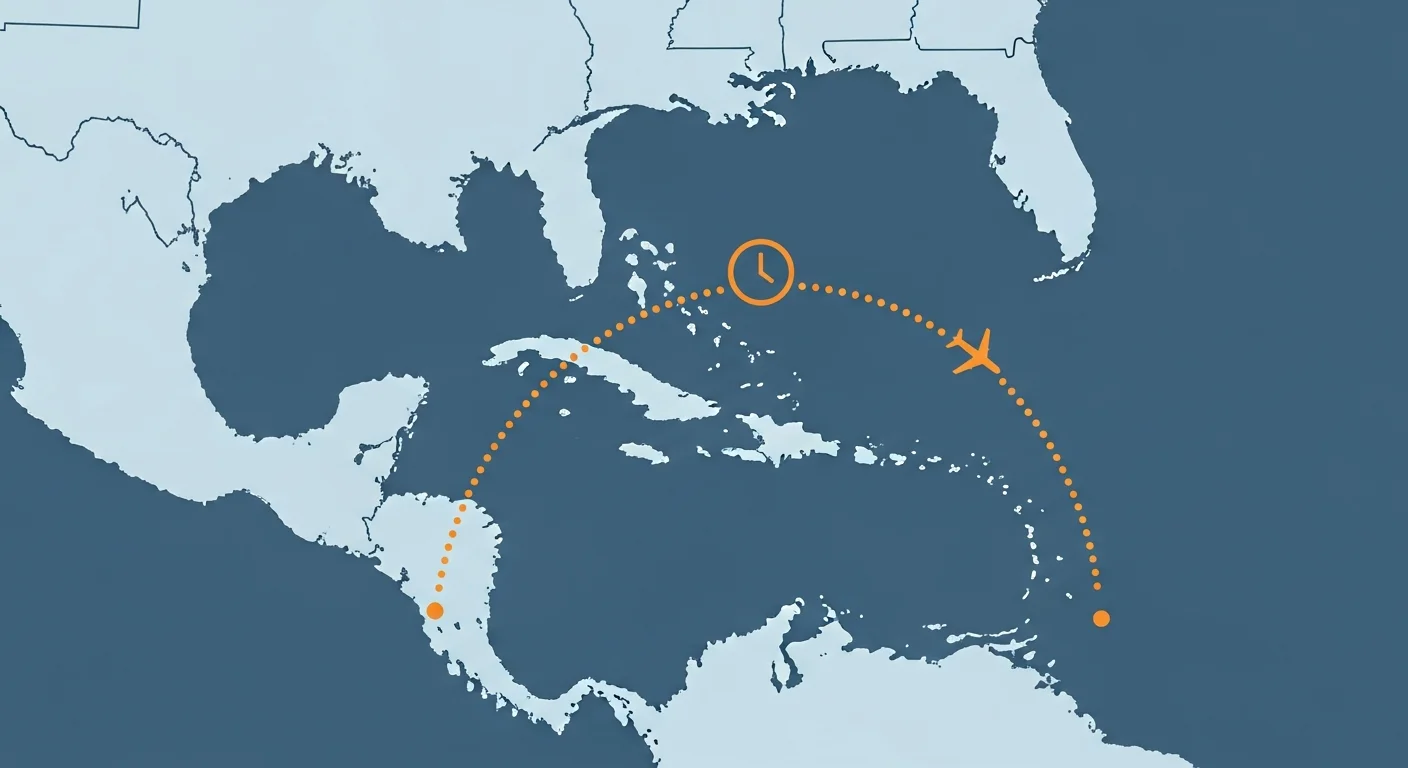 Dominican Republic2h27m to Miami, AST year-round
Mexico6–8 hrs overlap
Colombia7–8 hrs overlap
Costa Rica6–7 hrs overlap
Dominican Republic2h27m to Miami, AST year-round
Mexico6–8 hrs overlap
Colombia7–8 hrs overlap
Costa Rica6–7 hrs overlap
Timezone offset and flight proximity, Dominican Republic vs four other Latin America hiring markets.
| Country | Typical Offset from US Eastern | Real-Time Overlap |
|---|---|---|
| Dominican Republic | 0 to 1 hour | 7 to 8 hours, no daylight saving shift since 1974 |
| Mexico | 0 to 2 hours | 6 to 8 hours, spans all 4 US time zones |
| Colombia | 0 to 1 hour | 7 to 8 hours |
| Costa Rica | 1 to 2 hours | 6 to 7 hours, no daylight saving shift |
| Brazil | 1 to 2 hours | 7 to 8 hours, no daylight saving shift since 2019 |
Colombia posts a similar timezone offset on paper, but the Dominican Republic pulls ahead on two things a spreadsheet undersells: the shortest nonstop flight time to the US mainland of any option in this table, and a customer-facing English fluency rank that beats every mainland Latin America market Kore BPO covers. For a support queue that needs to sound native to a US caller, or a compliance team that wants to be on a plane same-day if something needs eyes on the ground, that combination is hard to replicate elsewhere in the region.
Where the Dominican Republic doesn’t lead is raw software engineering depth. Mexico and Brazil carry larger developer benches, and a company building a dedicated engineering team should start with the Mexico staffing agency or Brazil staffing agency pages instead. The Dominican Republic’s strongest fit is customer experience, sales support, back-office, and operations roles, not a software team.
When a Traditional Agency Still Wins
A traditional staffing agency still makes sense for a single urgent hire you need in a seat within a week or two, a highly specialized domestic skill set with no meaningful equivalent pool abroad, or a genuine short-term gap under 90 days where setup time outweighs any savings.
- You need someone in a chair within days, not through even a compressed nearshore onboarding cycle.
- The role requires a niche domestic certification, license, or clearance that narrows the pool to a handful of people.
- It’s a real 60 to 90 day bridge, not a temp role quietly on track to become permanent.
- In-person, on-site presence is a hard requirement of the job itself.
- You’re building an ongoing CX, sales support, or back-office function, not filling a one-off seat.
- Fluent, accent-neutral English on customer-facing calls is a real requirement, not a nice-to-have.
- Compliance and payroll obligations need to sit with the staffing partner, not on your own books.
- Cost per seat is a genuine constraint on how many people you can field this year.
If you’re hiring once, for one role, this year, the overhead of setting up a dedicated Dominican Republic team probably doesn’t pencil out yet. That’s a straightforward answer, not a hedge to soften the pitch.
 Ongoing CX/support need
English fluency required
Compliance owned by partner
Under 90-day bridge role
Ongoing CX/support need
English fluency required
Compliance owned by partner
Under 90-day bridge role
Quick decision checklist, traditional agency vs a dedicated Dominican Republic staffing model.
The Dedicated Dominican Republic Team Model
A dedicated Dominican Republic staffing model pairs a US company with vetted, full-time talent based in Santo Domingo or the country’s other free zone hubs, under one flat rate, with the staffing partner handling recruiting, TSS and INFOTEP registration, payroll, and Ministry of Labor compliance so the client manages the work, not the paperwork underneath it.
Kore BPO runs this model as part of its nearshore staffing agency practice, covering the Dominican Republic and the wider Latin America region for customer experience, sales support, and back-office roles. We’ve placed 6,236 hires for 257 US companies since founding, and the structure comes down to three things a contractor arrangement doesn’t offer, direct day-to-day management of the hire’s work, a resume turnaround of 2 to 5 business days, and zero upfront fees before a candidate ever lands in your inbox.
Where this model breaks down is a company treating it like a same-week contractor placement. Wrong expectation for this structure. Vetting a Dominican Republic hire for an embedded, ongoing role takes longer than a quick contractor fill, because the goal is someone still on the team in year three, not someone who fills a seat for a month.
Two things worth carrying out of this comparison.
A traditional agency’s fee compounds every year the base salary climbs, while a flat Dominican Republic staffing rate doesn’t move the same way. And the free zone tax advantage under Law 8-90 is real, but it isn’t a labor-law shortcut, so match the model, agency or dedicated Dominican Republic team, to what the role in front of you actually needs.
What Hiring Managers Actually Ask Before They Switch
Is a Dominican Republic staffing agency actually cheaper, or does it just look that way at first?
It holds up over the life of the engagement. A flat, all-in rate doesn’t carry the compounding markup a percentage-based agency fee does as salaries climb year over year, even after TSS and INFOTEP employer costs are built into that rate.
Realistically, how fast can a Dominican Republic-based hire start?
2 to 5 business days for an initial candidate slate with a dedicated staffing partner, though the full vetting-to-start timeline usually runs longer than a same-week contractor placement. Speed and long-term fit trade off against each other here.
Compliance and Delivery Speed
Does Free Trade Zone status under Law 8-90 exempt a staffing arrangement from labor law?
No. Law 8-90 exempts qualifying companies from corporate tax and import duties, not from the Dominican labor code. TSS contributions, INFOTEP, and wage law apply the same way inside a free zone as outside one.
Who’s liable if a Dominican Republic-based worker isn’t properly registered?
Usually the hiring company, unless a staffing or employer-of-record partner has formally assumed that role through Ministry of Labor registration and TSS enrollment. It’s a detail worth confirming before signing, not after a dispute.
Picking the Dominican Republic and Weighing the Tradeoffs
Does the Dominican Republic actually beat Mexico or Colombia on English fluency?
Yes, measurably. The Dominican Republic ranks 63rd globally in the EF English Proficiency Index 2025, ahead of Colombia (76th) and Mexico (103rd), which matters specifically for customer-facing roles.
Is the Dominican Republic the right call for a software engineering team?
Not usually. Mexico and Brazil carry deeper software engineering benches. The Dominican Republic’s real strength is customer experience, sales support, and back-office roles built on a 35-year-mature free zone sector.
Can a traditional staffing agency also place Dominican Republic-based workers?
Some do, usually through an informal contractor arrangement rather than a properly registered free zone employer. That gap is exactly where the compliance exposure covered above tends to start.
Disclosure. Kore BPO is a Latin America and offshore staffing company. Cost and market figures in this post are sourced from third-party research, including Upwork, SHRM, P&H Law, Esco Global Strategies, Ulises Cabrera, EF EPI, timeanddate.com, and FlightsFrom.com. Internal figures reflect Kore BPO’s aggregated placement data.
Related Articles



Ready to Build in the Dominican Republic?
Kore BPO places dedicated Dominican Republic staffing teams for US companies. Tell us the role. We’ll send pre-screened resumes in 2 to 5 days.
Contact Us