Why Software Quality Assurance Matters More When Your Engineering Team Is Offshore


One bug in production costs a hundred times what it costs to catch in testing. That’s not a rough heuristic. It’s what IBM’s research established decades ago, and it’s been validated repeatedly since. The math doesn’t move. But when your engineering team is offshore, that math applies to more bugs, across longer feedback cycles, with slower detection. That’s the real QA problem for companies building offshore engineering teams, and it’s one most articles on this topic skip entirely.
The risk isn’t that offshore engineers write worse code. They don’t. The risk is structural. Distance between the people who write code and the people who review it creates gaps that compound quietly. Time zones stretch feedback cycles from hours to days. Definitions of “done” drift across two continents without a single loud failure. Bugs that should have been caught in a sprint show up in production instead.
This is why software quality assurance doesn’t just matter when your dev team is offshore. It matters more. Here’s what actually breaks, what it costs, and how to close the gap before production pays the price.
Why Do Offshore Engineering Teams Create More QA Risk?
When your dev team is offshore, every standard communication gap in software gets wider. Time zones slow bug feedback loops, and the definition of “done” can drift across multiple sprints before anyone catches the pattern.
Distance between teams isn’t just geographic. It’s temporal. When your developers are in Manila and your product team is in Austin, a question that would have been answered in a hallway conversation now waits until the next standup. A bug that would have been caught the same morning now surfaces 24 to 48 hours later. By then, the developer who wrote it has moved on to the next story.
Most engineering teams don’t realize the problem exists until something slips. The first signs are subtle. A UI detail that wasn’t quite right. A validation that passed because the test case missed the edge case. Small things. The kind that get fixed next sprint and don’t raise flags.
By the time patterns emerge, you’re four or five sprints in and the quality debt is baked into the codebase. One fintech team we supported found more than 40 escaped defects across three releases after switching to a distributed dev model without updating their QA structure. The code was good. The review process was broken.
Not a talent problem. A feedback loop problem.
The “Definition of Done” Problem
Offshore dev teams and their onshore product owners silently diverge on what “done” means. Not in a meeting. Not in a documented policy change. Just gradually, across a few sprints, as the offshore team interprets acceptance criteria slightly differently than the product manager intended.
This is the slow leak. Not the blowout.
A feature gets marked complete. It passes the acceptance criteria on paper. But the behavior in production isn’t what the stakeholder expected. The offshore dev isn’t wrong. They built what was specified. The spec was just incomplete. And nobody caught the gap because nobody was testing with the stakeholder’s mental model in mind.
Dedicated QA engineers embedded in the sprint catch this. They’re the ones asking “but what about this edge case?” before the code ships. Without them, the gap widens every two weeks.
Feedback Loops Get Longer
A bug written Thursday afternoon in Bangalore gets noticed Monday morning in Seattle. The developer who wrote it is three sprints ahead. Context is gone. The fix cycle stretches from two hours to two days, minimum.
This isn’t a talent problem. It’s time zone math. And it means every bug that slips through costs more to fix than the same bug would cost on a co-located team. Not 10% more. Structurally more, because the people with context aren’t available when the problem surfaces.
What Does a Software Defect Actually Cost When Your Team Is Offshore?
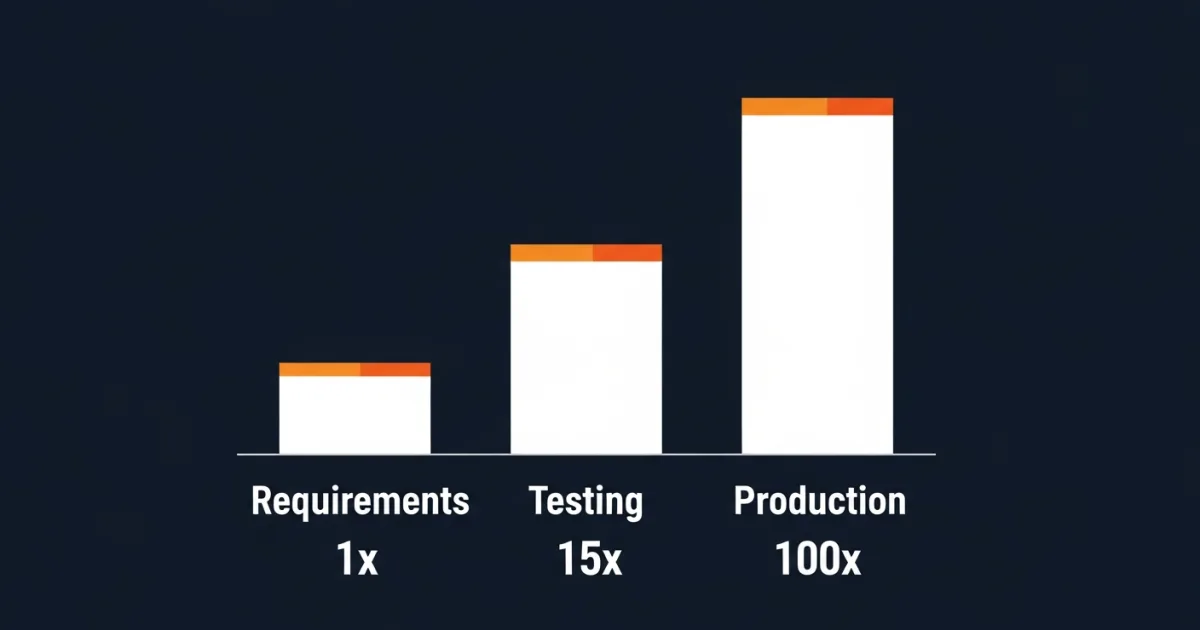
Fixing a defect in production costs roughly 100 times what it costs at the requirements phase. When your dev team is offshore and feedback loops are longer, more bugs reach production. That multiplier hits harder.
IBM’s research, now cited across hundreds of software testing references, found defect fix cost rises exponentially at each stage of the software development lifecycle. One unit at requirements. Fifteen units in testing. A hundred units in production. Those numbers held decades ago. They hold today.
Perforce reports that software defects cost US businesses $607 billion in 2022. Separately, 91% of large enterprises face downtime costs exceeding $300,000 per hour when production failures occur. These are aggregate numbers covering everything from minor UI glitches to mission-critical outages.
But the offshore angle sharpens them. Distributed teams with longer feedback loops let more defects reach production than co-located teams running the same sprint velocity. Not because the code is worse. Because the catch mechanism is missing.
Source: Perforce Software. The bulk of that cost comes from defects caught late, in testing or production, rather than early in the requirements or design phase.
A QA function embedded in the offshore sprint doesn’t just reduce defects. It moves the detection point left. From production to testing. From testing to development. From development to requirements. Each move cuts the fix cost by 5x to 10x. The math makes the QA investment fairly obvious.
| SDLC Phase | Relative Fix Cost | What Catches It | Offshore Risk Level |
|---|---|---|---|
| Requirements | 1x | QA reviewing specs with product team | Low |
| Design | 5x | Code review, architecture review | Low |
| Development | 10x | Unit testing, peer review | Medium |
| Testing / QA | 15x | Dedicated QA process, regression testing | Medium |
| Production | 100x | End user discovery, incident response | High without QA |
The offshore context pushes more bugs toward the right side of that table. Longer feedback loops, asynchronous communication, and definition-of-done gaps all favor late detection. The investment in moving detection left isn’t optional. It’s the math of distributed engineering.
Isn’t Offshore QA Just About Cutting Costs?
Cost reduction is why most companies start looking at offshore QA. But for teams with offshore dev, the case isn’t primarily about savings. It’s about defect prevention. The savings are a side effect.
About 60% of businesses now outsource at least some of their testing, according to AMQA Experts. They’re not doing it purely for cost. They’re doing it because outsourced QA teams accelerate release cycles by 30 to 50% and improve defect detection rates by 25%, per AspireSys research. Those are outcomes, not just line items.
The cost comparison is still worth understanding. A US-based QA engineer earns more than $100,000 annually in base salary, per the Bureau of Labor Statistics. With benefits, equipment, and overhead, fully-loaded cost reaches $140,000 to $160,000. An offshore QA engineer with equivalent skills typically runs $20,000 to $40,000 per year.
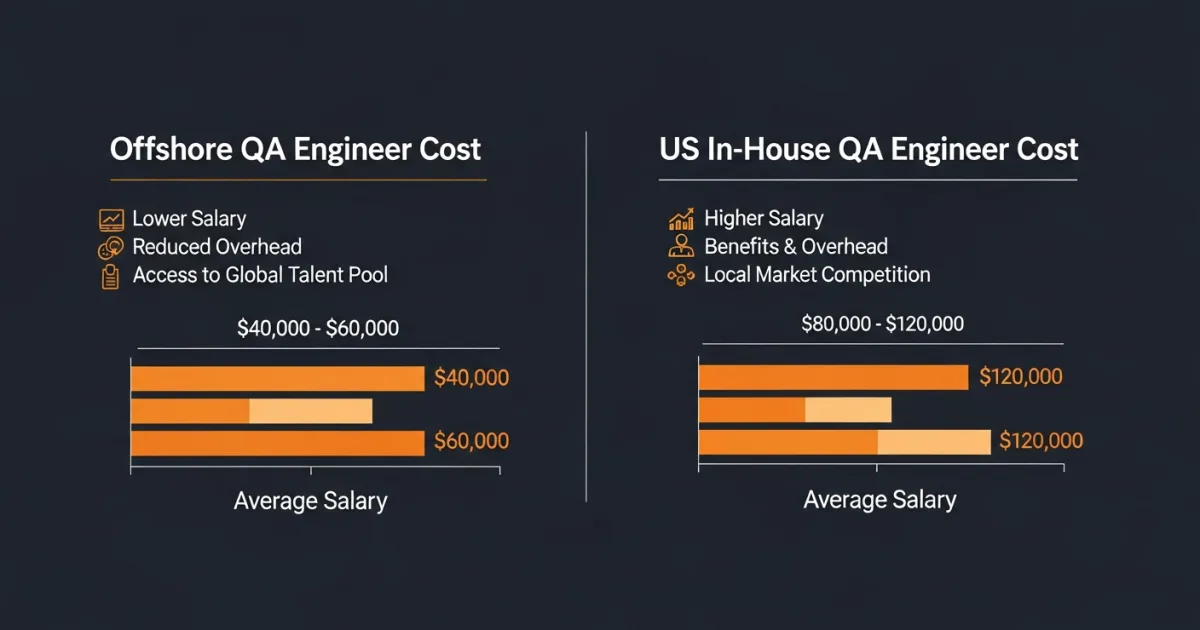
That’s a real saving. But it’s not why this decision is worth making when your dev team is already offshore. The reason to make it is that your offshore dev team already has a feedback loop problem. QA fixes that. The cost reduction is what makes it feasible to fix it at scale.
Bias acknowledged here. We benefit when you hire QA engineers through Kore BPO. But the defect math backs the case up regardless. A $30,000 offshore QA hire that prevents two production incidents costing $300,000 each in downtime pays for itself before the third sprint.
Add QA to Your Offshore Team
Pre-vetted QA engineers and automation specialists, embedded in your sprint from day one.
How Does QA Change When Both Dev and QA Are Offshore?
When dev and QA are both offshore, the coordination model matters more than geography. The risk isn’t where your teams are located. It’s whether QA is embedded in the sprint or running a parallel process that reports asynchronously.
The embedded model keeps QA and dev in the same sprint cadence. Test cases are written as stories are written. Bugs are caught before code review, not after release. The parallel model sounds efficient but creates an async handoff that adds 24 to 48 hours to every bug cycle. Multiply that across 26 sprints a year and you’ve lost significant release velocity for no structural reason.
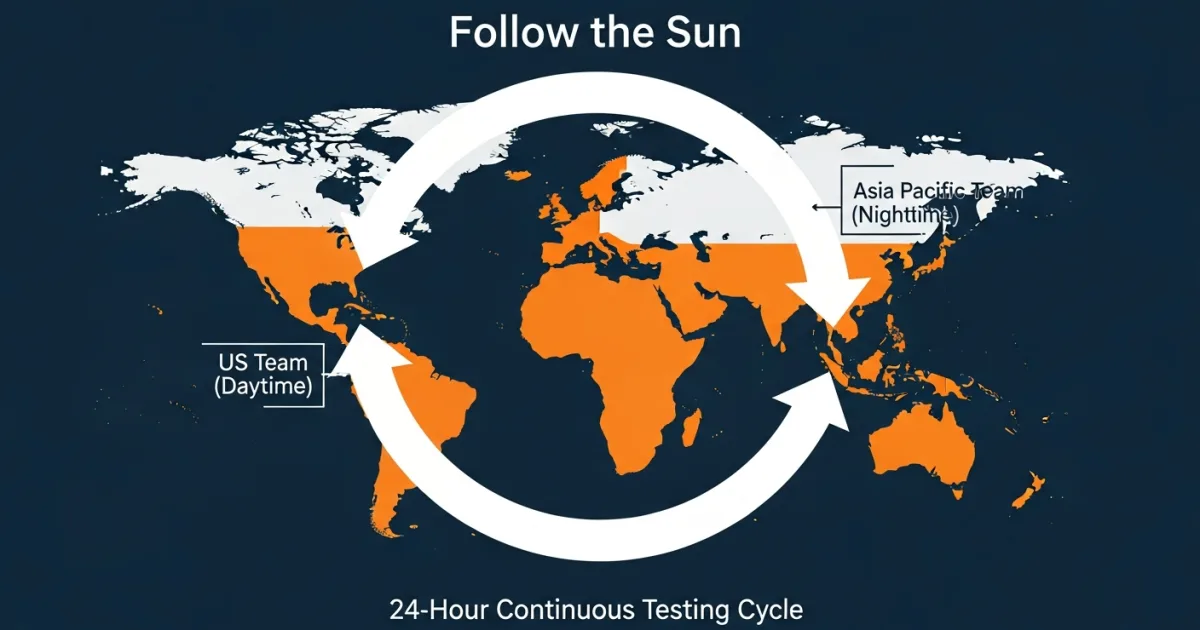
When QA is embedded and your dev team is offshore, testing runs while your US team sleeps. Your offshore software engineers in Bangalore submit code at end of day. Your QA engineers in a complementary time zone pick it up overnight. By the time your product manager opens their laptop in Phoenix, defects have been logged, categorized, and assigned back to dev. That’s a genuine “follow the sun” cycle that reduces release time without requiring anyone to work at 2am.
Integrating automated testing into your CI/CD pipeline amplifies this further. Research from Functionize found that CI/CD automation increases deployment frequency by 40% and cuts failed deployments by 24%. When your offshore QA team manages that automation layer, those gains apply without requiring your US team to maintain the test infrastructure themselves.
Three setup requirements determine whether this actually works. Role-based access controls so offshore QA engineers can only access environments relevant to their assigned sprint. Shared tooling your teams already use (Jira, GitHub, Slack, whatever the stack is). Daily async standups that give QA visibility into dev priorities without requiring full time zone overlap.
Skip any of these three and you don’t have an embedded QA model. You have a parallel one with extra steps.
Will AI Replace the Need for a Dedicated Offshore QA Team?
Short answer is no. And if anything, AI is making the case for dedicated QA stronger, not weaker.
Google’s 2025 DORA report found AI functions as an amplifier in software engineering, not a replacement for quality judgment. It accelerates code writing. It doesn’t catch the logic gaps, UX failures, and integration edge cases that break software in the real world.
The Stack Overflow Developer Survey 2025 found that 46% of developers distrust AI code accuracy versus 33% who trust it. That’s a majority of the people actually using these tools expressing skepticism about the output quality. The same developers writing more code faster are also the ones expressing concern about whether that code is right.
CodeRabbit’s December 2025 analysis made the point directly: AI-generated code carries approximately 1.7 times more defects than human-written code.
More code written faster with more defects per line needs more QA, not less.
We’ve watched clients cut their QA headcount to “let AI handle it,” then spend two full sprints chasing escaped production defects. Every time. AI is a tool that makes your offshore DevOps and engineering staff more productive. It is not a substitute for someone whose entire job is trying to break what developers build. Those are different skills. One produces. One proves.
The 78% of enterprises now using AI-driven testing tools aren’t replacing their QA engineers. They’re giving them better instruments. That distinction matters, especially on distributed teams where the catch mechanism is already stretched thin.
What to Look For When Building a QA Function for Your Offshore Team
The question at this point isn’t whether to add QA to your offshore dev setup. The math above makes that case. The question is how to structure it so it actually works.
Offshore engineering is not a QA shortcut. It’s a QA amplifier.
The farther apart your dev and product teams are, the more important it becomes to have someone whose entire job is catching what falls through the gaps between them. That’s not a criticism of offshore talent. It’s a structural observation about how distributed teams work and where the failure points live.
Three things worth keeping from this. First, the 100x cost multiplier applies more forcefully when your feedback loops are longer. Second, AI is generating code faster than it’s generating reliable code, which makes human QA more valuable, not less. Third, offshore QA doesn’t have to be a separate managed service. It can be a QA engineer embedded directly in your existing offshore sprint.
If you’re scaling an offshore engineering team and don’t yet have a QA function, that’s the gap to close first. Browse offshore QA and engineering roles at Kore BPO to see what dedicated placement looks like, with pre-screened candidates in 2 to 5 days.
Disclosure: Kore BPO places offshore QA engineers and benefits when companies choose to hire through us. All statistics in this post are sourced from third-party research and linked directly. We have not inflated the figures or omitted data that contradicts the case for offshore QA.
What Offshore Engineering Teams Ask About QA
How many QA engineers do I need per offshore developer?
Ranges from 1:4 to 1:8 depending on your testing model. For teams doing primarily manual testing, one QA engineer for every 4 to 5 developers keeps pace with sprint output without creating bottlenecks. Teams running heavy automation can stretch that ratio to 1:7 or 1:8 because automated regression runs without blocking velocity. The ratio also depends on release cadence. Daily deploys need more QA coverage than monthly releases. Start at 1:5 and adjust after two sprints of real data.
Can offshore QA engineers work in my time zone if needed?
Some can, though it reduces the “follow the sun” advantage that makes offshore QA genuinely useful. Most offshore QA engineers are willing to shift hours by 2 to 4 hours toward US time zones for daily standups. Full overlap is possible but not the default, and you’ll typically pay a small premium for it. For teams that prioritize real-time collaboration over round-the-clock coverage, partial overlap of 4 to 5 shared hours usually hits the right balance without burning out the offshore team on odd-hours scheduling.
What’s the actual ramp-up time for an offshore QA hire?
Two weeks to operational. Four to six weeks to fully productive. The first two weeks are environment access, test documentation review, and initial test case runs. By week four, a skilled offshore QA engineer should be running sprints independently and surfacing defects before they reach review. Compare that to building in-house. From job posting to an engineer producing consistent output typically takes 3 to 6 months. The ramp is real in both models. Offshore is just faster, and the cost during ramp is lower.
Do I need a QA lead before I hire individual testers?
Yes, if you’re starting from zero. The QA lead owns the testing strategy, defines acceptance from a quality perspective, writes the test plan, and acts as the gatekeeper between dev and release. Without a lead, individual testers have no direction and default to surface-level testing that misses the failure modes that actually matter. Hire the lead first. They’ll tell you how many testers you need, what the coverage gaps are, and what automation is worth building versus what should stay manual.
Is automated testing enough if my offshore team already uses AI tools?
No. And the data is fairly direct here. Google’s 2025 DORA report found AI amplifies engineering output but doesn’t replace quality judgment. CodeRabbit’s December 2025 analysis found AI-generated code carries 1.7 times more defects than human-written code. Stack Overflow’s 2025 survey found 46% of developers distrust AI code accuracy. Automated tests catch regressions. AI accelerates writing. Neither catches the logic gaps, UX failures, and edge cases that human QA engineers find through exploratory testing. More AI use typically means more QA need, not less.
Related Articles



Ready to Add QA to Your Offshore Engineering Team?
Kore BPO places dedicated QA engineers, automation specialists, and software engineers for US teams. Pre-screened resumes in 2 to 5 days.
Browse Offshore Roles