

- Costa Rican employers contribute 26.83% of gross salary to CCSS plus a 1% INS premium as of January 2026, per BDO Costa Rica
- US median customer service pay is $21.53/hr in direct wages alone, per BLS, before employer taxes and benefits
- Roughly half of organizations hit 20%+ outsourcing savings, per Deloitte’s 2025 Global Business Services Survey
- See the full Costa Rica customer service and back-office outsourcing overview for the bigger picture.
What Customer Service Outsourcing in Costa Rica Actually Costs
A Costa Rica-based customer service agent typically costs $12 to $18 an hour fully loaded before agency markup. That range sits on top of market wages once mandatory payroll contributions, benefits, and occupational insurance are added in, and it’s the number most quotes skip past on the way to a flat monthly rate. For the broader picture of how Costa Rica outsourcing fits into a staffing plan, see our Costa Rica customer service and back-office outsourcing guide.
ERI SalaryExpert’s 2026 Costa Rica data puts the average general-calls customer service rep at roughly $9 an hour in direct pay, with entry-level reps lower and agents carrying eight-plus years of experience closer to the top of the band. That $9 figure isn’t the cost. It’s the floor.
What Drives the Price: Wages, CCSS Payroll Load, and Agency Markup
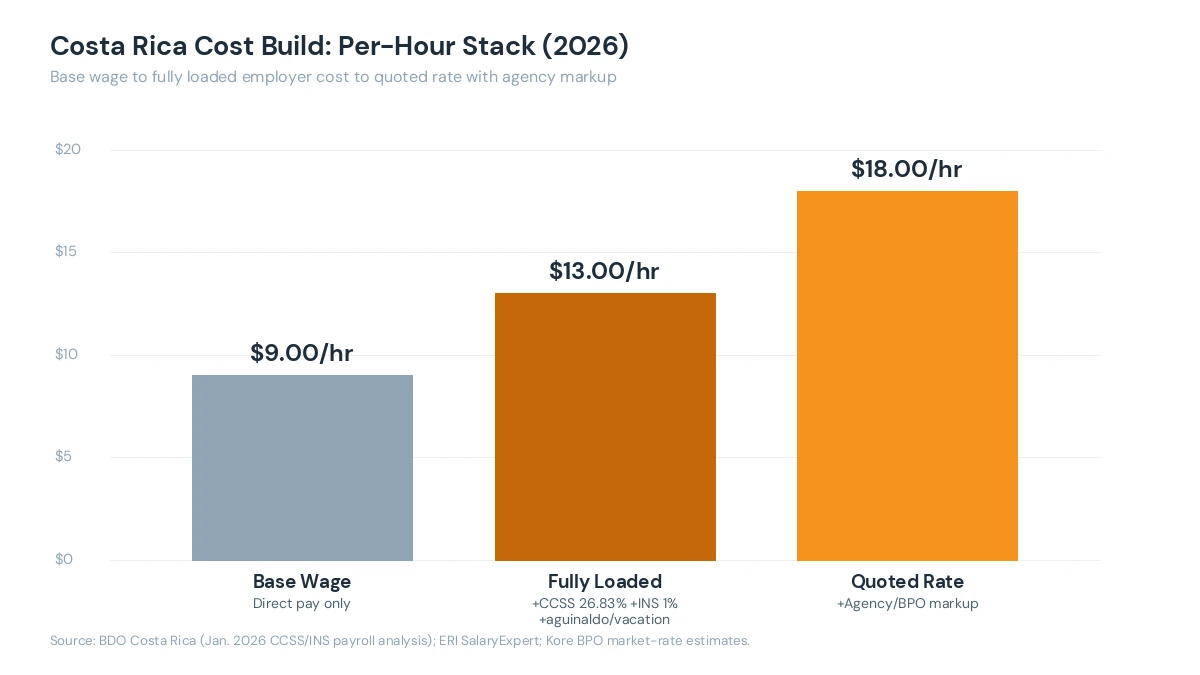
Three layers stack on top of each other to build the real number: base wage, mandatory Costa Rican employer cost load, and provider markup. As of January 2026, Costa Rican employers contribute 26.83% of gross salary to CCSS, the national social security system, plus a mandatory 1% INS occupational risk insurance premium, according to BDO Costa Rica’s January 2026 payroll analysis. Factor in aguinaldo (a mandatory 13th-month payment equal to 8.33% of annual salary), vacation accrual, and severance provisioning, and the fully loaded employer cost runs between 1.39 and 1.50 times base salary before a provider adds any margin.
| Cost Layer | What It Covers | Typical Range |
|---|---|---|
| Base wage | Direct pay to the agent | $7–$12/hr depending on experience |
| CCSS employer contribution | Health, pension, national social programs | 26.83% of gross salary |
| INS occupational insurance | Mandatory workplace injury coverage | 1% of gross salary |
| Aguinaldo + vacation accrual | 13th-month pay and statutory time off | Built into the 1.39x–1.50x multiplier |
| Fully loaded employer cost | Base wage × 1.39 to 1.50 | $10–$18/hr before markup |
| Agency/BPO markup | Facilities, management, recruiting, tech, margin | Often 25%–60% |
Three things move the number more than anything else: whether the role is bilingual or English-only, how specialized the work is (Tier-1 support versus technical, billing, or compliance escalations), and the coverage window. A seat staffed for 24/7 coverage simply costs more than one staffed business hours only, and that’s true in every market, not just Costa Rica.
Costa Rica vs US Onshore vs Other Nearshore Markets
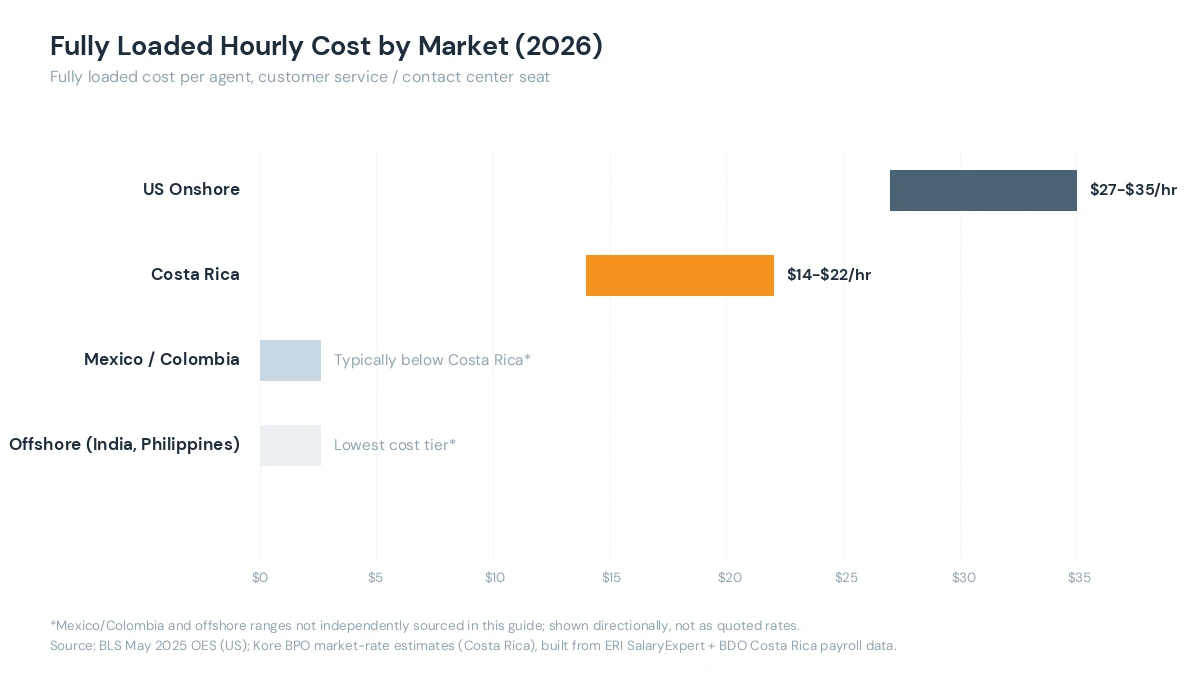
Costa Rica costs roughly 40 to 55% less than US onshore support on a fully loaded basis, and it typically prices slightly above Mexico and Colombia within the broader nearshore tier. The BLS May 2025 data puts the median US customer service rep wage at $21.53 an hour in direct pay, with the lowest 10% under $15.27 and the top 10% over $30.57. Add US payroll tax and benefits, typically 25 to 40% on top of base pay, and a fully loaded US rep runs $27 to $35 an hour.
| Market | Est. Fully Loaded Hourly Cost | English Proficiency | Time Zone Overlap with US |
|---|---|---|---|
| US Onshore | $27–$35/hr | Native | Full |
| Costa Rica | $14–$22/hr | High | Central Time, near-full overlap |
| Mexico/Colombia | Generally below Costa Rica | Strong, varies by city | Central/Eastern, near-full overlap |
| Offshore (India, Philippines) | Lowest cost tier | Strong, accent/cultural distance a factor for some | Limited real-time overlap |
What’s Included in the Price (and What Isn’t)
A quoted rate should cover recruiting, payroll compliance, facilities or remote infrastructure, and basic management. It often doesn’t cover custom tech integrations, premium shift differentials, or a dedicated overnight escalations desk. Read proposals line by line. The gap between a bare-bones quote and a fully supported one usually lives in exactly those line items.

Pricing by Experience and Specialization
Entry-level general support runs roughly $14 to $17 an hour fully loaded. Specialized support, covering billing or technical issues, runs $17 to $20 an hour. Senior bilingual agents handling escalations, team lead duties, or quality assurance push past $20, often landing in the $20 to $24 an hour range.
How Much You Can Actually Save
Total cost savings against US onshore support typically land in the 40 to 55% range for Costa Rica. For context on outsourcing savings more broadly, Deloitte’s 2025 Global Business Services Survey found that roughly half of organizations hit 20%+ savings from outsourced delivery, with the most cost-competitive markets reaching up to 70% in some categories. Costa Rica isn’t that cheapest tier, and it shouldn’t be framed as one. The savings case here is built on landing strong English fluency and near-full US time zone overlap at a meaningfully lower cost than onshore, not on chasing the rock-bottom number.
Who This Pricing Works Best For
Costa Rica pricing fits companies running live phone or chat support during US hours, handling disputes, billing, or technical issues that need real conversation quality, and teams that already tried ultra-cheap offshore and got burned on retention. It’s a weaker fit for a hard cost-floor budget that needs offshore-tier pricing, fully async ticket-only support, or 24/7 global coverage on a shoestring. Kore BPO is a staffing and BPO company, so we benefit any time Costa Rica turns out to be the right fit for your team. That’s exactly why we’d rather tell you upfront when it isn’t.
How to Budget for 2026
Start with headcount and coverage hours, map them to the tiers above, multiply, and add a 10 to 15% buffer for ramp-up during the first quarter. New hires rarely hit full productivity on day one, and budgeting for that lag now avoids a mid-year scramble later.
The bottom line: expect $14 to $22 an hour fully loaded for most seats in 2026, savings of 40 to 55% against US onshore, and a premium over Mexico and Colombia that buys stronger English fluency and near-full time zone overlap.
Common Questions
What’s driving the gap between a $9/hr base wage and an $18/hr quoted cost?+
Three line items close that gap: the 26.83% CCSS employer contribution, a 1% INS occupational insurance premium, and aguinaldo plus vacation accrual, which together push the fully loaded wage to roughly 1.4 to 1.5 times base pay before any provider markup is added.
Is Costa Rica actually cheaper than hiring in the US?+
Yes. BLS puts the US median customer service wage at $21.53 an hour in direct pay alone, and once payroll tax and benefits are added, a US-based rep runs $27 to $35 an hour fully loaded. Costa Rica lands at $14 to $22 an hour fully loaded for a comparable seat.
Why pick Costa Rica over cheaper offshore markets?+
Time zone overlap and language fluency, mostly. Offshore markets like India or the Philippines price lower on paper, but shift differentials for US-hours coverage and higher retraining costs from agent turnover can close that gap faster than the quote sheet suggests.
Does the quoted rate include management and QA?+
It depends on the provider, and this is one of the most negotiable line items in any proposal. Ask for a written breakdown before signing anything.
How much more does bilingual support cost than English-only?+
A noticeable step up, typically $3 to $6 an hour more, which puts bilingual seats closer to the specialized or senior pricing band than the entry-level one.
What’s a realistic ramp-up timeline before output stabilizes?+
Budget a full quarter. New agents typically need 60 to 90 days before throughput and quality metrics stabilize, which is why a 10 to 15% ramp-up buffer belongs in the first-year budget, not the steady-state one.
Can the markup layer be negotiated?+
The base wage and CCSS contribution are fixed by Costa Rican law, so there’s no room there. The provider’s markup is where contract length, seat volume, and payment terms actually move the number.

Related Articles



See What a Costa Rica Support Team Actually Costs You
Get qualified resumes for bilingual or English-fluent Costa Rica support agents in 2 to 5 business days.
Get Matched With a Specialist