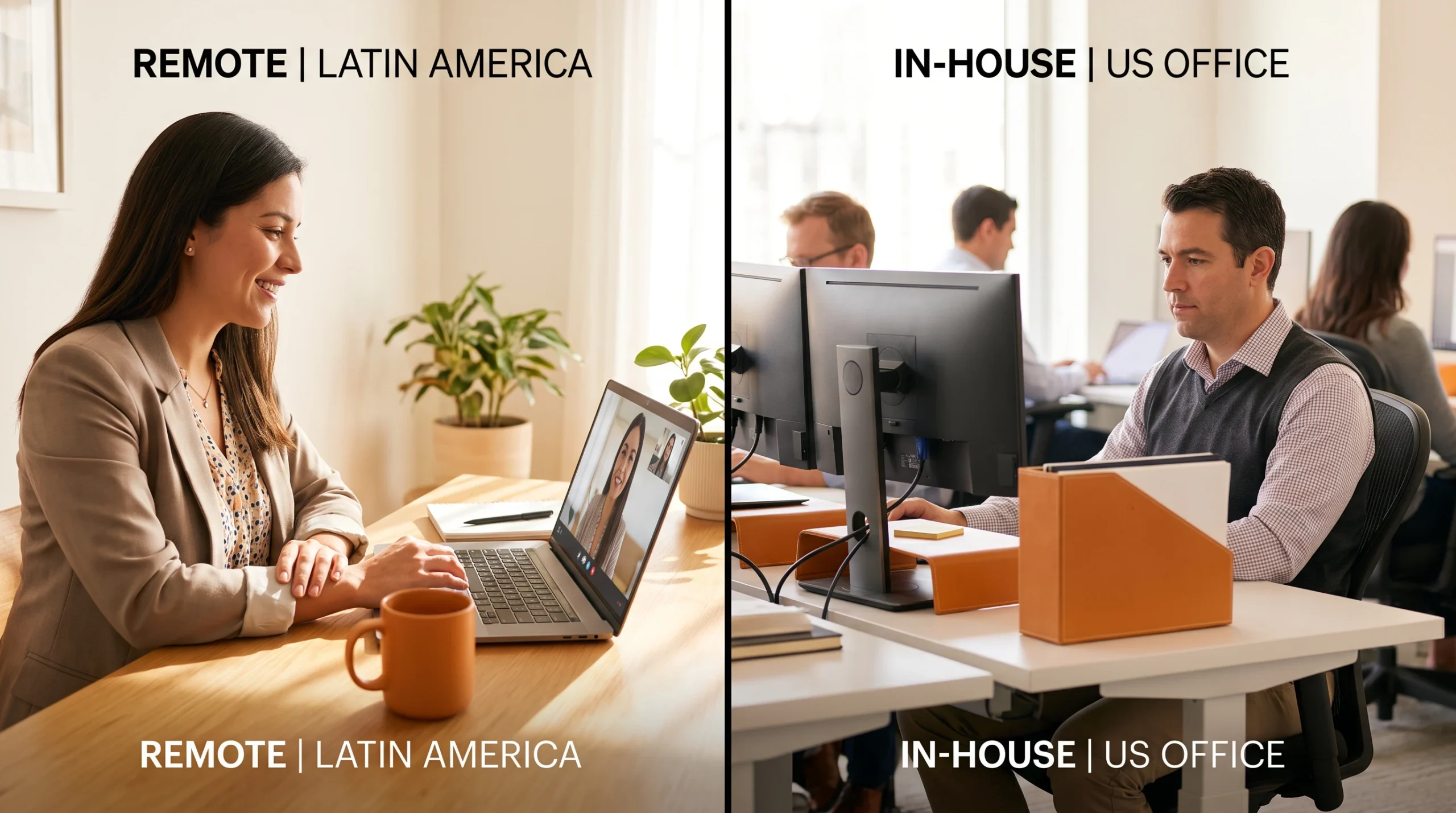
When weighing nearshore recruiters vs in-house hiring, ask a hiring manager why they haven’t considered a nearshore recruiter, and the honest answer is usually “I assumed it meant a time zone tradeoff.” That assumption is the single biggest reason companies default to an in-house US search, even when the role doesn’t need one. However, for this specific role, it’s mostly wrong. Mexico, Colombia, and Costa Rica all overlap US business hours without a shift adjustment, so the one real objection to offshore hiring simply doesn’t carry over here.
We staff both sides of this comparison: nearshore recruiters who join a client’s ATS directly, and in-house searches that run through our own pipeline. So this isn’t a hypothetical. Below, we lay out what actually differs on cost, speed, and availability. Then we give you a simple framework for which one fits the role you’re filling right now.
Nearshore Recruiters vs In-House: What a Nearshore Recruiter Is
A nearshore recruiter is a dedicated employee or contractor based in Mexico, Colombia, or Costa Rica. They join your company directly, sit inside your own ATS, and report to your hiring managers, exactly like an in-house hire would. The only real difference is location and employment structure. Typically, a staffing partner handles local payroll and compliance, so you don’t need your own entity in that country.
Scope-wise, a nearshore recruiter can be full-cycle, sourcing-only, or a coordinator, exactly like an in-house hire. The role itself doesn’t change shape based on where the person sits.
What an In-House US Recruiter Is
An in-house US recruiter is a direct employee based domestically, sourced through a local job posting, a staffing agency placement, or a referral, who joins your ATS and takes on the same full-cycle, sourcing, or coordinator responsibilities. The appeal is obvious: no cross-border employment logistics, immediate cultural and market familiarity, and a candidate pool that’s easy to reach through any standard US job board.
The ceiling is also obvious once you’ve hired a few: every candidate is priced at US wage levels, and the domestic recruiting talent pool isn’t infinite, especially for technical or specialized recruiting. Per LinkedIn’s 2025 talent solutions data, average time-to-fill across industries sits at 44 days and has been climbing, which applies just as much to filling a recruiter role itself as it does to the roles that recruiter will go on to fill.
Cost Comparison
The fee structures aren’t close, and this is where most buyers are surprised by the size of the gap. Per the BLS human resources specialists occupation data (May 2025), a mid-level US full-cycle recruiter runs $65,000-$95,000 in base salary, before the 25-35% that benefits and payroll taxes typically add on top. A comparable nearshore full-cycle recruiter in Mexico or Colombia runs $19,000-$36,000 fully loaded, already including statutory benefits.
| Role / Experience | In-House US | Nearshore | Cost Ratio |
|---|---|---|---|
| Recruiting Coordinator | $48,000-$62,000 | $12,000-$19,000 | 3-to-1 |
| Full-Cycle Recruiter | $65,000-$95,000 | $19,000-$35,000 | 2.5-to-1 |
| Senior Full-Cycle Recruiter | $85,000-$130,000 | $30,000-$55,000 | 2.3-to-1 |
| Technical Recruiter | $90,000-$140,000 | $24,000-$42,000 | 2.8-to-1 |
I’ll say the obvious part out loud: we place nearshore recruiters, so we benefit when the math favors that model. But the comparison above is pulled from the same BLS and market-benchmark data we use on our own nearshore recruiters pricing page, not a figure invented for this post. Run it against your own actual offer letters before trusting either side’s number, ours included.
Speed to Hire

A nearshore recruiting partner with an existing vetted pipeline typically has a candidate working within 5 to 10 business days of a scoping call. An in-house US search, run through a traditional agency or an internal hiring process, usually takes 4 to 8 weeks from job posting to start date, longer for specialized or technical recruiting profiles where the domestic candidate pool is thinner.
The gap isn’t about urgency on either side, it’s about pipeline depth. A nearshore partner is drawing from candidates already screened for ATS fluency and live English communication. A fresh US search starts from zero for every requisition unless you already have a bench.
Availability and Communication
This is the section that actually differs most from an offshore comparison, and it’s worth being precise about it. A nearshore recruiter in Mexico or Colombia sits on the same live calls, joins the same daily standups, and is reachable for a same-day schedule change exactly like an in-house hire. Mexico City and Bogotá track US Central and Eastern time respectively with no DST drift. Costa Rica sits one hour behind US Central year-round. None of that requires the recruiter to work an adjusted or overnight shift the way an offshore hire would.
Where a real difference shows up is candidate-facing communication for roles that specifically require in-person, on-site presence, a career fair, a campus recruiting event, a walk-in interview day. An in-house US recruiter can physically be there. A nearshore recruiter, like any other remote hire, cannot. For companies running primarily remote or hybrid hiring processes, this rarely matters. For companies with a heavy on-site, in-person recruiting motion, it’s worth naming as a real gap rather than glossing over it.
Retention and Institutional Knowledge

Retention dynamics are closer between these two models than between nearshore and a transactional staffing agency, because both a nearshore hire and an in-house hire are built for the long-term seat, not a one-off placement. The real retention variable is role engagement, not location: recruiters who manage real requisitions with real hiring managers and see placements convert stay longer than those doing narrow, repetitive work with no outcome visibility, whether they’re sitting in Dallas or Bogotá.
Institutional knowledge builds at the same rate for a nearshore hire as an in-house one, since both are working inside your actual ATS and sitting in your actual meetings day after day. The only caveat: if your hiring managers primarily build relationships through in-person rapport (coffee meetings, hallway check-ins), a nearshore hire will need slightly more deliberate async and video touchpoints to build the same trust, a solvable problem but one worth planning for in onboarding.
Not Sure Which Model Fits?
Talk to Kore BPO about the role you’re trying to fill. No obligation.
Which Model Fits Your Hiring Need

Neither model wins every scenario. Which one is right depends on your budget, your timeline, and how much in-person recruiting activity the role genuinely requires.
| Hiring Scenario | Better Fit | Why |
|---|---|---|
| Heavy on-site/in-person recruiting (career fairs, walk-ins) | In-house US | Physical presence is a hard requirement |
| Standard full-cycle hiring, remote or hybrid company | Nearshore | Same live availability at 2.3-3x lower cost |
| Budget-constrained scaling, multiple open reqs | Nearshore | Cost savings compound across every added recruiter |
| Executive or C-suite search requiring deep local network | In-house US | Senior relationship recruiting often leans on domestic network depth |
| Backfilling a recruiter who just left | Nearshore | 5-10 day fill vs. 4-8 week domestic search |
If your recruiting function is genuinely in-person and relationship-driven at the local level, an in-house US hire is the right tool, and we’d tell you that even though it isn’t our service. Where a nearshore recruiter earns its lower cost is everywhere else: full-cycle, sourcing, and coordinator work for a remote or hybrid company that doesn’t need a body physically present at a career fair. For the full role profile and vetting methodology, see Nearshore Recruiters Staffing, and for the hiring process itself, How to Hire Nearshore Recruiters.
What Hiring Managers Actually Ask Us
Does a nearshore recruiter really perform the same as an in-house US recruiter?
Yes, for the vast majority of full-cycle, sourcing, and coordinator work. Both sit inside the same ATS, join the same live calls, and are screened against the same competencies (Boolean search, pipeline management, candidate communication). The only place performance genuinely diverges is in-person activity, career fairs, campus events, walk-in interview days, where physical presence matters and a remote hire of any kind, nearshore or domestic remote, can’t substitute.
If nearshore is cheaper and just as available, why would anyone hire in-house domestically?
Three real reasons: heavy in-person recruiting activity, executive search that leans on deep domestic network relationships built over years, and companies with a strict no-remote-staff policy for compliance or culture reasons. Outside of those cases, the cost and speed advantages of nearshore are hard to argue against for this specific role.
How much onboarding time does a nearshore recruiter need compared to an in-house hire?
About the same, one to two weeks to full independent pipeline productivity with proper role briefs and a candidate quality rubric in place, since there’s no overnight-handoff lag slowing down feedback loops the way there would be with an offshore hire. The onboarding gap that does exist is relational, not operational: a nearshore hire builds hallway-style trust more slowly without in-person contact, so deliberate video check-ins in the first month matter more than they would for someone sitting down the hall.
Do I need a local entity in Mexico or Colombia to hire a nearshore recruiter instead of going in-house?
No. A nearshore staffing partner handles employment, payroll, and local compliance on your behalf, the same way you’d use a PEO domestically but for a different country. You direct the work and the role reports to you exactly like an in-house hire would. The partner just handles the parts of employment that require local registration.
Which one should a small business try first, nearshore or in-house?
Depends on the role’s in-person requirement, not company size. A remote or hybrid company filling its first dedicated recruiter role almost always comes out ahead starting nearshore, given the cost gap and comparable live availability. A company whose hiring is genuinely built around local career fairs and walk-in interviews should keep that specific seat in-house, regardless of size.

Related Articles



Ready to Compare Candidates Side by Side?
Tell us the role and we’ll show you real nearshore candidates against your current in-house hiring plan.
Start the Search