How to Choose a Costa Rica Staffing Agency


The right Costa Rica staffing agency names the exact entity or employer of record handling payroll in Costa Rica. It tests English directly instead of assuming it, and it shares real time-to-fill and tenure numbers instead of a culture-fit line. It also puts a replacement window in writing before you sign. Any hedge on those four points is your answer.
Every Costa Rica staffing agency pitch leans on the same three lines by the second call. Same time zone as the US. A bilingual, well-educated workforce. Political stability nobody else in the region can match. Generally, all three claims hold up. However, none of them tells you whether the specific firm on the call actually delivers, especially once the contract’s signed, the invoice clears, and the new hire’s three weeks in without anyone from the agency checking back.
What This Guide Covers
Specifically, Costa Rica isn’t interchangeable with the rest of Latin America, and pricing it like a discount version of Colombia or Mexico misses what actually makes the country different. Instead, this guide covers what to check before you sign and what a Costa Rica placement really costs once compliance is loaded in. It also covers the questions worth asking before a contract gets anywhere near a signature.
Why Costa Rica Specifically, Not Just “Nearshore Latin America”
Costa Rica sits on Central Standard Time and doesn’t observe daylight saving. As a result, it stays fully aligned with Chicago, Dallas, and Denver business hours all year, with no half-hour drift and no seasonal adjustment to track. For teams running live standups, client calls, or same-day support handoffs, that’s a full working day of real-time overlap, not a partial one.
A Deep, University-Fed Talent Pipeline
Beyond the time zone, the talent base earns the pitch instead of just supporting it. For example, CINDE, Costa Rica’s official investment promotion agency, reports digital technologies employment growing at roughly 13% a year, and more than 2,600 computer science diplomas are granted annually. Most of that talent sits in San Jose and the surrounding Greater Metropolitan Area, where the universities, free-trade zones, and multinational offices cluster close together. In addition, CINDE counts 16 of the world’s top 100 IT companies with operations in the country. Overall, that’s a market built on a growing, university-fed pipeline, not a one-time hiring boom.
Meanwhile, cost is where the story gets honest instead of promotional. Costa Rica runs as a premium nearshore market, and software development rates commonly land between $50 and $99 an hour, well above Colombia’s $25 to $49 range and closer to what a Mexican vendor charges. So, if the top priority is the lowest possible rate, Costa Rica probably isn’t the first stop. On the other hand, if the priority is English quality, political stability, and a talent pool built for senior and specialized roles, the premium tends to pay for itself.
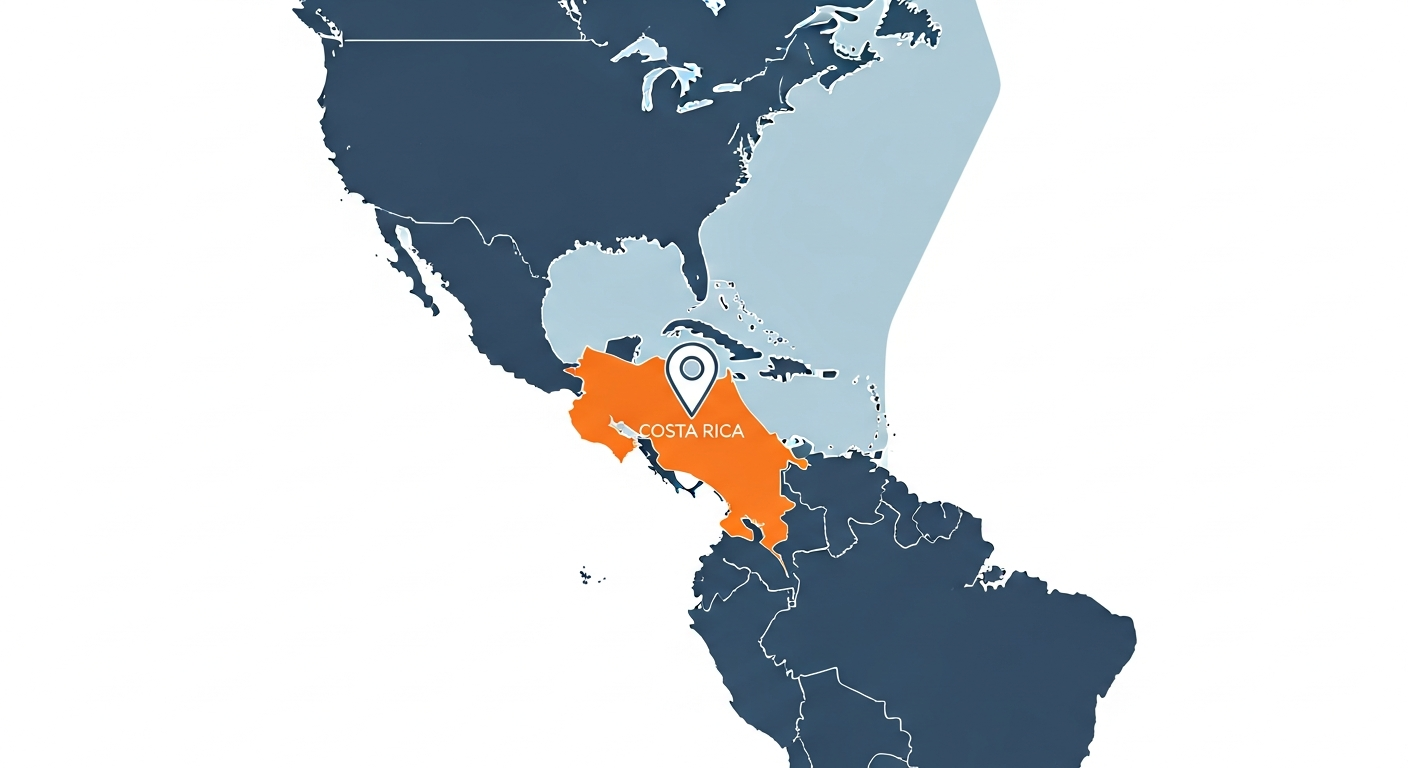 Costa Rica, CST (UTC-6), no DST
$50 to $99/hr, premium nearshore market
Costa Rica, CST (UTC-6), no DST
$50 to $99/hr, premium nearshore market
What a Costa Rica Staffing Agency Actually Does
“Staffing agency” covers more ground than the label suggests, and the differences between what firms actually own matter more than the marketing copy. Generally, three models show up under the same language.
Sourcing-Only vs. EOR vs. Full Entity
First, some firms only source and screen candidates. They send a shortlist, and you extend the offer. In that setup, you handle payroll, benefits, and statutory compliance yourself, usually through a separate employer of record or your own Costa Rican entity. Alternatively, other firms bundle sourcing with a named EOR relationship, where the agency finds the candidate while a third-party EOR legally employs them in Costa Rica on your behalf. Finally, a smaller group runs its own registered entity in Costa Rica, which means the same company that screened the candidate also handles payroll, CCSS contributions, and termination under Costa Rican labor law directly.
None of the three is automatically wrong, and a pure sourcing firm works fine if you already have a compliance structure in place. But if a firm can’t clearly say which of these three models it runs, treat that as a real gap, not a detail to sort out after signing.
The 2026 Compliance Load You’re Hiring Into
Costa Rica’s payroll math is more layered than the headline hourly rate suggests, and any agency quoting a bare salary number without the loaded cost is giving you half the picture. Specifically, BLP Legal, a Costa Rican corporate law firm, confirms the employer contribution to the Caja Costarricense de Seguro Social (CCSS) rose to 26.83% of gross wages effective January 1, 2026, covering health insurance and pensions. On top of that sits an 8.33% accrual for the Aguinaldo, Costa Rica’s mandatory 13th-month bonus.
The Aguinaldo Calendar
The Aguinaldo itself runs on a fixed calendar. Essentially, it equals one-twelfth of all gross wages earned across a 12-month accrual window running from December 1 through November 30, and it’s legally required to be paid in full by December 20 each year, with real fines attached for missing the date. Also, it’s exempt from CCSS charges and income tax, and a court-ordered support order is about the only deduction legally allowed against it. Beyond that, add roughly 4.17% for mandatory vacation accrual and about 1% for occupational risk insurance through the INS. Altogether, the full loaded employment cost in Costa Rica lands close to 39% above gross salary.
If a Costa Rica staffing agency can’t speak to the CCSS contribution rate or the Aguinaldo payment deadline without pausing, treat that as a signal. It’s worth noting before you go further, not after.
 CCSS employer contribution, 26.83%
Aguinaldo due December 20, ~39% total loaded cost
CCSS employer contribution, 26.83%
Aguinaldo due December 20, ~39% total loaded cost
The 6-Point Framework for Vetting a Costa Rica Staffing Agency
Run every firm through these six checks before a contract gets close to a signature. Skip one, and you’re betting on the part you didn’t verify.
The Rest of the Framework, Performance and Legal Terms
 Named Costa Rican entity or EOR
Real English and technical screening
Fee tied to placement
Time-to-fill and tenure data disclosed
Current on 2026 compliance costs
IP and data terms in writing
Named Costa Rican entity or EOR
Real English and technical screening
Fee tied to placement
Time-to-fill and tenure data disclosed
Current on 2026 compliance costs
IP and data terms in writing
San Jose vs Other Regions, Does It Matter
Costa Rica’s talent isn’t spread evenly across the country, and a firm that treats every region as interchangeable usually has shallow reach outside its home base. San Jose and the broader Greater Metropolitan Area carry the deepest bench by a wide margin. In fact, the region is home to a large share of the country’s 16 top-100 global IT companies, and the universities and free-trade zones there keep the pipeline of new graduates flowing.
Meanwhile, Heredia, just north of the capital, has built its own identity as a hub for multinational operations and advanced manufacturing-adjacent tech roles. A strong local university presence feeds that pipeline, which tends to favor candidates with experience inside larger, process-driven organizations, a different profile than the smaller, faster-moving teams more common in San Jose proper.
Where the Bench Gets Thinner
Coastal and outlying regions like Guanacaste carry real but thinner benches, generally stronger for customer service, hospitality-adjacent, and support roles than for specialized senior engineering.
| Region | Known For | What to Watch |
|---|---|---|
| San Jose / GAM | Largest bench, home to most top global IT companies | Higher senior-level demand tightens supply |
| Heredia | Multinational and enterprise-adjacent tech roles | Smaller pure-startup bench than San Jose |
| Cartago | Growing engineering and manufacturing talent pool | Thinner specialized software bench today |
| Guanacaste / Coastal | Customer service and support-oriented talent | Limited senior technical depth currently |
 San Jose, deepest tech talent bench
Heredia, multinational tech hub
San Jose, deepest tech talent bench
Heredia, multinational tech hub
Ask any Costa Rica staffing agency where its actual candidate pipeline sits, not just where its office happens to be. A firm with real bench depth in a given region can explain how sourcing there differs from the rest of the country. One without it usually repeats the same national statistics no matter which region you ask about.
See How Kore BPO Vets Costa Rica Talent
Sourcing, English and technical screening, and compliance handled end to end, with resumes back in 2 to 5 business days.
Questions to Ask on the Sales Call
Bring this list to the first real conversation. Ultimately, a confident, specific answer to each tells you more than anything on the agency’s homepage.
- Who legally employs the candidate in Costa Rica, your own entity, a named EOR, or the agency directly?
- What does your English and technical screening process actually look like, step by step?
- What’s the replacement window if this placement doesn’t work out, in writing?
- What’s your average time-to-fill and 12-month tenure for a role like this one?
- How does your pricing account for the CCSS contribution and Aguinaldo accrual specifically?
- Can I speak with a current client hiring a similar role in Costa Rica?
That last question is the tiebreaker. A published case study gets polished before it goes live. A live reference call doesn’t.
Red Flags That Should End the Call
Generally, bad Costa Rica placements are almost always avoidable, and the warning signs tend to show up before the contract, not after the hire starts.
Two More Red Flags to Watch For
For the broader picture across the region, see our guide to choosing a Latin America staffing partner and our overview of what Latin America staffing actually means for US buyers. The full Latin America staffing pricing breakdown covers cost by role and country.
Ultimately, the Costa Rica staffing agencies worth signing with rarely have the smoothest pitch deck. Instead, they’re the ones that name the employing entity without hesitation and test English instead of assuming it. They also walk through the real CCSS and Aguinaldo math instead of a rounded-up estimate.
Run every firm you’re considering through the six-point framework above, ask the sales-call questions, and treat any hedge on compliance or replacement terms as a hard stop. If you’d like to see how we structure Costa Rica staffing at Kore BPO, from screening through compliance, start at korebpo.com/contact.
What People Ask Before They Sign With a Costa Rica Staffing Agency
What makes Costa Rica different from other Latin America staffing options?
The time zone overlap and political stability are the clearest differentiators. Costa Rica runs on Central Standard Time year-round with no daylight saving, giving full overlap with Chicago, Dallas, and Denver business hours. Combined with a digital technologies sector CINDE reports is growing employment around 13% a year, it offers real-time collaboration alongside a genuinely deep talent pool. That comes at a premium rate compared to Colombia or Peru.
Is English proficiency actually a concern when hiring in Costa Rica?
It’s a smaller concern than in much of the region, but still worth screening for directly rather than assuming. Costa Rica’s EF English Proficiency score sits in the “Moderate” band and consistently ranks near the top of Latin America. Overall, a staffing agency that runs a direct English assessment as part of its screening process manages the remaining risk, while one that skips it is passing that gap on to you.
More Questions From Buyers
How much does Costa Rica’s 2026 compliance load add to hiring costs?
Employers contribute roughly 26.83% of gross wages to the CCSS, plus an 8.33% Aguinaldo accrual paid out by December 20 each year. Vacation and occupational risk insurance accruals add a bit more. Combined, the full loaded employment cost in Costa Rica lands close to 39% above the base gross salary. An agency quoting only the bare salary number is leaving out a real part of the budget.
Should I hire from San Jose specifically or elsewhere in Costa Rica?
It depends on the role more than the city. San Jose and the Greater Metropolitan Area carry by far the largest and most senior-skewed bench, home to most of the country’s top global IT companies. Heredia has real strength in multinational and enterprise-adjacent roles, while coastal regions like Guanacaste lean toward customer service and support talent rather than specialized engineering.
Timeline Expectations
How fast can a Costa Rica hire realistically start?
For a firm with an active, pre-vetted pipeline, expect a shortlist within days and a start date inside two to three weeks for most standard roles. Specialized senior engineering roles in high-demand categories can run longer simply because that specific pool is thinner. If a standard mid-level role is quoted at six weeks or more with no clear reason, ask why before assuming it reflects thoroughness.
Related Articles



Ready to Hire Costa Rica Talent the Right Way?
Kore BPO handles sourcing, English and technical screening, and compliance for Costa Rica hires, so you’re not gambling on any of the six criteria in this guide.
Book a Free Consultation