
How to Choose Nearshore Recruiting the Right Way in 2026


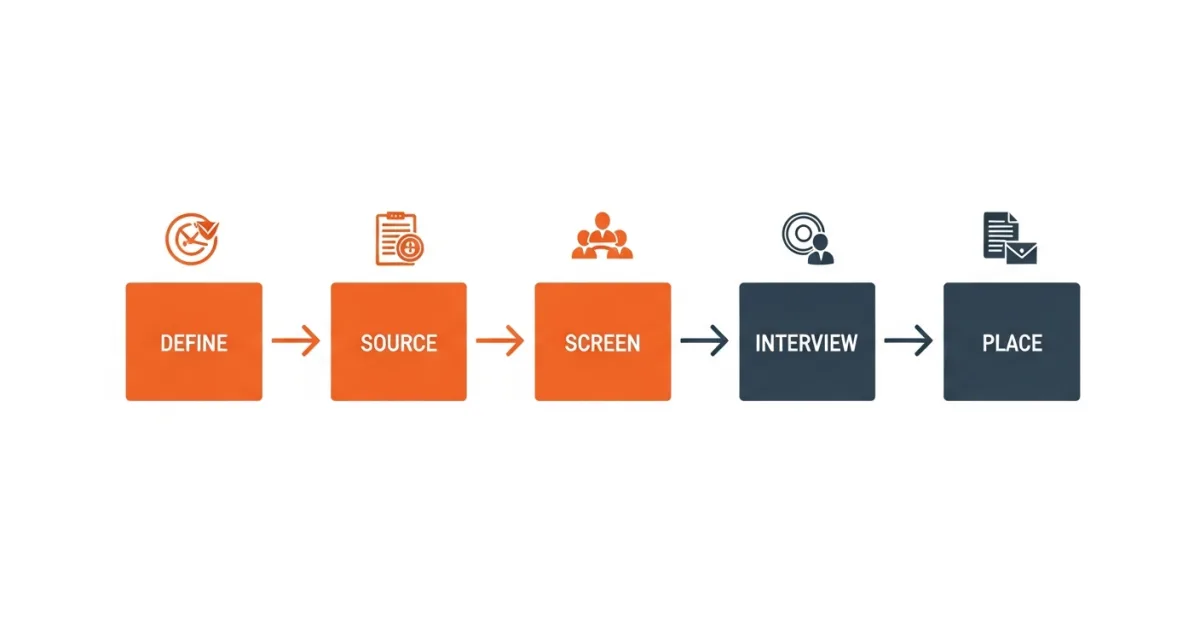
Choosing the right nearshore recruiting process means running candidates through five stages, define, source, screen, interview, place. Most standard roles clear all five in 2 to 3 weeks, not the 6-plus weeks generic hiring often takes.
Most guides on nearshore hiring answer the wrong question. They tell you how to pick a vendor, what to ask a sales rep, which red flags mean walk away. Useful stuff, and we’ve written that guide too. But none of it tells you what actually happens once you’ve picked someone, when a real candidate gets sourced, screened, interviewed, and placed in a real seat.
That’s a different problem. Nearshore recruiting, the actual mechanics of it, runs on its own timeline with its own failure points, and almost nobody documents it stage by stage. This guide does. It walks through the 5-stage process a nearshore hire actually goes through, how long each stage realistically takes, what changes in the nearshore hiring workflow compared to offshore recruiting, and where AI screening tools genuinely help versus where they just add noise.
If you’re still comparing agencies rather than the hiring process itself, our guide to choosing a nearshore staffing agency covers that decision. This one assumes you’ve already got a partner, or you’re building the process in-house, and you want to know what good actually looks like.
What Nearshore Recruiting Actually Means
Nearshore recruiting is the process of sourcing, screening, and placing candidates from a nearby country, usually Latin America for US companies, so the working day overlaps instead of running on opposite clocks. That’s the definition. The part that trips people up is assuming it’s the same recruiting playbook as domestic hiring with a passport stamp added.
It isn’t. Sourcing channels differ. LinkedIn still works, but a lot of the strongest nearshore talent comes through local dev communities, university partnerships, and referral networks that a US-based recruiter never sees. Screening differs too, because technical skill and English fluency both need verification, not assumption. ManpowerGroup’s 2026 Talent Shortage Survey found 72% of employers globally are struggling to fill roles, and AI skills have now overtaken traditional engineering as the hardest to source. That scarcity is exactly why a documented recruiting process matters more this year than it did two years ago. Guessing your way through sourcing wastes weeks you don’t have.
The 5-Stage Nearshore Recruiting Process
Every nearshore hire that actually works moves through the same five stages, in the same order. Skip one, or rush it, and the miss shows up three weeks into onboarding instead of during the interview, which is the expensive way to find out.
See Kore BPO’s Nearshore Recruiting Model
Sourcing, structured screening, and compliance handled end to end across Latin America.
How Long Nearshore Recruiting Actually Takes
Ask five different providers for a timeline and you’ll get five different answers, most of them vague. Here’s the stage-by-stage breakdown for a standard mid-level role, the kind that makes up most nearshore hiring volume.
| Stage | Realistic Timeline | What Slows It Down |
|---|---|---|
| Define the role | 1 to 2 days | Vague or shifting requirements |
| Source candidates | 3 to 5 days | Thin regional talent pool for niche stacks |
| Screen (skills + English + fit) | 3 to 5 days | No structured rubric, one-off impressions |
| Interview loop | 3 to 7 days | Hiring manager scheduling gaps |
| Place and onboard | 3 to 5 days | No EOR or entity ready to process paperwork |
| Total, standard role | 2 to 3 weeks |
Compare that to the general US labor market. iCIMS reported tech time-to-fill hit 51 days in February 2025, up from 48 the year before, and running 10 days longer than the overall market average. A well-run nearshore process doesn’t just save on cost. It routinely finishes in under half the time a stalled domestic search takes, mostly because sourcing and screening run in parallel instead of one recruiter working a single funnel alone.
Specialized or senior roles stretch past that 2 to 3 week window, sometimes by another week or two. That’s not a red flag on its own. It’s a smaller qualified pool taking longer to surface, which is the honest version of what “thorough” actually means.
Nearshore vs. Offshore Recruiting, What Actually Changes in the Workflow
Most comparisons stop at cost and time zone. Fair enough, those matter. But the recruiting workflow itself changes in ways that rarely get mentioned, and they affect how fast and how well a hire actually lands.
| Workflow Element | Nearshore (LatAm) | Offshore (Asia) |
|---|---|---|
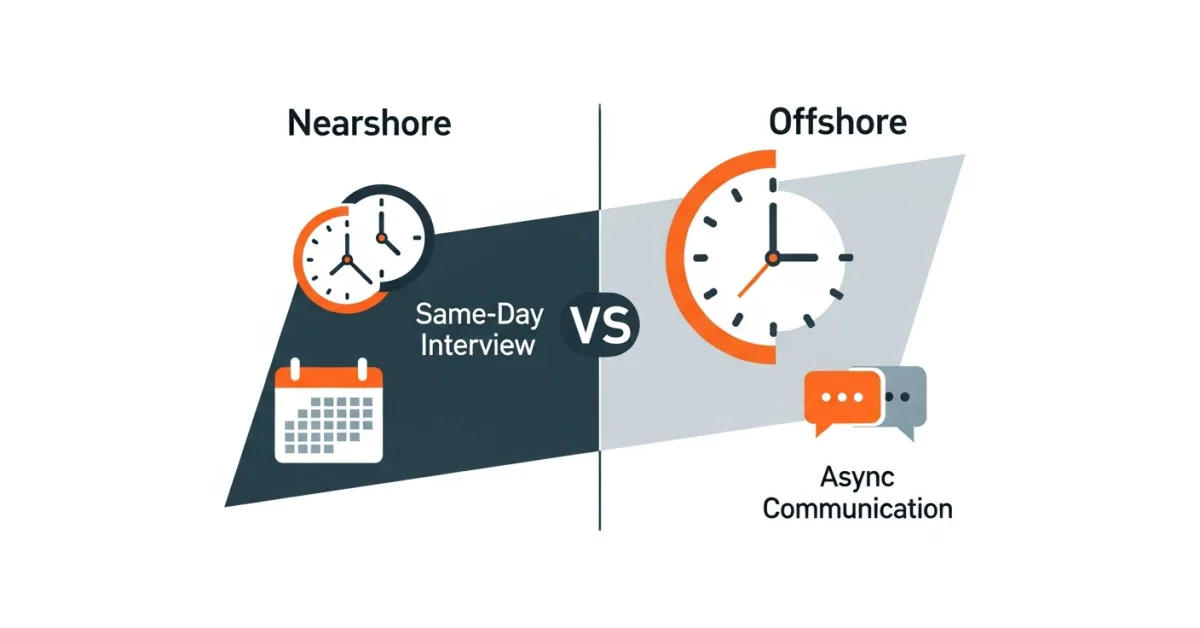
| Interview scheduling | Live, same-day loops | Async, often spread over days |
| Reference checks | Same-day calls possible | Overnight turnaround typical |
| English screening depth | Still required, verified | Usually deeper, more variance |
| Sourcing pool size | Smaller, more concentrated | Larger, wider spread |
| Time zone overlap | 1 to 3 hours | 8 to 14 hours |
The overlap gap isn’t just a scheduling nuisance. Researchers Tommy Pan Fang, Prithwiraj Choudhury, and Jasmina Chauvin, publishing in the peer-reviewed journal Organization Science, found that a one-hour increase in temporal distance between employees cut real-time communication by 11% at the Fortune 100 firm they studied. Stack four or five overlap hours on top of that, which is common in offshore recruiting workflows, and the entire interview and reference process shifts from same-day to next-day-if-you’re-lucky.
That’s the real distinction. Offshore recruiting workflows are built to tolerate delay because the work itself tolerates delay. Nearshore recruiting workflows are built to compress it, because the whole point of the model is collaboration that happens in real time, starting with the hiring process and continuing straight through into the working relationship.
Where AI Actually Fits in Nearshore Screening Right Now
AI resume screening and skills-matching tools have made real progress. They haven’t replaced human judgment, and anyone telling you otherwise is selling something. Here’s the honest split as of 2026.
What AI screening genuinely helps with is first-pass resume filtering against hard requirements, automated coding assessments with objective scoring, and flagging obvious mismatches before a human recruiter spends an hour on a call that was never going to work. Deloitte’s Global Outsourcing Survey found 83% of surveyed executives are already using AI somewhere in their outsourced services, screening included.
Where it still falls short is judging English fluency in the nuanced way a live conversation reveals, reading culture fit, and catching the kind of context a resume simply doesn’t contain, like why someone left a role or how they actually handle disagreement with a manager. Bias disclosed, we say this knowing it complicates the pitch for faster, cheaper screening. It’s still true. The honest version of AI in nearshore screening in 2026 is a faster funnel into stage 3, not a replacement for it.
We’ve seen teams try to skip the human interview loop entirely on the strength of an AI match score. It usually breaks down around week three, when the candidate turns out to communicate very differently than their transcript suggested. Use the tools to get to a smaller, better pool faster. Don’t use them to skip the conversation that actually decides fit.
Mistakes That Slow Down Nearshore Recruiting
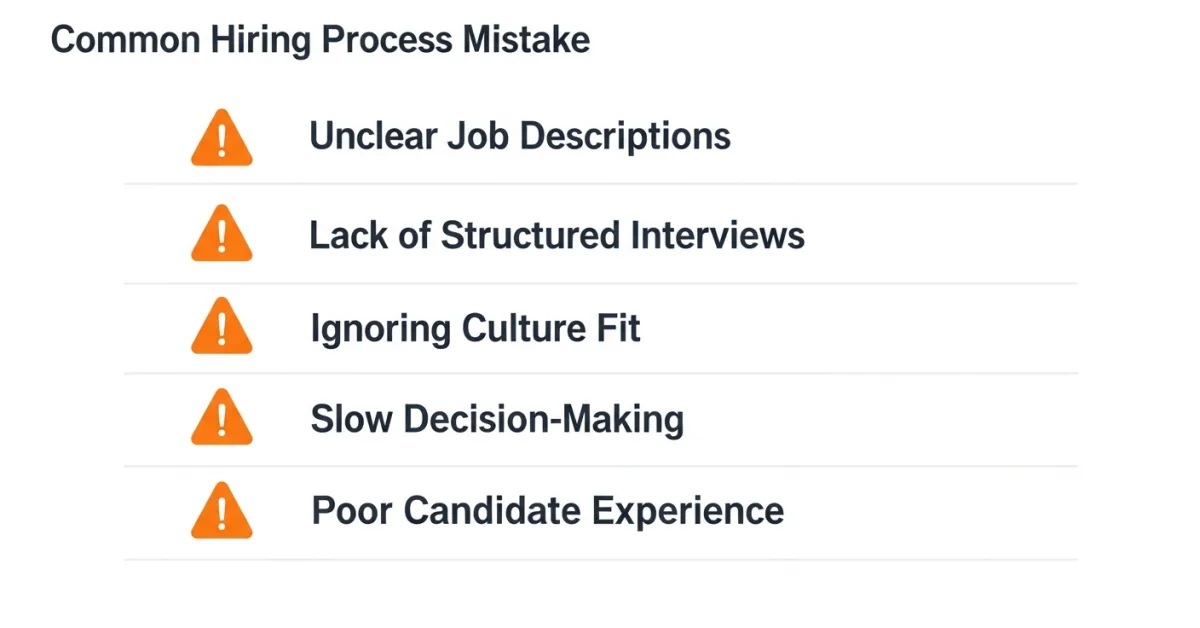
Most delays and mis-hires trace back to one of five recurring mistakes, not bad luck.
Nearshore recruiting isn’t complicated once you can see the five stages clearly. Define tightly. Source from channels that actually reach the region’s talent, not just a job board. Screen skills, English, and fit separately, in writing. Run a consistent interview loop. Write the onboarding plan before day one, not after.
Most standard roles clear that whole sequence in 2 to 3 weeks. If yours is taking six, the process is broken somewhere upstream, not the talent pool. For a full breakdown of where nearshore fits against offshore and onshore models more broadly, see our onshore vs. nearshore vs. offshore comparison, and if cost is the open question, our nearshore staffing agency pricing guide breaks down real 2026 rates by seniority.
Kore BPO runs this exact five-stage process for every nearshore placement, sourcing through onboarding. See how our nearshore BPO model works, or compare specific nearshore role types if you already know the seat you’re filling.
What Teams Ask Before Starting Nearshore Recruiting
So what does the nearshore recruiting process actually look like, stage by stage?
Five stages, in order. Define the role, source candidates from the right regional channels, screen for skills and English fluency and culture fit separately, run a consistent interview loop, then place and onboard with a written handoff. Most standard roles move through all five in 2 to 3 weeks. Specialized or senior roles run longer because the qualified pool is smaller, not because the process changes.
Realistically, how fast can this actually happen?
2 to 3 weeks for a standard mid-level role, start to signed offer. Sourcing and screening usually take 3 to 5 business days each, the interview loop another 3 to 7. Compare that to the general US labor market, where iCIMS put tech time-to-fill at 51 days in early 2025. Nearshore doesn’t just save cost. It regularly cuts time-to-hire by more than half when the process is actually followed.
How are nearshore candidates screened for English fluency, and does it actually matter?
Through a structured assessment, not a casual chat. Argentina ranks highest in Latin America for English proficiency per the EF EPI 2025, but that’s a country average, not a guarantee for any individual candidate. Fluency still needs testing at the individual level. Skip that step and you find the gap during a real client call instead of during hiring, which is the expensive place to find it.
Nearshore recruiting vs offshore recruiting, does the workflow gap actually matter?
Yes, more than most comparisons admit. Nearshore interview loops and reference checks can run same-day because of the 1 to 3 hour overlap. Offshore workflows, with 8 to 14 hours of separation, usually run async by necessity, adding days to every step that needs a live conversation. Peer-reviewed research on temporal distance backs this up directly. Even a one-hour time difference measurably cuts real-time communication.
Do nearshore recruiters actually use AI in screening, and can you trust it?
Increasingly, yes, mostly for first-pass resume filtering and objective skills scoring. Deloitte’s 2024 Global Outsourcing Survey found 83% of surveyed executives already use AI somewhere in outsourced services. What it can’t do well yet is judge English fluency the way a live conversation reveals it, or catch the context a resume leaves out. Treat it as a faster funnel into the human interview stage, not a replacement for one.
What’s the single biggest mistake companies make running nearshore recruiting themselves?
Skipping the structured screening stage and relying on a friendly interview instead. A candidate can sound fluent and capable in a 20-minute conversation and still lack the specific skill or language depth a role actually needs. Document every screen, skills test, language rubric, culture-fit notes, before anyone reaches the interview loop. It’s the one stage that’s cheapest to do right and most expensive to skip.
What Clients Say About Working With Kore BPO
Partnering with Kore BPO has been a game-changer for our operations. As a CMO for an MSP specializing in IT and cybersecurity services, I needed a team that could handle intricate processes while maintaining our brand standards. Thanks to their support, we have streamlined our operations and seen measurable growth.
Kore BPO has been instrumental in helping us streamline our operations. By outsourcing our customer-facing tasks to their team, we have been able to free up valuable time to focus on what matters most, building strong relationships with the right people.
Related Articles



Ready to Build a Nearshore Team the Right Way?
Kore BPO runs sourcing, structured screening, and compliance for every nearshore placement, so you’re not guessing your way through any of the five stages in this guide.
See Our Nearshore Staffing Agency